

Block Machine Market Opportunity in Vietnam: 2026 Buyer Guide for Investors
Most investors think buying European equipment is the safest bet. The real reason Chinese machines dominate uptime in Vietnam is on-ground adaptability and spare parts response speed under unstable grids.
Vietnam’s block machine market opportunity in 2026 is driven by accelerating infrastructure spending and urban housing gaps, but the window favors buyers who prioritize voltage adaptation, local raw material compatibility, and turnkey plant support over paper specs. A Linyi-based manufacturer with extended field presence in Vietnam confirms that site-specific engineering—not catalog capacity—determines whether a line survives its first 90 days.
I spent years on the factory floor in Linyi before being posted to Vietnam, first handling quality control and commissioning, then moving into trade. When the first batch of QT6-15 machines arrived at an industrial park in Bac Ninh, the local grid fluctuated so badly that PLC boards burned out twice in the first week. The client was furious. I spent three days in the workshop swapping control cabinets and redesigning the voltage stabilization setup before the line ran smoothly. That moment reshaped how I evaluate every block machine market opportunity in Vietnam: selling machines is not selling iron—it is selling a system that survives dusty air, shaky power, and unfamiliar aggregates.
Let us walk through what this market actually looks like, what specs matter under real working conditions, how to match models to investment scale, what a turnkey setup really involves, and how to evaluate a supplier beyond brochures.
Why Vietnam’s Block Machine Market Is Opening Now?
Infrastructure investment and urbanization are releasing sustained demand for concrete blocks, but the competitive landscape and timing window are shifting faster than most buyer guides acknowledge.
Vietnam’s construction sector has been expanding at a noticeable pace, fueled by public infrastructure programs and a structural shortage of affordable urban housing [NEED_CITE: Vietnam GSO construction investment growth trend]. The government’s housing development plans continue to prioritize mid-range and social housing units, which rely heavily on concrete block rather than red clay brick—a material increasingly restricted for environmental reasons [NEED_CITE: Vietnam Ministry of Construction unbaked brick policy direction]. This policy shift directly expands the addressable market for concrete block making machine Vietnam solutions.
At the same time, the buyer profile is fragmentizing. Private investors setting up small-to-medium block plants are multiplying in northern provinces near Hanoi and around Ho Chi Minh City’s periphery. Equipment distributors in Vietnam are no longer satisfied with single-machine imports; they want complete brick production line investment Vietnam packages with spare parts depth and local technical backup. Government contractors executing public works tend to require CE or SGS documentation and formal turnkey delivery records.
From my vantage point in Vietnam, the most visible change is the speed at which second-line buyers emerge. A distributor in a central province started with one semi-automatic line as a trial, and within months追加’d a second line after seeing payback materialize. This pattern—trial, validate, scale—is now the dominant entry behavior, not the exception. The block machine market opportunity in Vietnam is real, but it rewards buyers who treat the first purchase as a learning round rather than a final commitment.
What Machine Specs Actually Matter in Vietnam’s Working Conditions?
Voltage adaptability, dust resistance, and compatibility with locally sourced raw materials matter far more than nominal daily output figures when a line is running in Vietnam.
The Vietnamese industrial grid, particularly in peri-urban and provincial zones, is prone to voltage fluctuation and intermittent drops. PLC-controlled automatic block machines are sensitive to these swings. Without proper stabilization, control boards fail repeatedly, and downtime erodes the economics of the entire plant [NEED_CITE: industrial voltage fluctuation impact on PLC-controlled machinery in Southeast Asia].
A practical example: at the Bac Ninh site I mentioned earlier, the original control cabinets had no built-in voltage regulation. After the second PLC board failure, we retrofitted a dedicated stabilization cabinet. Downtime dropped noticeably, and the debugging cycle shortened from days to hours for subsequent issues. This is not a theoretical spec—it is the difference between a plant that runs and one that bleeds cash.
Dust is the second silent killer. Vietnam’s dry season in northern provinces generates fine particulate matter that infiltrates hydraulic systems and sensor housings. Machines without adequate dust sealing on critical components experience accelerated wear on molds, conveyors, and pallet loaders. A buyer evaluating a concrete block making machine Vietnam option must ask explicitly about seal ratings and maintenance intervals under dusty conditions, not just cycle time.
Third, raw material compatibility. Vietnamese aggregates vary significantly by region—river sand in the south, crushed limestone in the central highlands, laterite-based mixes in certain northern areas. Standard recipes calibrated for European or Chinese aggregates do not transfer directly. A machine that cannot accommodate recipe adjustment through mold pressure, vibration frequency, and mix water ratio will produce weak or inconsistent blocks regardless of its automation level.
| Factor | Standard Catalog Spec | Vietnam-Adapted Spec |
|---|---|---|
| Voltage tolerance | Fixed range | Stabilized cabinet integrated |
| Dust protection | Basic enclosure | Sealed hydraulic and sensor zones |
| Raw material recipe | Fixed default | Adjustable vibration, pressure, water ratio |
| PLC brand | Single-source | Locally serviceable or dual-sourced |
The block machine market opportunity in Vietnam belongs to suppliers who engineer for these conditions before shipment, not those who ship a catalog machine and expect the buyer to adapt on site.
How to Match Machine Models to Your Investment Scale?
Choosing the wrong model is the largest hidden cost in a brick production line investment Vietnam—QT6-15 suits market-entry validation, while QT10-15 and QT12-15 serve scaled production, and mismatching destroys payback timelines.
Private investors often assume that a fully automatic high-output line is always the better investment. This is a misconception. When daily demand is below a certain threshold, the capital cost, maintenance overhead, and staffing requirement of a large automatic line extend the payback period compared to a semi-automatic model like the QT6-15.
The QT6-15 occupies a strategic position for first-time investors in Vietnam. It delivers meaningful daily output with a smaller footprint, lower initial capital, and reduced staffing—typically manageable by a small crew with basic training. For an investor testing demand in a new province or supplying a localized construction project, the QT6-15 allows market validation without overcommitting capital. Several investors around Ho Chi Minh City’s outskirts started with this model, adjusted their block recipes to local river sand, and reached acceptable strength standards after a short formulation debugging period.
For established distributors or contractors with confirmed demand pipelines, the QT10-15 or QT12-15 becomes the rational choice. These models deliver substantially higher daily output, integrate more fully with automated batching, conveying, and stacking systems, and justify the investment when volume commitments are secure. The central province distributor I referenced earlier moved from a single QT6-15 to a second line within months—not by upgrading to a QT12-15, but by duplicating the proven model. This is a telling detail: duplication of a validated setup often carries less risk than jumping to a larger model prematurely.
| Model | Typical Investor Profile | Staffing Level | Capital Commitment | Payback Sensitivity |
|---|---|---|---|---|
| QT4-25 | Micro-entry, manual-heavy | Minimal | Low | Highly sensitive to volume |
| QT6-15 | First-line private investor | Small crew | Moderate | Balanced for market validation |
| QT10-15 | Established distributor, confirmed demand | Medium team | Substantial | Requires volume commitment |
| QT12-15 / QT15-15 | Large-scale plant, government contracts | Full shift teams | High | Dependent on long-term offtake |
The block machine market opportunity in Vietnam is not a single-entry game. It rewards staged investment—start with a model that matches your confirmed demand, validate the local recipe and operational rhythm, then scale by duplication or upgrade.
What Does a Turnkey Block Plant Setup Really Involve?
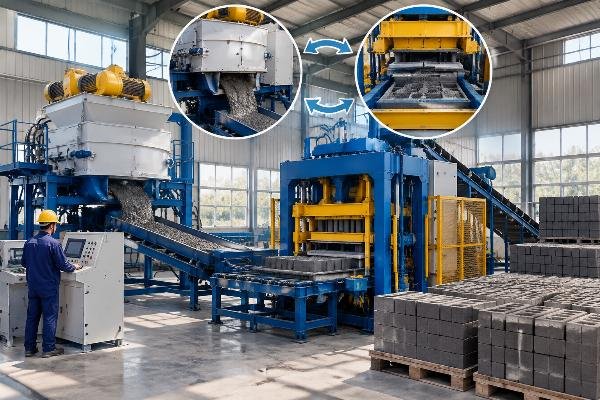
A turnkey automatic block plant setup North Vietnam or anywhere in Vietnam is not just machine delivery—it is site planning, recipe debugging, operator training, and on-site commissioning that determines whether the plant survives its critical first 90 days.
Many buyers assume that once the machine arrives, production begins. This is dangerously wrong. Without recipe support, operator training, and proper commissioning, the first months of operation can produce废品 rates that consume the entire projected margin [NEED_CITE: block plant commissioning failure rate in emerging markets].
A genuine turnkey setup for a brick production line investment Vietnam project involves several interconnected layers:
First, site layout planning. The positioning of the batching system, mixer, block machine, conveyor runs, curing area, and stacking zone must account for material flow, worker movement, and local climate (rain protection for curing, drainage for wet-season sites). A poorly planned layout adds hidden labor cost and slows cycle time permanently.
Second, raw material recipe debugging. Vietnamese aggregates differ from the reference materials used in factory testing. The supplier’s technical team must work on-site to adjust cement ratio, aggregate gradation, water content, and vibration parameters until block strength meets local standards. This debugging typically takes a matter of weeks, not days, and requires iterative testing.
Third, operator training. PLC-controlled lines demand operators who understand not just button sequences but fault diagnosis, mold change procedures, and basic maintenance. Training delivered only through translated manuals is insufficient. Hands-on training during commissioning, with the supplier’s engineers present, is essential.
Fourth, spare parts depth and accessibility. The initial spare parts package must cover wear-prone components for an extended operating period, and the supplier must maintain accessible inventory for emergency replacements. A machine sitting idle waiting for a shipped part costs multiples of the part’s value.
The block machine market opportunity in Vietnam is won or lost in this turnkey execution layer. Suppliers who treat delivery as the end of their responsibility leave buyers exposed. Those who treat commissioning and training as core deliverables build repeat customers.
How to Evaluate a Block Machine Supplier for Vietnam?
Evaluating a supplier for the block machine market opportunity in Vietnam requires looking past certificates and quotations to field service records, spare parts inventory depth, and customization responsiveness.
Certificates like CE, SGS, and ISO are baseline requirements, not differentiators. Nearly every established Chinese manufacturer holds them. What separates a reliable partner from a risky one is verifiable field performance in Vietnam specifically.
Ask the supplier for concrete references: how many lines have they commissioned in Vietnam, in which provinces, and what were the specific challenges encountered and resolved? A supplier who can describe voltage stabilization adaptations, dust-proofing modifications, or recipe adjustments for local aggregates demonstrates real field experience. A supplier who only offers generic testimonials is a red flag.
Spare parts policy is equally revealing. Does the supplier maintain a regional spare parts inventory, or does every replacement require international shipping? For a brick production line investment Vietnam, the answer determines whether a minor breakdown becomes a multi-week shutdown.
Customization responsiveness matters because Vietnam’s conditions are not uniform. A supplier willing to modify control cabinets for local voltage, adjust mold dimensions for regional block preferences, or integrate locally sourced components shows flexibility that rigid catalog sellers lack.
Finally, evaluate the supplier’s training and after-sales commitment. On-site installation, commissioning, and operator training should be explicit deliverables, not optional add-ons. Lifetime after-sales support is a common claim—verify it by asking how the supplier handles post-commissioning technical queries and whether they maintain a local or regional technical presence.
The block machine market opportunity in Vietnam is accessible, but supplier selection is the single most consequential decision an investor makes. Choose based on demonstrated field behavior, not brochure promises.
Conclusion
Vietnam’s block machine market rewards grounded preparation over optimistic speculation. Infrastructure demand and housing policy create a genuine window, but success depends on voltage adaptation, raw material recipe tuning, staged model selection, and turnkey execution. Buyers who evaluate suppliers on field service depth rather than certificate lists position themselves to capture the block machine market opportunity in Vietnam with controlled risk and realistic payback.
Leave a Reply