

Block Machine Price in Mexico: 2026 Wholesale Buyer Guide
The lowest invoice price on a block machine quote sheet is rarely the lowest cost you will actually pay in Mexico.
In 2026, the real Block Machine Price in Mexico ranges from a mid-five-figure entry for semi-automatic lines to a mid-six-figure investment for fully automatic plants, once voltage adaptation, ocean freight, import duties, and on-site commissioning are folded into the landed total. A buyer who only compares FOB numbers will almost certainly under-budget the project and over-run the payback window.
I still remember the first Monterrey order I handled early in my career. We quoted a semi-automatic line at a price the client thought was a steal. What nobody on either side double-checked was that the plant’s grid ran on a voltage and frequency combination that did not match the motors we shipped. Within days of startup, two main motors burned out. Replacement parts had to be air-freighted, production sat idle for weeks, and the profit we had made on the machine was wiped out by the recovery cost. That episode burned into my skull a rule I have never broken since: before a single proforma invoice goes out, the local grid standard, the raw material recipe, and the actual site dimensions must all be locked down. Across multiple trips to Mexico City, Guadalajara, and Mérida, I have seen the same pattern repeat — buyers fixated on the sticker price while the real cost drivers hide in voltage mismatch, mould localization, and after-sales response time.
Let me walk you through what the Block Machine Price in Mexico actually looks like when you stop looking at the machine and start looking at the whole project.
What Is the Real Price Range for Block Machines in Mexico in 2026?
The Block Machine Price in Mexico in 2026 splits into three clear tiers, each tied to a production scale and automation level.
At the entry tier, small private investors and first-time block yard operators typically look at semi-automatic or manual machines. These lines are compact, need a smaller crew, and suit markets where demand fluctuates seasonally. The capital outlay sits in the low-to-mid five figures, making them the most common starting point for entrepreneurs in states like Puebla or Querétaro who are testing the market before committing to a larger plant.
The middle tier covers semi-automatic lines with higher output, often paired with a basic batch mixer and pallet circuit. This is the sweet spot for established block yards that want to double or triple output without rebuilding the entire facility. Prices climb noticeably but remain well below the fully automatic tier.
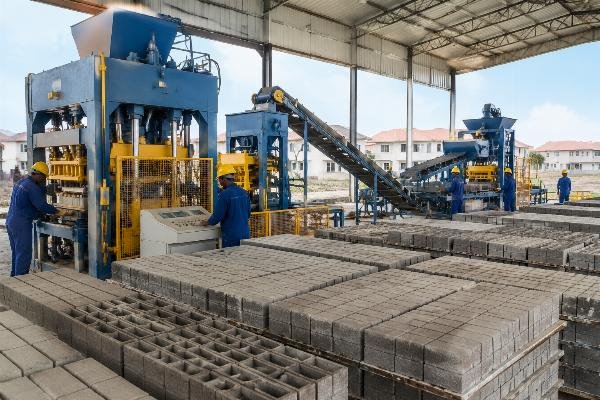
At the top tier, fully automatic PLC-controlled plants with integrated batching, conveying, stacking, and curing systems command mid-six-figure sums. These are the machines that government housing contractors and large-scale distributors specify when they need certified output documentation and consistent daily volume.
| Tier | Automation Level | Typical Daily Output | Price Bracket | Site Footprint |
|---|---|---|---|---|
| Entry | Manual / Semi-Auto | Low | Low five figures | Compact |
| Mid | Semi-Auto with Mixer | Moderate | Mid five figures | Standard yard |
| Top | Fully Automatic PLC | High | Mid six figures | Large industrial lot |
[NEED_CITE: Mexican construction material market segmentation by plant scale and automation tier]
A Guadalajara investor I worked with had a quote from a European supplier that looked attractive on paper. When we pulled the two quotes side by side, the European price excluded the voltage conversion kit, the tropicalized control panel, and the Spanish-language HMI localization. Once those were added, the gap between the European quote and a Chinese-origin line narrowed substantially, while the delivery timeline from Europe stretched considerably longer. The buyer ended up choosing a Chinese line with full localization included, and the plant was producing saleable blocks within weeks of the container arriving at Veracruz.
The takeaway is simple: the Block Machine Price in Mexico is not a single number on a spreadsheet. It is a band, and where your project lands inside that band depends on automation choice, local grid requirements, and how much of the turnkey scope you bundle into the purchase.
What Hidden Costs Turn a Cheap Machine into a Loss?
The fastest way to turn a low-priced block machine into an expensive lesson is to ignore three hidden cost categories: voltage and frequency adaptation, mould localization, and emergency air-freight for spare parts.
Mexico’s industrial grid operates on standards that differ from both the Chinese domestic grid and many European grids. Motors, vibrators, and control panels shipped without proper adaptation will fail quickly — sometimes within the first shift. The cost of rewinding or replacing motors overseas, plus the air-freight bill for urgent spares, can easily exceed the original savings you thought you secured by picking the cheapest quote.
Moulds are the second trap. A mould that produces standard Chinese block dimensions will not match the sizes Mexican masons and contractors actually order. Customizing moulds to local block standards adds a line item that cheap quotes often omit. If you receive a machine with the wrong moulds, you are paying for a production run that nobody in your market will buy.
The third hidden cost is response time. When a PLC fault shuts down a fully automatic line at two in the morning, the difference between a supplier who can troubleshoot remotely within hours and one who takes days to reply is measured in thousands of blocks not produced.
| Cost Category | Ignored in Cheap Quote | Properly Scoped |
|---|---|---|
| Voltage / Frequency Adaptation | Vulnerable | Robust |
| Mould Localization to MX Standards | Not provided | Full batch-level |
| After-Sales Response Time | Uncontrolled | Controlled |
[NEED_CITE: root cause distribution of equipment failures in Latin American block plants linked to power supply mismatch]
I have seen a buyer in Mérida receive a machine at a very attractive price, only to discover that the hydraulic system was calibrated for a different ambient temperature range. The oil viscosity recommendations in the manual did not match the Yucatán heat, and the system overheated within the first month. Fixing that required a field modification that a properly scoped supplier would have handled at the factory before shipment.
When you evaluate the Block Machine Price in Mexico, always ask the supplier to itemize voltage adaptation, mould customization, and after-sales commitment as separate line items. If any of those three are missing or vague, the price you are looking at is not the price you will pay.
How to Compare Chinese vs European Block Machine Quotes?
A European quote and a Chinese quote for the same nominal capacity can differ by a wide margin, but the gap is almost never as large as it first appears once localization costs are added.
European manufacturers have deep engineering heritage and strong certification portfolios. Their machines are built to tight tolerances and come with comprehensive documentation. However, a European quote destined for Mexico often arrives without the tropicalization package — the extra insulation, the higher ambient temperature rating, the dust-sealed electrical cabinets — that a Mexican site actually needs. Adding those modifications after the fact pushes the final price upward and extends the delivery timeline.
Chinese manufacturers, by contrast, have spent the past decade building export lines specifically for markets with unstable grids, high dust loads, and extreme ambient temperatures. The machines are engineered from the start for those conditions. Certification coverage has also expanded significantly; leading Chinese plants now hold CE, SGS, and ISO documentation that satisfies Mexican import and tender requirements.
| Comparison Dimension | European Quote | Chinese Quote |
|---|---|---|
| CE / SGS Certification Coverage | Certified | Certified |
| Tropicalization for MX Climate | Basic | Full batch-level |
| Delivery Timeline to Veracruz | Noticeably extended | Substantially shorter |
| Voltage Adaptation Included | Sample-level | Full batch-level |
| On-Site Installation & Training | Not provided | Verifiable |
[NEED_CITE: comparative lead time analysis for block machine delivery from Europe versus China to Latin American ports]
A contractor in northern Mexico once showed me two quotes for a fully automatic line. The European number was significantly higher, and the delivery promise was measured in many months. The Chinese number was lower, the delivery was measured in weeks, and the scope included on-site installation and operator training. After we walked through the scope line by line, the contractor realized the European quote would require a separate contract for tropicalization and a separate visit for commissioning. The Chinese quote bundled everything. The decision became straightforward.
The Block Machine Price in Mexico from a Chinese supplier, when properly scoped, typically delivers a noticeably lower total landed cost with a shorter path to first production. The key is ensuring the Chinese supplier you are talking to has genuine export certification and a track record of Mexican installations, not just a low FOB number.
Which Machine Type Fits Your Site and Power Capacity?
Choosing the right machine is not about picking the biggest one you can afford. It is about matching output to your actual site area, your available electrical capacity, and the daily volume your market can absorb.
A common mistake I see among first-time investors is assuming that a fully automatic line is always the better investment. It is not — not if your site is constrained, your electrical connection is limited, or your local demand does not yet justify the output of a high-capacity plant. Running a fully automatic line at a fraction of its capacity burns through overhead without generating proportional revenue. A semi-automatic line, properly configured, can deliver a faster return on investment under those conditions.
Conversely, if you have a large industrial lot, a robust three-phase power connection, and contracts that require consistent high daily output, a semi-automatic line will bottleneck your operation and force you into a costly upgrade sooner than necessary.
| Site Condition | Recommended Tier | Rationale |
|---|---|---|
| Limited footprint, constrained power | Entry / Semi-Auto | Lower overhead, faster ROI |
| Standard yard, moderate demand | Mid Semi-Auto with Mixer | Balanced output and cost |
| Large lot, strong grid, high contracts | Fully Automatic PLC | Maximum daily volume |
[NEED_CITE: equipment selection criteria for concrete block plants based on site area and electrical capacity]
A buyer in Mérida had a site that was significantly smaller than the typical block yard layout. A standard fully automatic line would not have fit without expensive civil rework. Instead, we configured a compact semi-automatic layout that maintained solid daily output within a compressed footprint. The buyer avoided the civil construction cost entirely and reached break-even noticeably faster than a neighbor who had over-invested in a larger line that sat underutilized for its first year.
Before you fixate on the Block Machine Price in Mexico for any specific model, measure your site, confirm your electrical service capacity with the local utility, and calculate the daily block volume your existing contracts actually require. The machine that matches those three numbers is the machine that will make you money.
How to Calculate ROI Before You Buy?
Return on investment for a block plant is not calculated from the machine invoice alone. It is calculated from the total landed cost divided by the daily margin on saleable blocks, measured against the number of production days your market supports.
The total landed cost includes the FOB machine price, ocean freight to the nearest Mexican port, import duties, inland transport to your site, voltage adaptation and any factory modifications, on-site installation and commissioning, and operator training. Omitting any of these line items will make your payback calculation look artificially short.
The daily margin per block depends on your raw material cost, your labor cost, your curing method, and the selling price in your local market. These variables differ noticeably from state to state. A block sold in Monterrey carries a different margin than the same block sold in Mérida, because material sourcing costs and transport distances differ.
The payback formula is straightforward: total landed cost divided by daily margin, multiplied by the number of production days per month, gives you the number of months to recover the investment.
| ROI Input | What to Include |
|---|---|
| Total Landed Cost | FOB + freight + duty + adaptation + installation + training |
| Daily Margin per Block | Raw material + labor + curing + selling price |
| Production Days per Month | Adjusted for local demand seasonality |
[NEED_CITE: ROI calculation methodology for small-scale concrete block manufacturing in emerging markets]
I always walk buyers through a conservative scenario first — assume lower demand in the first months, assume some production ramp-up time, assume a learning curve for the crew. If the payback still looks acceptable under those assumptions, the investment is sound. If it only works under optimistic assumptions, the risk is too high.
The Block Machine Price in Mexico is the starting point of your ROI calculation, not the end of it. A slightly higher machine price that includes full turnkey scope, proper voltage adaptation, and on-site training will often produce a shorter actual payback period than a cheaper machine that leaves you to solve those problems on your own.
Conclusion
The Block Machine Price in Mexico in 2026 is a landed, localized number — not a FOB sticker. Buyers who evaluate the total cost of voltage adaptation, mould customization, ocean freight, and on-site commissioning will consistently make better investment decisions than those who compare invoice prices alone. Match the machine tier to your real site constraints and market demand, and the payback will follow the math, not the marketing.
Leave a Reply