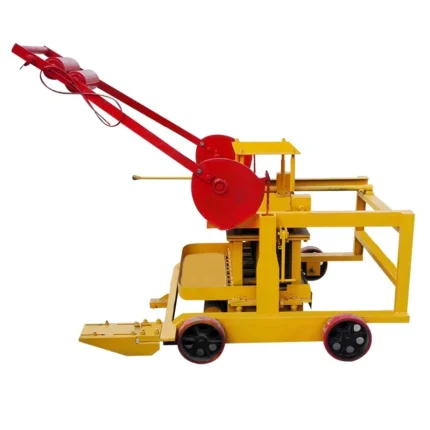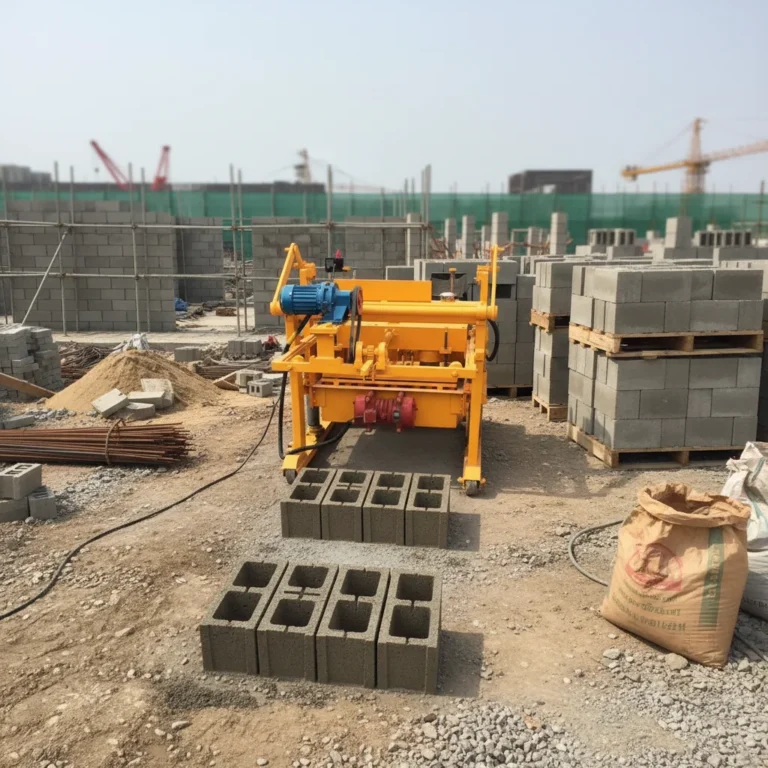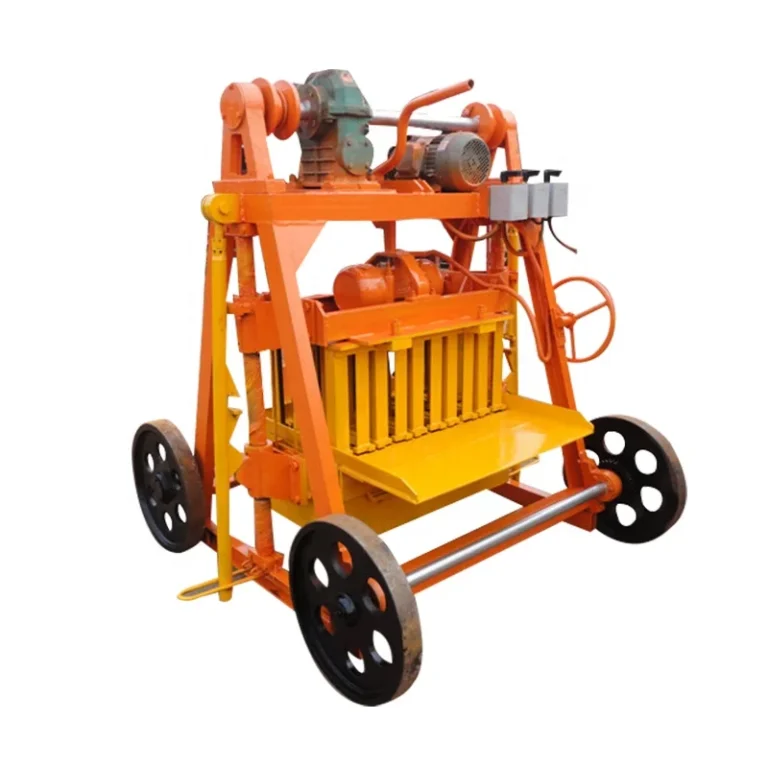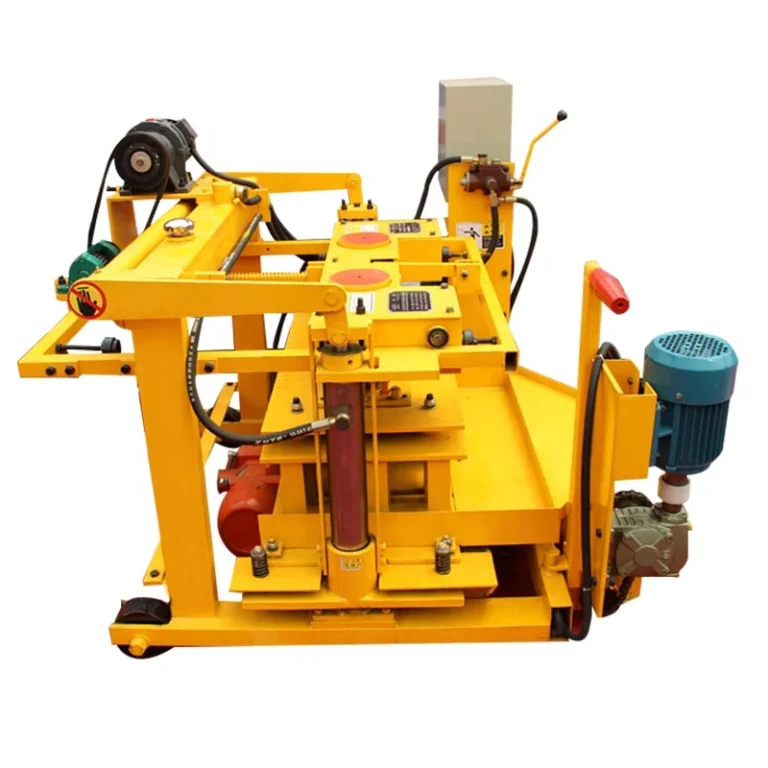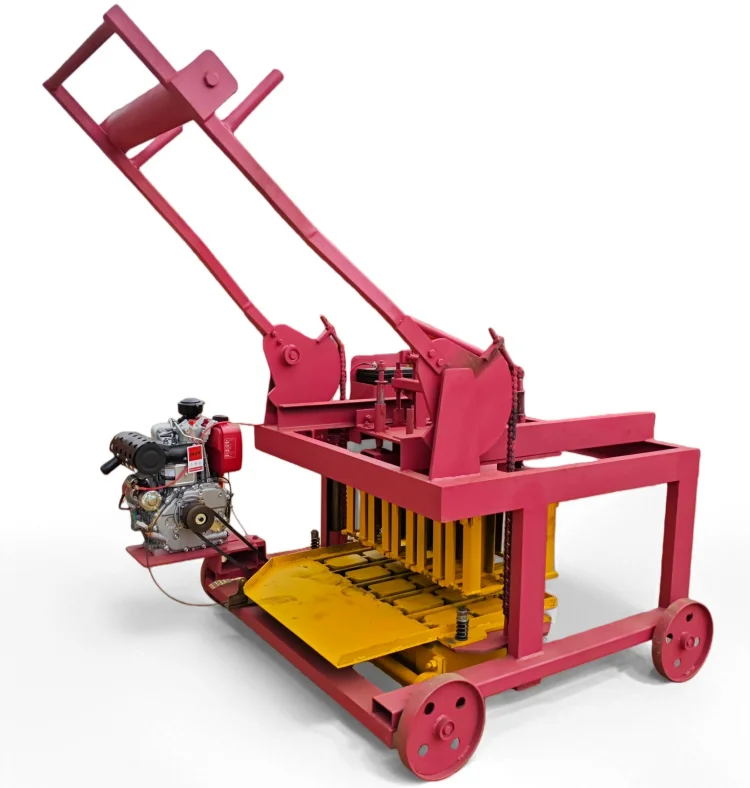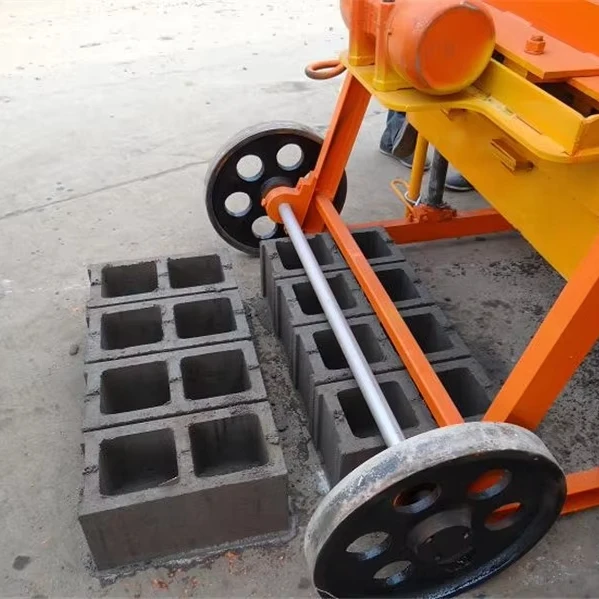
Description
Configuration set against your actual mix design and local aggregate — every QMJ4-45 parameter is validated against the buyer’s raw material sample before a proposal leaves our workshop, not pulled from a catalogue default.
Technical Specifications
| Parameter | Value |
|---|---|
| Model | QMJ4-45 |
| Product Type | Mobile Egg-Laying Block Making Machine |
| Molding Capacity | 4 pcs/mould (basis: 400×200×200 mm hollow block) |
| Vibration Frequency | 2400 r/min |
| Vibration Method | Mold vibration |
| Molding Cycle | 40–45 s |
| Productivity (400×200×200 mm hollow block) | 3000 pcs/day (8-hour shift, 4 pcs/mould, 40–45 s cycle) |
| Productivity (400×150×200 mm hollow block) | 3500 pcs/day (8-hour shift, 5 pcs/mould, 40–45 s cycle) |
| Productivity (400×120×200 mm hollow block) | 4500 pcs/day (8-hour shift, 6 pcs/mould, 40–45 s cycle) |
| Demold Method | Manual |
| Turning Method | Manual (egg-laying / mobile) |
| Total Power | 6 kW |
| Power Source | Diesel / Petrol engine |
| Pallet Requirement | None (produces directly on ground) |
| Automation Level | Manual |
| Control System | Not applicable on base configuration; available with PLC or MCC control on upgraded configurations |
| Hydraulic Pressure | Not applicable (vibration-only forming) |
| Warranty | 1 year (whole machine) |
Application Suitability
| Application | Material or Output |
|---|---|
| On-site hollow block production at housing project sites | Crushed stone, river sand, and cement mixes |
| Small-scale cement block manufacturing at existing work yards | Local aggregate with standard Portland cement |
| Entrepreneur first block plant with minimal infrastructure | 400×200×200 mm, 400×150×200 mm, and 400×120×200 mm hollow blocks |
| Paving block and solid brick production | Mould-dependent; material must match mould geometry |
| Remote project fulfilment without fixed plant or grid power | Diesel or petrol engine-driven operation on unprepared ground |
What "4000 Blocks a Day" Actually Means on the QMJ4-45
Daily output depends entirely on which block format you run and how long each cycle actually takes on your mix.
Suppliers often quote a single productivity number for a mobile egg-laying machine without naming the block format behind it. On the QMJ4-45, an 8-hour shift producing 400×200×200 mm hollow blocks yields around 3000 pieces, while switching to the narrower 400×120×200 mm format raises that figure to roughly 4500 pieces — same machine, same shift, very different daily totals. I spent weeks on a commissioning call last year because the buyer planned his entire project schedule around a catalogue headline number that assumed a format he never intended to sell. The automatic mobile block machine label can mean very different things depending on what sits inside the mould, and that conversation needs to happen before the order is placed [NEED_CITE: block format and cycle time assumptions in mobile block machine quotations].
Engine-Driven Mobility for Sites Without Grid Power
The QMJ4-45 runs on a diesel or petrol engine rather than a grid-tied electric motor, which removes the first bottleneck most remote construction sites face. No generator sizing, no temporary power drop from the utility — the machine moves with the crew and starts producing as soon as the ground is levelled. For contractors running a housing development in stages, this means the automatic mobile block machine travels to where the next foundation is being poured instead of waiting for infrastructure to catch up.
Twice-Vibration Molding and Block Density Consistency
The mold vibration system on the QMJ4-45 operates at 2400 r/min, applying vibration force directly through the mould cavity rather than through a separate table. A twice-vibration core design delivers two compaction passes per cycle, which improves aggregate interlock and produces a more uniform density across the block face. This matters especially when local aggregate varies in particle shape — rounded river sand compacts differently from crushed volcanic rock, and a single-pass vibration often leaves the bottom course under-dense [NEED_CITE: vibration pass count and concrete block compressive strength correlation].
Spec Interpretation: Cycle Time, Mould Count, and the Operator Factor
The 40–45 second molding cycle is the mechanical baseline — the time the vibration motor runs and the mould lifts clear. On a manual demold and manual turning system like the QMJ4-45, the real cycle includes the operator positioning the machine, releasing the latch, and walking it forward to the next laying position. With a 400×200×200 mm mould holding four blocks per drop, that rhythm settles into a sustainable pace over an 8-hour shift. The 6 kW total power rating covers the vibration motor and any auxiliary drives on upgraded configurations, which keeps fuel consumption within a range that a standard diesel tank can sustain for a full working day. Buyers comparing the automatic mobile block machine against pallet-fed presses should note that the egg-laying design eliminates pallet handling entirely, trading cycle speed for the removal of pallet investment, curing rack labour, and stacking crew.
The Hidden Cost of Skipping the Aggregate Sample
When a buyer orders a vibration-only forming machine without submitting a local aggregate sample, the factory ships with settings calibrated for standard river sand. If the actual material is volcanic scoria, crushed coral, or a high-fines quarry dust, the vibration frequency and amplitude will not match the particle geometry, and the blocks leave the mould with inconsistent wall thickness and weak corners. I watched this play out with a West African buyer who sent us a photo of crumbling blocks three days after commissioning — we pulled a new aggregate sample by courier, adjusted the vibration timing, and had it resolved within a week, but the first two weeks of production were written off entirely [NEED_CITE: aggregate particle shape effect on vibration compaction in concrete block forming].
Why Source This Machine Here
Block machinery is our single focus, so the QMJ4-45 arrives as a matched system — machine, mould, and handling specified together rather than assembled from separate suppliers. Every configuration is set against the buyer’s actual mix design and target block format, with capacity calculations stated per format so there is no ambiguity about what the daily output figure assumes. Mould design covers the formats your market actually sells, and custom mould drawings are available when a project calls for a non-standard profile. The automation level is selectable: a buyer can start with the full manual baseline and move toward a PLC-controlled egg-laying block machine configuration when production volume justifies the upgrade. Installation and commissioning support includes operator training on the specific mould and cycle rhythm your crew will run.
Documentation & Verification
- Line layout showing egg-laying path and curing area spacing per block format
- Capacity calculation sheet stating the exact block format and cycle time assumed
- Mould drawing and format list matching your market’s hollow block dimensions
- Hydraulic and electrical schematic for upgraded PLC-controlled configurations
- Factory test record run on your submitted aggregate sample before dispatch
- Operation and maintenance manual with wear parts list and mould change procedure
Installation, Commissioning & Support
- Levelled compacted ground required; no concrete foundation or fixed plinth needed for the 6 kW engine-driven unit
- Diesel or petrol engine fuel supply arranged on-site; no electrical grid connection or dedicated circuit necessary
- Machine ships partially assembled; vibration motor and mould frame bolt on at destination with basic hand tools
- First-run parameter setting against your aggregate sample, including vibration timing and mould release adjustment
- Operator training covers mould change sequence, daily greasing points, and engine maintenance intervals
- Wear parts list included with shipment; replacement moulds and vibration components available from stock
Before You Request a Quotation
Send us the block formats your market sells, the daily output you need per format, and a sample of the aggregate you plan to use. If your site has no grid power, confirm the diesel or petrol engine preference and the ambient temperature range. For buyers considering the PLC controlled egg-laying block machine upgrade path, let us know the control language your operators need and whether you plan to add automatic stacking later.
Frequently Asked Questions
Q: How is daily output calculated and which block format does the figure assume?
A: Every output figure we quote names the block format, mould cavity count, and cycle time behind it. For the QMJ4-45, 3000 pieces per day assumes 400×200×200 mm hollow blocks at 4 pieces per mould over an 8-hour shift with a 40–45 second cycle. Switching to a narrower format changes the number. We provide a full capacity calculation sheet per format with your quotation.
Q: What automation level can be added to the QMJ4-45, and what does it remove from the operator?
A: The base machine is fully manual — hand demold, hand turning, no control panel. Upgraded configurations are available with PLC or MCC control, which can automate vibration timing and mould release sequencing. This removes cycle-to-cycle variation caused by operator fatigue and brings batch consistency closer to what a pallet-fed press delivers, while keeping the egg-laying mobility advantage.
Q: What control system and language options are available on upgraded configurations?
A: Where a PLC controlled egg-laying block machine configuration is selected, the control display language is confirmed before dispatch. The PLC manages vibration duration and cycle sequencing. Buyers specify the language their operators read, and the interface is set accordingly so commissioning does not stall over a display the crew cannot follow.
Q: How does the egg-laying method affect block consistency compared to a pallet-fed press?
A: Egg-laying machines produce directly on the ground, so surface flatness and ground moisture affect the block base. A pallet-fed press gives a controlled steel or bamboo surface every cycle. The QMJ4-45 compensates through twice-vibration molding and consistent cycle timing, but buyers should prepare a levelled, compacted production strip to maintain dimensional uniformity across a full shift.
Q: What mould formats are available and how long does a mould change take on site?
A: Standard moulds cover 400×200×200 mm, 400×150×200 mm, and 400×120×200 mm hollow blocks, with paving block and solid brick moulds available depending on market demand. Custom moulds are built to buyer drawings. Mould change is manual — the operator unbolts the mould frame and swaps in the new cavity set, which typically takes one person a portion of a shift the first time and becomes faster with practice.