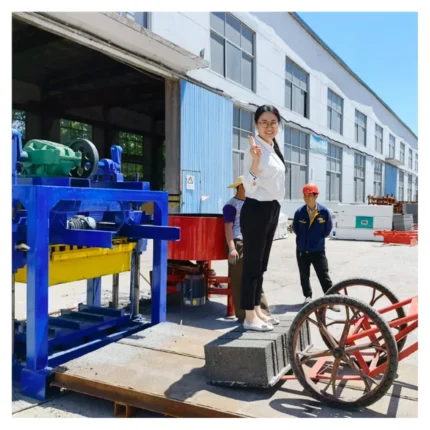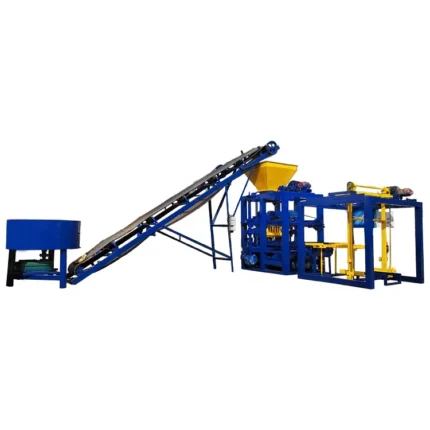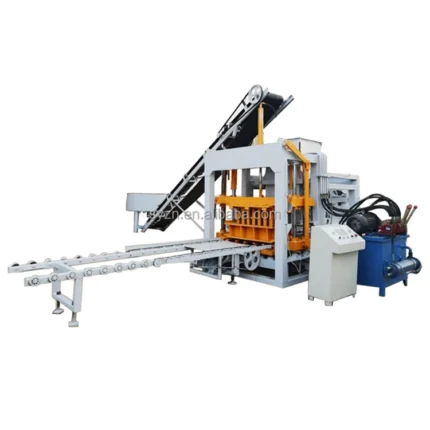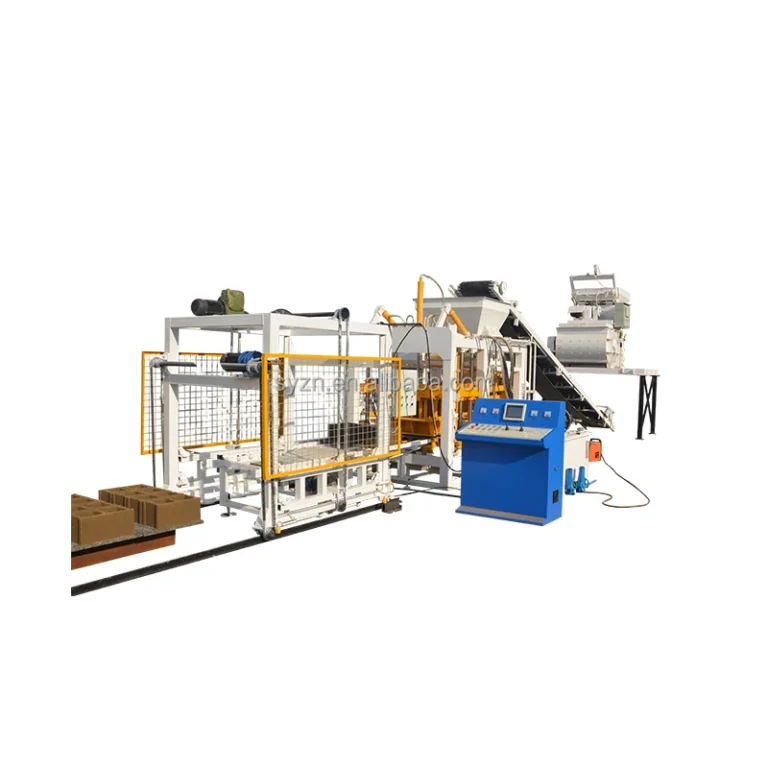
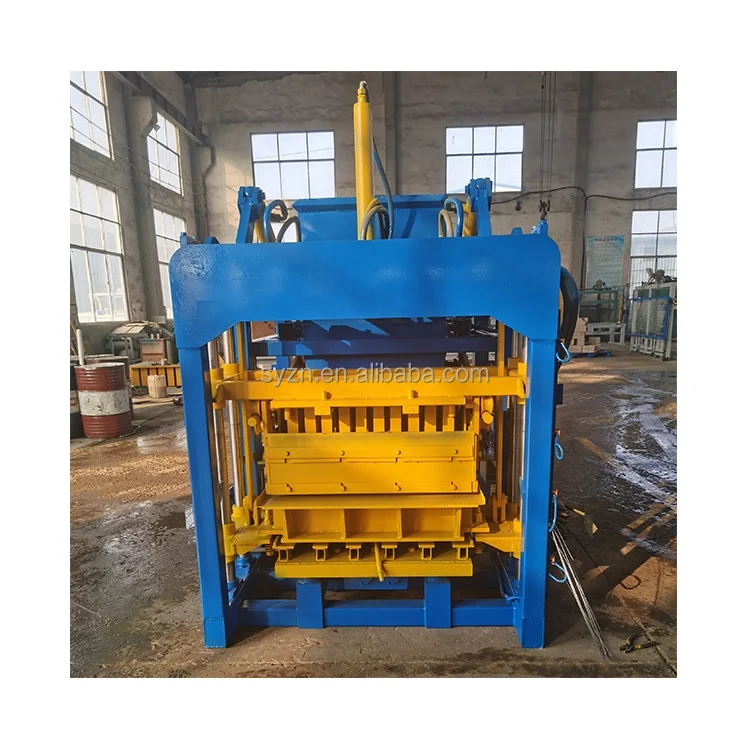
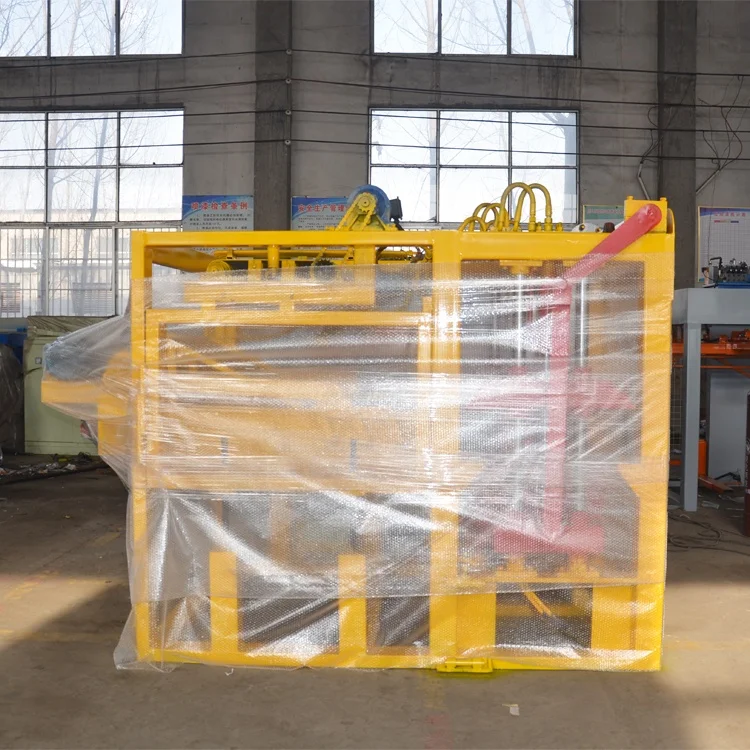
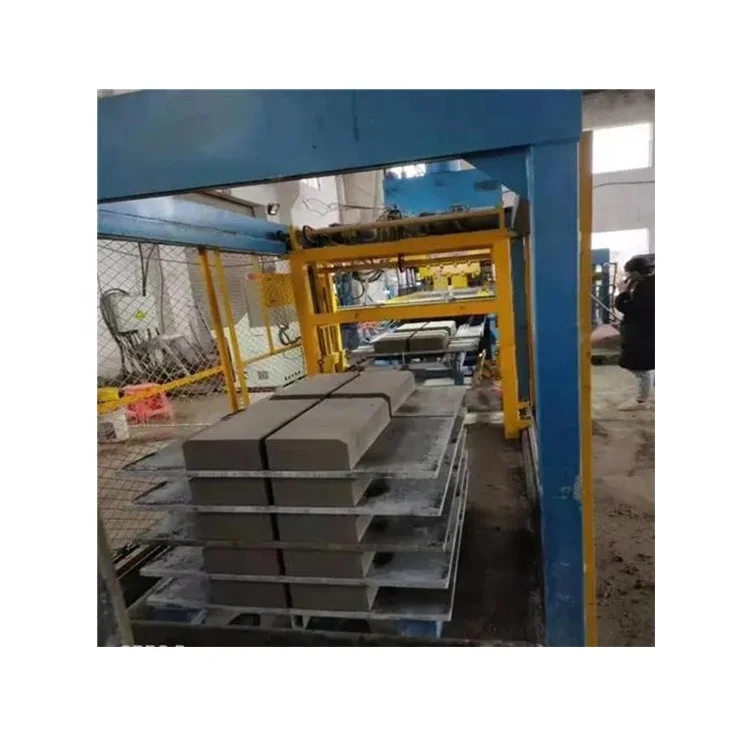
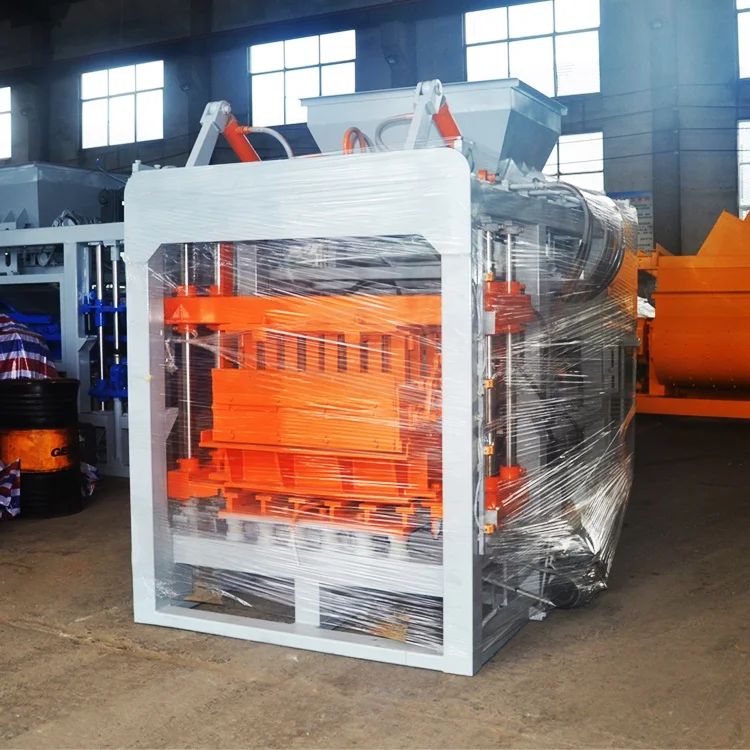
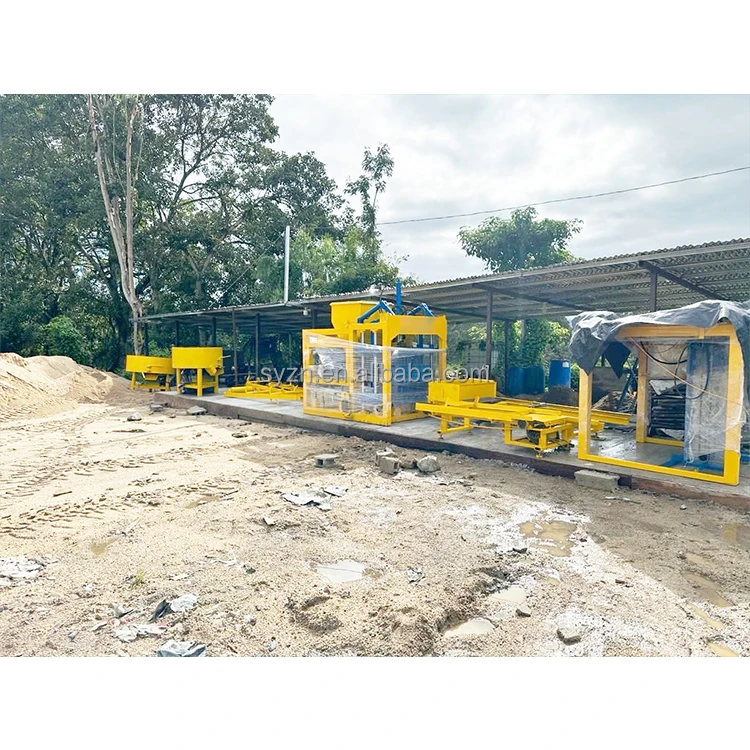
Description
Programmable Cycle Control — The QT4-15 locks vibration time and hydraulic pressure per mould format in the PLC, so every shift repeats the exact same parameters instead of relying on operator memory.
Technical Specifications
| Parameter | Value |
|---|---|
| Model | QT4-15A |
| Product Type | Fully Automatic Concrete Block Making Machine |
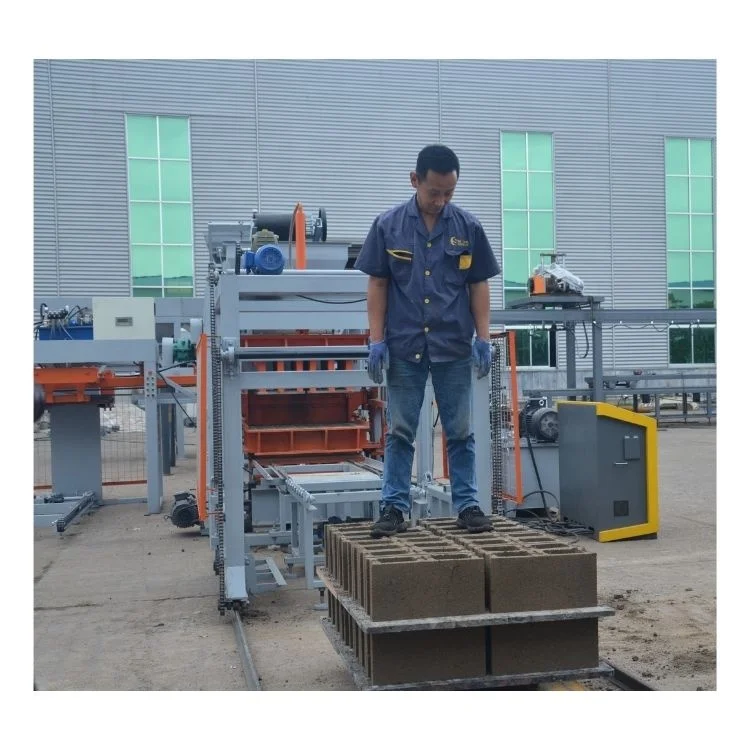
| Overall Dimensions (L×W×H) | 7100×1600×2610 mm |
| Molding Cycle | 15–25 s (adjustable per format via PLC) |
| Vibration Frequency | 4600 r/min |
| Exciting Power | 40–50 kN |
| Rated Power | 18.45 kW |
| Mixer Model | JQ350 |
| Pallet Size | 850×550×25 mm |
| Total Weight | 3 T |
| Automation Level | Automatic (with automatic stacker) |
| Hydraulic System | Hydraulic station (pressure rating to be confirmed) |
| Control System | PLC (brand and display language to be confirmed before production) |
| Voltage & Frequency | Configurable (confirm local supply before commissioning) |
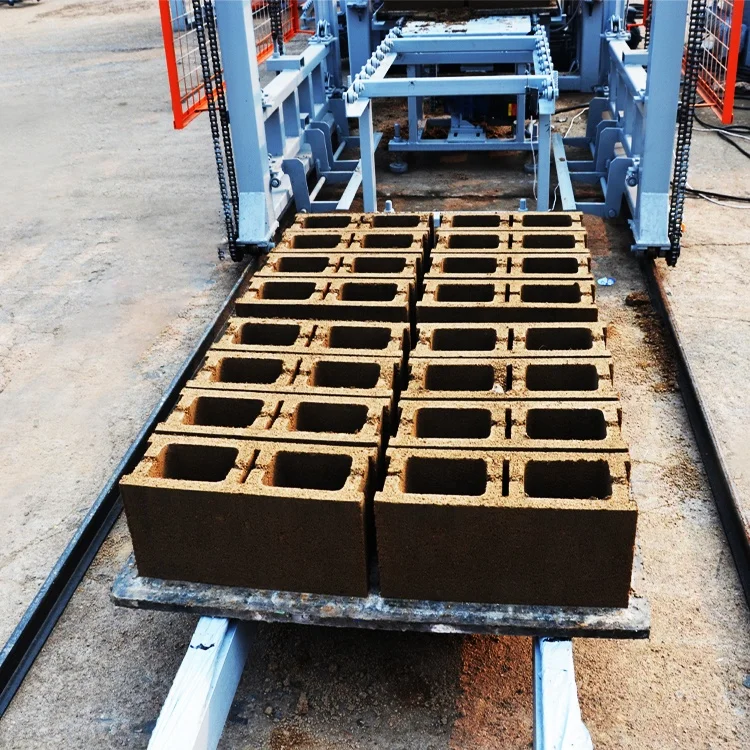
| Output Capacity | 408 pcs/h based on 400×200×200 mm hollow block, 4 pcs/mould |
| Output Capacity | 510 pcs/h based on 400×150×200 mm hollow block, 5 pcs/mould |
| Output Capacity | 2100 pcs/h based on 240×115×53 mm solid brick, 18 pcs/mould |
| Daily Output (8 hr) | 3264 pcs based on 400×200×200 mm hollow block |
| Daily Output (8 hr) | 4080 pcs based on 400×150×200 mm hollow block |
| Daily Output (8 hr) | 17000 pcs based on 240×115×53 mm solid brick |
| Applied Products | Paver, solid brick, hollow block, curbstone |
| Raw Materials | Crushed stones, sand, cement, dust, fly ash |
| Standards | CE (verify applicability to this model) |
Application Suitability
| Application | Material or Output |
|---|---|
| Hollow block production for residential and commercial walls | Crushed stone, sand, cement, and fly ash mixes |
| Solid brick manufacturing for load-bearing and partition masonry | Sand, cement, dust, and crushed stone blends |
| Interlocking paver production for driveways and walkways | Fine aggregate and cement with pigment additives |
| Kerbstone and curb production for road and site edging | Coarse aggregate and cement at higher compaction settings |
What Happens When Vibration and Pressure Do Not Match Your Mix
Programmable cycle parameters let you lock in the exact vibration time and hydraulic pressure for your specific mix, then repeat it identically across every shift.
Block strength inconsistency is rarely a machine defect. It is usually the result of vibration force and hydraulic pressure that were never matched to the buyer’s actual aggregate and cement ratio. I have walked onto sites where operators adjusted the cycle by feel every morning, producing stronger blocks before lunch and weaker ones by afternoon because the settings drifted. With an automatic block making machine PLC controlled from the start, those parameters are saved per mould format and recalled at the push of a button. The operator cannot accidentally shorten the vibration window or lower the pressure when the foreman is not watching. [NEED_CITE: relationship between vibration duration and compressive strength in concrete masonry units]
How PLC Control Removes Operator Guesswork
On a semi-automatic line, the operator decides when the vibration stops and the press lifts. That decision changes with fatigue, shift handovers, and production pressure. The automatic block making machine PLC controlled cycle on the QT4-15 governs pallet feeding, vibration duration, hydraulic pressing, and stacking in one continuous sequence. Once the recipe is validated for a given block format, the PLC stores the timing and force values and executes them without deviation. This is what separates consistent block density from batch-to-batch variation that only shows up during strength testing.
Consistency Across Shifts, Formats, and Operators
The real value of automation appears at the second shift changeover. By the time the afternoon crew takes over, the morning settings are still active in the controller. When the production schedule switches from 400×200×200 mm hollow blocks to solid bricks, the operator selects the saved mould programme rather than recalibrating from memory. The automatic stacker keeps pace with the press output, so pallets move to the curing area without a manual bottleneck. This is how an automatic block making machine PLC controlled system earns its label — not through a single feature, but through the elimination of every point where human inconsistency enters the cycle. [NEED_CITE: PLC programming standards for industrial block making equipment]
Reading the Specs That Actually Determine Block Quality
The vibration frequency of 4600 r/min and exciting power of 40–50 kN define how densely the concrete mix is compacted inside the mould. Higher compaction density translates directly to higher compressive strength, but only if the vibration time is long enough for the mix to settle fully. A 15–25 second molding cycle, adjustable through the PLC, lets you extend vibration for a drier mix with higher aggregate content or shorten it for a wetter paver mix that consolidates faster. The hydraulic system applies additional pressure on top of vibration, and the combined effect determines whether a hollow block can survive transport without corner damage. The 850×550×25 mm pallet size must match your existing curing racks and forklift fork width — if your forklift is rated for a narrower pallet, the automatic stacker will place pallets that the curing crew cannot move.
The Hidden Cost of Underspecified Automation
A buyer who selects a semi-automatic press to save on the initial outlay often discovers that manual pallet handling becomes the line’s real constraint. Output stacks up faster than workers can carry pallets to the curing area, and the press sits idle waiting for the next empty pallet to be fed in. The result is a rated cycle time that never materialises in actual daily production. When the market later demands a new block format, a machine without stored PLC programmes requires a full manual recalibration for every changeover, turning a flexible production line into a single-format asset. [NEED_CITE: automation level impact on block plant labour allocation]
Why Source the QT4-15 Through This Channel
The machine, mould, pallet, and automatic stacker are specified as one matched system rather than assembled from separate suppliers, which means pallet dimensions and stacker stroke are confirmed against your curing layout before production begins. Configuration is set against your actual mix design and local aggregate, not a catalogue default — the same mix sample you send us determines the vibration time and pressure values loaded into the PLC at the factory. Mould design covers the formats your market actually sells, including custom drawings if your region demands a non-standard kerbstone profile. The automation level is selectable, so a buyer can start with the QT4-15’s automatic stacker and add full cubing or remote diagnostics later as production volume grows. Installation support includes on-site commissioning where the PLC parameters are validated against your raw materials, and operator training covers programme selection, mould change procedure, and daily maintenance checkpoints.
Documentation & Verification
- Line layout drawing with capacity calculation stated per block format and mould cavity count
- Machine specification sheet confirming vibration frequency, exciting power, and hydraulic pressure settings
- PLC programme list showing stored mould formats and adjustable cycle parameters
- Factory test record documenting actual cycle times per mould format, not catalogue maximums
- Pallet specification confirming 850×550×25 mm dimensions and material grade for your curing environment
- Voltage, frequency, and PLC display language confirmation form signed before production release
Installation, Commissioning & Support
- Foundation pad must accommodate the 7100×1600 mm footprint plus stacker clearance and pallet return path
- Dedicated power circuit required for the 18.45 kW rated load plus mixer and hydraulic station draw
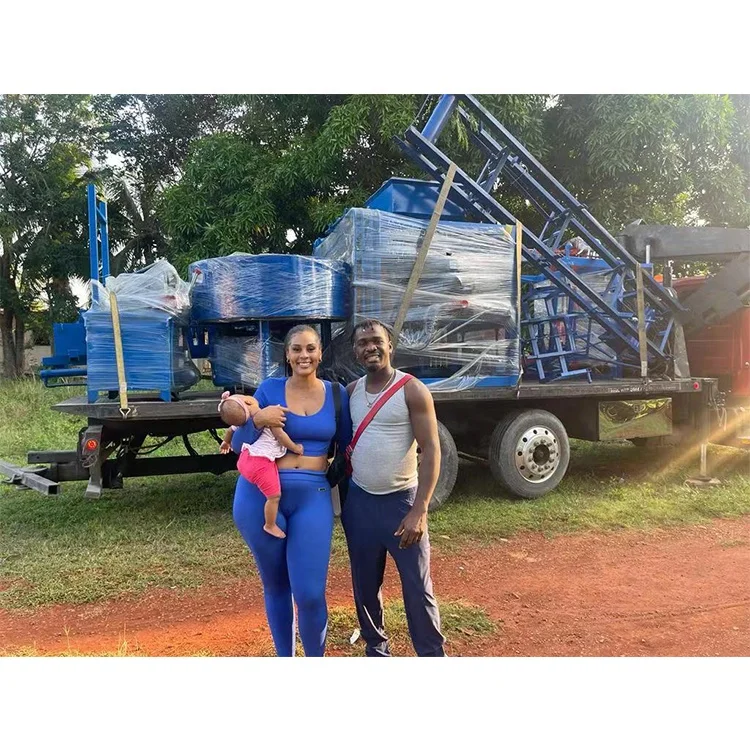
- Machine ships partially assembled; on-site reassembly includes hydraulic line connection and PLC power-up
- Commissioning validates PLC cycle parameters against your raw material sample and target block density
- Operator training covers programme recall, mould changeover procedure, and automatic stacker adjustment
- Wear parts list provided at quotation stage so first replacement order ships with the machine
What We Need From You to Configure the Line
To size the QT4-15 correctly, share the block formats your market sells most, the daily output you need for each format, and a sample of your local aggregate so we can set vibration and pressure values before the machine leaves the factory. Confirm your site voltage, frequency, and preferred PLC display language. Tell us the pallet size your existing curing racks and forklift can handle so the automatic stacker is matched to your layout from day one.
Frequently Asked Questions
Q: How do I verify the real daily output for the block format I actually sell?
A: Request a capacity calculation document that states the output per hour for your specific block dimensions and mould cavity count, not only the 400×200×200 mm hollow block figure. The QT4-15 test record shows actual cycle times per format, and daily output is calculated from those recorded times with allowance for pallet change and mould switching intervals.
Q: What PLC brand and display language options are available?
A: The PLC brand and display language are confirmed in writing before production starts. Common language options include English, Spanish, Arabic, and French, and the display language can typically be changed on-site through the controller settings menu without reprogramming the cycle logic.
Q: How does the automatic stacker integrate with my existing curing rack layout?
A: The stacker is configured for the 850×550×25 mm pallet, and its lift height and travel stroke are set to match your curing rack spacing. You need to share rack dimensions, aisle width, and forklift capacity so the stacker discharge height and pallet orientation align with your existing handling equipment.
Q: What is the upgrade path if I want to add full cubing later?
A: The QT4-15 line supports adding a cubing station downstream of the automatic stacker when production volume justifies it. The PLC architecture allows additional I/O modules to be integrated, and the conveyor layout can be extended to route cured pallets through a cubing and wrapping station without replacing the core press.
Q: How are vibration time and pressure set for a new mix design?
A: When you introduce a new mix, the operator runs a test cycle and adjusts vibration duration and hydraulic pressure through the PLC interface until block density meets your strength target. The validated values are then saved as a named programme, and operators recall that programme for subsequent production runs without needing to reprogram the controller.