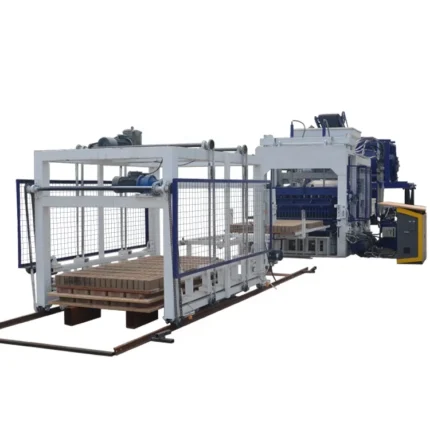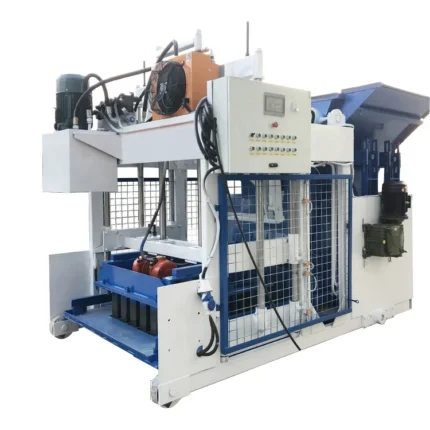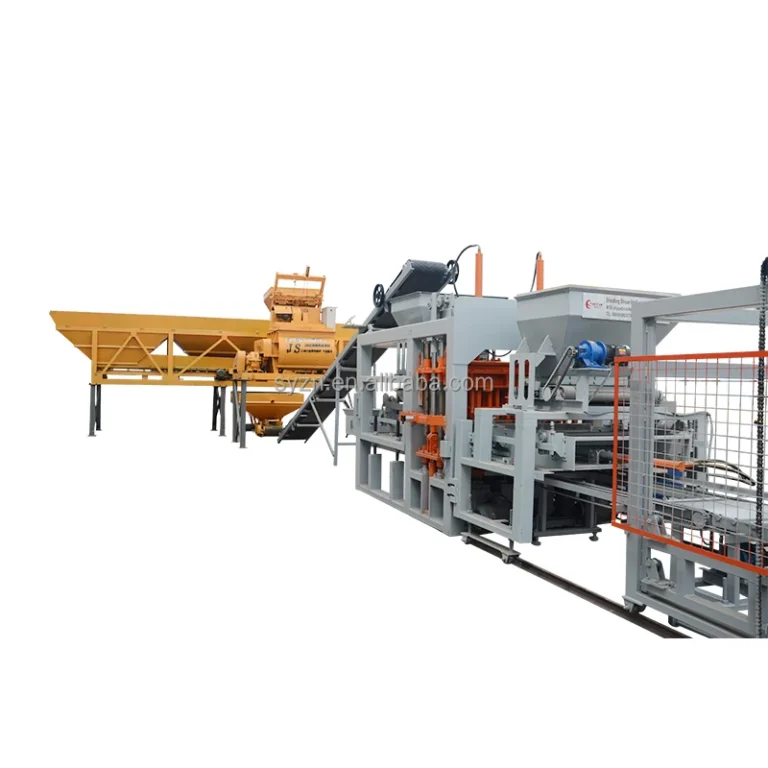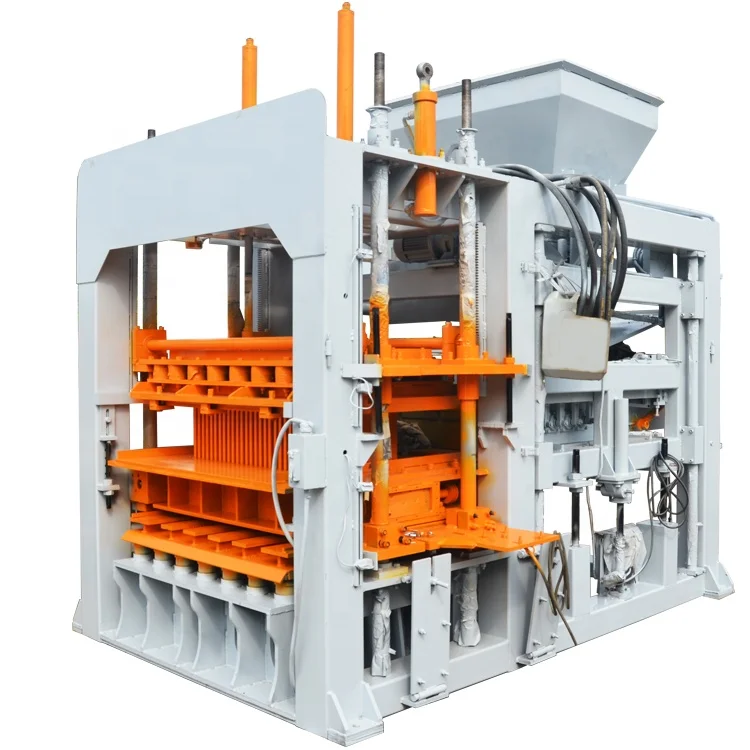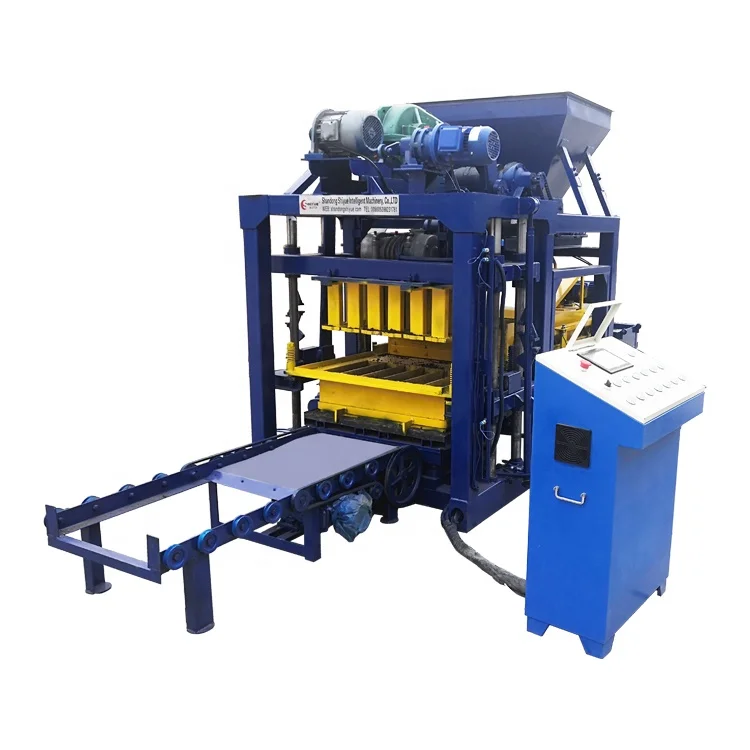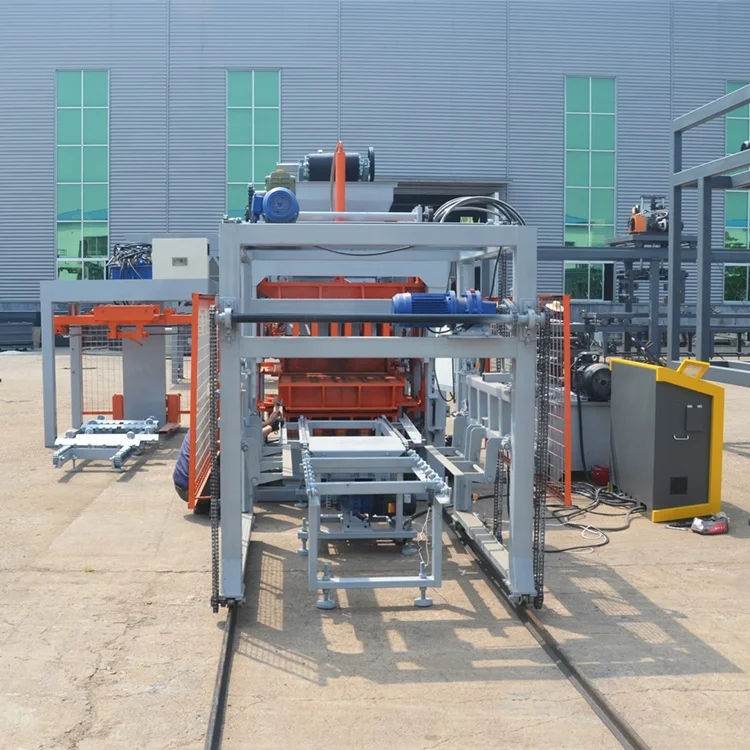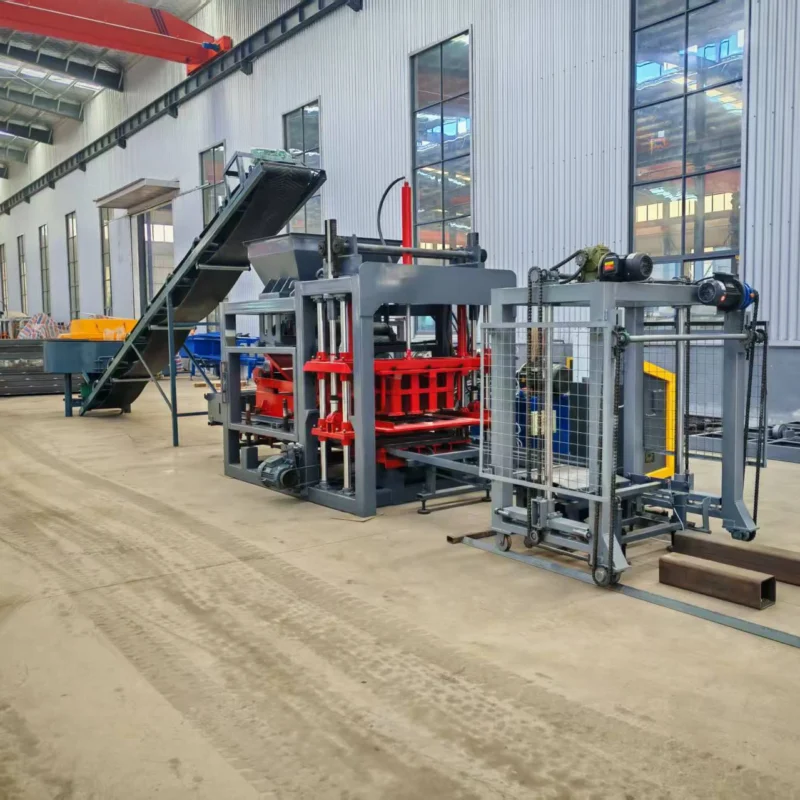

Description
PLC-First Configuration — Every QT4-15A automatic concrete block making machine PLC controlled is tuned to the buyer’s local aggregate and mix design before dispatch, not left at factory defaults.
Technical Specifications
| Parameter | Value |
|---|---|
| Model | QT4-15A |
| Product Type | Fully Automatic Concrete Block Making Machine |
| Overall Dimension | 4100×1600×2600 mm |
| Rated Pressure | 16-21 MPa |
| Main Vibration Form | Platform Vibration |
| Vibration Frequency | 4200 r/min |
| Vibration Force | 55 kN |
| Pallet Size | 880×550 mm |
| Molding Cycle | 25-30 s (basis not stated in source — confirm block format / material / thickness) |
| Overall Power | 18.45 kW |
| Demolding Method | Hydraulic |
| Total Mass | 4 T |
| Factory Area | 300 m² |
| Control System | PLC |
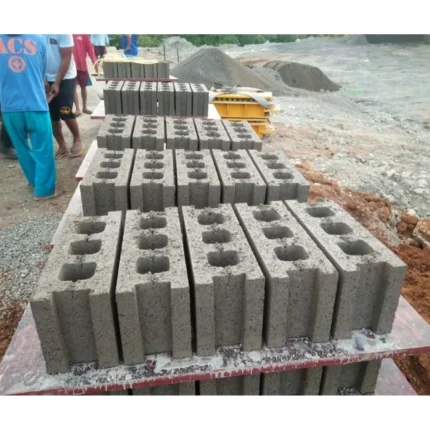
| Applied Products | Concrete blocks, hollow/solid blocks, pavers, interlocking blocks, curbstone, colored pavers |
| Raw Material | Crushed stone, sand, cement, dust, fly ash, gravel, slag |
| Loading | 1×40HQ container (basic equipment) |
| Warranty | 1 year |
| Standards | CE (verify for specific model) |
Application Suitability
| Application | Material or Output |
|---|---|
| Hollow block production | Crushed stone, sand, cement, fly ash blends |
| Solid block manufacturing | Gravel, cement, and dust aggregates |
| Paver and colored paver runs | Fine sand, cement, pigment-integrated mixes |
| Interlocking block output | Crushed stone and slag with cement binder |
| Curbstone pressing | Coarse aggregate with high cement ratio |
Why the PLC Language Question Must Come Before the Price
Confirm display language, voltage, and frequency in writing before production starts, or commissioning stalls the moment the crate opens.
I once watched a fully capable automatic concrete block making machine PLC controlled sit idle for days because the operator interface was in a language the crew could not read. The electrician had to trace every relay manually while the PLC screen blinked parameters nobody could interpret. That delay cost the buyer more than any discount the supplier offered. Voltage mismatches cause similar standoffs — a machine wired for 380V/50Hz arriving at a 440V/60Hz site will not run, and rewiring the control cabinet on the shop floor is neither fast nor cheap [NEED_CITE: voltage and frequency standards by export market].
Programmable Molding Cycles That Adapt to Your Mix
The QT4-15A stores separate parameter sets for each block format inside its PLC, meaning an operator switches from hollow blocks to pavers by selecting a recipe rather than adjusting limit switches by hand. Molding cycles run between 25 and 30 seconds depending on the block thickness and material density loaded into the program. The platform vibration at 4200 r/min and 55 kN is modulated through the PLC so that vibration duration and intensity match the aggregate particle size in the buyer’s mix. This level of programmability is what separates a true automatic concrete block making machine PLC controlled unit from a relay-based press that demands manual tuning every time the material source changes.
Consistency the Operator Cannot Override
Hydraulic demolding at 16-21 MPa holds pressure constant across every pallet regardless of operator fatigue or shift changes. The PLC monitors press position and pressure in real time, rejecting a cycle if the values drift outside the stored tolerance window. On semi-automatic machines, an operator might shorten the vibration phase to chase a higher pallet count, producing blocks that crumble at the stacking stage. Here, the automatic concrete block making machine PLC controlled logic enforces the full cycle every time [NEED_CITE: CE machinery directive requirements for industrial equipment]. Batch-to-batch strength stays within the range the mix design was built for, which is what structural testing labs actually measure.
Reading the Numbers That Matter on the Press Floor
The 55 kN vibration force paired with 16-21 MPa hydraulic pressure determines how tightly aggregate particles compact inside the mould cavity — higher vibration without sufficient hydraulic clamping lets the mix splash out, while heavy pressure without enough vibration leaves voids in the block core. The 880×550 mm pallet size must match the curing racks and forklift tines the buyer already operates; a mismatch means purchasing new racks or watching pallets overhang and crack during transport. Total power of 18.45 kW defines the transformer capacity and cable gauge the site electrician must prepare before arrival. A 4-tonne machine mass on a 300 m² factory footprint means the floor slab must handle concentrated point loads at the four leveling feet, not just an averaged weight distribution.
The Hidden Cost of Vague Automation Scope
A quotation that reads "fully automatic" without listing which stations are included leaves buyers discovering on delivery day that pallet feeding, stacking, and cubing still require manual labour. I have seen contractors assign three workers to move and stack pallets that were supposed to be handled automatically, erasing the labour savings the PLC was meant to deliver. Remote diagnostics mean little if the PLC brand does not have a local service partner who can read the fault codes. And a mould change system that takes half a shift to swap cancels out the format flexibility the buyer invested in [NEED_CITE: typical mould changeover practices in block production].
Why Buyers Specify Here
Block machinery is the single focus of this operation, so the QT4-15A is supplied as a matched system — press, mould, pallet, and handling — rather than assembled from unrelated vendors. Configuration is set against the buyer’s actual mix design and local aggregate, not pulled from a catalogue default. Moulds are designed for the formats the buyer’s market actually sells, including custom drawings when standard cavities do not fit. The automation level is selectable, allowing a buyer to start with manual pallet handling and add automatic stacking later without replacing the press. Installation support includes operator training at the site so the crew learns the PLC interface before the engineer leaves.
Documentation & Verification
- Line layout and capacity calculation stating the block format and mix assumed
- Machine specification sheet with PLC brand and I/O list
- Mould drawing and format list for every cavity supplied
- Voltage, frequency, and control language confirmation signed before production
- Factory test record run on the buyer’s target block format
- Hydraulic and electrical schematic for on-site troubleshooting
Installation, Commissioning & Support
- Floor slab must handle 4-tonne concentrated loads at four leveling feet across the 4100×1600 mm footprint
- Dedicated circuit rated for 18.45 kW with voltage and frequency matching the PLC configuration
- Machine ships in one 40HQ container; reassembly of hydraulic hoses and wiring on site
- PLC parameters tuned to local aggregate and cement ratio during commissioning runs
- Operator training covers recipe selection, fault reading, and mould change procedure
- Wear parts list and hydraulic seal kit supplied with first shipment
- Daily greasing points marked on the vibration platform and hydraulic cylinder guides
What to Include With Your Inquiry
Send the target block formats with dimensions, your daily output requirement per format, and samples or lab reports of the local aggregate and sand you plan to use. Confirm your site voltage, frequency, and preferred PLC display language so the control cabinet is wired correctly before dispatch. Specify which automation stations you need included — pallet feeding, stacking, cubing — so the quotation matches your actual labour plan rather than leaving gaps you fill with extra workers on day one.
Frequently Asked Questions
Q: How is the PLC configured for my local voltage, frequency, and operator language?
A: Before production begins, we confirm your site voltage, frequency, and preferred display language in writing. The control cabinet is then wired and programmed to those specifications and verified during the factory test. This prevents commissioning delays caused by mismatched electrical standards or unreadable operator screens when the machine arrives at your facility.
Q: What automation level am I buying — does the quotation include automatic pallet feeding, stacking, and cubing?
A: The QT4-15A quotation lists each station separately so you know exactly which processes are automated and which remain manual. If stacking or cubing is not included, we state that clearly so you can plan labour or add those stations in a later phase. This eliminates surprise costs after delivery.
Q: Can I start semi-automatic and upgrade to full automation later without replacing the press?
A: Yes. The QT4-15A press accepts add-on modules for automatic pallet feeding, stacking, and cubing at a later date. The PLC has reserved I/O channels for these upgrades, so adding automation does not require replacing the main controller or rewiring the entire cabinet from scratch.
Q: How are vibration frequency and hydraulic pressure tuned to my specific mix design and aggregate?
A: During commissioning, we run test cycles using your actual raw materials and adjust the PLC vibration duration and hydraulic pressure within the 16-21 MPa and 4200 r/min range. The goal is to match compaction energy to your aggregate particle size and cement ratio so block strength meets local structural standards consistently.
Q: What remote diagnostics or troubleshooting support is available after commissioning?
A: The PLC records fault codes and cycle data that can be shared with our service team for remote diagnosis. We recommend confirming whether the PLC brand has a local distributor in your region who can supply replacement modules quickly if hardware issues arise after the warranty period.