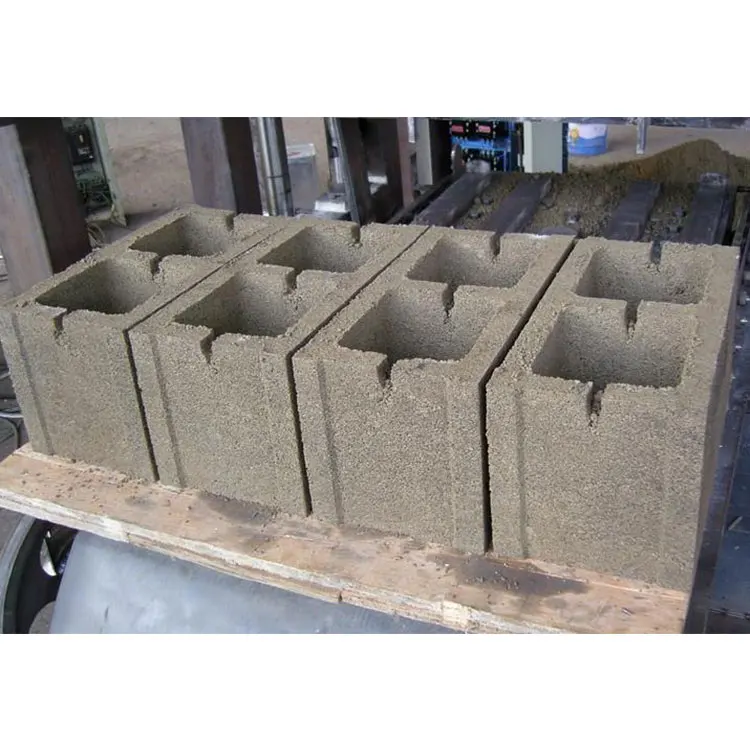
Description
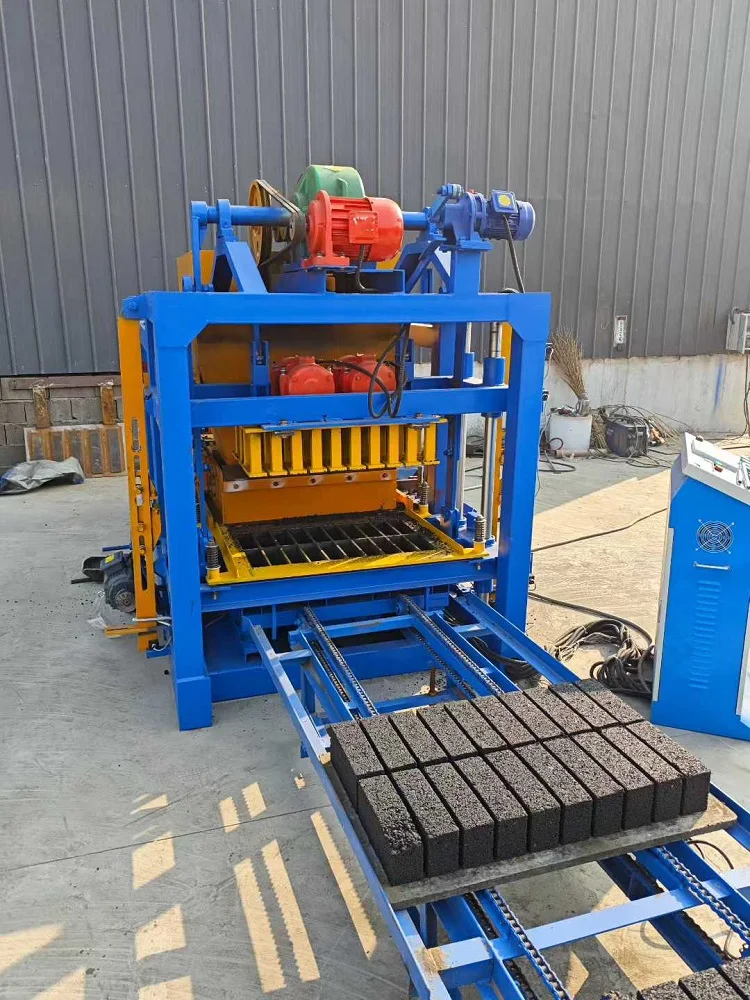
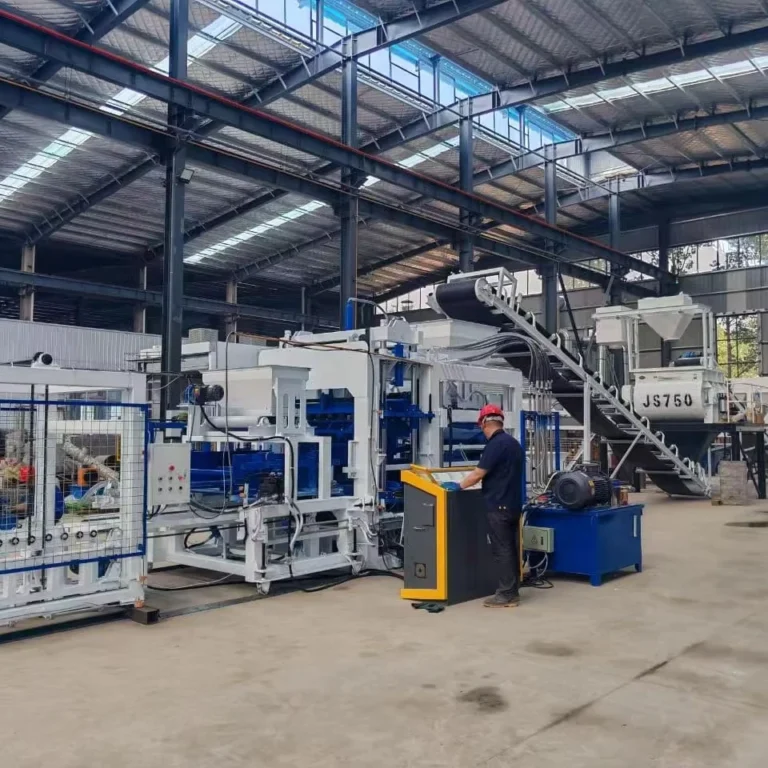
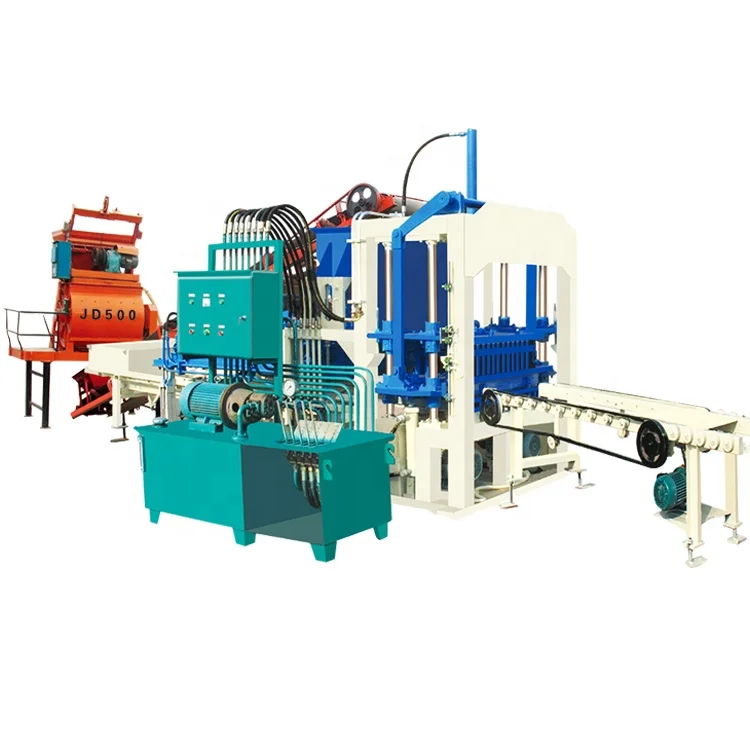
Controlled synchronization — The QT4-15A runs as a coordinated system where PLC logic ties the press, pallet feeder, stacker, and batching station together, so automation removes the operator from the material flow rather than adding complexity.
Technical Specifications
| Parameter | Value |
|---|---|
| Model | QT4-15A |
| Product Type | Automatic Hydraulic Block Making Machine |
| Overall Dimensions | 7100 × 1700 × 2610 mm |
| Main Vibration Form | Platform vibration |
| Vibration Frequency | 4600 r/min |
| Exciting Force | 35.5 kN |
| Rated Hydraulic Pressure | 16 MPa |
| Pallet Size | 900 × 500 × 25 mm |
| Molding Cycle | 15–20 s (basis not stated in source — confirm block format, material, thickness) |
| Total Power | 25.7 kW |
| Voltage | 380 V / 3-phase / 50 Hz (customizable to local grid) |
| Automation Level | Fully automatic |
| Line Configuration | Main block machine, mixer, belt conveyor, automatic stacker, automatic pallet feeder, batching plant, cement silo |
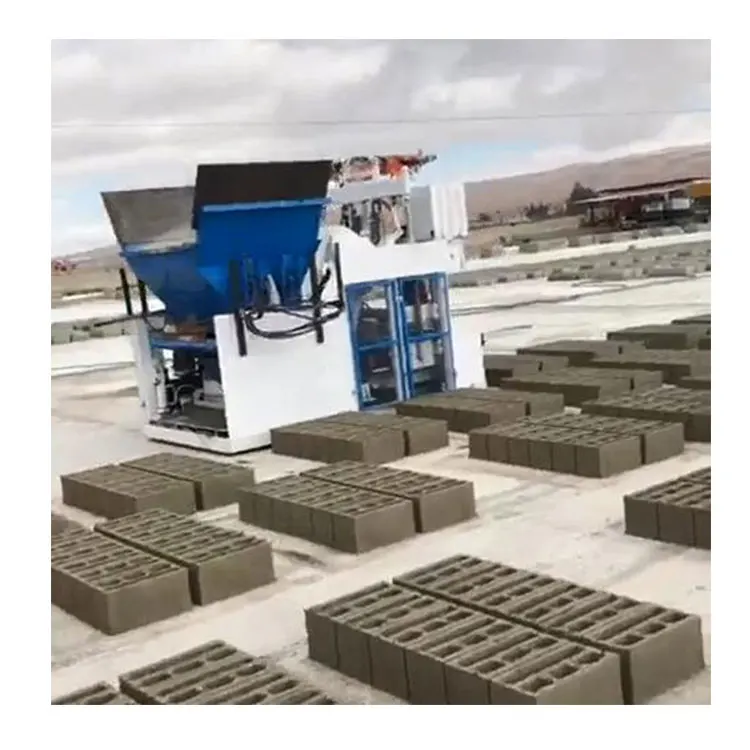
| Mould Compatibility | Exchangeable moulds (hollow, solid, paver, interlocking, kerbstone, porous) |
| Assembly State | Whole line loadable in one 20 ft container (verify against final configuration) |
| Warranty | 1 year (excluding wearing parts) |
| Certification Scope | CE (confirm applicability for specific model and destination market) |
Application Suitability
| Application | Material or Output |
|---|---|
| Hollow block production | Crushed stone, sand, cement, and water mixed to local aggregate grading |
| Solid block manufacturing | Dense concrete mixes for load-bearing masonry walls |
| Paving block and kerbstone | High-strength face-mix or through-mix concrete for pedestrian and vehicular surfaces |
| Interlocking and porous brick | Specialized permeable or dry-stack formats for landscaping and drainage |
| On-site contractor production | Mobile or fixed setup for housing and infrastructure projects producing blocks locally |
Why the PLC Language Question Must Come Before the Quotation
A control panel the operator cannot read is a machine that cannot run.
When an automatic block making machine with PLC control arrives at a site in West Africa with the HMI locked to a language the local technicians do not read, commissioning stops before it starts. The electrician cannot navigate fault menus, the supervisor cannot adjust cycle parameters, and the supplier’s remote support is limited to video calls where someone translates each screen one menu at a time [NEED_CITE: language and interface requirements in international machinery exports]. This is not a software preference — it is a production-blocking failure that costs weeks of idle time while the correct language pack is sourced, flashed, and tested. Voltage mismatch carries the same weight: a 380 V / 50 Hz motor connected to a 440 V / 60 Hz grid will overheat and fail within days, and rewinding a motor overseas is neither fast nor cheap.
What Full Automation Actually Coordinates
The QT4-15A automatic block making machine with PLC control links every station into a single timed sequence. The batching plant delivers measured material to the mixer, the mixer feeds the press hopper on a cycle that prevents overflow or starvation, the pallet feeder slides a fresh pallet into position before the press completes its current stroke, and the stacker collects finished blocks and indexes the curing rack without manual intervention. Each station has its own sensor feedback loop — pallet present, hopper level, stack height — and the PLC arbitrates between them so no station runs ahead or falls behind. This is the difference between an automatic block making machine with PLC control and a manual line where five operators watch each other for hand signals.
Where Batch Consistency Comes From
Block strength inconsistency is rarely a press problem in isolation. It is a batching and timing problem that shows up at the press. When the automatic block making machine with PLC control meters cement, aggregate, and water by weight or volume on each cycle, and when vibration duration and hydraulic pressure are held to the same setpoints stroke after stroke, the variable that normally destroys consistency — human pacing — is removed from the process [NEED_CITE: causes of compressive strength variation in concrete masonry units]. A pallet that sits under vibration for exactly the programmed seconds, under exactly 16 MPa of hydraulic pressure, produces a block with a predictable density. Run the same programme on Monday and Friday and the blocks test within the same strength band, regardless of who is on shift.
Reading the Numbers That Actually Matter
Vibration force and hydraulic pressure work as a pair, not independently. The 35.5 kN exciting force at 4600 r/min consolidates the concrete mix against the mould walls, while the 16 MPa hydraulic pressure holds the mould head down during that consolidation. If vibration is high but pressure is low, the block expands slightly as the head lifts, producing a unit that is dimensionally inconsistent. If pressure is high but vibration is low, the mix does not fully compact and the block has internal voids that reduce strength. The QT4-15A specifications place both values in a range suited to standard concrete mixes, but the actual settings on site must be tuned against the buyer’s specific aggregate size, moisture content, and cement ratio — which is why the configuration conversation starts with a material sample, not a catalogue page. Pallet size at 900 × 500 × 25 mm defines the maximum block footprint per cycle and must align with the curing rack dimensions and forklift capacity already in use at the plant.
What Happens When the Line Is Not Specified as a System
A buyer who purchases a press without confirming the pallet feeder and stacker as part of the scope ends up with a machine that produces faster than two workers can carry blocks to the curing area. Output piles on the floor, blocks chip during manual handling, and the press is stopped and restarted to wait for pallets to return from the rack. The automation investment pays for the press but the bottleneck moves to the end of the line [NEED_CITE: bottleneck migration in partially automated production systems]. Similarly, specifying a mould change system that requires tools and alignment jigs the buyer does not have on site turns a quick format switch into a half-shift exercise, negating the flexibility the exchangeable mould system was meant to deliver.
Why Configuration Conversations Start Here
This line is specified as a matched system — press, pallet feeder, stacker, batching, and mixer — so cycle times at each station are set to the same rhythm rather than negotiated after arrival. The mould selection is built around the formats the buyer’s market actually buys, with custom mould drawings available where standard formats do not match. Voltage and frequency are confirmed against the buyer’s local grid before production begins, and PLC display language is locked in at the same stage. The automation level is selectable, meaning a buyer can start with semi-automatic pallet handling and add the stacker later without replacing the press. Installation and commissioning support includes operator training on the specific control interface the buyer will use daily.
Documentation & Verification
- Line layout and capacity calculation stating the assumed block format and cycle time
- Hydraulic and electrical schematic matching the as-built QT4-15A configuration
- Voltage, frequency, and PLC display language confirmation signed before production
- Mould drawing, format list, and wear parts catalogue for the supplied mould set
- Factory test record documenting block output and dimensional checks on the buyer’s format
Installation, Commissioning & Support
- Foundation must accommodate the 7100 × 1700 mm press footprint and the full line conveyor run
- 25.7 kW total power requires a dedicated 3-phase circuit at the confirmed voltage and frequency
- Line arrives dismantled for container loading; reassembly and station alignment handled on site
- PLC parameters set against the buyer’s mix design and block format during commissioning
- Operator training covers mould change procedure, fault navigation, and daily maintenance checks
- Wear parts and mould spares list provided so first replacements are on hand before they are needed
What We Need to Configure Your Line
To build a quotation that reflects your actual production conditions rather than a catalogue default, share the block formats you sell and the daily output target for each, the local aggregate type and typical mix design you work with, and the voltage, frequency, and preferred PLC display language at your site. If you have existing pallets, curing racks, or forklifts, include those dimensions so the pallet and stacking specification matches what you already handle.
Frequently Asked Questions
Q: How is daily output stated for each block format?
A: Capacity is calculated per specific block format using the mould cavity count, cycle time for that format, and pallet size — not as a generic cycles-per-hour figure that hides which block was assumed. The quotation states the format, the cycle, and the resulting daily output so you can plan production against real orders.
Q: What does the QT4-15A automation package include, and can I add stations later?
A: The standard line includes the press, mixer, belt conveyor, automatic stacker, pallet feeder, batching plant, and cement silo. A buyer starting with semi-automatic pallet handling can add the stacker and feeder as separate modules later without replacing the main press or rewriting the PLC programme.
Q: How are voltage and PLC language confirmed before the machine ships?
A: Both are documented in a written confirmation that the buyer signs before production starts. The motor is wound and the PLC HMI is loaded to match the buyer’s local grid and preferred operator language, so commissioning on arrival does not stall on an unreadable screen or an incompatible power supply.
Q: How is vibration and pressure matched to my local aggregate?
A: The buyer provides a sample or specification of local aggregate, and the press parameters — vibration frequency, duration, and hydraulic pressure — are set during factory testing against that material. On-site commissioning fine-tunes the settings against the actual mix to ensure consistent block density and strength.
Q: How long does a mould change take on the QT4-15A?
A: The exchangeable mould system uses a bolt-and-locator interface designed for removal and alignment without specialist jigs. Change time depends on the operator’s familiarity with the procedure, which is covered during on-site training so the first live change is practised under supervision.