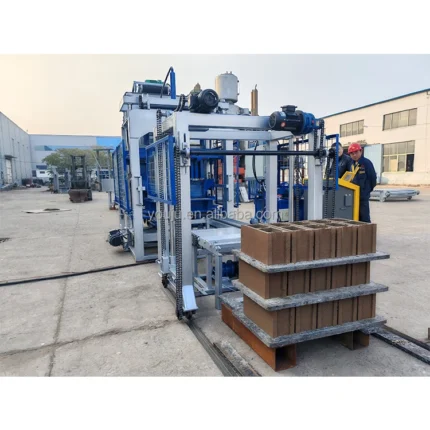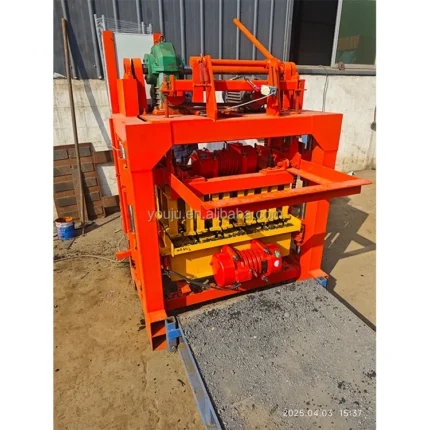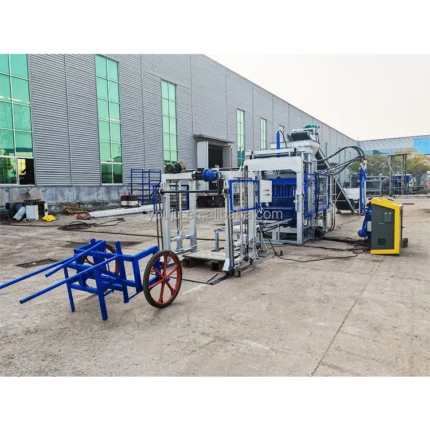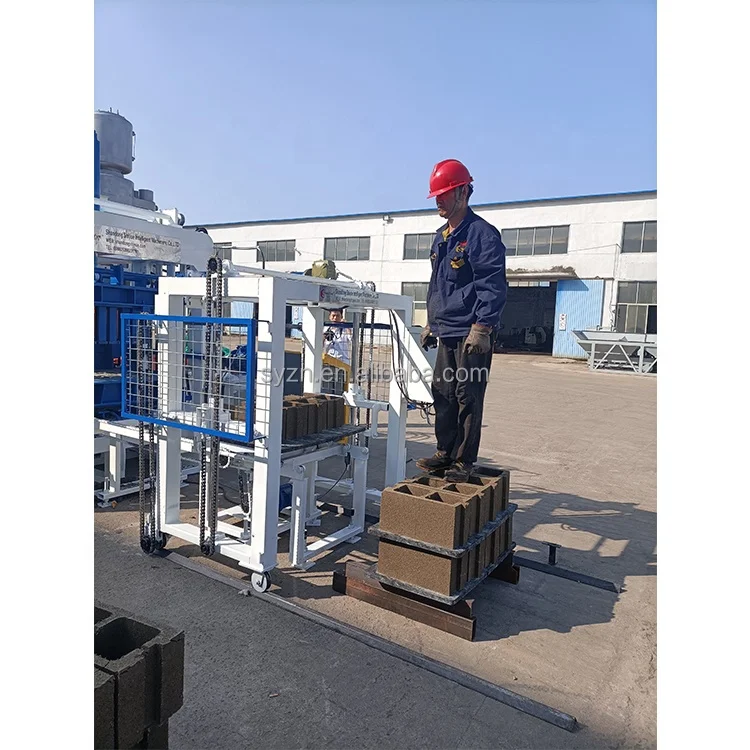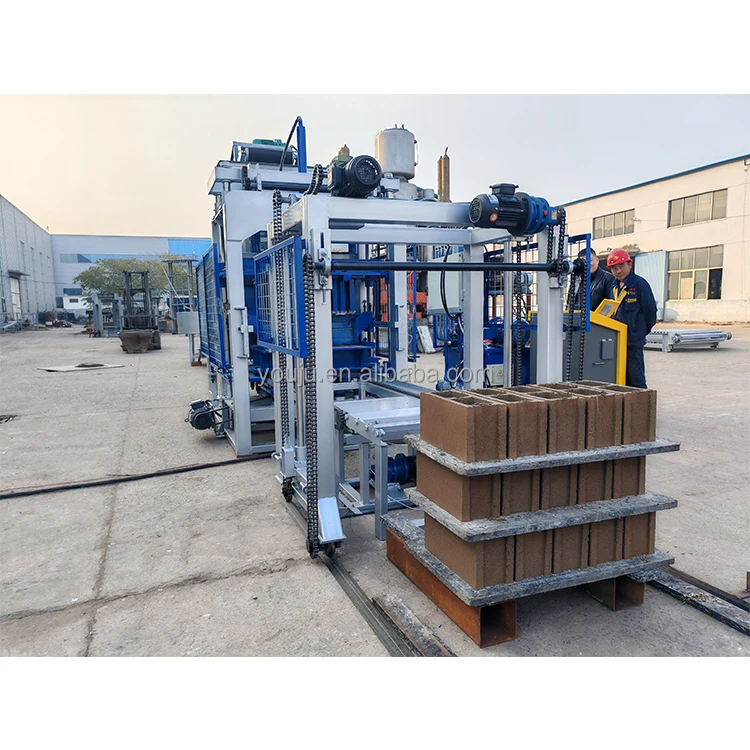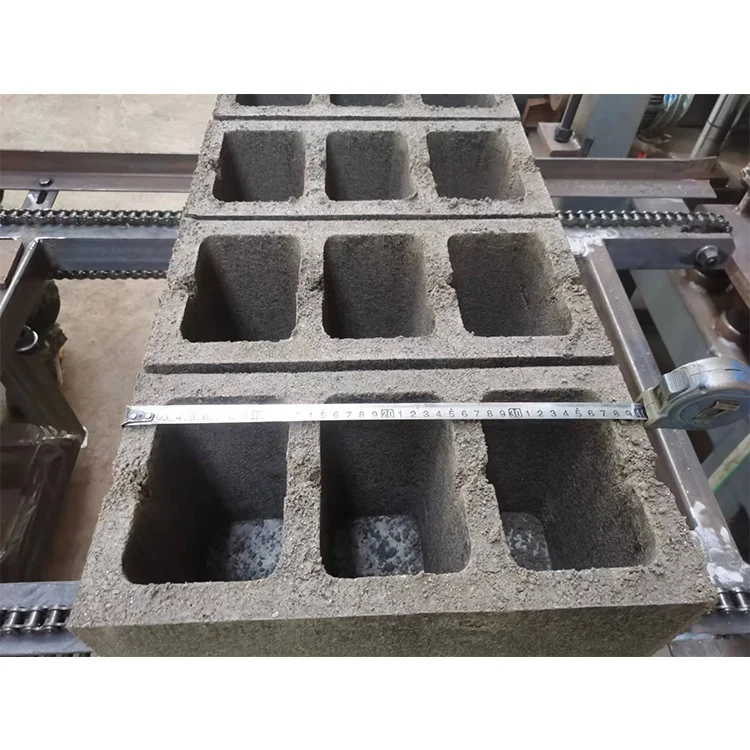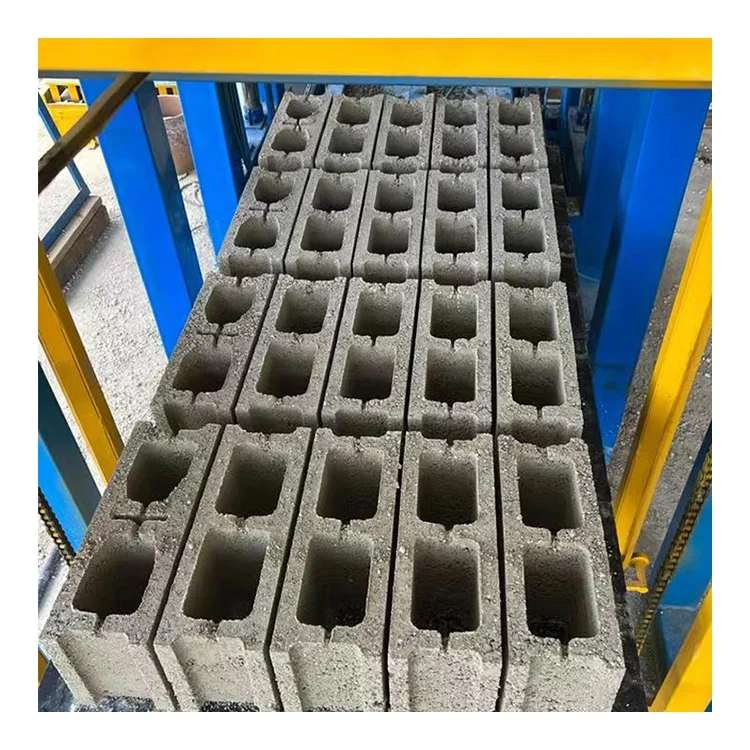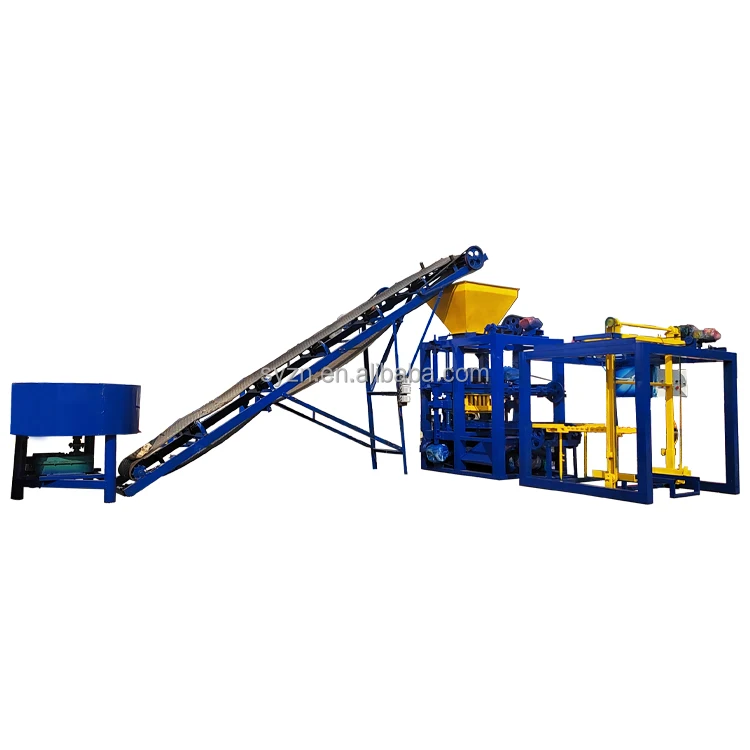


Description
Automation That Matches Your Cycle — Every QTJ4-24 we configure starts with your pallet size, curing rack spacing, and forklift tonnage, so the PLC-controlled QTJ4-24 block making machine never outpaces the rest of your handling line.
Technical Specifications
| Parameter | Value |
|---|---|
| Model | QTJ4-24 |
| Product Type | Stationary Block Making Machine |
| Overall Dimensions (L×W×H) | 3600 × 1700 × 2560 mm |
| Pallet Size | 850 × 450 mm |
| Molding Cycle | 24–26 s |
| Overall Power | 11.95 kW |
| Vibration Force | 45 kN |
| Total Mass | 2 T |
| Molding Method | Mechanical |
| Vibration Configuration | 2 × 3 kW lower vibrators + 2 × 1.5 kW upper vibrators |
| Material Distribution | Full-automatic spiral |
| Reducer for Mold Lifting | 350-type |
| Automation Level | Semi-automatic (mechanical molding with automatic spiral feeding) |
| Voltage & Frequency | Configurable to site requirement (basis to be confirmed) |
| Control System | PLC-ready, language configurable (basis to be confirmed) |
| Output Capacity | Varies by block format and mix design (basis to be confirmed) |
| Warranty | 1 year (excluding spare parts) |
Application Suitability
| Application | Material or Output |
|---|---|
| Hollow block production | Cement, sand, crushed stone aggregate |
| Solid block production | Cement, sand, fine aggregate blends |
| Interlocking brick production | Cement, laterite, quarry dust mixes |
| Paving brick production | Cement, sand, granite chips |
| Small to medium block plants | Semi-automatic line with manual pallet handling |
| On-site contractor production | Compact footprint for relocation between project sites |
| First-time plant startups | Lower investment entry point with upgrade path |
Why "Cycles per Hour" Tells You Almost Nothing
A molding cycle number without the block format attached is a capacity figure you cannot plan a business around.
When buyers tell me their last machine never hit the quoted output, the root cause is almost always the same: the seller gave them a cycle count based on a thin paving brick, but they are actually running 200 mm hollow blocks that need longer vibration and a heavier mix. I have seen this gap frustrate plant owners across multiple export markets, especially where local aggregate varies seasonally and the original mix design no longer applies [NEED_CITE: block format assumptions in capacity quotations]. The PLC controlled QTJ4-24 block making machine states its 24–26 second cycle as a mechanical baseline, and any daily output figure must be recalculated once your exact block format, cavity count, and mix are locked in.
How the PLC Layer Changes Operator Dependency
The semi-automatic base configuration of this automatic stationary block machine handles material distribution through the spiral feeder without operator input, while the mechanical press cycle runs on a fixed timer. Adding PLC control shifts the remaining manual decisions — cycle timing adjustment, vibration duration per format, fault indication — into programmed logic. What that removes from the operator is the guesswork that causes batch-to-batch density variation when shift workers interpret settings differently.
Where Automation Stops Being Useful
I spent years wiring QTJ-series machines in assembly bays before moving into technical selection, and the lesson that stuck is this: intelligence at the press is wasted if the downstream handling cannot keep pace. One project involved a fully automatic stacking line shipped to a site where the curing area was too small and the forklift could not reach the stack height the cuber was producing. The whole line bottlenecked at the discharge end, waiting on manual intervention. That is why we confirm your curing rack dimensions, forklift capacity, and available floor space before the PLC controlled QTJ4-24 block making machine leaves the factory [NEED_CITE: block plant layout and material handling integration].
Reading the Specs That Actually Matter
The 45 kN vibration force comes from a dual-layer arrangement — two 3 kW lower vibrators working with two 1.5 kW upper vibrators — which compacts from both directions simultaneously. In practical terms, upper vibration settles the face mix while lower vibration drives density through the block body, and the balance between them determines whether your hollow blocks crack at the webs during demoulding. The 350-type reducer on the mold lifting mechanism handles continuous cycling loads that burn out lighter gearboxes within the first year of two-shift operation. Pallet size at 850 × 450 mm defines the maximum block footprint per cycle and must match the spacing on your existing curing racks, or you will be rebuilding the rack system after the machine arrives. Overall power of 11.95 kW keeps the electrical demand low enough for sites running on generator supply, which matters in markets where grid connection costs delay commissioning by months.
The Cost of Skipping Configuration Questions
When voltage and frequency are not confirmed before production, a machine built for 380 V / 50 Hz arrives at a 440 V / 60 Hz site and the motors overheat within the first week. When the PLC display language is not specified, operators run the press on default settings they cannot read, and fault codes go unacknowledged until mechanical damage occurs. I have seen buyers lose an entire commissioning week to rewiring and panel replacement because these details were treated as secondary to the unit price [NEED_CITE: electrical specification mismatches in machinery exports]. The consequences are never just delay — they are damaged windings, voided warranties, and operator frustration that carries into every shift that follows.
Why Buyers Source This Machine Through Us
Block machinery is our single focus, which means the QTJ4-24 arrives as a matched system — press, mould, pallet, and handling specified together rather than assembled from separate suppliers. We configure the vibration force and cycle timing against your actual mix design and local aggregate, not a catalogue default. Mould design covers the formats your market sells, including custom drawings when standard cavities do not match your block dimensions. The automation level is selectable: you can start with semi-automatic mechanical molding and add pallet feeding or stacking later without replacing the press. Installation support includes on-site commissioning and operator training, so the first production run happens with someone who knows the machine standing next to your team.
Documentation & Verification
- Line layout showing QTJ4-24 footprint with pallet flow direction and curing rack spacing
- Machine specification sheet confirming vibration force and power at your voltage
- Mould drawing package listing cavity count and block dimensions per format
- Pallet specification matched to your curing rack and forklift load rating
- Voltage, frequency, and PLC display language confirmation before production
- Factory test record showing cycle timing on your specified block format
Installation, Commissioning & Support
- Foundation slab leveled to ±5 mm across the 3600 × 1700 mm machine footprint
- Dedicated power circuit sized for 11.95 kW continuous draw plus startup surge
- Vibration isolators installed before first run to prevent resonance transfer to slab
- PLC parameters loaded with your block format cycle times during commissioning
- Mould change procedure trained on-site with your production team present
- Wear parts list provided with recommended reorder intervals per operating hours
What We Need to Configure Your Line
Before quoting, we need to know the block formats you intend to produce, the daily volume you are targeting per format, and the local aggregate available at your site. Your curing area dimensions and existing forklift tonnage determine pallet handling configuration. Confirm your site voltage, frequency, and preferred PLC display language so the automatic stationary block machine arrives ready to commission.
Frequently Asked Questions
Q: How is daily output calculated for the QTJ4-24, and which block format is assumed?
A: The 24–26 second molding cycle is a mechanical baseline. Daily output depends on the specific block format, cavity count per mould, and mix design you run. We calculate capacity per format and state the assumption clearly, so the figure you plan around matches the block you actually sell.
Q: What PLC control options and display language are available, and can I upgrade later?
A: The PLC controlled QTJ4-24 block making machine supports configurable control logic and display language set before shipment. You can start semi-automatic and add pallet feeding or stacking modules later, because the press platform is designed to accept automation upgrades without structural modification.
Q: How does the dual-layer vibration affect block strength with different local aggregates?
A: The 45 kN combined force from upper and lower vibrators compacts from both directions, which matters when your aggregate gradation differs from standard test mixes. We adjust vibration duration and pressure balance during commissioning based on your specific material source and target block strength.
Q: What voltage and frequency configurations are supported?
A: Voltage and frequency are configured to your site requirement before production begins. We confirm these parameters along with the PLC display language during the ordering process to prevent commissioning delays and motor damage on arrival [NEED_CITE: voltage and frequency standards by export market].
Q: What is the mould change procedure and how much shift time does a format swap take?
A: The 350-type reducer handles the mold lifting mechanism for format swaps. Change time depends on mould weight and operator familiarity. We train your team on the procedure during commissioning and provide format-specific lifting points and alignment references in the mould documentation.