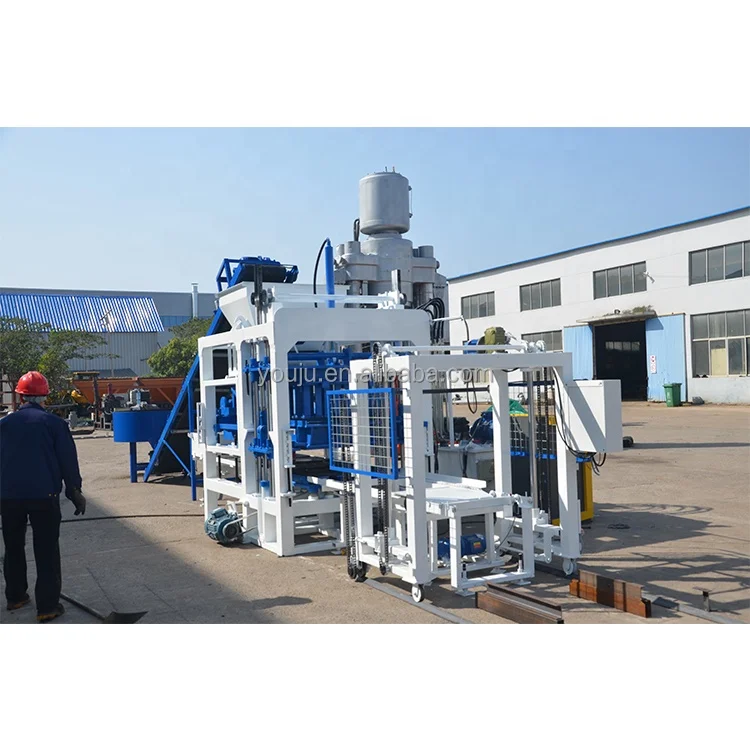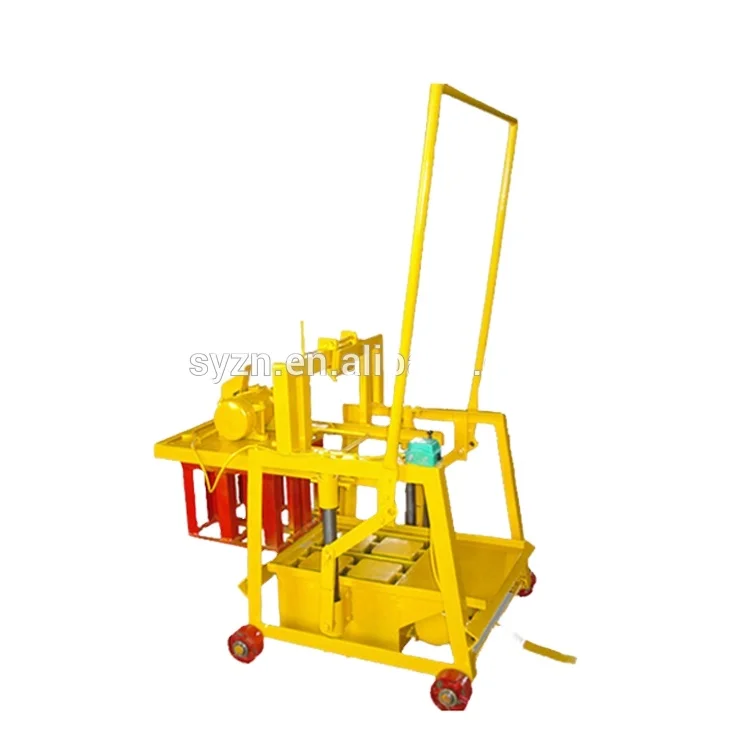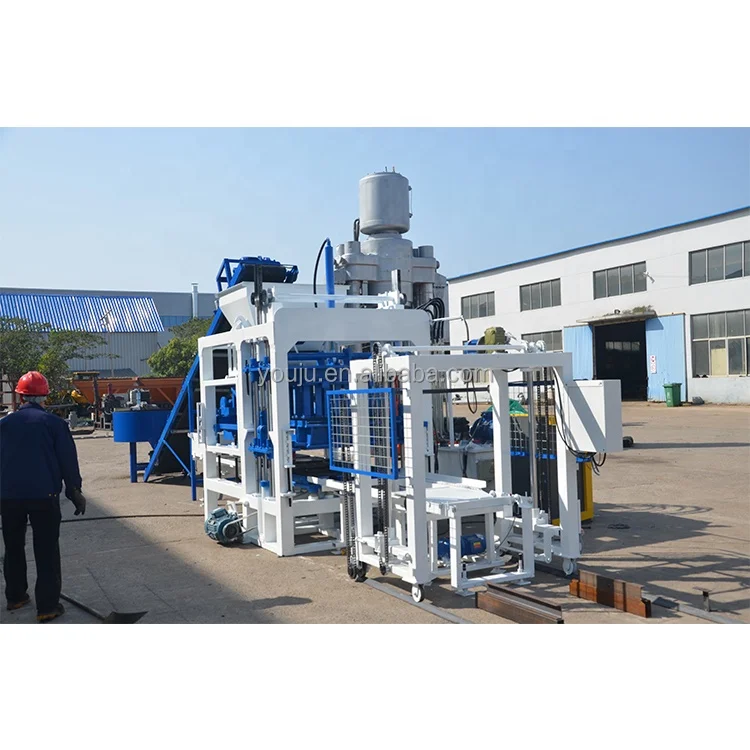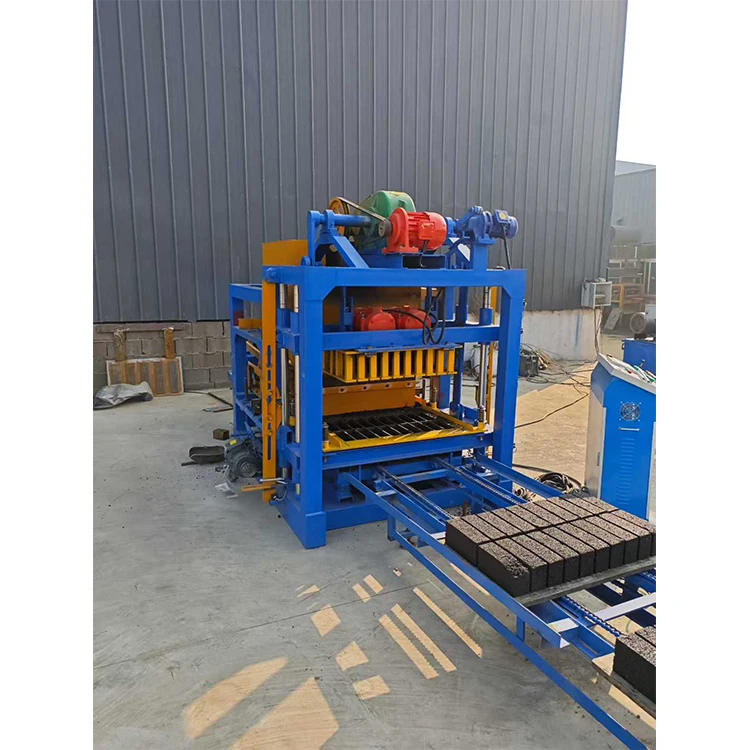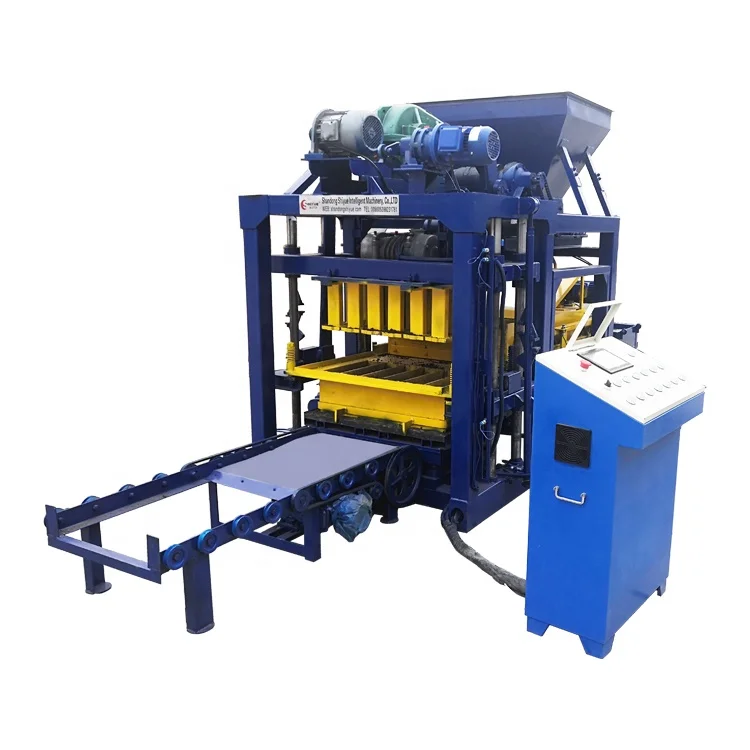
Description
Electric Control with Automation Upgrade Path — The QTJ4-25 ships as a semi-automatic press with electric control, yet its pallet and stacking interfaces are pre-wired so a buyer can add PLC-driven automation later without swapping the mainframe.
Technical Specifications
| Parameter | Value |
|---|---|
| Product Type | Semi-Automatic Concrete Block Making Machine |
| Model | QTJ4-25 |
| Overall Dimensions (L×W×H) | 3060×1730×2580 mm |
| Total Weight | 4 T |
| Vibration Force | 45 kN |
| Cycle Time | 25 s |
| Pallet Size | 850×550 mm |
| Block Height Range | 40–280 mm |
| Workshop Area | 50–150 m² |
| Material Storage Area | 300–500 m² |
| Belt Conveyor Length | 8 m |
| Mixer Model | JQ500 |
| Motor Brand | Siemens or ABB |
| Voltage & Frequency | 380V, 3-phase, 50Hz (customizable to local voltage) |
| Control System | Electric control (PLC option to be confirmed) |
| Automation Level | Semi-automatic |
| Output Capacity | 480 pcs/h based on 400×200×200 mm hollow block, 4 pcs/mould (basis to be confirmed) |
| Output Capacity | 600 pcs/h based on 400×150×200 mm hollow block, 5 pcs/mould (basis to be confirmed) |
| Output Capacity | 840 pcs/h based on 400×100×200 mm hollow block, 7 pcs/mould (basis to be confirmed) |
| Output Capacity | 2880 pcs/h based on 240×115×53 mm solid brick, 24 pcs/mould (basis to be confirmed) |
| Warranty | 1 year (excluding wearing parts) |
Application Suitability
| Application | Material or Output |
|---|---|
| Hollow block production | Crushed stone, sand, cement, fly ash |
| Solid brick manufacturing | Quarry dust, river sand, cement blends |
| Interlocking paver forming | Colored concrete mixes with fine aggregate |
| Curbstone and kerb production | Coarse aggregate concrete with high cement ratio |
| On-site contractor block making | Locally sourced aggregate with portable mixer feed |
| First plant entrepreneur setup | Standard concrete mixes with semi-automatic handling |
What "Semi-Automatic" Actually Means for Your Control Panel
The control system is the operator’s only window into the machine, and if the language on that panel does not match the crew reading it, the first production day becomes a troubleshooting day.
I once watched a block line in a desert project stall because the electric control labels were only in a language the local crew could not read. The automatic QTJ4-25 block machine PLC controlled interface is where this problem either gets solved before shipment or discovered on site. Voltage, frequency, and display language are not afterthoughts — they are commissioning prerequisites [NEED_CITE: voltage and frequency standards by export market]. When the panel speaks the operator’s language, cycle adjustments and fault codes become immediate instead of requiring a translator on the shop floor.
Control Logic That Grows with Your Plant
The electric control system on this press manages the core pressing cycle, vibration timing, and motor sequencing from day one. For a first-time plant owner, this means the operator learns one set of buttons and one rhythm before additional automation layers are introduced. The semi-automatic baseline keeps the initial investment contained while the press itself remains capable of accepting a full PLC upgrade later.
Where Automation Removes the Operator from the Equation
Manual pallet feeding and hand stacking are the two stations where batch-to-batch inconsistency enters the line. Each time an operator places a pallet slightly off-center or stacks a green block at an angle, the curing result shifts. Adding automatic pallet feeding and cubing later removes these variables, and the press control architecture is designed to integrate those modules without replacing the main cabinet. The upgrade path is a wiring and programming change, not a new machine [NEED_CITE: PLC integration standards for block making equipment].
Matching Cycle Time to Block Format and Local Aggregate
The 25-second cycle is a baseline that must be tuned against the buyer’s specific mix design. A dense aggregate with low water content needs longer vibration to achieve full compaction, while a lighter fly ash mix may require shorter cycles to avoid over-vibration and surface cracking. The vibration force of 45 kN acting across the 850×550 mm pallet area determines how uniformly the concrete consolidates in the mould cavity. If the local aggregate differs from the factory test material, cycle time adjustment at the control panel is the first correction to make.
The Cost of Skipping the Language and Voltage Conversation
When control panel language is confirmed after the machine arrives, the options are limited: apply adhesive labels over the original text, or rewire indicator circuits to a replacement panel. Both add days to commissioning and introduce errors that surface weeks later when an operator misreads a fault code. Similarly, a machine wired for 380V/50Hz arriving at a site running 440V/60Hz will burn out motors within the first shift if a transformer is not already in place. These are not warranty claims — they are specification gaps that close only with written confirmation before production begins [NEED_CITE: CE machinery directive requirements for industrial equipment].
Why Buyers Source This Press Through the Automation-Focused Channel
Every configuration discussion starts with the buyer’s actual block format and daily target, not a catalogue default. The machine, mould, pallet, and handling equipment are specified as one matched system so the press is never waiting on upstream material or downstream pallet removal. Mould design covers the formats the buyer’s market actually sells, including custom drawings when a standard mould does not exist. The automation level is selectable at order and upgradeable after installation, so capital expenditure tracks the plant’s growth rather than forcing a full-capacity investment on day one. Factory testing records document the cycle time and block strength achieved with the buyer’s specified mix before the machine leaves the production floor.
Documentation & Verification
- Line layout showing pallet flow and curing rack positions scaled to the 850×550 mm pallet
- Capacity calculation stating which block format each hourly output figure assumes
- Voltage, frequency, and control display language confirmed in writing before production
- Factory test record on buyer’s specified mix design and target block dimensions
- Hydraulic and electrical schematic matching the as-built cabinet configuration
- Wear parts and mould list with part numbers for first replacement orders
Installation, Commissioning & Support
- Foundation pad leveled to the 3060×1730 mm footprint with anchor bolt template provided
- Dedicated 3-phase circuit sized for Siemens or ABB motor starting current at confirmed voltage
- Belt conveyor and mixer positioned to match the 8 m feed length and JQ500 discharge height
- Control panel powered on and all cycle sequences verified against the buyer’s block format
- Operator training covers mould change procedure, cycle adjustment, and daily vibration motor inspection
- First replacement set of wear parts and hydraulic seals shipped with the machine
What to Include in Your First Inquiry
Share the exact block format and dimensions your market demands, along with the daily output target you need to hit. Confirm your site voltage, frequency, and the language your operators read on a control panel. If you already have curing racks, forklifts, or a mixer on site, include their specifications so the line layout accounts for equipment that is already in place.
Frequently Asked Questions
Q: How do I verify the real daily output for the block format I actually sell?
A: The capacity figures quoted for this machine are each tied to a specific block dimension and mould cavity count. Ask for a written capacity calculation that names your exact block format, mould layout, and assumed cycle time so you can convert hourly rates into realistic daily production against your shift length.
Q: Can the electric control system be upgraded to full PLC automation later?
A: The press is designed to accept automatic pallet feeding, stacking, and cubing modules after the initial semi-automatic installation. The upgrade involves adding sensors, actuators, and a PLC module to the existing cabinet rather than replacing the entire control system or the press frame.
Q: What voltage, frequency, and control language options should I confirm before shipment?
A: Confirm your site supply voltage and frequency in writing, along with the language your operators need on the control display. These three items affect motor winding, transformer sizing, and panel labeling, and correcting them after arrival adds days to commissioning.
Q: How is vibration force and cycle time matched to my local aggregate?
A: The 45 kN vibration force and 25-second baseline cycle must be adjusted against your specific mix design and aggregate density. Factory testing with your material sample establishes the starting parameters, and fine-tuning continues during on-site commissioning using the control panel adjustments.
Q: Which mould formats are included and how long does a changeover take?
A: The machine accepts moulds for hollow blocks, solid bricks, interlocking pavers, and curbstones within the 40–280 mm block height range. Mould changeover is manual on the semi-automatic configuration, and the exact time depends on crew familiarity and whether quick-release hardware is specified at order.