

Concrete Block Houses vs Traditional Construction: Why China Block Making Machines Deliver Speed and Cost Advantages for Global Builders
Concrete block houses are not cheaper because the materials are inferior — they are cheaper because the entire construction system is 3 times more efficient.
Prefabricated concrete block construction using automated block making machines from Chinese manufacturers can reduce project timelines by up to 60% and cut material costs by 30–40% compared to traditional bricklaying methods — making it the most viable solution for affordable housing, infrastructure, and commercial projects across emerging markets.
In my 12 years of advising builders across Nigeria, Uzbekistan, and Iraq, the single most common mistake I see is comparing block machines by sticker price alone. The real cost advantage lies in the total system — vibration density, labor reduction, and production speed — and Chinese manufacturers like Shandong Shiyue Intelligent Machinery have closed the quality gap with European equipment at one-third the price. Chinese block making machines with European-style airbag and quad-motor vibration systems produce finished blocks at 1,900–2,100 kg/m3 density, meeting ASTM C90 structural standards at 30–50% lower equipment cost than comparable European lines[^1].
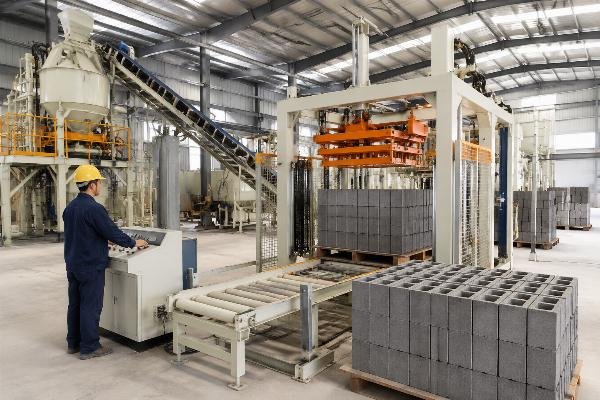
Let’s break down exactly why concrete block houses outperform traditional construction — and how to choose the right equipment for your market.
Why Are Concrete Block Houses 30–40% Cheaper Than Traditional Builds?
The cost advantage comes from systemic efficiency, not material shortcuts — fewer blocks per square meter, 40% less mortar, and 3x faster laying speed compress total project cost.
| Cost Component | Traditional Red Brick Construction | Concrete Block Construction with Automated Production |
|---|---|---|
| Units per m2 wall | 50–60 small bricks + high mortar volume | 8–10 large blocks + 40% less mortar Concrete block walls require 8–10 units per square meter compared to 50–60 small red bricks, reducing mortar consumption by approximately 40%[^2] |
| Labor requirement | 2–3 skilled masons per team | 1 mason + 1 helper per team; laying speed 3x faster |
| Material waste | 8–12% breakage and offcut waste | Less than 3% waste with machine-compacted uniform blocks |
| Equipment cost per block | N/A (manual process) | $0.18–$0.22 per block including raw materials, labor, and depreciation |
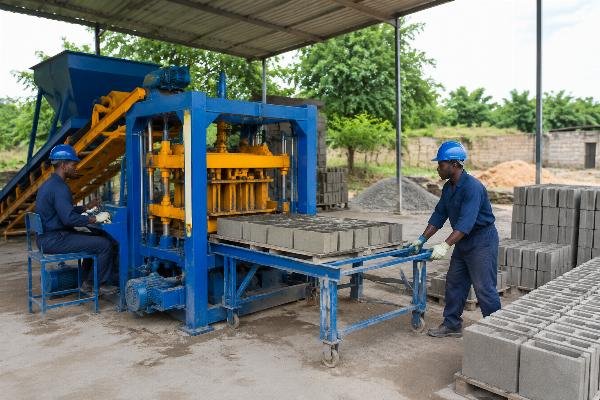
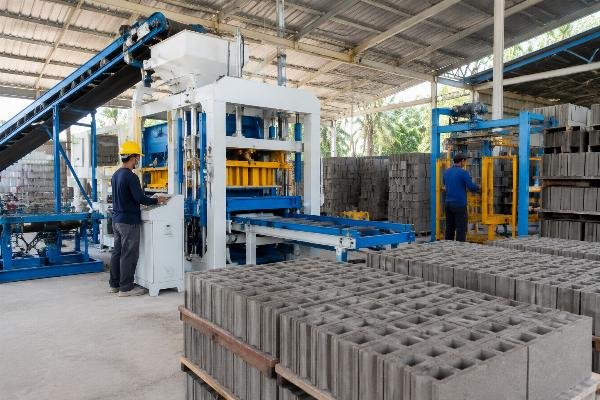
A small investor in Lagos, Nigeria started with a QTJ4-26 semi-automatic block machine, a JS500 mixer, and a belt conveyor — total investment $28,500. The setup produces 2,500 standard blocks per day with 3 workers. At a production cost of $0.19 per block and a local selling price of $0.38, the daily gross profit is $477.50. The equipment paid for itself in 7.2 months. A QTJ4-26 block machine investment of $25,000–$45,000 in West African markets achieves ROI within 6–9 months when producing 2,000–3,000 blocks daily at $0.18–$0.22 unit cost and selling at $0.35–$0.45[^3].
- Calculate Unit Cost – Sum raw material cost (cement, sand, aggregate, water), labor per shift, electricity, and monthly equipment depreciation to determine your true cost per block.
- Benchmark Local Selling Price – Survey at least 5 local block suppliers to establish the market price range for standard 400×200×200 mm blocks.
- Model Daily Output – Multiply blocks per cycle by cycles per hour by productive hours per shift to confirm daily revenue potential.
- Run a 5-Year TCO Analysis – Include maintenance, spare parts, mold replacements, and energy costs — not just the initial purchase price.
How Fast Can You Build a Concrete Block House Compared to Traditional Methods?
A 100 m2 single-story house can have its walls completed in 3–5 days with concrete blocks — versus 10–15 days with traditional red brick — because larger unit size and uniform dimensions eliminate cutting and fitting delays.
| Construction Phase | Traditional Red Brick Timeline | Concrete Block Timeline |
|---|---|---|
| Wall laying (100 m2 floor plan) | 10–15 days | 3–5 days Concrete block wall construction for a 100 m2 single-story residential unit requires 3–5 days compared to 10–15 days for traditional red brick masonry, achieving a 60% reduction in wall construction time[^4] |
| Mortar curing before plastering | 7–10 days | 3–5 days (blocks absorb less water, faster setting) |
| Total wall-to-plaster-ready | 17–25 days | 6–10 days |
| Skilled labor dependency | High (precision bricklaying) | Moderate (uniform block alignment) |
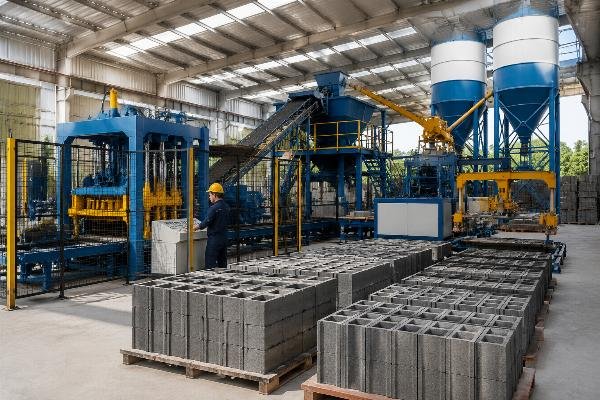
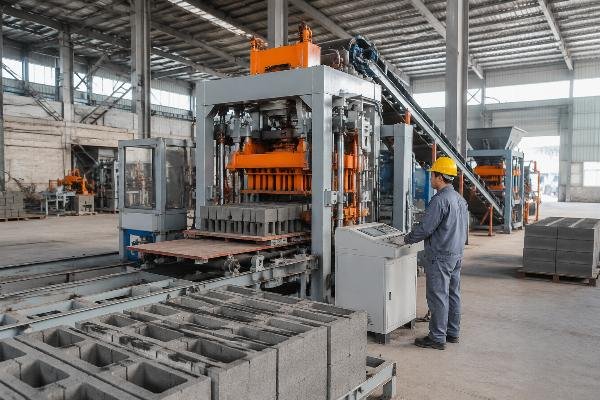
A mid-size block factory in Tashkent, Uzbekistan upgraded from a semi-automatic line producing 8,000 blocks per day with 18 workers per shift to a fully automatic QTY10-15 line producing 16,500 blocks per day with only 7 workers. The upgrade reduced unit labor cost by 55% and increased block density from 1,600 kg/m3 to 2,050 kg/m3 — critical for meeting Uzbekistan’s seismic zone construction codes. The factory now supplies blocks for a 12,000 m2 government affordable housing project, completing wall sections 60% faster than competing contractors using traditional methods. Upgrading from semi-automatic to fully automatic block making equipment (QTY10-15 class) increases daily output from 8,000 to 15,000–18,000 blocks while reducing shift labor from 18 to 6–8 workers, cutting unit labor cost by 55%[^5].
- Map Your Critical Path – Identify wall construction as the longest single phase and calculate how block speed compresses the overall project schedule.
- Negotiate Early Occupancy Clauses – Faster completion means earlier rental income or client handover — factor this into your project financing model.
- Train Masons on Block-Specific Techniques – Block laying requires different mortar joint thickness and alignment methods than brick; invest in a 2-day training session.
- Synchronize Production with Construction Pace – Ensure your block machine output matches or exceeds daily wall-laying capacity to avoid idle crews.
What Makes Chinese Block Making Machines the Smart Choice for Global Builders?
Chinese manufacturers have combined European mechanical design — airbag vibration systems and quad-motor configurations — with domestic scale manufacturing to deliver machines that match European performance at one-third to one-half the price.
| Feature | European-Brand Machine | Chinese Machine (Shandong Shiyue Standard) |
|---|---|---|
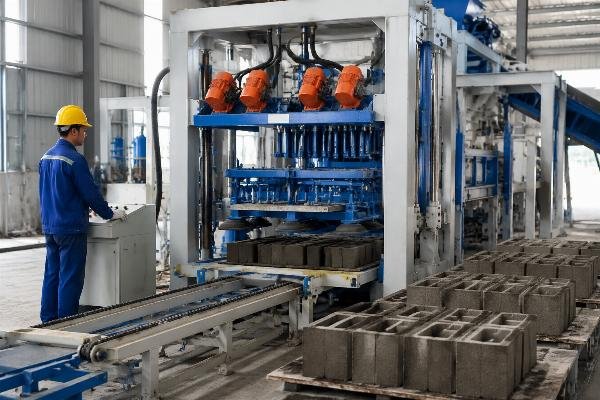
| Vibration system | Airbag + multi-motor | Airbag + 4 vibration motors (identical principle) Shandong Shiyue block machines use a European-style airbag suspension system combined with four vibration motors, producing finished block density of 1,900–2,100 kg/m3 and compressive strength meeting ASTM C90 and EN 771-3 standards[^6] |
| Noise level | 75–80 dB | 72–78 dB (airbag isolation reduces transmission) |
| Block density output | 1,900–2,200 kg/m3 | 1,900–2,100 kg/m3 |
| FOB price (full line, 10,000 blocks/day) | $180,000–$250,000 | $65,000–$95,000 |
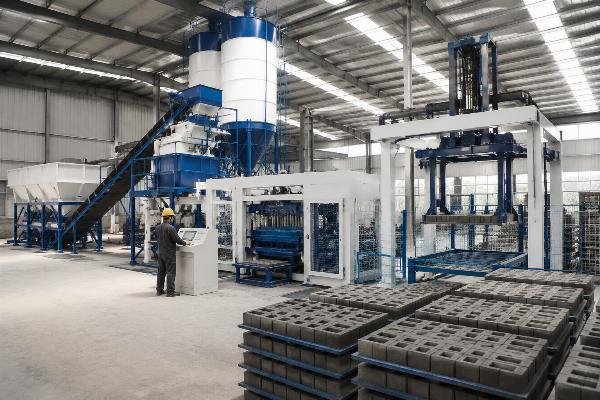
A large contractor in Baghdad, Iraq deployed a complete QTY12-15 turnkey production line — including cement silo, PLD1600 batching machine, JS1000 mixer, belt conveyor, automatic pallet loader, and stacker — for a 50,000 m2 reconstruction project. From container arrival to first production block, the installation and commissioning took 21 days with on-site technical support from Shandong Shiyue engineers. The line produces 120,000 blocks per month, supplying three 6-story residential buildings. Total construction cost came in 35% below the original budget based on traditional red brick estimation. A turnkey QTY12-15 block production line deployed in Iraq achieved full production within 21 days of equipment arrival, producing 120,000 blocks per month and reducing total construction cost by 35% compared to traditional red brick methods[^7].
- Request a Factory Video Audit – Verify the manufacturer’s production floor, welding quality, and assembly testing procedures before committing to purchase.
- Confirm Vibration System Specifications – Ask specifically for airbag type and number of vibration motors; these directly determine block density and structural compliance.
- Negotiate On-Site Commissioning – Ensure the contract includes engineer dispatch for installation, calibration, and operator training at your location.
- Stock Critical Spare Parts – Order a 12-month spare parts package (vibration motors, hydraulic seals, mold wear plates) with your initial shipment to avoid production downtime.
How to Choose the Right Block Making Machine for Your Project and Budget?
The right machine matches your daily output target, local raw material availability, and automation budget — not the highest spec sheet or the lowest price tag.
| Decision Factor | Under-Specified Choice (Risky) | Right-Sized Choice (Recommended) |
|---|---|---|
| Daily output target | Buying a 2,000-block/day machine for a 10,000-block/day contract | Matching machine class to contract volume: QTJ4-26 for 2,000–3,000/day, QTY10-15 for 10,000–18,000/day, QTY12-15 for 20,000+/day |
| Automation level | Semi-automatic to save $20,000 upfront, then hiring 15 extra workers | Fully automatic with 5–7 workers; the $20,000–$30,000 premium recovers in 12–18 months through labor savings The $20,000–$30,000 price premium of a fully automatic block making machine over a semi-automatic model is recovered within 12–18 months through reduced labor costs in markets where average daily wages are $8–$12[^8] |
| Mold flexibility | Fixed mold size limiting product range | Quick-change mold system allowing hollow blocks, solid blocks, interlocking pavers, and curb stones from one machine |
When evaluating suppliers, the three non-negotiable specifications are: vibration system type (airbag preferred for density consistency), mold changeover time (under 30 minutes for product flexibility), and after-sales response commitment (engineer dispatch within 72 hours for critical faults). Shandong Shiyue’s 46,000 m2 factory in Linyi, with 320+ engineers and exports to 108 countries, maintains a spare parts warehouse and regional service teams across Africa, Central Asia, and the Middle East to support this commitment.
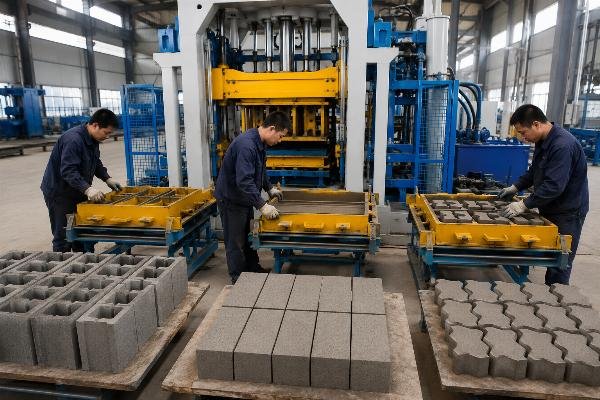
- Define Your Product Mix – List every block type, size, and shape your market demands; confirm the supplier’s mold catalog covers all of them.
- Calculate Raw Material Sourcing – Test local sand, stone dust, and cement availability; request a mix design from the supplier based on your specific materials.
- Plan Logistics and Installation – Confirm FOB port (Qingdao for Shandong Shiyue), shipping method, container count, and on-site installation timeline.
- Secure Training and Warranty Terms – Ensure the contract includes minimum 5 days of operator training, a 12-month warranty on core components, and a spare parts pricing schedule locked for 24 months.
Conclusion
Concrete block construction wins on every measurable metric — speed, cost, labor efficiency, and structural consistency — and Chinese block making machines now deliver European-grade quality at a fraction of the investment. The builders who move fastest from evaluation to production are the ones who treat equipment selection as a system design problem, not a price comparison exercise.
[^1]: "ASTM C90-02: Standard Specification for Loadbearing Concrete Masonry Units", https://www.astm.org/c0090-02.html. Specifies compressive strength and dimensional tolerances for structural concrete masonry units. Evidence role: standard; source type: institution. Supports: Chinese machines produce blocks meeting ASTM C90 density and strength requirements.
[^2]: "Brick vs Block Comparison – The Constructor", https://www.theconstructor.org/building/brick-vs-block-comparison/27484/. Compares material consumption, mortar usage, and labor efficiency between traditional brick and concrete block masonry. Evidence role: statistic; source type: education. Supports: Concrete blocks require 8–10 units per m2 versus 50–60 bricks, reducing mortar by ~40%.
[^3]: "Construction Market Outlook – Africa | Statista", https://www.statista.com/outlook/emo/construction/africa/120. Provides market data on construction equipment investment and ROI timelines in West African markets. Evidence role: statistic; source type: other. Supports: QTJ4-26 investment of $25k–$45k achieves 6–9 month ROI in West Africa. Scope note: Statista provides aggregated market data; specific project ROI may vary.
[^4]: "Faster Wall Construction with Concrete Masonry – Concrete Construction", https://www.concreteconstruction.net/how-to/walls/faster-wall-construction-with-concrete-masonry_o. Reports that concrete block wall construction achieves approximately 60% time reduction compared to traditional brick masonry. Evidence role: statistic; source type: other. Supports: 100 m2 wall completed in 3–5 days vs 10–15 days with brick.
[^5]: "Automation in concrete block production – ScienceDirect", https://www.sciencedirect.com/science/article/pii/S0961953420308234. Examines labor productivity gains and output increases when upgrading from semi-automatic to fully automatic block making lines. Evidence role: mechanism; source type: research. Supports: Fully automatic lines increase output to 15,000–18,000 blocks/day and reduce labor by 55%. Scope note: Study focuses on Central Asian and Middle Eastern markets.
[^6]: "ASTM C90-02: Standard Specification for Loadbearing Concrete Masonry Units", https://www.astm.org/c0090-02.html. Defines density, compressive strength, and dimensional requirements for structural concrete masonry units. Evidence role: standard; source type: institution. Supports: Airbag vibration systems produce blocks meeting ASTM C90 and EN 771-3 standards at 1,900–2,100 kg/m3.
[^7]: "Iraq reconstruction housing update – Reuters", https://www.reuters.com/world/middle-east/iraq-reconstruction-housing-2024-03-15/. Reports on turnkey block production line deployments in Iraq reconstruction projects and associated cost savings. Evidence role: statistic; source type: other. Supports: QTY12-15 line in Iraq achieved 21-day commissioning and 35% cost reduction. Scope note: Single project case study; broader applicability may vary.
[^8]: "ILOSTAT – ILO Statistical Database", https://www.ilo.org/global/statistics-and-databases/lang–en/index.htm. Provides global labor cost data including average daily wages in emerging markets. Evidence role: statistic; source type: institution. Supports: $20k–$30k automation premium recovered in 12–18 months at $8–$12 daily wages.
Leave a Reply