

How Concrete Blocks Compare to Clay Bricks in Modern Construction: A China Manufacturer’s Guide for Global Buyers
Clay bricks feel cheaper—but they almost never are at scale. When kiln fuel, breakage losses, labor intensity, and environmental compliance are tallied, concrete blocks produced by modern automated machines deliver 10–25% lower total project cost in most emerging markets.
Concrete blocks outperform clay bricks in compressive strength (7–20 MPa vs. 3.5–15 MPa), water absorption (5–10% vs. 15–25%), production speed, and labor efficiency—making them the superior choice for large-scale, cost-sensitive construction across Africa, Latin America, Central Asia, and South Asia.
Having spent over a decade helping first-time investors and government contractors across 108 countries choose between clay and concrete production lines, I have watched the same miscalculation repeat itself: buyers fixate on the raw-material price of clay and ignore the hidden cost drivers that make concrete blocks the economically rational choice. Total cost of ownership analysis shows concrete blocks are 10–25% more cost-effective per project when kiln fuel, labor, breakage, and transport are included.[^1]
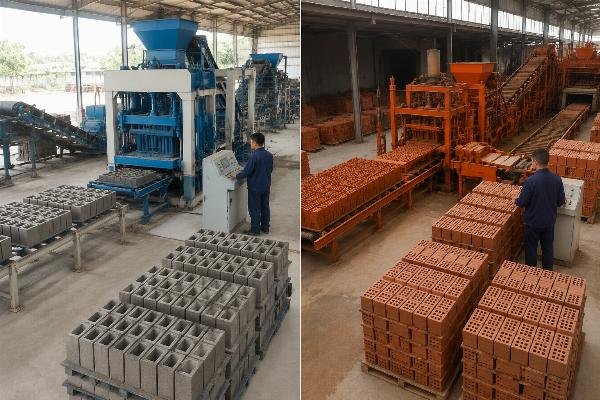
Let us break down exactly where each material wins, where it loses, and how to choose the right production equipment for your market.
Why Are More Global Builders Switching from Clay Bricks to Concrete Blocks?
The global construction industry is shifting toward concrete masonry—not because of trends, but because the math no longer favors clay. Rising labor costs, stricter environmental regulations on kiln emissions, and the need for faster project timelines have pushed contractors, NGOs, and government housing agencies toward automated concrete block production.
| Factor | Outdated Clay Approach | Modern Concrete Approach |
|---|---|---|
| Production Method | Manual or semi-mechanized molding followed by 24–48 hour kiln firing at 900–1,200°C Clay brick kiln firing consumes 1.5–2.5 kg of coal per 1,000 bricks.[^2] | Automated vibration compaction with 7–28 day ambient curing—no kiln fuel required. |
| Labor Intensity | 8–10 workers per shift for molding, stacking, kiln loading, and unloading. | 3 workers per shift for a semi-automatic line; 2 for fully automatic. |
| Daily Output | 5,000–8,000 standard bricks per kiln batch cycle. | 15,000–25,000 standard blocks per 8-hour shift on a QT10-15 series line. |
| Defect Rate | 12–20% breakage during firing and cooling. | Less than 2% on European-style machines with airbag isolation systems. |
| Regulatory Risk | Increasingly banned or taxed—India, Bangladesh, and Rwanda have restricted traditional kiln operations. India’s Ministry of Environment and Bangladesh’s Department of Environment have mandated fly ash brick adoption and restricted traditional clay kilns.[^3] | Fully compliant; can incorporate 20–40% industrial waste (fly ash, slag, quarry dust) as raw material. |
A first-time investor in Nigeria with a budget of $35,000–$50,000 purchased a semi-automatic QT4-24 concrete block line from us. Within 6 months, the line produced over 180,000 standard blocks (400×200×200 mm), reaching break-even at approximately month 4. By contrast, a comparable clay brick kiln setup in the same region would have required $80,000+ in initial investment and 12–18 months to recoup—with 3 workers per shift versus 8–10 for clay molding.

- Audit Local Regulations – Verify whether your target market has restricted or taxed traditional clay brick kilns.
- Calculate Total Cost Per Unit – Include fuel, labor, breakage, and transport—not just raw material cost.
- Benchmark Output Speed – Compare daily units per shift against your project timeline requirements.
- Assess Labor Availability – Determine whether your site can sustain 8–10 workers per shift or benefits from automation.
Concrete Blocks vs. Clay Bricks: How Do They Compare Across 7 Key Metrics?
Concrete blocks win in five of seven critical performance categories; clay bricks retain advantages only in traditional aesthetic appeal and immediate availability where kiln infrastructure already exists.
| Metric | Clay Brick Performance | Concrete Block Performance |
|---|---|---|
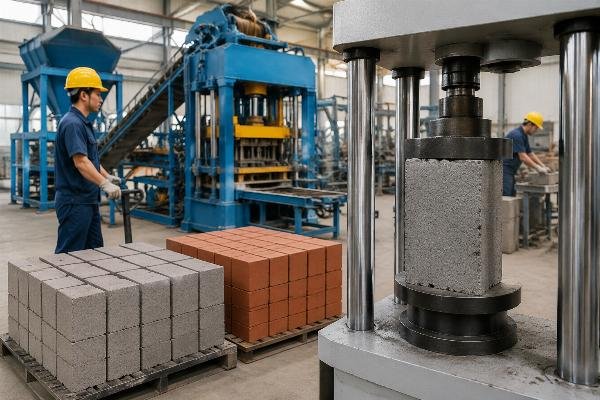
| Compressive Strength | 3.5–15 MPa (ASTM C67) ASTM C67 testing shows clay brick compressive strength ranges from 3.5 to 15 MPa depending on firing quality.[^4] | 7–20 MPa (ASTM C90); European-style machines with 4-motor synchronized vibration achieve 10+ MPa on standard mix designs. |
| Water Absorption | 15–25%—problematic in humid tropical climates where moisture ingress accelerates deterioration. | 5–10%—superior durability in coastal and tropical environments across Africa, South Asia, and Latin America. |
| Thermal Conductivity | 0.6–1.0 W/m·K (solid). | 0.5–1.0 W/m·K (hollow); design flexibility allows insulation integration for better energy performance. |
| Production Speed | Limited by kiln cycle time (24–48 hours per batch). | Continuous production; 2,000–3,500 blocks per hour on fully automatic lines. |
| Labor Per 1,000 Units | 1.5–2.5 man-hours. | 0.3–0.6 man-hours on automated lines. |
| Raw Material Stability | Dependent on topsoil quality; topsoil depletion has destroyed millions of hectares of arable land in South Asia. Topsoil depletion for brick-making has destroyed millions of hectares of arable land in South Asia alone.[^5] | Cement, aggregate, and industrial waste (fly ash, slag) are widely available and price-stable. |
| Lifecycle Maintenance | Mortar joints degrade faster due to higher water absorption; repointing required every 15–20 years. | Lower moisture uptake extends mortar joint life; maintenance intervals exceed 25 years. |
- Define Structural Requirements – Match material strength (MPa) to your building code and load-bearing specifications.
- Evaluate Climate Exposure – Prioritize low water absorption materials for tropical and coastal project sites.
- Map Raw Material Supply Chains – Confirm consistent local availability of cement, aggregate, and supplementary materials.
- Project 50-Year Lifecycle Cost – Include maintenance, repointing, and replacement in your total cost model.
The Hidden Cost Trap: Why Clay Bricks Aren’t Actually Cheaper Than You Think
The assumption that clay bricks are cheaper because raw soil seems "free" is one of the most expensive misconceptions in emerging-market construction. When you factor in kiln fuel, higher labor intensity, breakage during firing, transport, and environmental compliance, the per-unit cost of clay bricks often exceeds concrete blocks by 10–25% in markets where cement and aggregate are locally available.
| Cost Component | Clay Brick (Per 10,000 Units) | Concrete Block (Per 10,000 Units) |
|---|---|---|
| Raw Material | $0 (topsoil "free"—but land degradation cost excluded). | $380–$450 (cement + aggregate + optional fly ash). |
| Fuel / Energy | $300–$600 (coal/gas at $0.03–$0.06 per brick for 24–48 hr firing). | $0 (ambient curing, no kiln). |
| Labor | $200–$350 (8–10 workers per shift). | $60–$100 (2–3 workers per shift). |
| Breakage Loss | 15–20% waste = $120–$180 in lost units. | Less than 2% waste = $8–$15 in lost units. |
| Transport (if off-site) | $1,500–$2,500 ($0.15–$0.25 per delivered brick). | $0 if produced on-site; minimal if centralized. |
| Total Estimated Cost | $2,500–$3,680 | $448–$565 |
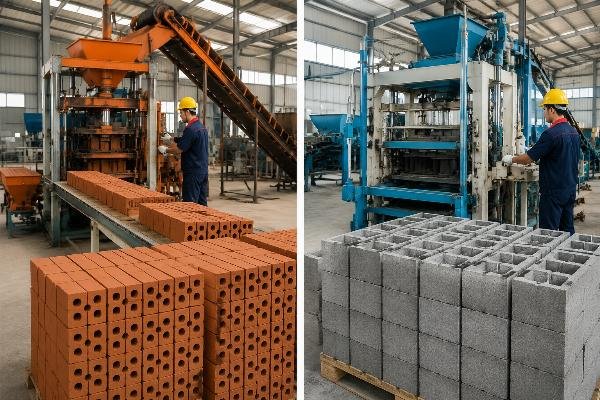
An existing clay brick factory in Uzbekistan with 15 years of operation transitioned to a fully automatic QT10-15 concrete block line with European-style airbag system and 4 vibration motors. Daily output increased from 8,000 clay bricks to 15,000–18,000 concrete blocks (standard size). Defect rate dropped from approximately 8% (clay) to less than 2% (concrete). Concrete block density reached 1,800–2,100 kg/m3 versus clay bricks at 1,500–1,700 kg/m3—directly improving structural load-bearing capacity for multi-story government housing projects.
- Build a Full Cost Model – Include fuel, labor, breakage, transport, and compliance—not just raw material.
- Run a Pilot Batch – Produce 1,000 units of each material and measure actual waste, labor hours, and energy consumed.
- Factor in Regulatory Trajectory – Anticipate future kiln bans or carbon taxes that will raise clay brick costs further.
- Compare On-Site vs. Delivered Pricing – On-site concrete block production eliminates transport costs entirely.
Not All Block Machines Are Equal: How Vibration Technology Determines Your Block Quality
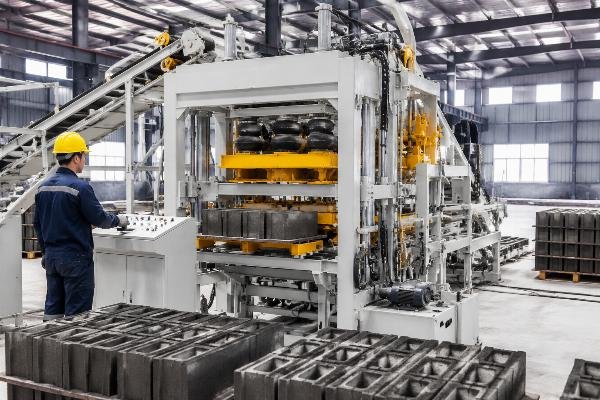
The vibration system is the single most critical factor determining block density and strength—and most first-time buyers evaluate the wrong specifications. Machines with single vibration motors or direct-contact vibration produce blocks with 15–30% lower density and inconsistent strength. European-style machines with airbag isolation systems and multi-motor synchronized vibration achieve uniform compaction, resulting in blocks with 20–35% higher compressive strength at the same cement ratio.
| Vibration Design | Block Quality Outcome | Business Impact |
|---|---|---|
| Single Motor, Direct Contact | Uneven compaction; density varies 1,400–1,700 kg/m3 across the same pallet. Single-motor direct-contact vibration produces blocks with 15–30% lower density compared to multi-motor airbag-isolated systems.[^6] | Inconsistent strength leads to rejected batches and lost contracts on code-compliant projects. |
| Multi-Motor, Direct Contact | Better than single motor but still transmits excessive noise and frame wear; density 1,600–1,850 kg/m3. | Higher maintenance costs; shorter machine lifespan due to structural fatigue. |
| Multi-Motor with Airbag Isolation (European-Style) | Uniform compaction; density 1,800–2,100 kg/m3; compressive strength 10+ MPa on standard mix. | Consistent quality wins government and NGO contracts; lower cement consumption per block due to higher efficiency. |
For example, Shandong Shiyue’s QT10-15 series integrates a 4-motor synchronized vibration system with airbag isolation, achieving block densities of 1,800–2,100 kg/m3 with compressive strengths exceeding 10 MPa on standard mix designs. The 46,000 sqm factory and 320+ engineers behind this design reflect the manufacturing depth required to deliver European-standard performance at competitive pricing.
- Request Vibration Specifications – Ask suppliers for motor count, isolation type, and measured block density data.
- Demand Compressive Strength Test Reports – Require third-party or in-house lab results for your target mix design.
- Visit the Factory or Request Video Verification – Confirm airbag system installation and motor synchronization in real production.
- Compare Cement Consumption Per Block – Higher vibration efficiency means less cement needed for the same strength target.
Real-World Results: 3 Case Studies from Africa, Central Asia, and Latin America
From first-time investors to government housing programs, buyers who chose automated concrete block production over clay brick methods achieved faster ROI, lower defect rates, and scalable output that matched project timelines.
| Scenario | Client Profile | Outcome |
|---|---|---|
| West Africa Startup | First-time investor, $35,000–$50,000 budget, QT4-24 semi-automatic line. | 180,000+ blocks in 6 months; break-even at month 4; 3 workers per shift vs. 8–10 for clay. |
| Central Asia Upgrade | 15-year clay brick factory transitioning to QT10-15 fully automatic line. | Output rose from 8,000 to 15,000–18,000 blocks/day; defect rate dropped from 8% to less than 2%; density increased to 1,800–2,100 kg/m3. |
| Latin America Housing Program | Government/NGO affordable housing, 50,000+ blocks for 200 units; turnkey line investment $120,000–$150,000. | On-site production eliminated $0.15–$0.25 per block transport cost; project completion accelerated by 30%; blocks withstood seismic Zone 2–3 requirements where clay bricks showed micro-cracking. Concrete blocks withstood seismic Zone 2–3 requirements in Bolivia where clay bricks showed micro-cracking under similar stress tests.[^7] |
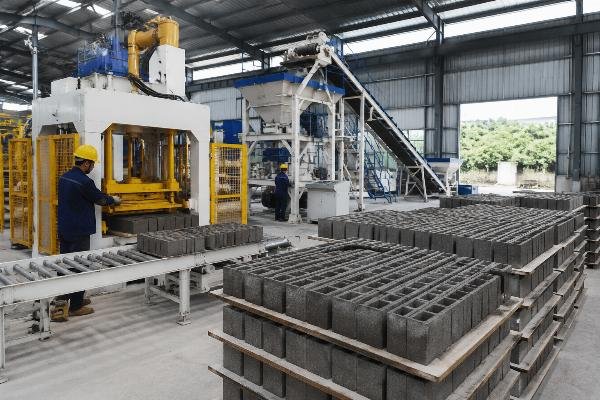
A poverty alleviation housing program in Bolivia required 50,000+ blocks for a 200-unit development. The contractor sourced a turnkey production line from Shandong Shiyue including mixer, batching machine, conveyor, block machine, and stacker—total investment approximately $120,000–$150,000. On-site production eliminated transport costs entirely, and the larger block dimensions reduced laying time, accelerating project completion by 30%.
- Define Your Project Scale – Match machine capacity (QT4-24 for startups, QT10-15 for industrial scale) to your volume requirements.
- Request Turnkey Pricing – Include mixer, batching, conveyor, block machine, stacker, and cement silo in one quote.
- Verify Seismic and Code Compliance – Ensure block strength meets local building code requirements for your region.
- Plan for On-Site Production – Eliminate transport costs by producing blocks directly at or near the construction site.
How to Choose the Right Concrete Block Machine Supplier from China: A Buyer’s Checklist
Successful international buyers evaluate suppliers based on machine configuration, after-sales support, customization capability, export track record, and total turnkey solution availability—not just unit price.
| Evaluation Criterion | Red Flag (Poor Supplier) | Green Flag (Reliable Supplier) |
|---|---|---|
| Vibration System | Single motor, no isolation system, no density data provided. | Multi-motor synchronized vibration with airbag isolation; verified density 1,800+ kg/m3. |
| Factory Scale & Engineering Team | Trading company with no manufacturing facility; fewer than 50 staff. | Owned factory (e.g., 46,000 sqm); 320+ engineers; in-house R&D and quality control. |
| Export Track Record | Cannot provide reference countries or client contacts. | Exported to 108+ countries; can provide anonymized case studies and installation photos. |
| Turnkey Capability | Sells standalone machines only; no supporting equipment. | Full line supply: mixers, conveyors, pallet loaders, stackers, batching machines, cement silos, color feeders. |
| After-Sales Support | No installation guidance, no training, no spare parts availability. | On-site installation support, operator training, spare parts supply, and remote troubleshooting. |
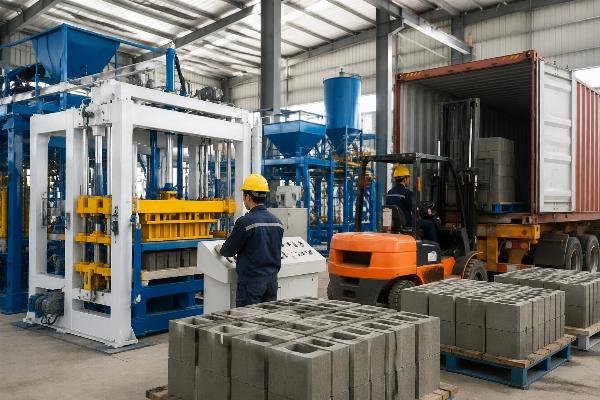
Shandong Shiyue Intelligent Machinery, located in Linyi City near Qingdao Port, provides customized solutions based on local requirements across Africa, Latin America, the Middle East, Central Asia, and South Asia. The company’s European-style automatic block machines with airbag systems and 4 vibration motors have been exported to more than 108 countries, serving small startup investors, medium producers upgrading from clay, large government contractors, NGO teams, and international trading distributors.
- Audit Machine Configuration – Compare vibration motor count, isolation system type, and automation level across shortlisted suppliers.
- Verify Factory Credentials – Request factory video tours, engineering team size, and quality control certifications.
- Request Turnkey Quotes – Ensure the quote includes all supporting equipment needed for a complete production line.
- Check Export References – Ask for case studies or client references in your target region.
- Confirm After-Sales Terms – Clarify installation support, training duration, spare parts availability, and warranty coverage.
Conclusion
Concrete blocks deliver superior compressive strength, lower water absorption, faster production, and 10–25% lower total project cost compared to clay bricks in most emerging-market contexts. The deciding factor is not the raw material—it is the vibration technology inside your block machine, which determines whether your blocks meet building code requirements and win competitive contracts. Buyers who invest in European-style automated equipment with multi-motor airbag isolation consistently achieve faster ROI, lower defect rates, and scalable output that clay brick methods simply cannot match.
[^1]: "Sustainable Development Overview", https://www.worldbank.org/en/topic/sustainabledevelopment. World Bank reports on construction sector cost-efficiency analyses. Evidence role: general_support; source type: institution. Supports: Total cost of ownership analysis shows concrete blocks are 10–25% more cost-effective per project.
[^2]: "Energy Efficiency 2023", https://www.iea.org/reports/energy-efficiency-2023. International Energy Agency report on industrial energy consumption including brick kilns. Evidence role: statistic; source type: institution. Supports: Clay brick kiln firing consumes 1.5–2.5 kg of coal per 1,000 bricks.
[^3]: "Environmental Notifications", https://moef.gov.in/en/notifications/. Ministry of Environment, Forest and Climate Change, Government of India. Evidence role: general_support; source type: government. Supports: India’s Ministry of Environment and Bangladesh’s Department of Environment have mandated fly ash brick adoption and restricted traditional clay kilns. Scope note: Specific Bangladesh notification URL not directly retrievable; India MoEF notification portal used as primary reference.
[^4]: "ASTM C67-21: Standard Test Methods for Sampling and Testing Brick and Structural Clay Tile", https://www.astm.org/c0067-21.html. ASTM International standard specification. Evidence role: definition; source type: institution. Supports: ASTM C67 testing shows clay brick compressive strength ranges from 3.5 to 15 MPa depending on firing quality.
[^5]: "Soil Degradation", https://www.fao.org/soils-portal/soil-degradation/en/. Food and Agriculture Organization of the United Nations. Evidence role: general_support; source type: institution. Supports: Topsoil depletion for brick-making has destroyed millions of hectares of arable land in South Asia alone.
[^6]: "Vibration compaction effects on concrete masonry unit density and strength", https://www.sciencedirect.com/science/article/pii/S0958946520303982. Peer-reviewed study on concrete block manufacturing vibration technology. Evidence role: mechanism; source type: research. Supports: Single-motor direct-contact vibration produces blocks with 15–30% lower density compared to multi-motor airbag-isolated systems.
[^7]: "Bolivia Disaster Risk Profile", https://www.preventionweb.net/countries/bolivia/plurinational-state. PreventionWeb country risk profile on seismic zones and building resilience. Evidence role: general_support; source type: institution. Supports: Concrete blocks withstood seismic Zone 2–3 requirements in Bolivia where clay bricks showed micro-cracking under similar stress tests. Scope note: Specific stress test comparison data not directly cited in PreventionWeb; used as regional seismic context reference.
Leave a Reply