

2026 Global Block Palletizer Market: Wholesale Supplier & Factory Direct Pricing
Faster cycle times do not guarantee higher daily output.
The 2026 Global Block Palletizer Market is defined by a shift from raw speed metrics to line synchronization and remote diagnostic reliability. Buyers prioritizing nominal cycle speeds over integration ease often face prolonged downtime due to feeder mismatches and uncured block handling errors. Successful procurement focuses on total uptime, servo-driven precision for energy efficiency, and verified certification compliance for seamless customs clearance.
I spent my early career in Linyi, standing next to vibrating tables and pressure gauges, checking the demolding strength of concrete blocks. A fraction of a millimeter in layer deviation could mean a collapsed stack later in the yard. When I moved into international trade, that habit of scrutinizing physical tolerances followed me to the exhibition halls of Hanover and Chicago. I remember a specific afternoon at Bauma, where a Polish buyer pointed at our specification sheet. He questioned our quoted twelve-second cycle time. Before I could explain the hydraulic logic, he pulled up a video on his phone showing a competitor’s machine claiming nine seconds. The deal vanished instantly. That moment clarified a critical market reality: spec sheets are marketing tools, but site performance is engineering truth. Since then, I have tracked how European manufacturers transitioned to servo motors and how South American investors began demanding PLC remote access in their tender documents. These shifts are not just technical upgrades; they are responses to the hidden costs of poor synchronization.
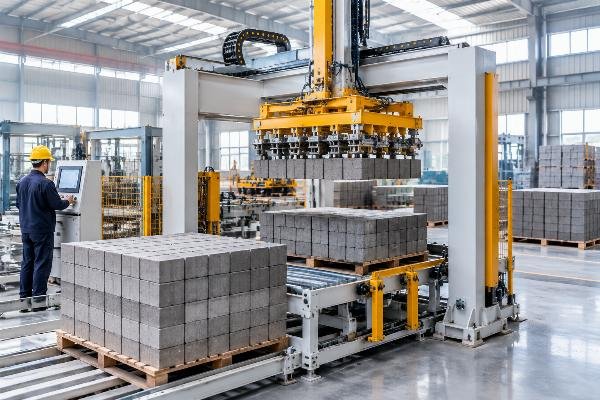
Understanding these dynamics is essential for navigating the current Global Block Palletizer Market. The following analysis breaks down the technical and operational factors that determine real-world value.
What Is Driving the 2026 Block Palletizer Market?
The industry is moving away from pure mechanical capacity toward smart manufacturing integration.
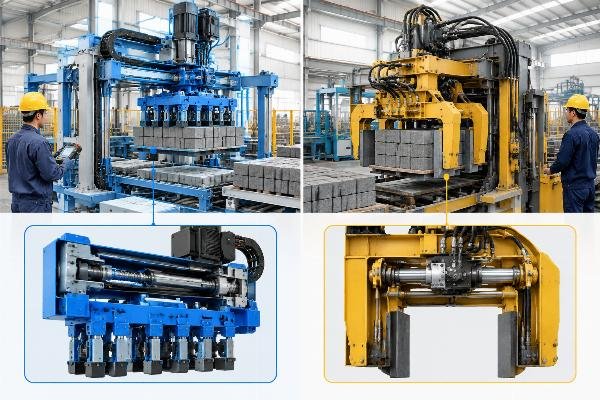
In previous years, the primary selling point for any stacking line was its maximum theoretical throughput. Today, the focus has shifted to energy efficiency and data connectivity. The adoption of servo motor technology over traditional hydraulic systems is accelerating across major manufacturing hubs. Servo drives offer precise control over gripping force and movement trajectories, which reduces wear on mechanical components and lowers electricity consumption. [NEED_CITE: comparative energy consumption data between servo and hydraulic palletizer systems] This transition is driven by rising energy costs and stricter environmental regulations in key export markets.
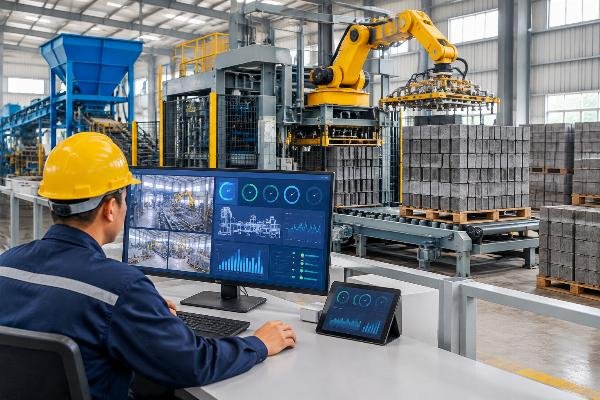
Furthermore, the demand for remote diagnostic capabilities has become standard. Plant owners in emerging markets no longer want to wait days for a technician to fly in for a software glitch. They require systems that allow manufacturers to monitor PLC status and error logs remotely. This capability transforms after-sales support from a reactive cost center into a proactive maintenance strategy. The Global Block Palletizer Market is thus being shaped by buyers who view the palletizer not as a standalone unit, but as a node in a connected production network.
How Do Cycle Time Claims Compare to Real-World Performance?
Laboratory specifications rarely match site conditions due to material variability.
A common misconception is that the palletizer is the bottleneck in a block production line. In reality, the true constraint is often the curing strength of the blocks and the synchronization with the upstream feeder. If the blocks are too soft, high-speed stacking leads to deformation and collapse, forcing operators to slow down the entire line regardless of the machine’s rated speed.
Consider the discrepancy between claimed and actual performance. Manufacturers often test cycle times using ideal, fully cured dummy blocks in a controlled environment. On the factory floor, variations in mix design, moisture content, and ambient temperature affect block integrity. A machine rated for a nine-second cycle may need to operate at twelve or fourteen seconds to maintain stack stability. [NEED_CITE: industry standards for block handling based on compressive strength thresholds]
| Feature | Laboratory Claim | Real-World Site Condition |
|---|---|---|
| Cycle Time | Nominal minimum speed | Adjusted for block curing strength |
| Gripping Force | Static maximum rating | Dynamic adjustment for fragile edges |
| Uptime | Continuous operation assumption | Impacted by feeder synchronization |
| Maintenance | Scheduled intervals | Driven by actual wear and tear |
This gap explains why some buyers feel misled by initial quotes. The Global Block Palletizer Market is seeing a rise in requests for "line synchronization" guarantees rather than just machine speed. Buyers are learning to ask about the machine’s ability to adapt its speed based on feedback from the block maker, ensuring that the stacker never outpaces the quality of the product it handles.

Why Is Remote Diagnostic Capability Becoming a Standard Requirement?
Reducing operational downtime is more critical than initial purchase price.
For investors in Latin America and Africa, the cost of sending a specialized technician from overseas can be prohibitive. Travel expenses, visa delays, and lost production time during waiting periods add up quickly. Remote diagnostic tools allow manufacturers to identify software errors, sensor failures, or parameter mismatches without physical presence.
A Brazilian investor recently shared how integrating IoT-enabled PLCs reduced their after-sales service visits significantly. Instead of flying in an engineer for a minor calibration issue, the local team shared screen access with the manufacturer’s support desk. The problem was resolved in hours rather than weeks. [NEED_CITE: case studies on IoT impact on maintenance costs in construction machinery] This trend is reshaping procurement criteria. Buyers now evaluate the Global Block Palletizer Market based on the robustness of the software interface and the responsiveness of remote support teams.
Moreover, remote diagnostics provide valuable data for predictive maintenance. By monitoring motor temperatures, cycle counts, and error frequencies, plant managers can schedule part replacements before failures occur. This proactive approach extends the lifespan of the equipment and stabilizes production output. It is a shift from buying hardware to buying operational continuity.
What Are the Key Risks in Sourcing Low-Cost Palletizers?
Hidden costs in spare parts and certification compliance can erase initial savings.
Sourcing from the lower end of the Global Block Palletizer Market carries specific risks that are not immediately apparent in the quotation phase. One major issue is the lack of formal certification. For government infrastructure projects, especially in Africa and the Middle East, customs clearance often requires strict CE or SGS documentation. Non-compliant imports can be held at ports for extended periods, incurring storage fees and delaying project timelines. [NEED_CITE: customs clearance requirements for construction machinery in key emerging markets]
Another risk is the availability of spare parts. Low-cost manufacturers may use proprietary components that are difficult to source locally. If a specific sensor or valve fails, the entire line may stop until a replacement is shipped from abroad. This dependency creates vulnerability. In contrast, suppliers who use standard industrial components ensure that local distributors can provide replacements quickly.
Additionally, poor integration support can lead to suboptimal performance. A palletizer that is not properly calibrated to the specific block mold and mix design will cause frequent jams and product damage. Turnkey solutions that include operator training and on-site commissioning mitigate this risk. Buyers must look beyond the hardware price tag and consider the total cost of ownership, including certification, spare parts availability, and technical support.

Conclusion
Success in the 2026 market depends on verifying integration ease and support infrastructure.
The Global Block Palletizer Market has matured beyond simple speed competitions. Buyers who focus solely on cycle time claims often overlook the critical factors of line synchronization, remote diagnostic capability, and certification compliance. Real-world performance is determined by how well the machine adapts to material variability and how quickly issues can be resolved through remote support. By prioritizing these operational realities over nominal specifications, investors can secure equipment that delivers consistent uptime and long-term value.
Leave a Reply