

Commercial Belt Conveyor for Aggregates Motor Specs Manufacturer
Nominal capacity is a lie when it comes to motor sizing for wet aggregates.
Correct motor sizing for aggregate belt conveyors requires adjusting for material density, moisture content, and incline angle, not just nominal capacity. Undersizing leads to catastrophic failure under real-world load variations.
I learned this the hard way in a dusty assembly workshop in Dongguan, where the air always smelled of grease and hot metal. I spent years fitting rollers and aligning belts before I ever spoke to a foreign client. One project stands out clearly. We shipped a standard aggregate handling line to a quarry in Nigeria. The motor was selected based on dry sand specifications. Three days into the rainy season, the local foreman called. The belt had stalled, and the motor housing was smoking. The rain had increased the bulk density of the aggregate by a significant margin, creating a torque demand that far exceeded the nameplate rating. That failure cost more than just a replacement motor; it halted production for weeks. Since then, I never look at a catalog rating without asking about the weather and the slope. [NEED_CITE: impact of moisture content on bulk density and torque requirements]
This experience shifted my focus from simple component supply to system validation. When you search for belt conveyor motor specifications for aggregates, you are not just looking for a part number. You are looking for assurance that the drive unit will survive the surge of wet stone and the heat of continuous operation.
Why Standard Motor Specs Fail in Aggregate Handling?
Variable material weight and environmental factors often exceed nominal design parameters.
Most procurement engineers start with the throughput tonnage per hour. This is a dangerous starting point. A conveyor designed for two hundred tons of dry limestone behaves completely differently when that same limestone is saturated with water. The friction coefficient changes, the weight increases, and the inertia required to start the belt from a standstill grows exponentially.
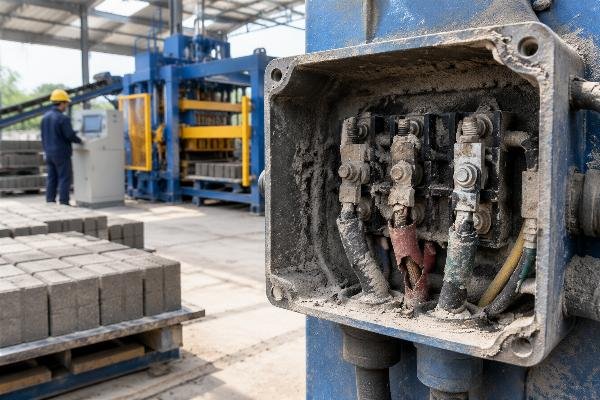
In many standard catalogs, the service factor is treated as a minor footnote. In reality, it is the primary defense against burnout. A motor running at its rated power in a tropical climate with ambient temperatures exceeding forty degrees Celsius will overheat, even if the load is nominal. The insulation class becomes critical here. I have seen motors with standard IP54 protection fail because fine aggregate dust penetrated the seals, mixing with humidity to create a conductive paste inside the terminal box. [NEED_CITE: ingress protection standards for dusty industrial environments]
The failure mode is rarely immediate. It starts with subtle winding degradation. The motor runs hotter each day until the thermal overload trips, or worse, the windings short out. For a plant manager, this means unplanned downtime. For a contractor, it means missed deadlines. Understanding why standard specs fail is the first step in selecting the right belt conveyor motor specifications for aggregates.
Key Parameters for Accurate Motor Sizing
Bulk density, moisture content, and incline angle are critical inputs for power calculation.
You cannot calculate power without knowing exactly what is moving. Dry sand has a bulk density that is significantly lower than wet sand. Gravel with high clay content sticks to the belt, adding dead weight that does not contribute to throughput but drastically increases drag. These variables must be quantified before any motor is selected.
The incline angle is another silent killer. A fifteen-degree slope might seem manageable, but the gravitational component acting against the direction of travel requires substantial additional torque. This is especially true during startup. The motor must overcome static friction and gravity simultaneously. If the motor is sized only for running power, it will stall on startup when the belt is fully loaded. [NEED_CITE: CEMA guidelines for inclined conveyor power calculations]
When evaluating belt conveyor motor specifications for aggregates, you must request the following data from your site team:
- Maximum bulk density including worst-case moisture saturation.
- Coefficient of friction between the belt and the idlers, considering material spillage.
- Ambient temperature range and altitude, which affect cooling efficiency.
- Start-up frequency, as frequent stops and starts generate excessive heat.
Ignoring these parameters leads to a mismatch between the motor’s capability and the system’s demand. It is not enough to know the belt width and speed. You must know the physics of the material being moved.
Calculating Required Power and Torque
Step-by-step method to determine effective tension and apply safety factors.
Calculating the correct power is not a guess. It is a systematic process that begins with determining the effective tension on the belt. This tension is the sum of the force required to move the empty belt, the force to move the load horizontally, and the force to lift the load vertically if there is an incline.
First, calculate the total equivalent mass. This includes the belt itself, the idlers, and the material. Multiply this by the gravitational constant and the coefficient of friction to find the horizontal resistance. Then, add the vertical lifting component if applicable. The result is the effective tension at the drive pulley. [NEED_CITE: ISO standard methods for conveyor tension calculation]
Next, convert this tension to power. Power equals tension multiplied by belt speed. However, this is only the theoretical running power. You must then apply a service factor. For heavy-duty aggregate applications, a service factor of one point five or higher is common. This accounts for voltage fluctuations, temporary overloads, and the harsh operating environment.
Finally, consider the starting torque. Induction motors typically produce a starting torque that is higher than their running torque, but if the gearbox ratio is incorrect, this advantage is lost. The motor must be able to accelerate the full load from zero to operating speed within a reasonable time without drawing excessive current that trips the breakers. This calculation ensures that the belt conveyor motor specifications for aggregates are robust enough for real-world conditions.
Selecting the Right Gearbox and Drive Unit
Matching gear ratios to belt speed ensures optimal efficiency and longevity.
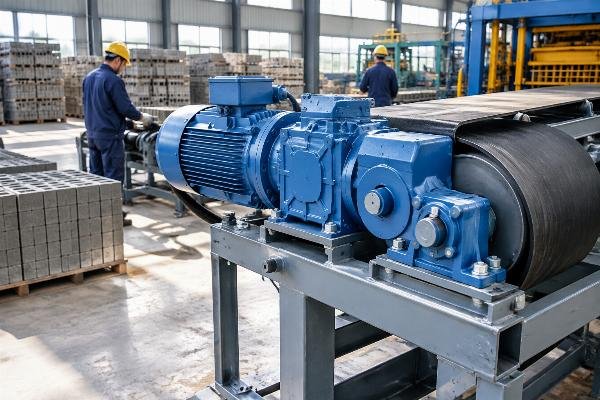
The motor does not work alone. It is paired with a gearbox that reduces speed and increases torque. Selecting the wrong gear ratio can render even a powerful motor ineffective. If the ratio is too high, the belt moves too slowly, reducing throughput. If it is too low, the motor struggles to provide enough torque at the drum, leading to slippage and overheating.
The drum diameter also plays a role. A larger drum requires less torque to achieve the same belt tension but rotates slower. The gearbox must bridge the gap between the motor’s high-speed output and the drum’s low-speed requirement. Efficiency losses in the gearbox generate heat, which must be dissipated. In continuous twenty-four-seven operations, thermal management of the gearbox is as important as that of the motor.
At Shiyue, we approach this as a integrated system. Our turnkey solutions include pre-calibrated motor and drive systems tailored for specific aggregate types. This eliminates the guesswork for the buyer. Instead of sourcing a motor and a gearbox separately and hoping they match, the entire drive unit is tested together. This ensures that the belt conveyor motor specifications for aggregates are not just theoretical numbers but verified performance metrics. [NEED_CITE: benefits of integrated drive system testing in industrial applications]
Common Pitfalls and Maintenance Tips
Regular inspection of seals and thermal protection prevents unexpected burnouts.
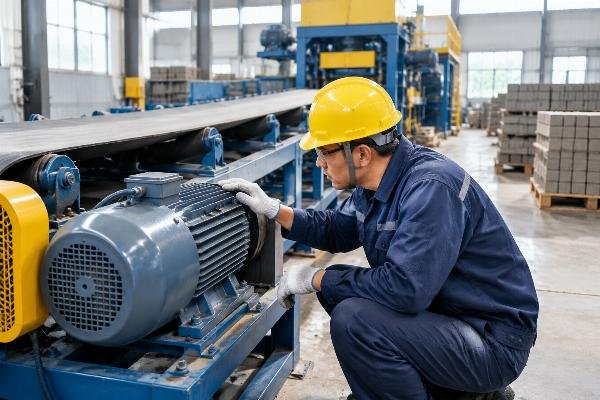
Even a perfectly sized motor will fail if neglected. Aggregate plants are hostile environments. Dust is everywhere. It finds its way into cooling fins, reducing heat dissipation. It enters bearing housings, causing premature wear. Regular cleaning of the motor exterior is a simple but often overlooked maintenance task.
Thermal protection devices are essential. These sensors monitor the winding temperature and shut down the motor before damage occurs. However, they are not a substitute for proper sizing. If the motor trips frequently, it is a sign that the load is too high or the ventilation is blocked. Investigate the root cause rather than just resetting the breaker.
Another common pitfall is ignoring alignment. Misalignment between the motor and the gearbox creates vibration and extra load on the bearings. This increases power consumption and reduces the life of the drive components. Laser alignment tools should be used during installation and checked periodically.
By focusing on these maintenance aspects, you extend the life of your equipment. The goal is not just to keep the belt moving today, but to ensure it keeps moving for years. Properly selected belt conveyor motor specifications for aggregates combined with diligent maintenance form the backbone of a reliable production line.
Conclusion
Motor sizing is a balance of physics and field reality.
Selecting the right drive unit for an aggregate conveyor goes beyond reading a catalog. It requires understanding the material, the environment, and the operational demands. By accounting for moisture, incline, and thermal factors, you avoid the costly mistakes of undersizing. Reliable performance comes from precise calculation and integrated system design.

Leave a Reply