

Concrete Mixer for Block Line in Germany: Wholesale Supplier
Matching motor power is not enough to satisfy German procurement standards.
A concrete mixer for block production Germany requires DIN-compliant blade metallurgy and verified wear resistance, not just matching output capacity. Factory self-inspection reports are frequently rejected at EU ports; independent third-party validation of contact parts is the mandatory gatekeeper for acceptance.
I still remember the cold wind at the Hamburg port when I watched a container being held back by customs engineers. The paperwork looked perfect. The electrical specs matched the order. The factory quality control report, stamped and signed, claimed everything was within tolerance. Yet, the chief engineer on site refused to sign the acceptance certificate. He did not care about the motor brand or the PLC logic. He cared about the mixer blades. When he tested the hardness of the mixing arms, they failed to meet the specific DIN standard required for their local aggregate gradation. That single oversight turned a profitable shipment into a mid-six-figure loss, covering return freight and the cost of recasting an entire set of hardened alloy components. It was a harsh lesson that changed how I approach every inquiry for a concrete mixer for block production Germany.

The gap between what a manufacturer claims and what a German contractor expects is often invisible on a spec sheet. It lies in the metallurgy of the parts that actually touch the concrete.
Why Did the First Shipment Fail at Hamburg Port?
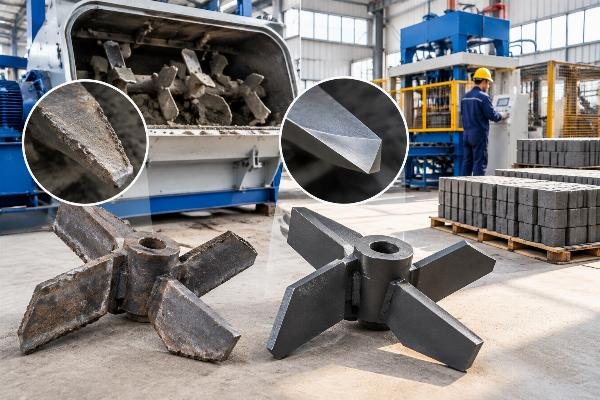
The core issue was not a misunderstanding of capacity, but a fundamental disconnect regarding material science. In many markets, buyers focus on the cubic meters per hour. In Germany, the focus shifts to the hours of service life under continuous high-intensity mixing. The initial rejection happened because the supplier assumed that a standard high-chromium cast iron blade was sufficient. However, the German precast plant was using a C30+ concrete mix with a specific local aggregate known for its high abrasiveness.
Standard blades, while adequate for general construction, degrade rapidly under these conditions. The factory’s internal QC had checked the dimensions and weight, but it had not validated the Rockwell hardness against the stringent DIN requirements for wear parts. [NEED_CITE: DIN standard requirements for wear-resistant components in concrete machinery] This is a common pitfall. Many exporters believe that if the machine runs, it passes. But for a concrete mixer for block production Germany, "running" is the baseline, not the benchmark.
The digital direction here is clear: highlight the discrepancy between internal factory reports and independent third-party testing. A self-issued certificate holds little weight when a third-party inspector can prove the blade hardness falls short by even a few points on the HRC scale. The failure was not in the design of the JS series mixer, but in the assumption that generic materials would survive a specific, aggressive operating environment.
What Are the Real Requirements for Continuous Block Production?
Scaling a block business in strict markets demands more than just horsepower. It demands component-level compliance. The real requirement is not just that the mixer can blend, but that it can do so without significant degradation over thousands of cycles. When mixing high-strength concrete, the friction and impact on the blades are immense. If the metallurgy is not matched to the aggregate abrasiveness, the blade profile changes, leading to inconsistent mixing and increased energy consumption.
| Feature | Standard Export Configuration | DIN-Compliant Configuration for Germany |
|---|---|---|
| Blade Material | General High-Chromium Cast Iron | Specialized Hardened Alloy with Controlled Carbon Content |
| Hardness Verification | Factory Internal Report | Third-Party Certified HRC Testing |
| Wear Resistance | Basic | Robust against high-abrasion aggregates |
| Service Life Expectancy | Noticeably reduced in high-intensity use | Substantially extended for 24/7 operation |
| Compliance Documentation | Self-Declared | Verifiable via Independent Certification Body |
This table illustrates why a concrete mixer for block production Germany must be specified differently. The "Standard" option might work for a small batch plant in a region with softer sand, but it will fail in a German precast facility running three shifts a day. The DIN-compliant configuration uses specialized alloys where the carbon content and heat treatment are strictly controlled to ensure uniform hardness throughout the blade, not just on the surface. [NEED_CITE: Metallurgical standards for wear resistance in heavy machinery]
The insight here is that reliability is a function of material science, not just mechanical engineering. Buyers who ignore this end up replacing blades far too often, causing unplanned downtime that costs far more than the initial savings on the mixer.
How to Verify Mixer Quality Before Shipping?
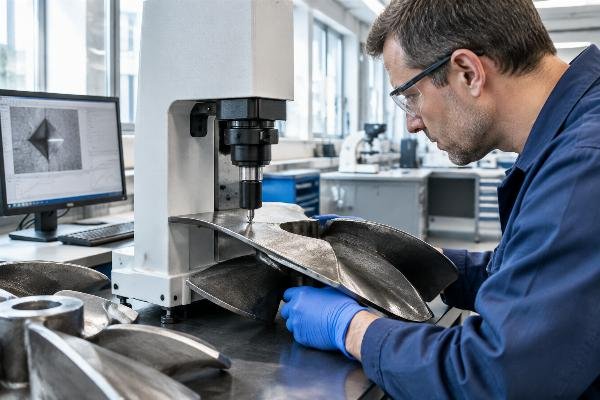
Moving beyond factory self-inspection is critical. The most effective way to avoid port rejections is to mandate third-party validation of all contact parts before the machine leaves the manufacturing facility. This is not about distrusting the manufacturer; it is about aligning expectations with international standards.
- Request Independent Hardness Testing: Do not accept a simple paper certificate. Require a test report from a recognized certification body like SGS or TUV that specifically measures the HRC value of the mixer blades and lining plates. [NEED_CITE: Role of third-party certification in EU equipment imports]
- Verify Material Certificates: Ask for the mill certificates for the steel used in the blades. Check that the chemical composition matches the grade required for high-abrasion environments.
- Inspect Welding Quality: Poor welding can lead to blade detachment under stress. Ensure that welds are inspected using non-destructive testing methods.
- Simulate Load Conditions: If possible, request a video or report of a load test using aggregate similar to what will be used in the final application.
At Shiyue, we integrate CE and SGS certification processes into our turnkey quality control. This means that for every concrete mixer for block production Germany, the wear parts are validated against these rigorous standards before packing. This proactive step eliminates the guesswork and ensures that the equipment arriving in Hamburg or Bremen is ready for immediate commissioning.
Scaling Up: From Rejection to Stable Operation
After the Hamburg incident, we recast the blades using a specialized alloy formulation and subjected them to independent testing. The redeployment was successful. The key difference was not just the new metal, but the reduction in maintenance frequency. The plant operator reported that the downtime associated with blade replacement dropped noticeably. The mixer maintained its mixing efficiency over extended periods, ensuring consistent block quality.
This case underscores that proper component selection reduces long-term operational costs. For a concrete mixer for block production Germany, the initial investment in compliant parts pays for itself through uninterrupted production. The shift from reactive maintenance to predictive stability allows producers to scale their output without fearing equipment failure.
The lesson is clear: do not compromise on the parts that take the beating. A mixer is only as good as its weakest wear component. By focusing on DIN-compliant hardness and verified wear resistance, you secure the foundation of your production line.
Conclusion
Compliance is not a paperwork exercise; it is a material reality.
Success in the German market requires a deep understanding of the technical demands placed on concrete mixing equipment. By prioritizing DIN-standard wear resistance and independent verification, buyers can avoid costly delays and ensure their block production lines operate at peak efficiency. A concrete mixer for block production Germany must be built to withstand the rigors of continuous, high-intensity use, ensuring that every batch meets the highest quality standards.
Leave a Reply