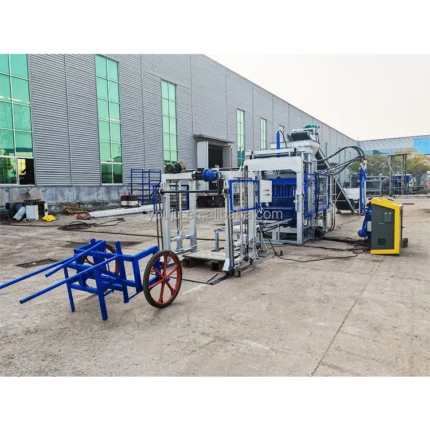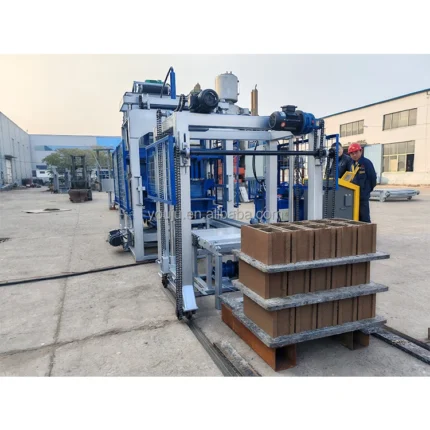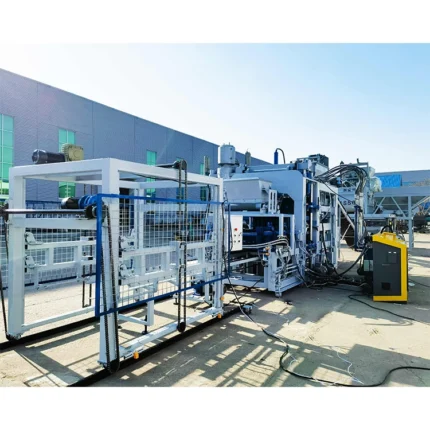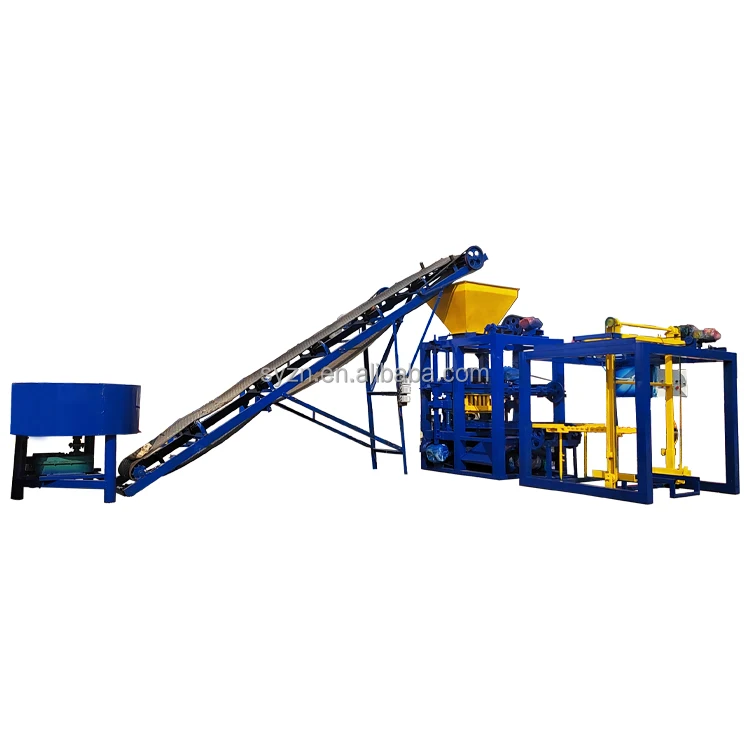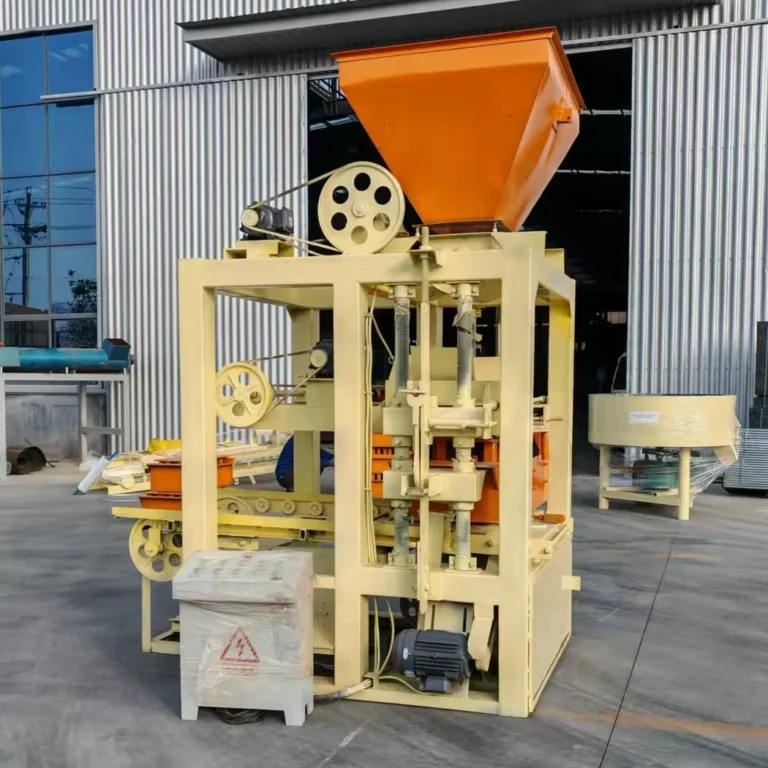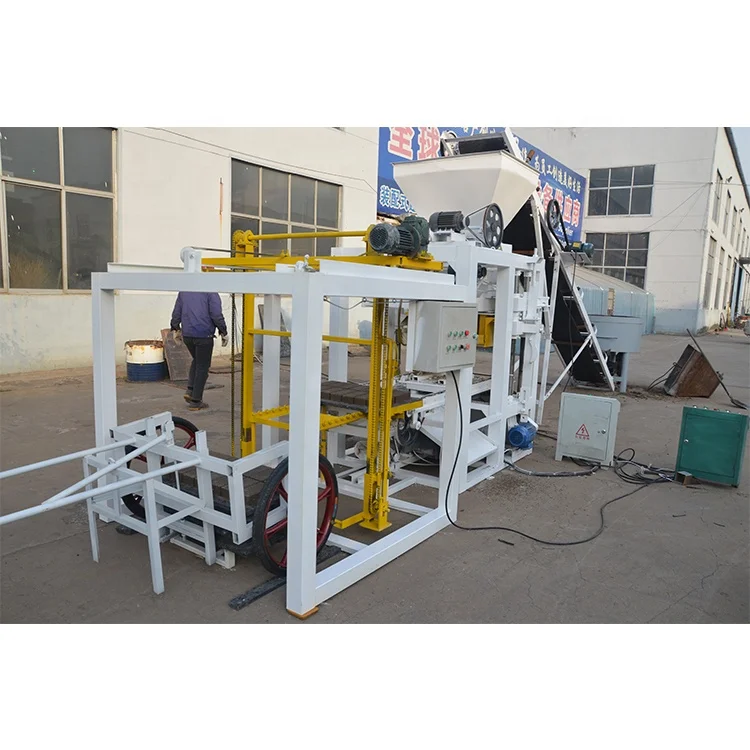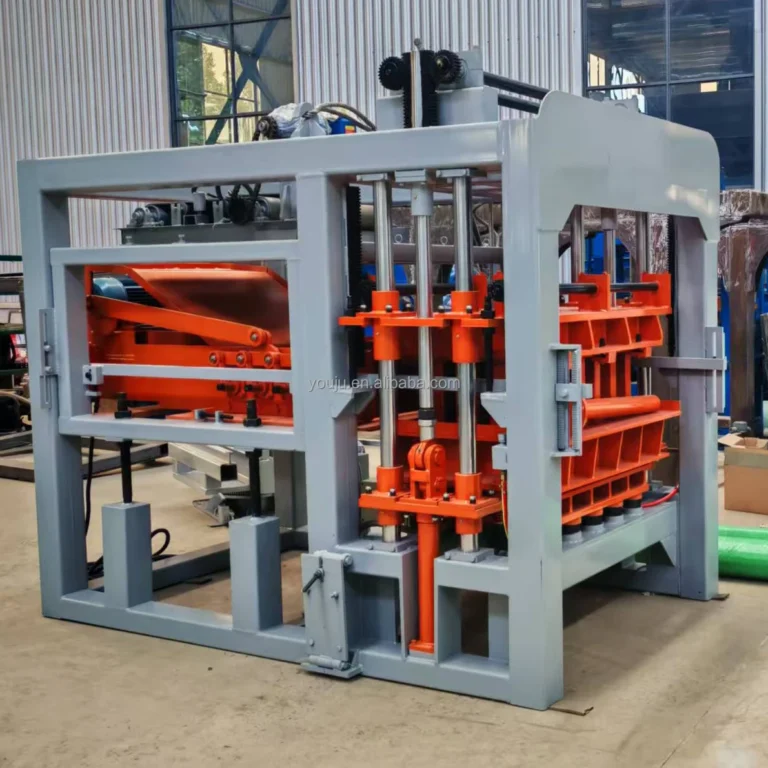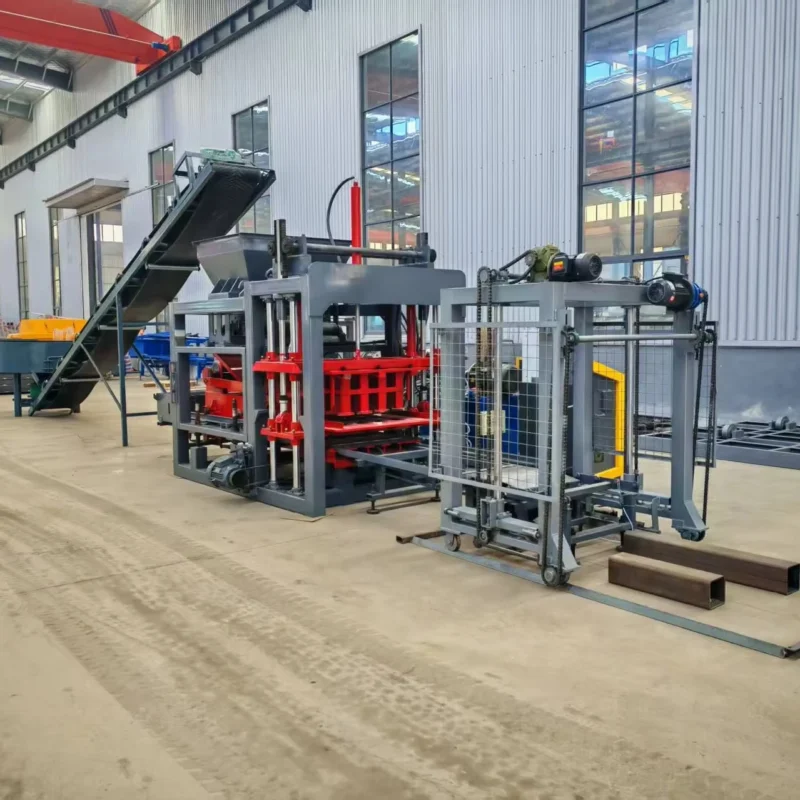
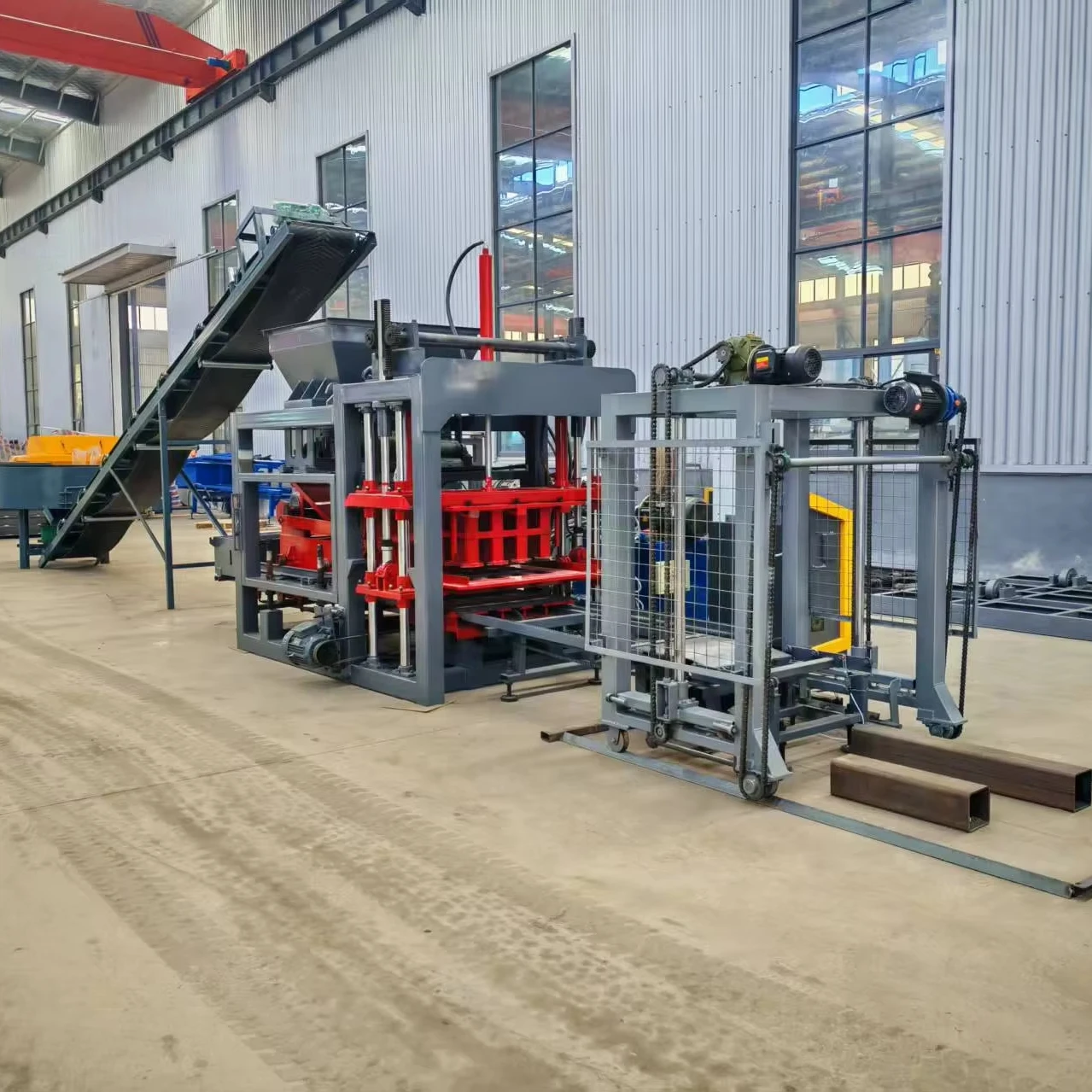
Description
Intelligent control configuration — The automatic QT4-15 block making machine PLC controlled setup integrates Siemens logic with proportional hydraulics, configured against the buyer’s confirmed block format and local raw material rather than a default factory preset.
Technical Specifications
| Parameter | Value |
|---|---|
| Product Type | Automatic Hydraulic Block Making Machine |
| Model | QT4-15 |
| Overall Dimensions | 7100×1600×2610 mm |
| Host Machine Dimensions | 2800×1800×2550 mm |
| Rated Hydraulic Pressure | 16 MPa |
| Main Vibration Form | Platform Vibration |
| Vibration Frequency | 4600 r/min |
| Vibration Force | 40 kN |
| Pallet Size | 950×550×20/25 mm |
| Molding Cycle | 15–25 s |
| Overall Power | 27.5 kW |
| Host Machine Power | 19.2 kW |
| Total Mass | 5 T |
| General Water Consumption | 4 T/day |
| Control System | PLC (original Siemens PLC with independently developed control program; customizable) |
| Motor Brand | Siemens or ABB (based on buyer requirement) |
| Hydraulic Valve | Double proportional hydraulic valve (Calyca or Youken brand) |
| Automation Level | Automatic (with PLC control) |
| Capacity – Hollow Brick | 720–960 pcs/h (basis: 390×190×190 mm, 4 pcs/mold, 15–20 s cycle) |
| Capacity – Porous Brick | 2520–3360 pcs/h (basis: 240×115×90 mm, 14 pcs/mold, 15–20 s cycle) |
| Capacity – Standard Brick | 5930–6720 pcs/h (basis: 240×115×53 mm, 28 pcs/mold, 15–17 s cycle) |
| Warranty | 1 year for the whole machine (excluding spare parts) |
Application Suitability
| Application | Material or Output |
|---|---|
| Hollow block production for commercial and residential construction | Concrete mix using cement, sand, crushed stone, and water |
| Porous brick manufacturing for urban drainage systems | Cement-based mixtures with fine aggregates |
| Standard solid brick production for structural walls | Concrete with varied aggregate sizing and cement ratios |
| Paving brick and interlocking brick for landscaping | High-density concrete mix with color pigment option |
What "Automatic Output" Means Without Verified Cycle Times
Capacity is only meaningful when tied to a specific block format, mold count, and confirmed cycle duration.
When evaluating an automatic QT4-15 block making machine PLC controlled system, buyers often focus on the headline pieces-per-hour number. That figure can shift dramatically depending on whether the machine is producing hollow blocks at four per mold or standard bricks at twenty-eight per mold, and whether the actual cycle time in your workshop matches the lab-tested optimum. I have seen buyers quote a capacity number to their investors without confirming the underlying format, only to find their daily output falls short once production starts [NEED_CITE: capacity calculation methods for stationary block machines]. The configuration must be locked to your target format before the capacity number becomes reliable.
PLC Logic Tuned to Block Density, Not Just Speed
The automatic QT4-15 block making machine PLC controlled interface does more than sequence the press cycle. The independently developed control program coordinates vibration duration, hydraulic pressure ramp-up, and feed timing so that each parameter responds to the density target of the chosen format. A hollow block requires a different pressure profile than a porous brick, and the PLC adjusts accordingly rather than forcing the operator to manually recalibrate between runs.
How Proportional Hydraulics Reduce Inconsistency Between Batches
A standard on-off hydraulic valve causes pressure spikes each time the press head engages, leading to density variation across a single pallet of blocks. The double proportional valve from Calyca or Youken modulates flow gradually, maintaining the rated 16 MPa pressure within a tight band throughout the pressing stroke. This matters most when your raw material moisture content fluctuates between deliveries, as the valve compensates without requiring operator intervention [NEED_CITE: proportional hydraulic valve performance in block presses].
Vibration Force and Pressure: Why Both Numbers Matter Together
Platform vibration at 4600 r/min delivers 40 kN of force upward through the pallet, compacting the concrete mix from below. Simultaneously, the hydraulic press applies 16 MPa from above. Neither figure alone determines block strength — it is the combination, timed precisely by the PLC, that determines whether the final product meets the load-bearing requirement. If your local aggregate is angular crushed stone rather than smooth river gravel, the vibration frequency and pressure dwell time must be adjusted to ensure full compaction without cracking.
The Hidden Cost of Unconfirmed Voltage and Control Language
Buyers who skip voltage and frequency confirmation before production face delays at commissioning. A machine wired for 380V/50Hz arriving in a region with 440V/60Hz supply will either fail to start or run the motors outside their rated envelope, shortening bearing life and voiding warranty coverage. Similarly, if the PLC display language is not confirmed, operators cannot interpret fault codes during the critical first weeks of production [NEED_CITE: voltage and frequency standards by export market]. These are small details in the specification stage that become expensive oversights after the container is loaded.
Why Sourcing the Full Line Here Makes Sense for Automation Upgrades
Block machinery is the single focus of this supply chain, meaning the QT4-15 press, mold, pallet, and handling stations are specified as one matched system rather than assembled from separate suppliers. The automation level is selectable — a buyer can start with automatic pressing and manual pallet handling, then add automatic stacking and cubing later without replacing the host machine. Configuration is set against your actual mix design and target block format, not a catalogue default, and the factory test record verifies cycle time and block density before shipment. Mould design covers the formats your market actually sells, including custom drawings when standard molds do not match your requirement.
Documentation & Verification
- Line layout showing press, mixer, and pallet flow with cycle time matched per station
- Factory test record demonstrating cycle time and density on your confirmed block format
- Hydraulic and electrical schematic with valve and PLC component identification
- Voltage, frequency, and PLC display language confirmation document before production
- Mould drawing and format list with dimensional tolerance for each cavity
- Operation and maintenance manual in confirmed language with wear parts schedule
Installation, Commissioning & Support
- Foundation pad sized to the 7100×1600 mm overall footprint with level tolerance confirmed
- Dedicated circuit rated for the 27.5 kW overall power with voltage verified on-site
- Machine arrives with host press separated from feeder for standard container loading
- Commissioning includes PLC parameter tuning against your local aggregate test results
- Operator training covers mold changeover procedure and PLC fault code interpretation
- Wear parts list identifies hydraulic seals and vibration motor bearings with replacement intervals
What to Prepare Before Requesting a Quotation
Provide your target block format with dimensions, the daily output you need to meet your sales commitments, and the type of aggregate available locally — whether river sand, crushed stone, or recycled material. Confirm your site voltage and frequency, the control language your operators require, and whether your existing curing area and forklift are compatible with the 950×550 mm pallet size. If you have an existing mixer or batching system, share its capacity so the line can be balanced accordingly.
Frequently Asked Questions
Q: How is the QT4-15 capacity verified per block format, and what cycle time is assumed?
A: Each capacity figure is tied to a specific block size, mold cavity count, and cycle range. For hollow bricks at 390×190×190 mm, the quoted 720–960 pcs/h assumes 4 cavities and a 15–20 second cycle. Your actual output depends on whether your mix and local conditions allow the press to sustain that cycle consistently over a full shift.
Q: What PLC language and HMI options are available, and how is voltage confirmed before shipment?
A: The Siemens PLC display language is confirmed during the order stage to match your operator team. Voltage and frequency are locked in writing before production begins, and the electrical schematic reflects the confirmed supply standard so that commissioning proceeds without motor or transformer substitution on arrival.
Q: How does the automation level on the QT4-15 compare with semi-automatic models, and what is the upgrade path?
A: The automatic configuration handles the press cycle, feed timing, and vibration sequence through PLC control, removing operator dependency from the forming stage. If you start without automatic stacking or cubing, those stations can be added later as separate modules without replacing the host press or reprogramming the base control logic.
Q: How are vibration force and hydraulic pressure matched to my local aggregate and mix design?
A: Before the machine is finalized, your raw material sample is tested to determine compaction behavior. The PLC program parameters for vibration duration and pressure ramp are then adjusted so that the 40 kN vibration force and 16 MPa hydraulic pressure produce consistent density with your specific aggregate profile.