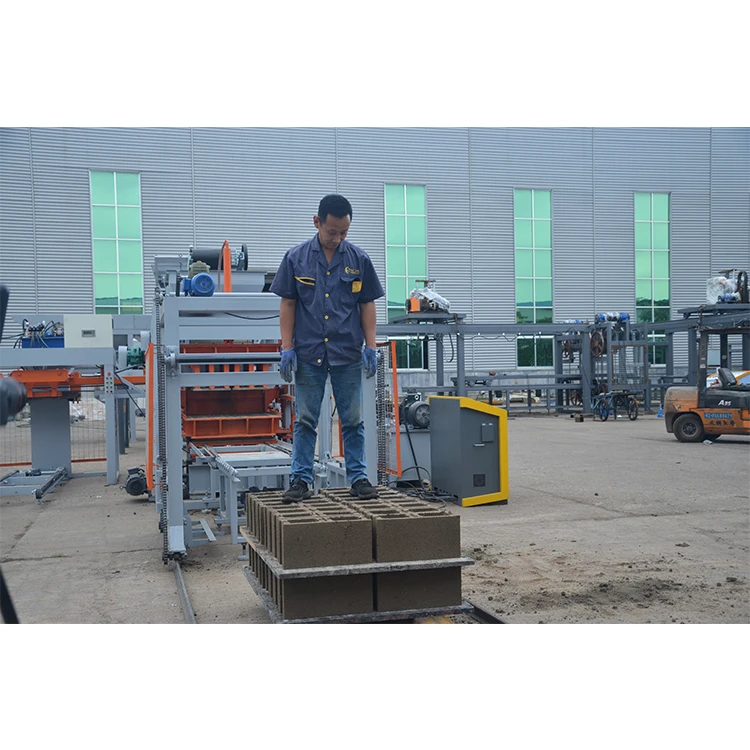


Description
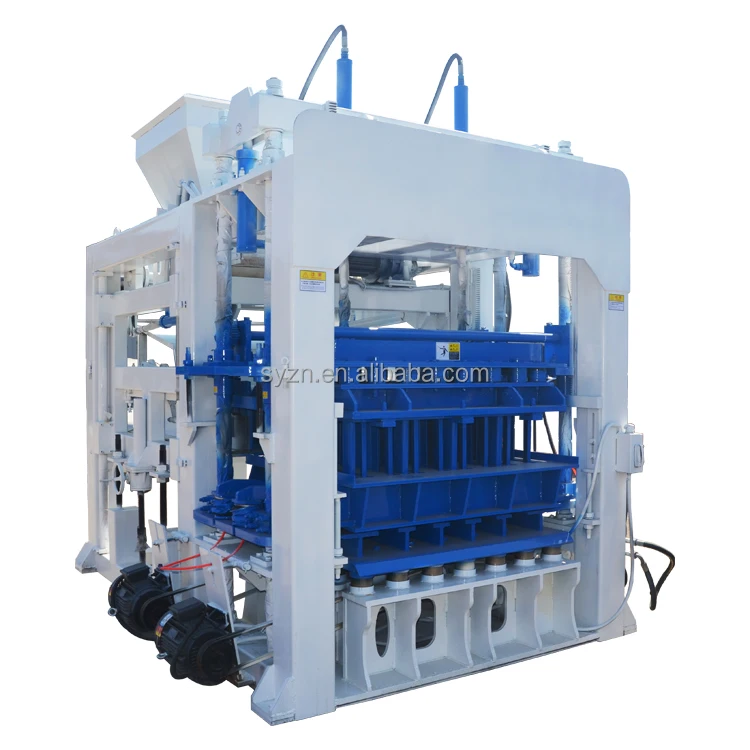
Coordinated Line Control — The automatic QT6-15 block making machine PLC controlled configuration keeps pallet loading, press cycling, and block separation timed as a single sequence, removing operator bottlenecks from the production floor.
Technical Specifications
| Parameter | Value |
|---|---|
| Model | QT6-15 |
| Product Type | Automatic Interlocking Brick Block Making Machine |
| Molding Method | Vibration and hydraulic pressing |
| Rated Pressure | 21 MPa |
| Molding Cycle | 15 s – 20 s (basis not stated in source — confirm block format, material, and thickness) |
| Pallet Size | 900 × 700 mm |
| Main Machine Weight | 6000 kg |
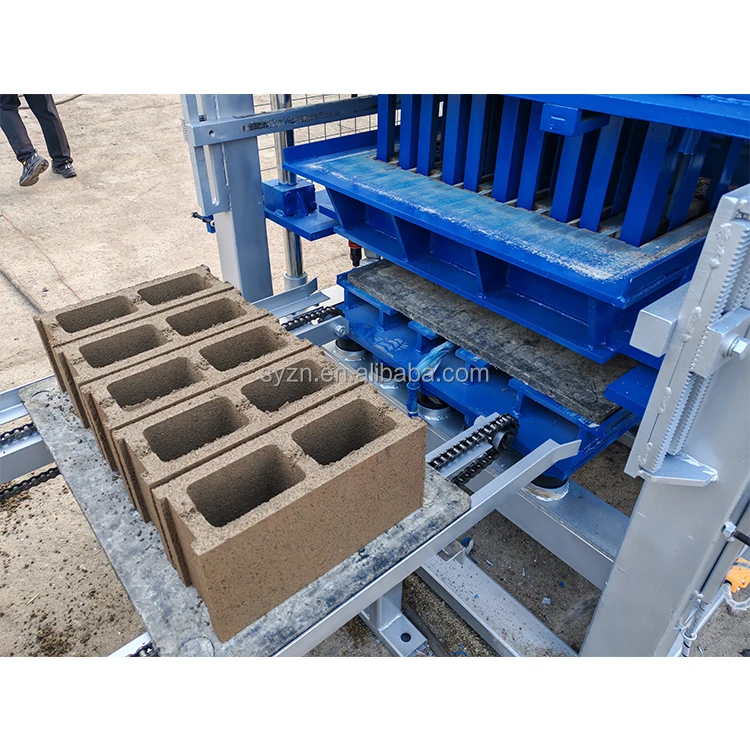
| Output — Hollow Block 400 × 200 × 200 mm | 6 pcs/pallet, 1440 pcs/h, 11520 pcs per 8 h (theoretical) |
| Output — Paving Brick 200 × 100 × 60 mm | 21 pcs/pallet, 5040 pcs/h, 40320 pcs per 8 h (theoretical) |
| Output — Solid Brick 240 × 115 × 53 mm | 32 pcs/pallet, 7680 pcs/h, 61440 pcs per 8 h (theoretical) |
| Control System | PLC (brand and HMI language to be confirmed) |
| Automation Level | Automatic, including pallet loader and block-pallet separator in full line |
| Voltage & Frequency | Customizable to local standard (exact value to be confirmed) |
| Raw Materials | Cement, sand, fly ash, stone powder, slag |
| Simple Line Equipment | JS500 mixer, 8 m conveyor belt, automatic stacker |
| Full Line Equipment | Cement silo, screw conveyor, cement scale, batching machine, pallet loader, block-pallet separator |
| Warranty | 1 year (excluding wearing parts) |
| Assembly State | Top cylinder removed for container loading; reassembled on site |
Application Suitability
| Application | Material or Output |
|---|---|
| Hollow block production for load-bearing walls | Cement, sand, and crushed stone aggregate at 400 × 200 × 200 mm |
| Interlocking paver manufacturing for walkways and plazas | Cement, stone powder, and pigment blends at 200 × 100 × 60 mm |
| Solid brick runs for partition and infill masonry | Fly ash, cement, and slag mixes at 240 × 115 × 53 mm |
| Curbstone and kerb production for road infrastructure | High-density concrete with coarse aggregate |
| Color sidewalk paver runs for municipal projects | Face-mix concrete with pigment dosing |
What "15 to 20 Seconds" Actually Means for Your Daily Run
Cycle time on the automatic QT6-15 block making machine PLC controlled system only holds when pallet return, material feed, and block stacking keep pace with the press.
A quoted cycle of 15 to 20 seconds looks attractive on a spec sheet, but the number assumes every supporting station is ready the instant the press finishes its stroke. If the pallet loader falls one beat behind, or the stacker waits for a forklift to clear the curing area, the real interval stretches well beyond what the PLC display shows. I have watched lines in the field where a 15-second press ended up running closer to a 30-second effective cycle simply because the material hopper could not refill fast enough for the next mould charge. [NEED_CITE: effect of upstream station delays on press cycle time]
How PLC Sequencing Removes Manual Waiting
The PLC on the automatic QT6-15 block making machine PLC controlled setup coordinates pallet loading, vibration-press timing, and block-pallet separation into one continuous loop. Each station receives its start signal from the previous station’s completion sensor rather than from a fixed timer, so the line self-adjusts when a pallet takes slightly longer to seat. This closed-loop sequencing is what separates true automatic cycling from a press that simply runs on repeat while operators chase pallets by hand.
Where the Automation Boundary Actually Sits
Choosing between the simple line and the full line determines how much of that sequencing is hands-free. The simple line pairs the QT6-15 with a JS500 mixer, an 8 m belt conveyor, and an automatic stacker — enough to run continuous shifts if you have labour available for pallet return and curing-area handling. The full line adds a cement silo, screw conveyor, weighing scale, batching machine, pallet loader, and block-pallet separator, closing the loop from raw material dosing through to block stacking without manual transfer points. [NEED_CITE: labour allocation differences between simple and full block lines]
Reading the Pressure and Vibration Numbers Together
Rated pressure of 21 MPa tells you the maximum hydraulic force the press can apply, but block density depends on how that pressure combines with vibration frequency and amplitude at the mould table. A high-pressure press with weak vibration leaves air pockets in stiff mixes; strong vibration with low pressure produces blocks that crumble at the edges. The QT6-15 uses simultaneous vibration and hydraulic pressing, so both forces act on the material at the same stage of the cycle rather than in separate strokes. When you share your local aggregate grading and cement ratio with the factory, the vibration parameters can be adjusted before shipment so the 21 MPa pressure works with your actual mix instead of against it.
When a Pallet Size Decision Comes Back to Hurt You
The 900 × 700 mm pallet dimension drives more than mould layout — it determines how many pallets fit across your curing rack width, how your existing forklift handles a loaded rack, and whether the pallets you already have in stock can run on the new machine. Ordering a press without confirming pallet compatibility means discovering after arrival that your curing area needs to be rebuilt or that a different forklift attachment is required. [NEED_CITE: pallet and curing area mismatch issues in block plants]
Why Buying the Press Alone Is Not a Line
A well-tuned automatic QT6-15 block making machine PLC controlled press sitting in front of a bottleneck mixer or a manual pallet-return zone will never reach the output its spec sheet implies. Every station upstream and downstream has its own cycle, and the slowest station sets the real daily number. Sizing the supporting equipment to match the press throughput — not the other way around — is what turns a standalone machine into a production line that runs at its rated pace shift after shift.
What You Get When the Line Is Specified as One System
The QT6-15 is offered as part of a matched line where press, moulds, pallets, and handling equipment are configured together before production begins. Configuration starts from your local aggregate and target block format rather than a catalogue default, so the vibration and pressure settings align with what your plant will actually run. Moulds are designed or selected for the formats your market sells, and automation level is selectable so you can start with the simple line and add full-line stations later without replacing the press. Installation support includes on-site commissioning and operator training so the PLC parameters are validated against your real material on day one.
Documentation & Verification
- Capacity calculation sheet stating output per block format, not a single headline figure
- PLC brand, HMI language, and communication protocol confirmation before production
- Voltage and frequency validation matching the destination site electrical standard
- Hydraulic and electrical schematic for on-site maintenance reference
- Mould drawing and format list with cycle-time-by-format table
- Factory test record run on material matching your mix design
Installation, Commissioning & Support
- Top cylinder removed for container loading and reassembled on site to match the 6000 kg main frame
- PLC cabinet wiring confirmed against your site voltage and frequency before dispatch
- Commissioning includes vibration and pressure tuning using your local aggregate sample
- Operator training covers PLC sequence adjustment, mould change, and daily inspection routines
- Wear parts list and hydraulic seal kit provided for first-year maintenance planning
Before You Send an Inquiry
Share the block formats your market currently sells along with your target daily output per format, and the line can be sized from real numbers instead of catalogue assumptions. Confirm your site voltage, frequency, and preferred PLC display language early so the control cabinet is built to match. If you already have pallets, curing racks, or a mixer on site, send their dimensions and specifications so the supporting equipment is selected to fit what you have.
Frequently Asked Questions
Q: How is the 15–20 s cycle time measured, and which block format does it assume?
A: The 15 to 20 second range is measured from press close to press open for a single mould stroke, but the exact figure depends on block geometry, wall thickness, and material density. A thin paving brick typically cycles faster than a tall hollow block because the vibration and pressure stages are shorter. Always request a format-specific cycle table rather than relying on one headline number.
Q: What PLC brand and HMI language options are available for the QT6-15?
A: The PLC brand and human-machine interface language are confirmed during the pre-production technical review. Common options include widely serviced international PLC brands with display text set to English, Spanish, or other languages requested by the buyer. Confirming this before the control cabinet is wired avoids reprogramming delays after the line arrives on site.
Q: How do I match the automation level to my current labour and curing area?
A: The simple line with a JS500 mixer, conveyor, and automatic stacker suits plants where operators can handle pallet return and curing-area movement. The full line adds batching, silo feeding, pallet loading, and block-pallet separation, reducing manual touchpoints. Your decision should factor in available floor space, existing forklift capacity, and the number of workers you plan to assign per shift.
Q: What voltage and frequency configurations are confirmed before shipment?
A: The automatic QT6-15 block making machine PLC controlled system is built to the voltage and frequency standard of the destination site, confirmed in writing before the control cabinet is assembled. This covers main motor supply, control circuit voltage, and any auxiliary equipment motors. Providing your site electrical specification early prevents rewiring work after the container is unloaded.
Q: How does mould change time on the QT6-15 affect real daily output when producing multiple formats?
A: Every mould change stops the press, clears the current pallet, and requires the new mould to be seated and the PLC program switched to the matching format recipe. If your production plan calls for two or three formats per day, the total changeover minutes must be subtracted from available shift time. Requesting the documented mould change procedure and average duration helps you plan realistic daily output across all formats.