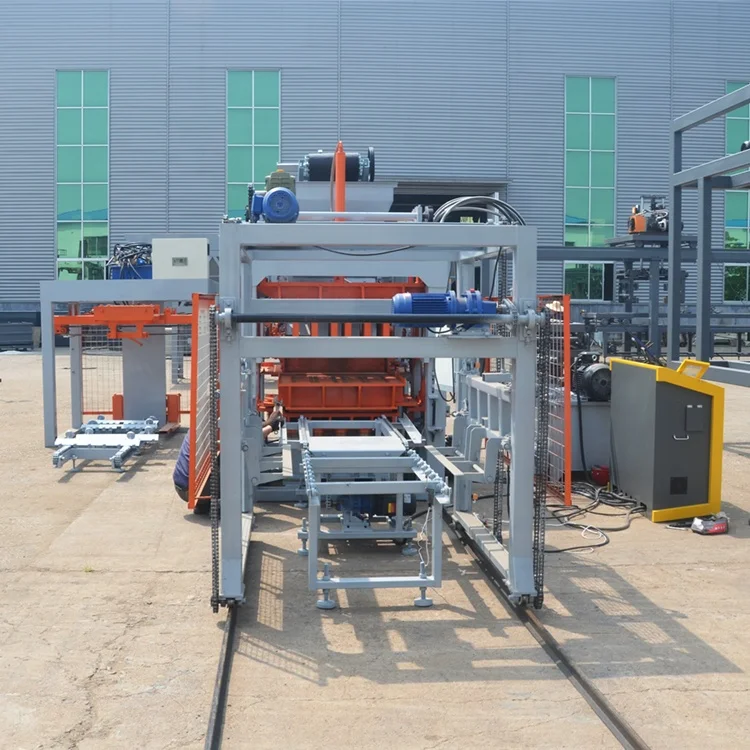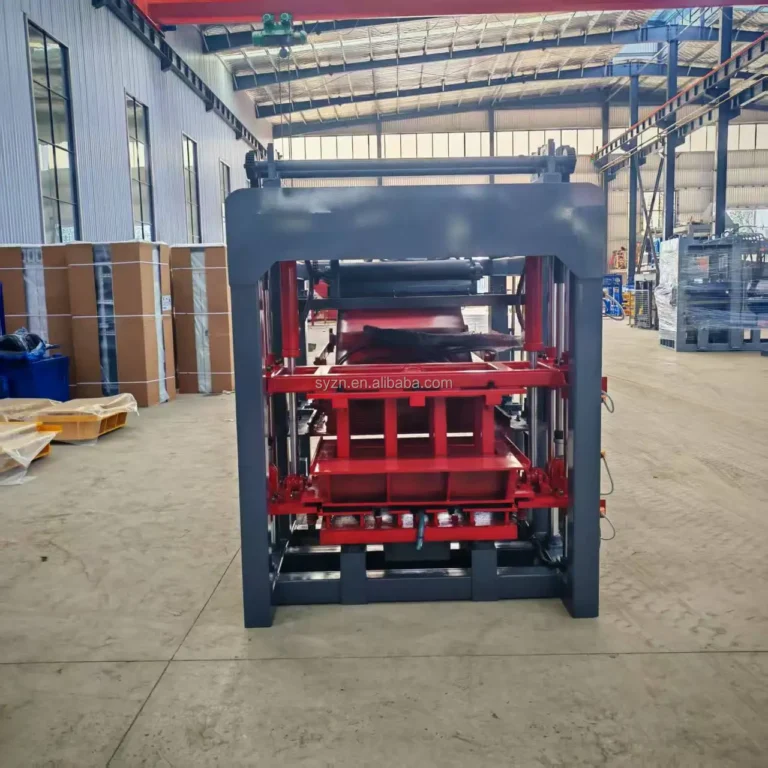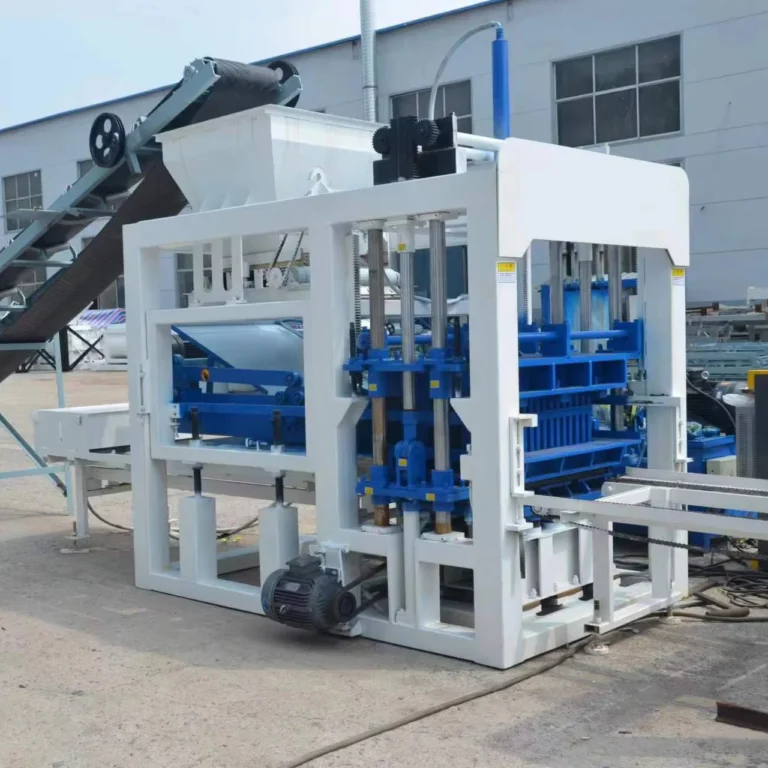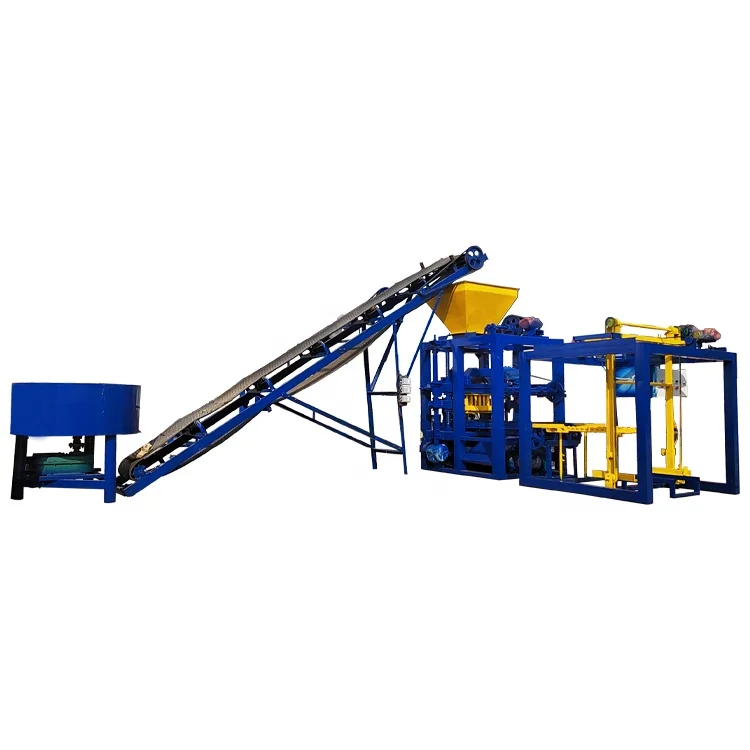


Description
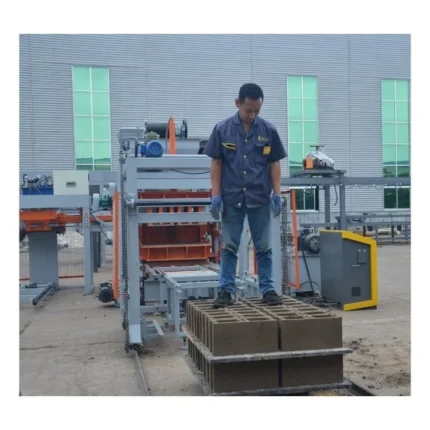
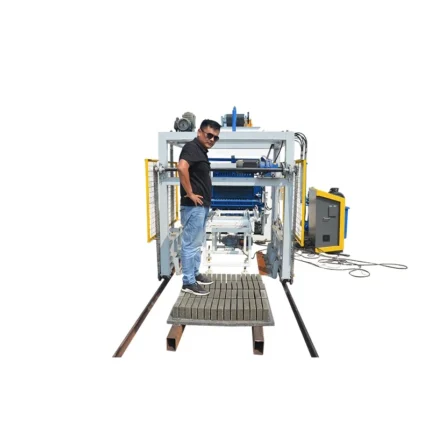
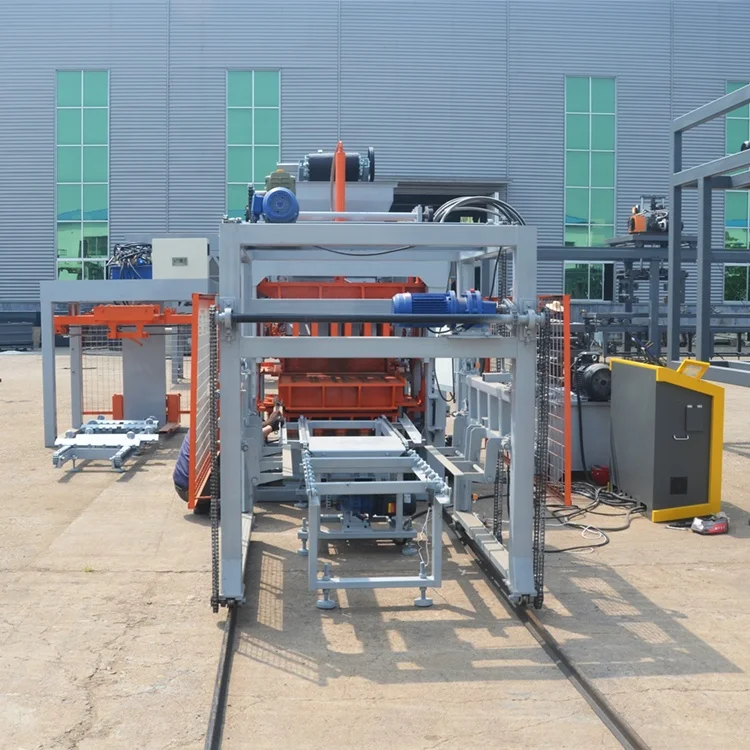
Integrated Control Logic — electrical-mechanical interworking on the QTJ4-24 keeps vibration and molding phases locked into a repeatable sequence, removing timing guesswork from the operator.
Technical Specifications
| Parameter | Value |
|---|---|
| Model | QTJ4-24 / QT4-24 |
| Product Type | Semi-Automatic Concrete Block Making Machine |
| Overall Dimensions (L×W×H) | 3600mm × 1700mm × 2560mm |
| Total Mass | 3.5T |
| Main Machine Power | 11.95kW |
| Pallet Size | 900mm × 450mm |
| Molding Cycle | 24-26s (basis not stated in source — confirm block format / material / thickness) |
| Vibration Type | Table vibration feeding, fluctuation vibration molding |
| Control System | Electrical control cabinet with mechanical interworking (PLC or relay logic to be confirmed) |
| Feeding Method | Manual feeding, two feed ways available |
| Automation Level | Semi-automatic (mechanical + manual operation) |
| Compatible Line Equipment | J350 or JQ500 vertical mixer, 6m or 8m belt conveyor |
| Voltage & Frequency | Configurable (confirm local supply before order) |
| Warranty | 1 year for whole machine (excluding spare parts) |
Application Suitability
| Application | Material or Output |
|---|---|
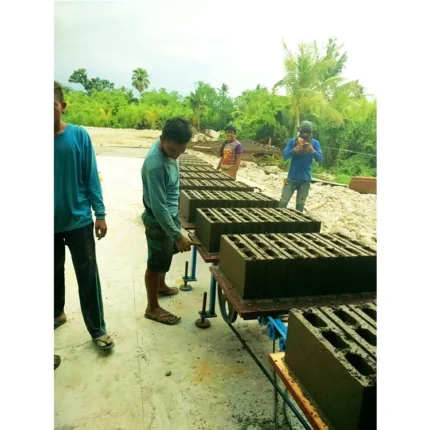
| Small-scale hollow block production | Crushed stone, sand, cement, and water mix for 400×200×200mm hollow blocks |
| Solid brick manufacturing for local construction | Fly ash or clay blends with cement for 240×115×53mm standard bricks |
| On-site block production for contractors | Local aggregate and cement for 390×240×190mm or 390×120×190mm formats |
| Entry-level paver and kerbstone trials | Fine aggregate mixes with pigment for interlocking or paving formats |
Why the Control Language Must Be Confirmed Before the Crate Is Sealed
An operator who cannot read the panel will stop the line every time an alarm triggers.
I once configured a QTJ4-24 for a buyer in West Africa. The control cabinet shipped with the default English interface, and the local crew had no one who could read the fault codes. The machine sat idle on day one until we pushed a remote language update overnight. A mismatched display language on a semi-automatic line does not just slow production — it creates a safety gap where the operator bypasses interlocks to keep the press running. That is why I now verify the panel language against the buyer’s workforce before the electrical cabinet leaves the factory [NEED_CITE: importance of HMI language matching operator literacy].
When a plant owner upgrades from fully manual block pressing to a PLC controlled semi-automatic block machine, the first expectation is consistency. The QTJ4-24 delivers that through its electrical-mechanical interworking, which prevents the press from firing until the mould box is seated and the feed shoe has completed its pass.
How Electrical-Mechanical Interworking Replaces Operator Judgment
On a purely manual press, the operator decides when to vibrate, when to feed, and when to strip the mould. That sequence varies from person to person and from the first block of the shift to the last. The automatic QTJ4-24 block machine removes this variance by locking the feed and vibration phases into a timed electrical sequence, so the cycle repeats identically whether a veteran or a new hire is at the controls.
Where Semi-Automatic Stops and the Upgrade Path Begins
The QTJ4-24 handles the press cycle automatically, but pallet feeding and block stacking remain manual tasks. This is a deliberate boundary: it keeps the initial investment low while the buyer learns the mix design and local curing conditions. When daily volume justifies it, the same pallet size and press footprint can be integrated into a line with automatic pallet feeding, stacking, and cubing — the press itself does not need to be replaced, only the surrounding handling stations [NEED_CITE: typical upgrade path from semi-automatic to automatic block lines].
Vibration, Pressure, and the 24-26 Second Window
The 24-26s molding cycle is not a single number — it is the time the table vibration and fluctuation vibration spend compacting a specific block format at a specific mix moisture. A 400×200×200mm hollow block draws a full 26 seconds of vibration to reach target density, while a thinner 240×115×53mm solid brick may complete in 24 seconds. The electrical cabinet times this window, but the actual block strength depends on whether the vibration force matches the buyer’s local aggregate grading and cement ratio. Requesting a capacity calculation that states the assumed format and mix prevents a mismatch between quoted cycles and real daily output.
The Pallet Question That Arrives After the Machine Does
A 900mm × 450mm pallet must travel from the press to the curing yard and back dozens of times per shift. If the buyer’s existing forklift tines are spaced for a different pallet width, every pallet transfer becomes a manual lift. Confirming pallet dimensions against the curing rack spacing and forklift capacity before shipment avoids a bottleneck that no amount of control logic can fix [NEED_CITE: pallet handling integration in block production lines].
When a Missing Voltage Confirmation Delays Commissioning
The main machine draws 11.95kW, the mixer adds further load, and the conveyor runs on its own circuit. If the buyer’s site supply is 50Hz but the motor windings were wound for 60Hz, the press will run hotter and the vibration amplitude will drop, producing blocks that fail the drop test. Wiring specifications — 3×16mm² for the general supply, 3×6mm² for the main machine, 3×4mm² for the mixer, 3×2.5mm² for the conveyor — must match the local transformer output before the cable is pulled through the conduit.
Why Sourcing From a Line-Focused Supplier Matters Here
The QTJ4-24 is specified as part of a matched system: the J350 or JQ500 mixer, the 6m or 8m conveyor, and the 900×450mm pallet are selected together so the press is never left waiting for mix or pallets. Configuration is set against the buyer’s actual aggregate and target block format, not a catalogue default. Mould design covers the formats the local market sells, including custom drawings. The automation level is selectable, so a buyer can start semi-automatic and add stacking later. Installation support includes operator training on the specific control language and cycle timing.
Documentation & Verification
- Line layout showing the 24-26s cycle assumption per block format
- Electrical schematic with voltage, frequency, and wire gauge confirmed for your site
- Factory test record on your specified mould format before dispatch
- Pallet specification matched to your curing rack and forklift dimensions
- Operation manual in the operator’s confirmed language
Installation, Commissioning & Support
- Foundation pad leveled to 3600mm × 1700mm footprint with anchor bolt template provided
- Dedicated 3×16mm² supply circuit with isolator within 2m of the control cabinet
- Mixer and conveyor wired to separate 3×4mm² and 3×2.5mm² circuits per schematic
- First-run vibration amplitude checked against your local aggregate sample
- Operator trained on fault code reading in confirmed panel language
- Wear parts list with mould and vibration spring reorder intervals documented
What to Include in Your First Inquiry
Tell us the block format your market sells most, the daily volume you need to hit, and the local aggregate you plan to use. Include your site voltage and frequency, the language your operators read, and whether your curing yard already has pallets and racks. With that, we can confirm the exact cycle time for your format and map out the line layout.
Frequently Asked Questions
Q: What does the 24-26s molding cycle actually mean — which block format is it based on?
A: The 24-26s range covers different block thicknesses and densities. A 400×200×200mm hollow block typically needs the full 26 seconds of vibration to reach target compaction, while a thinner solid brick may cycle in 24 seconds. Request a capacity sheet that states your exact format and mix so you can calculate realistic daily output.
Q: Is the control system PLC-based or relay-based, and can the display language be set to my local language?
A: The QTJ4-24 uses an electrical control cabinet with mechanical interworking. Whether the logic is PLC or relay depends on the configuration selected at order. The display language is confirmed before shipment — we verify it three times against the operator’s reading ability to avoid first-day downtime.
Q: How do I upgrade this semi-automatic line to a fully automatic system later?
A: The press, pallet size, and mould interface remain unchanged. You add automatic pallet feeding, a stacker, and a cubing station around the existing QTJ4-24. The electrical cabinet is upgraded to coordinate the new stations, and the cycle timing is re-verified for the faster material flow.
Q: How does vibration force interact with my local aggregate to ensure consistent block strength?
A: Vibration compacts the mix, but the final density depends on aggregate grading, cement ratio, and moisture. If your local stone is coarser than the default test mix, the vibration duration or amplitude may need adjustment. We match the QTJ4-24 vibration settings to your sample mix before confirming the cycle time.
Q: What voltage, frequency, and wiring do I need to prepare before the machine arrives?
A: The main machine requires a 3×16mm² general supply, 3×6mm² for the press, 3×4mm² for the mixer, and 3×2.5mm² for the conveyor. Voltage and frequency are confirmed at order to match your local transformer. An isolator switch within 2m of the cabinet is required for safe maintenance access.