Description
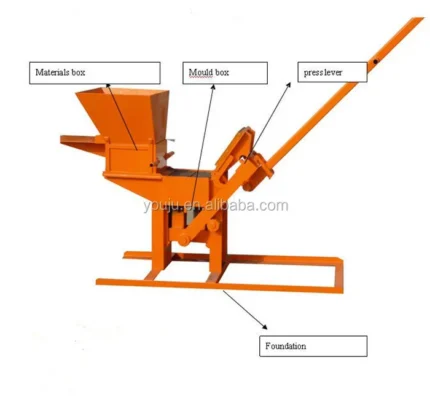
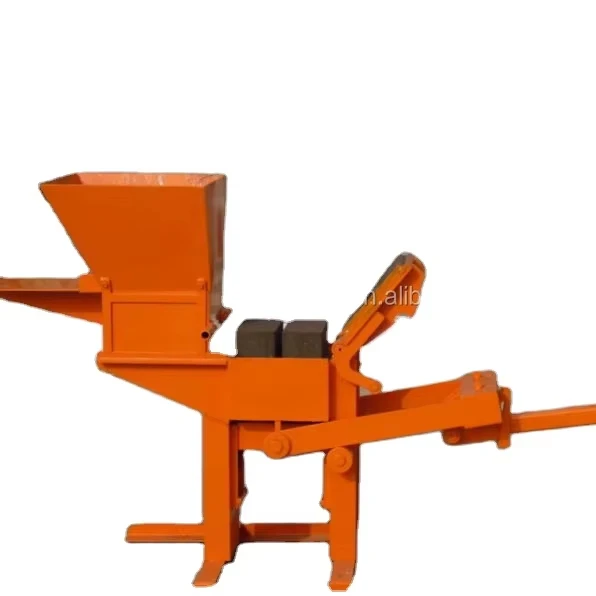
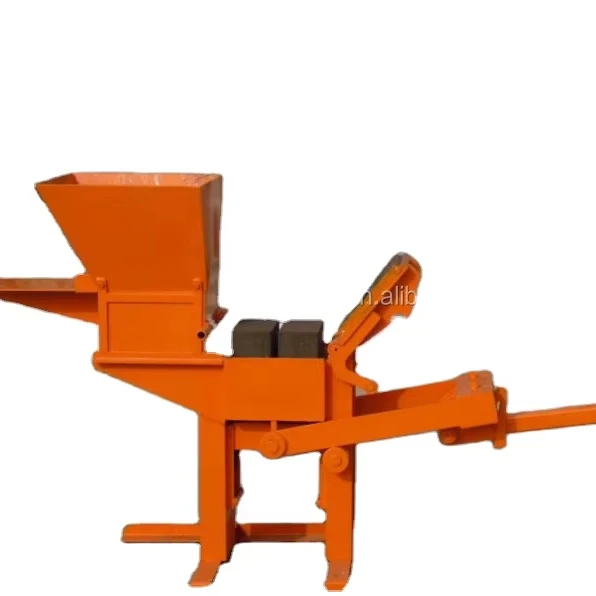
Automation-ready baseline — the LY2-40 manual clay interlocking brick press defines the starting point from which PLC-controlled batching, pallet feeding and stacking stations are measured and added.
Technical Specifications
| Parameter | Value |
|---|---|
| Model | LY2-40 |
| Product Type | Clay Interlocking Brick Making Machine |
| Operation Mode | Fully manual, no electrical drive |
| Control System | Manual operation (no PLC / MCC) |
| Rated Power | None (manually operated) |
| Voltage & Frequency | N/A |
| Overall Dimensions (L×W×H) | 1600 × 700 × 1200 mm |
| Net Weight | 200–240 kg |
| Cycle Time | 30–40 s (basis not stated in source — confirm block format / material / thickness) |
| Output Capacity | 400–1000 pcs/day (basis not stated in source — confirm block format / material / thickness) |
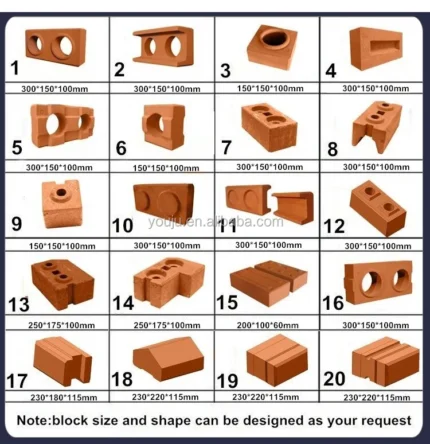
| Mould Format | Interlocking clay brick; changeable moulds |
| Hydraulic Pressure | Not applicable (manual press) |
| Vibration Force | Not applicable (no vibration system) |
| Mobility | Steel wheels for on-site relocation |
| Automation Level | Fully manual |
| Stacking Method | Manual |
| Recommended Mixer | JFA-1 or JQ350 |
| Warranty | 1 Year |
Application Suitability
| Application | Material or Output |
|---|---|
| Off-grid construction sites | Interlocking clay bricks from local soil-cement mix |
| Small-scale on-site housing projects | Clay interlocking bricks with manual soil-cement workflows |
| First block plants with minimal capital | Interlocking profiles from locally sourced clay and cement |
| Contractor-led development builds | Hand-pressed interlocking bricks for wall construction |
Why "Fully Manual" Still Belongs in an Automation Conversation
The LY2-40 is the zero-automation reference point that makes every downstream station’s value measurable.
When plant owners talk about adding an automatic PLC controlled clay interlocking brick making machine to their line, the first question should be: what exactly are we automating away from the operator? Without a clear manual baseline, it is impossible to calculate what PLC-controlled batching, automatic pallet feeding, or robotic stacking actually removes from the workflow. The LY2-40 gives you that baseline — a 30–40 s cycle done entirely by hand, where every variable from mix consistency to pressing force depends on the operator’s judgment [NEED_CITE: manual vs automated cycle consistency in block production].
I have watched crews on manual presses lose entire afternoons to mould changeovers because the bolt pattern was not standardised, and I have seen batch-to-batch density swing wildly when the same operator pressed bricks before and after lunch. These are not operator failures. They are the predictable outcome of a process where human effort is the only control variable.
What the Operator Controls — and What Automation Eventually Takes Over
On the LY2-40, the operator decides when the mix is ready, how hard to pull the press lever, and when the brick is dense enough to demould. That 30–40 s cycle time holds only when the operator maintains consistent rhythm and the soil-cement mix arrives at uniform moisture. In practice, fatigue, ambient temperature, and material variation push real cycle times outside that window across a full shift.
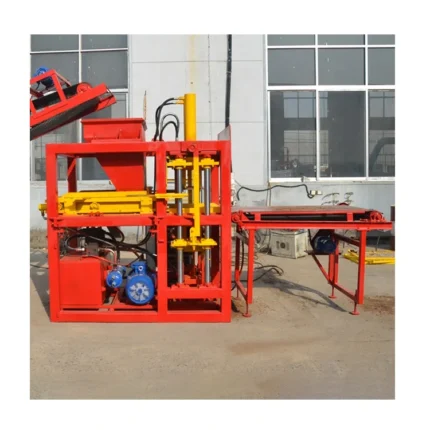
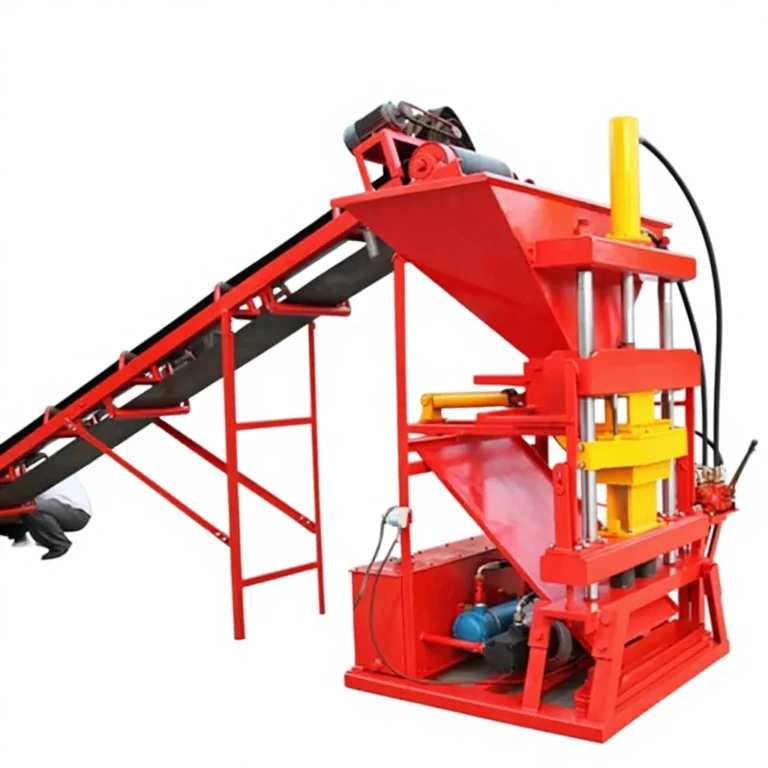
This is exactly where an automatic PLC controlled clay interlocking brick making machine begins to differentiate itself — not by pressing faster, but by pressing the same way every single cycle. PLC-controlled batching locks the soil-to-cement ratio within a narrow band, and hydraulic pressure replaces lever force with a repeatable value [NEED_CITE: PLC batching accuracy in soil-cement block production].
The Upgrade Path from Manual to Intelligent Line
The LY2-40’s changeable mould system is the foundation that carries forward when a buyer upgrades. The interlocking profile the market demands does not change just because the press becomes hydraulic — the mould geometry stays the same. What changes is how consistently that profile is filled, pressed, and cured.
A plant starting with the LY2-40 can add stations incrementally: first a mechanical mixer to replace hand-mixing, then a pallet feeder to eliminate manual pallet placement, then an automatic stacker to remove the heaviest labour from the curing area. Each addition is a discrete capital decision with a measurable labour and consistency outcome, not an all-or-nothing line replacement.
Reading the Specs Through an Automation Lens
The LY2-40’s zero-power design means it operates in off-grid locations where electrical infrastructure does not exist — but it also means there is no control system to calibrate, no sensors to maintain, and no PLC language to configure. When a buyer later adds automatic pallet feeding and stacking stations to a line built around interlocking clay brick production, voltage, frequency, and PLC display language become critical pre-shipment confirmations that simply do not exist at the manual stage.
The 1600 × 700 × 1200 mm footprint and 200–240 kg weight on steel wheels define the spatial envelope that downstream automation must accommodate. An automatic stacker needs to know the discharge height; a pallet feeder needs to match the mould opening width. The manual press sets these physical constraints before any intelligent station is specified.
The Cost of Skipping the Baseline Assessment
Buyers who jump straight to an automatic line without understanding what manual operation actually involves tend to over-automate or under-automate in the wrong places. They may invest in robotic cubing while still hand-mixing, leaving the batch inconsistency that caused quality complaints entirely unaddressed [NEED_CITE: block line bottleneck identification in phased automation projects].
The other failure mode is specifying automation stations that do not match the physical output rhythm of the press. A high-speed stacker paired with a press that cycles every 30–40 s will sit idle most of the time, while a slow pallet feeder starves a faster press. Matching station speed to actual cycle time — measured on your specific block format and mix — is where the manual baseline earns its place in the planning process.
Why Procurement Starts Here
Block machinery is our single focus, so the LY2-40 is specified alongside its mould, pallet, and handling requirements as one matched system rather than assembled from separate suppliers. The mould formats we supply are chosen against the interlocking profiles your local market actually sells, confirmed by drawing before production.
Configuration is set against your actual soil sample and target block format, not a catalogue default — I have spent days on-site adjusting mix ratios because the sample never left the buyer’s country. Automation level is selectable and documented, so a buyer starting with the LY2-40 has a written upgrade path through semi-automatic and fully automatic stacking and cubing. Installation, commissioning, and operator training are included, and mould and wear parts support continues after the line is running.
Documentation & Verification
- Machine specification sheet stating capacity per interlocking block format
- Mould drawing and format list matched to your market profile
- Voltage and control language confirmation for any added automation stations
- Factory test record on your soil-cement mix before dispatch
- Operation and maintenance manual with upgrade path documentation
Installation, Commissioning & Support
- Steel-wheel mobility allows on-site positioning without foundation work for the LY2-40 manual unit
- Recommended JFA-1 or JQ350 mixer setup with material feed height matching the 1200 mm press frame
- First commissioning includes soil-cement mix calibration against your local clay sample
- Operator training covers mould change procedure and manual cycle rhythm for consistent density
- Wear parts list and mould replacement schedule provided at handover
- Upgrade consultation for adding pallet feeding or stacking stations when production volume grows
Before You Send an Inquiry
To configure the right line — whether starting from the LY2-40 manual press or specifying a fully automatic interlocking brick plant — we need your target block format and profile drawing, the daily output you plan to achieve, and a sample of the local clay or soil you intend to use. Share your site’s voltage and frequency if you are considering automation stations, and let us know whether you already have pallets, mixers, or curing racks on site.
Frequently Asked Questions
Q: How do I verify the real daily output of the LY2-40 on my specific interlocking brick format?
A: The 400–1000 pcs/day range is stated without a confirmed block format assumption. Request a capacity calculation that names the exact interlocking profile, wall thickness, and soil-cement mix you will use. Cycle time varies by format complexity and operator rhythm, so the per-format number is the only one that matters for planning.
Q: What does PLC control add over the LY2-40’s manual operation for interlocking clay bricks?
A: PLC-controlled batching locks the soil-to-cement ratio cycle after cycle, removing the mix variation that causes density swings in manual pressing. Automatic press cycles replace lever force with repeatable hydraulic pressure. The result is batch-to-batch consistency that no operator can maintain across a full shift by hand.
Q: Which automation stations can be added step-by-step to a manual interlocking brick line?
A: The typical sequence starts with a mechanical mixer to replace hand-mixing, then a pallet feeder to automate pallet placement, followed by an automatic stacker at the discharge end. Cubing and curing rack handling come last. Each station is a separate capital decision with measurable labour impact.
Q: How is PLC interface language confirmed before an automatic station ships?
A: The PLC display language and electrical voltage are confirmed in writing during the quotation stage, before production begins. This covers the HMI menu language, alarm text, and any documentation that accompanies the control panel. Late changes after assembly require reprogramming and re-testing.
Q: What is the mould change time on an automatic interlocking brick press versus the manual LY2-40?
A: Manual mould change on the LY2-40 depends on bolt count and operator experience, and no standardised time is published. Automatic presses can feature quick-change mould systems that reduce changeover to a fraction of a shift, but the exact time depends on the press model and mould locking mechanism specified.