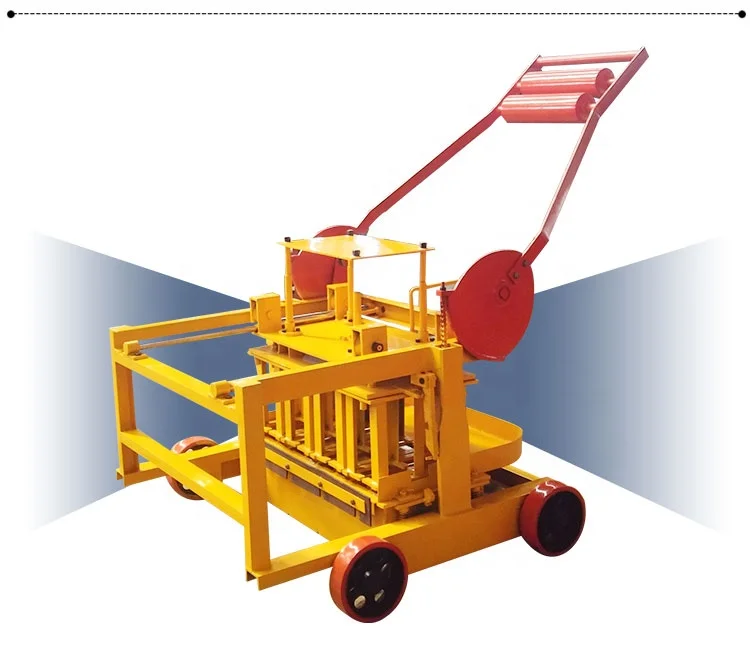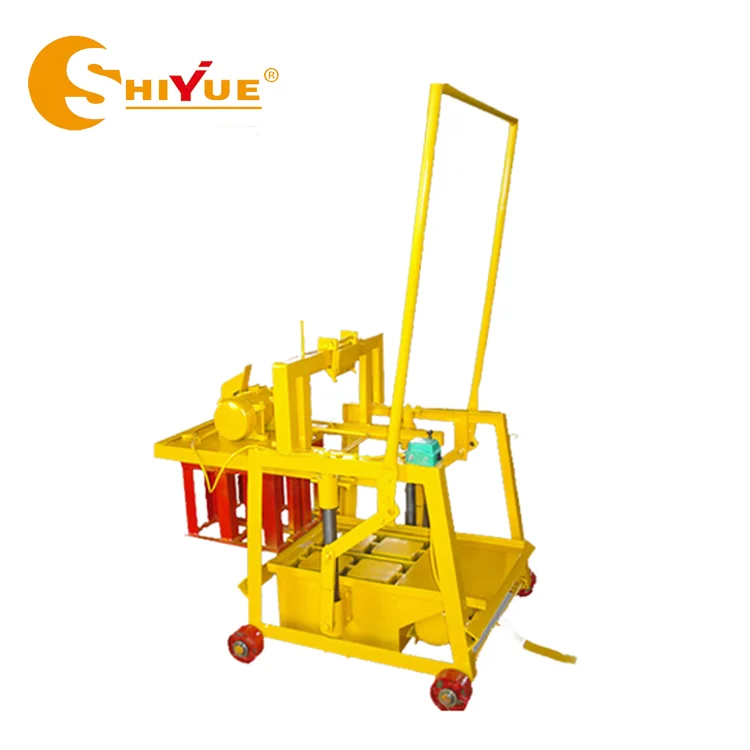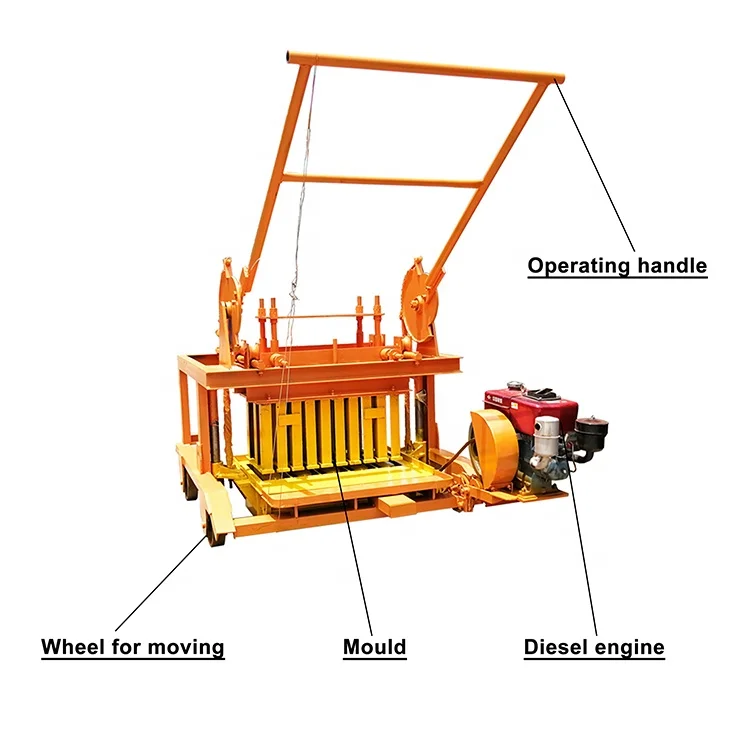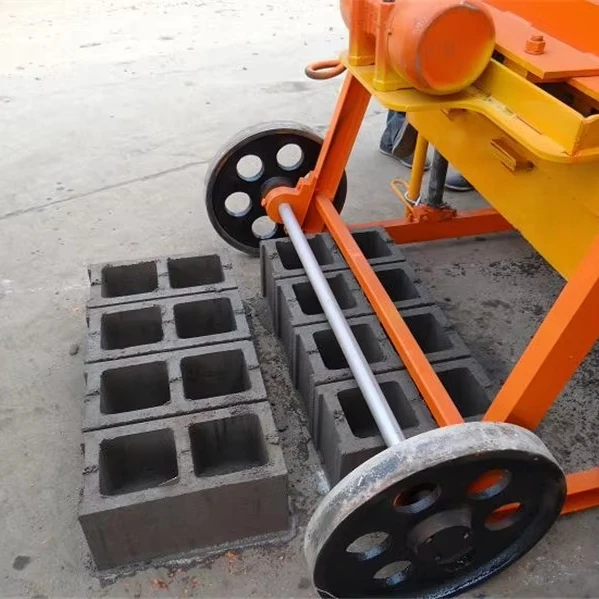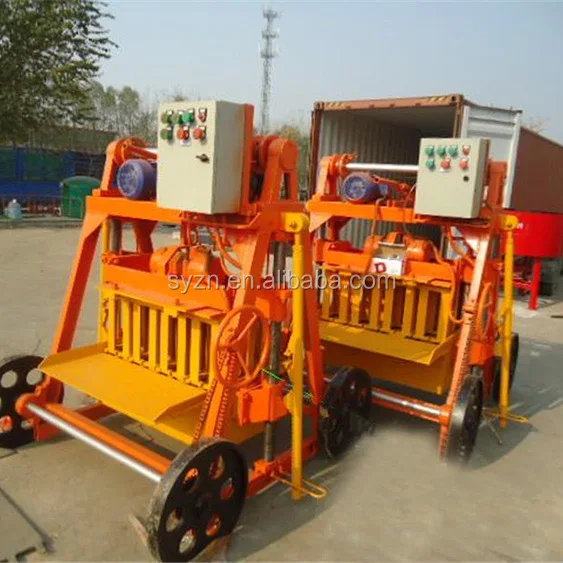
Description
Mechanical alignment precision — The QMJ4-45 egg-laying block machine uses a four-pole guided pressure head with ultralong orientation bearings, ensuring repeatable mould alignment that any future PLC control system depends on for batch-to-batch consistency.
Technical Specifications
| Parameter | Value |
|---|---|
| Model | QMJ4-45 |
| Product Type | Mobile Egg Laying Block Machine |
| Machine Power | 7.4 kW |
| Molding Cycle | 45 s (basis not stated in source — confirm block format / material / thickness) |
| Output Capacity | 2400 pcs/8h (based on 400×200×200mm hollow block, 4 pcs/mould) |
| Output Capacity | 3200 pcs/8h (based on 400×150×200mm hollow block, 5 pcs/mould) |
| Raw Materials | Concrete, sand, cement, fly ash, lime, gypsum |
| Machine Weight | 1 T |
| Overall Dimensions (L×W×H) | 1550×1335×1580 mm |
| Pallet Requirement | No pallets required (egg-laying type) |
| Voltage | Customizable to local standard (basis to be confirmed) |
| Control System | Manual force control with jog control |
| Guidance System | Four-pole oriented with ultralong orientation bearing |
| Mould Compatibility | Interchangeable moulds for hollow blocks, road blocks, curb stones and other concrete products |
| Automation Level | Manual / semi-automatic operation |
| Key Features | Egg-laying design eliminates pallet handling, curing-rack logistics, and forklift dependency |
Application Suitability
| Application | Material or Output |
|---|---|
| On-site block production | Direct production at housing or infrastructure construction sites without fixed plant infrastructure |
| Small-scale block manufacturing | Hollow blocks and solid blocks for local building material markets using sand, cement, fly ash |
| Road and curb construction | Road blocks and curb stones produced from concrete with locally available aggregates |
| Entrepreneurial block plants | First-time block plant setup with minimal capital investment and room to automate later |
| Remote or off-grid projects | Mobile production capability for locations where transporting finished blocks is impractical |
Why the Voltage Question Should Come Before the Price
Voltage mismatch at commissioning delays projects longer than any shipping delay ever could.
I once watched a QMJ4-45 egg-laying block machine sit idle for three weeks on an African job site because the motor was configured for 380V while the local grid ran 415V three-phase. The contractor had confirmed the order, paid the deposit, and scheduled the crew — but nobody had asked about the site’s actual voltage and frequency before production started [NEED_CITE: voltage and frequency standards by export market]. That machine eventually ran fine after a transformer retrofit, but the delay cost the contractor more than any price negotiation would have saved. The automatic egg laying block machine you specify must match your site’s electrical reality from day one.
Control Architecture That Scales With Your Operation
The QMJ4-45 ships with manual jog control as the baseline, giving operators direct tactile feedback during the learning curve. This configuration works for contractors producing blocks for their own projects where output volume stays predictable and format changes remain infrequent. When your operation grows or you add a second shift, the manual base can accept a PLC controlled mobile block machine upgrade that takes over batching accuracy, mould change sequencing, and eventually automatic stacking and cubing. The mechanical platform does not need replacement — only the control layer adds on.
What Automation Actually Removes From the Operator
Running a mobile egg-laying machine manually means the operator controls feed timing, vibration duration, and head pressure by feel. That skill takes weeks to develop and disappears when that operator leaves. A PLC controlled mobile block machine replaces that tacit knowledge with repeatable parameters stored in memory, so the second shift produces blocks with the same density and dimensional tolerance as the first [NEED_CITE: CE machinery directive requirements for industrial equipment]. The upgrade path from jog control to full automation is not about replacing workers — it is about removing batch-to-batch variation that manual operation cannot eliminate.
Specifying What the Numbers Actually Mean
The 7.4 kW machine power drives both the vibration motor and the hydraulic system that controls head pressure. Vibration force and hydraulic pressure must be matched to your specific mix design — the sand-to-cement ratio, aggregate size, and moisture content you actually source locally. A mix that works at one vibration setting may produce weak blocks at another. The 45-second molding cycle is the mechanical baseline; your actual cycle time depends on block thickness, material flow characteristics, and the strength requirement your market demands.
The four-pole guidance system with ultralong orientation bearings keeps the pressure head aligned through thousands of cycles. Misalignment causes uneven block density and accelerated mould wear — problems that do not show up in the first hundred blocks but become costly by the first thousand. The 1550×1335×1580 mm footprint means the machine fits through standard site gates and can be repositioned as the curing area fills.
The Hidden Cost of Skipping Configuration Details
Buyers often focus on the press price and treat pallet handling, stacking, and curing as afterthoughts. With an egg-laying design, you eliminate pallets entirely — but you still need a flat, prepared curing surface that the machine can traverse. If your site has uneven ground or soft soil, the machine sinks and blocks crack before curing completes. Contractors who discover this after delivery spend weeks leveling ground that should have been specified before the order [NEED_CITE: typical site preparation requirements for mobile block production]. The QMJ4-45 weighs one ton; it needs a surface that can support that weight repeatedly without settling.
Why Procurement Happens Here
Every QMJ4-45 leaves the factory with voltage, frequency, and control language confirmed in writing before production begins — not discovered at commissioning. Mould drawings and format lists ship with the quotation, so you know exactly which block dimensions are covered before you pay. The capacity calculation document states the block format assumed for each output figure, making daily production expectations contractually verifiable. Configuration is set against your actual mix design and local aggregate, not a catalogue default that assumes materials you cannot source. The upgrade path from manual jog control to automated batching and stacking is defined in advance, so you can plan capital expenditure without replacing the press.
Documentation & Verification
- Capacity calculation sheet stating block format and mould assumed for each output figure
- Machine specification sheet with voltage, frequency, and control language confirmed pre-production
- Mould drawing and format list included with quotation, covering hollow blocks, road blocks, and curb stones
- Hydraulic and electrical schematic showing control system architecture and future automation interface points
- Factory test record demonstrating cycle time and block dimensions on your specified format before dispatch
Installation, Commissioning & Support
- Site must provide flat, load-bearing curing surface supporting 1 T machine weight with prepared access routes
- 7.4 kW power requirement needs dedicated circuit matching confirmed voltage and frequency specification
- Machine ships assembled; on-site setup involves electrical connection and mould installation only
- Initial commissioning includes parameter setting for your mix design, aggregate type, and target block strength
- Operator training covers manual jog control operation and basic troubleshooting before handover
- Mould and hydraulic wear parts list provided with recommended replacement intervals and sourcing information
What We Need to Specify Your Machine
To configure the QMJ4-45 for your operation, provide the block formats your market actually buys — dimensions, hollow or solid, and the strength requirement your local standards specify. Confirm your site’s voltage, phase, and frequency along with the control language your operators will use. Describe your local raw materials: sand type, cement grade, and any supplementary materials like fly ash or lime you plan to incorporate. If you anticipate scaling to automated batching and stacking within the next production cycle, state that now so the control architecture can accommodate the upgrade path.
Frequently Asked Questions
Q: How do I verify the real daily output of the QMJ4-45 for the block format my market actually buys?
A: Every quotation includes a capacity calculation document that states the output figure alongside the specific block format, mould cavity count, and cycle time it assumes. For the QMJ4-45, the baseline is 2400 pieces per 8-hour shift on 400×200×200mm hollow blocks at 4 pieces per mould, or 3200 pieces on 400×150×200mm blocks at 5 pieces per mould. Your actual output depends on your mix design, operator efficiency, and site conditions. We confirm these assumptions in writing before production begins, so your daily expectation is contractually clear rather than a catalogue claim.
Q: What is the upgrade path from manual jog control to PLC-controlled automatic stacking and cubing?
A: The QMJ4-45 manual jog control base accepts a PLC upgrade that takes over batching accuracy, mould change sequencing, and vibration timing. From there, automatic pallet feeding (if you later add pallet-based production), stacking, and cubing stations can be integrated without replacing the press. The mechanical platform — the four-pole guidance system and vibration table — remains unchanged. We define which automation stations can be added and in what sequence during the initial specification, so your capital planning accounts for the upgrade cost and timing rather than discovering compatibility gaps later.
Q: Will the voltage, frequency and control language be confirmed before the machine ships?
A: Yes. Voltage, frequency, and PLC display language are confirmed in writing during the specification phase, before production begins. This prevents the commissioning delays that occur when electrical configuration is assumed rather than verified. The QMJ4-45 motor and control system are built to match your site’s actual electrical supply — whether that is 380V, 415V, or another standard — and the operator interface displays in your specified language. The confirmation document becomes part of your factory test record and ships with the machine.
Q: How does the egg-laying design interact with my existing curing area and site conditions?
A: The egg-laying design eliminates pallets, curing racks, and forklift dependency — blocks are deposited directly onto the ground as the machine moves forward. Your curing area must be flat, load-bearing, and large enough to accommodate daily output without blocking the machine’s path. The QMJ4-45 weighs one ton, so soft or uneven ground causes settling that cracks uncured blocks. Site preparation — grading, compacting, and drainage — should be completed before the machine arrives. We specify these requirements during the inquiry phase so your curing area is ready on day one.
Q: Which moulds are included, and how fast is a format change on site?
A: The standard QMJ4-45 configuration includes moulds for the block formats specified in your quotation — typically hollow blocks in your market’s common dimensions, plus road blocks or curb stones if requested. Format change is a mechanical mould swap: the old mould unbolts, the new mould bolts on, and the pressure head adjusts to the new block height. With the four-pole guidance system maintaining alignment, a trained operator completes the change without recalibrating the entire machine. Custom mould designs are available to buyer drawings if your market sells formats outside the standard range.