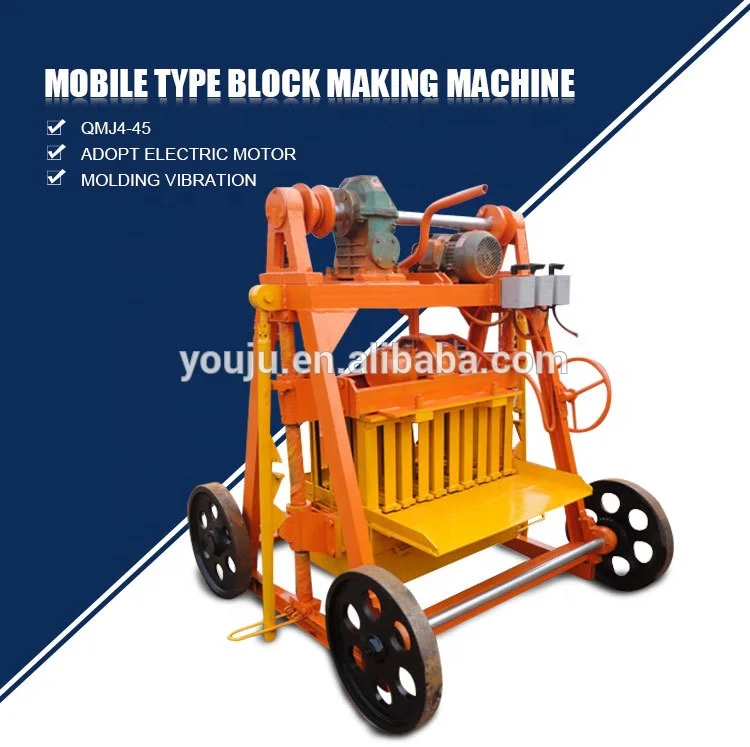

Description
Configuration set against the buyer’s actual mix design — the QMJ4-45 is specified with vibration frequency and mould selection matched to your local aggregate, not a catalogue default, serving as a starting point for an automatic block machine upgrade path from manual QMJ4-45 operation.
Technical Specifications
| Parameter | Value |
|---|---|
| Model | QMJ4-45 |
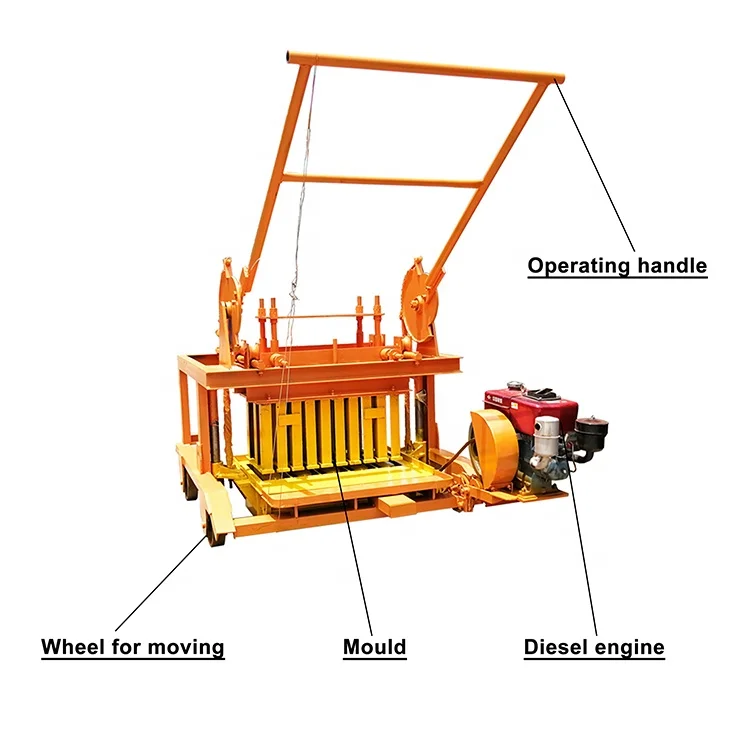
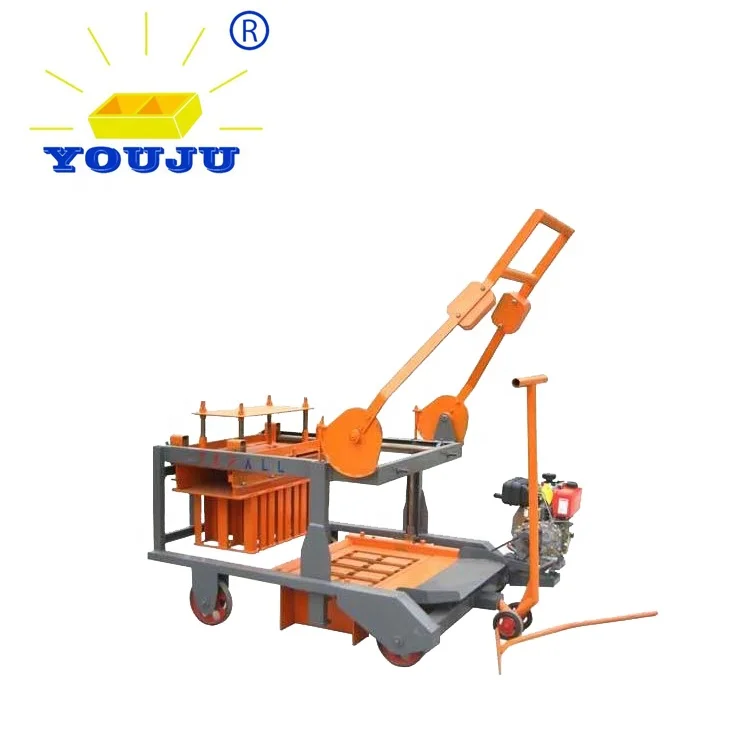
| Product Type | Manual Egg-Laying Block Making Machine |
| Forming Method | Mold vibration |
| Vibration Frequency | 2400 r/m |
| Molding Cycle | 45 s |
| Total Power | 6 kW |
| Power Source | Diesel / Petrol engine |
| Demold Method | Manual |
| Turning Method | Manual |
| Control System | Manual operation (no PLC) |
| Automation Level | Manual (egg-laying / mobile) |
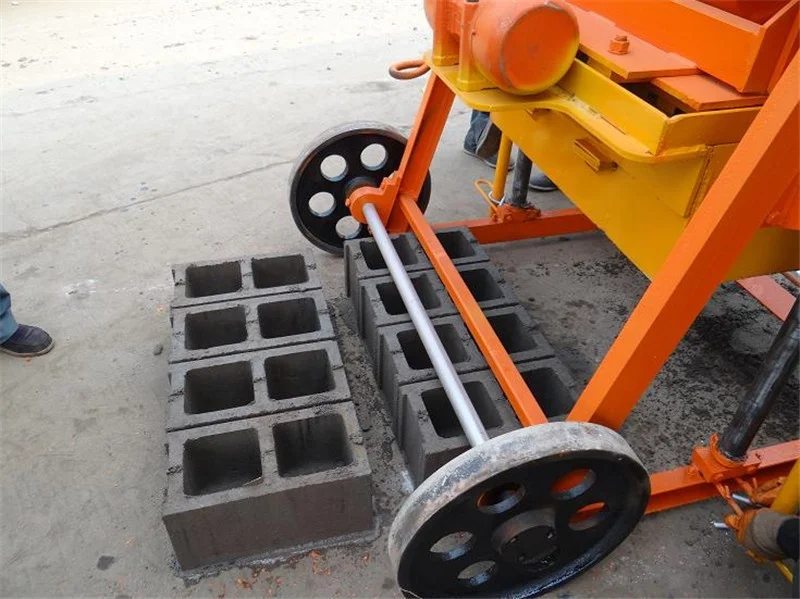
| Mould Format Options | 400×200×200 mm (4 pcs/mould); 400×150×200 mm (5 pcs/mould); 400×120×200 mm (6 pcs/mould) |
| Hydraulic Pressure | Not applicable (vibration-only forming) |
| Warranty | 1 year (whole machine) |
Application Suitability
| Application | Material or Output |
|---|---|
| Small-scale on-site hollow block production | Cement, crushed stone, and sand mixes for garden or minor construction projects |
| Contractor self-production at project sites | Hollow blocks in 120 mm, 150 mm, or 200 mm widths using interchangeable moulds |
| Off-grid block manufacturing | Diesel or petrol engine-driven operation where grid power is unavailable |
| Entry-level block plant operations | Manual egg-laying output on existing cement working areas |
Why "4000 Blocks a Day" Means Nothing Without Your Mix Design
The stated output only holds if your aggregate gradation and cement ratio match the test conditions.
Many buyers order a QMJ4-45 based on a headline daily figure, then discover on-site that their local weathered rock or crusher dust behaves differently from the standard river sand used during factory testing. The vibration force at 2400 r/m may compact one mix to full density while leaving another friable and under-strength. I have watched contractors lose entire production runs because the automatic block machine upgrade path from manual QMJ4-45 operation was never planned around what their own quarry actually supplied [NEED_CITE: block density variance across aggregate types in small-scale production].
Operator Skill as the Primary Control Variable
Without PLC logic governing feed timing and vibration duration, the QMJ4-45 places compaction consistency entirely in the operator’s hands. The manual demold and turning sequence means cycle time fluctuates with operator pace, and block height tolerance depends on how uniformly the mix is loaded into the mould cavity. This is not a flaw — it is a design choice for sites where electrical infrastructure and automation budgets are not yet justified. Buyers evaluating the automatic block machine upgrade path from manual QMJ4-45 should treat this phase as a deliberate baseline.
What the Engine-Driven Configuration Solves
Running a 6 kW diesel or petrol engine eliminates the dependency on a three-phase grid connection that many rural project sites simply lack. The engine-driven setup means the machine can be positioned directly where blocks are needed, moved by hand across a prepared concrete slab, and relocated when the project phase shifts. No pallet feeder, no conveyor, no electrical panel — the entire production loop is contained in a single mobile unit that arrives ready to run once fuel is added.
Interpreting the Mould and Vibration Specifications
The 2400 r/m vibration frequency is calibrated for cement-aggregate mixes typical of hollow block production, but the compaction result changes when the buyer’s local aggregate shifts from rounded river gravel to angular crusher dust. Angular particles interlock differently under vibration, often requiring a longer molding cycle or a leaner water ratio to reach the same demold strength [NEED_CITE: vibration compaction behavior across aggregate shapes]. The three available mould formats — 400×200, 400×150, and 400×120 mm — each produce a different piece count per cycle, which directly affects the realistic daily output once manual turning and repositioning time is factored in. Mould change itself is a mechanical swap, not a quick-release system, so buyers planning frequent format rotation should account for the downtime that introduces.
The Hidden Cost of Skipping the Mix Trial
When a buyer skips testing their local aggregate on the QMJ4-45 before committing to a production run, the consequences surface within the first week: blocks crack during demolding, wall thickness varies between units, and mould wear accelerates because the abrasive fines in certain crusher dusts eat through steel faster than standard sand. By the time replacement moulds are ordered, the project schedule has already slipped and the operator has developed compensating habits that reduce output further [NEED_CITE: mould wear acceleration from angular aggregate fines].
Why Source This Configuration Here
Block machinery is our single focus, so the QMJ4-45 is specified as a matched system — mould, vibration frequency, and engine rating confirmed together rather than assembled from unrelated suppliers. We configure the machine against the buyer’s actual mix design and target block format before dispatch, not after arrival when rework becomes necessary. Mould options are selected for the formats the buyer’s local market actually purchases, and custom drawings are available when standard formats do not match. The documentation package includes a factory test record run on a mix profile the buyer provides, so there are no surprises when the first block is laid on-site.
Documentation & Verification
- Machine specification sheet confirming engine rating, vibration frequency, and mould format list
- Factory test record run on a mix profile matching the buyer’s local aggregate
- Mould drawing and format list for each cavity size included in the order
- Operation and maintenance manual covering engine service intervals and mould care
- Wear parts and mould availability list with lead times for first replacements
Installation, Commissioning & Support
- Site preparation requires a level concrete slab sufficient for engine-driven mobile operation
- Diesel or petrol engine commissioned on-site with fuel system and vibration alignment checks
- Manual demold and turning technique trained with the buyer’s operator over initial production runs
- Mould change procedure demonstrated for each included format cavity size
- Wear parts inventory reviewed before first replacement cycle is due
- Upgrade consultation available when volume growth justifies semi-automatic or PLC-controlled transition
Planning the Next Configuration Step
Buyers considering the QMJ4-45 as a starting point should share their target block format, local aggregate source and gradation, daily output requirement, and whether grid power will be available for a future line. This information determines which mould cavities to include now and which automation tier makes sense when production volume outgrows manual operation.
Frequently Asked Questions
Q: How is the daily output of the QMJ4-45 verified, and which block format does it assume?
A: The stated productivity range applies to specific mould formats under controlled test conditions using standard aggregate. Actual daily output on-site depends on the buyer’s mix design, operator cycle pace, and manual repositioning time between cycles. We provide a capacity calculation that names the exact block format, mix ratio, and shift length assumed before the order is placed.
Q: What does manual operation leave to the operator that automation would remove?
A: Manual operation means the operator controls feed volume, vibration timing, demold speed, and machine repositioning. Block height consistency and cycle-to-cycle density variation depend on operator discipline. An automatic block machine upgrade path from manual QMJ4-45 replaces these variables with PLC-governed feed, vibration, and stacking cycles for batch-to-batch repeatability.
Q: How should the QMJ4-45 be matched to the buyer’s local aggregate and mix?
A: We request the buyer’s aggregate type, gradation curve, and cement ratio before finalizing the machine configuration. The 2400 r/m vibration frequency performs differently on rounded river sand versus angular crusher dust, and the factory test record confirms density and demold strength against the actual mix before dispatch.
Q: What is the upgrade path from this machine to PLC-controlled production?
A: The QMJ4-45 serves as an entry point for buyers who need immediate on-site production without grid power or automation capital. When volume grows, the transition typically moves to a semi-automatic stationary line with pallet feeder and mixer, then to a fully automatic line with PLC control, stacking, and cubing — each tier building on the format and mix knowledge gained from this phase.
Q: How are moulds and wear parts supplied after the machine is delivered?
A: A wear parts and mould list with part numbers is provided at delivery, covering vibration components, mould cavity inserts, and engine service items. Replacement moulds for existing or new block formats are manufactured to the same cavity specifications, and lead times for the first replacement set are confirmed before shipment.