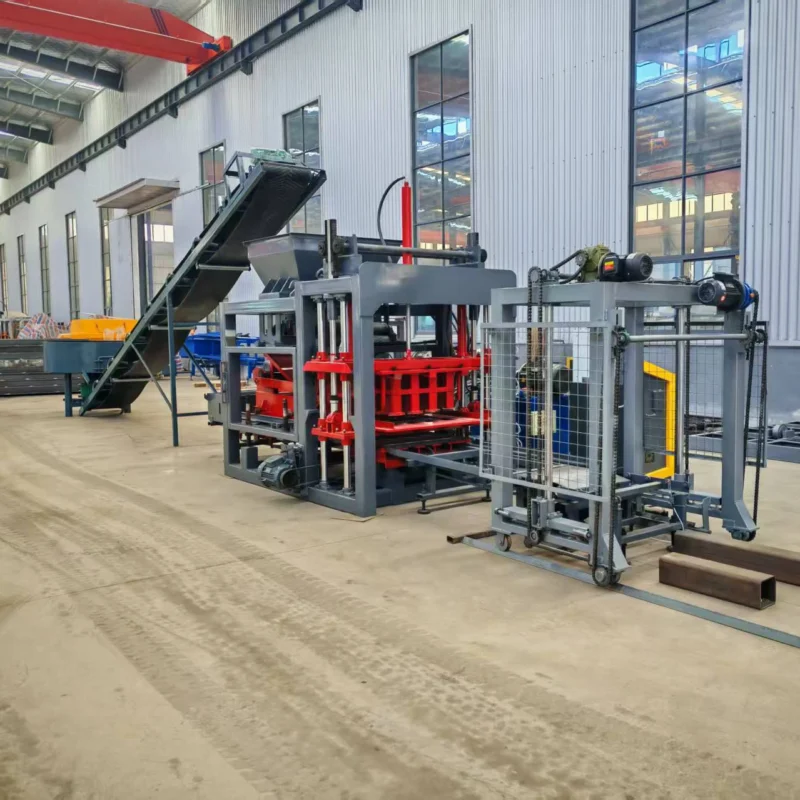
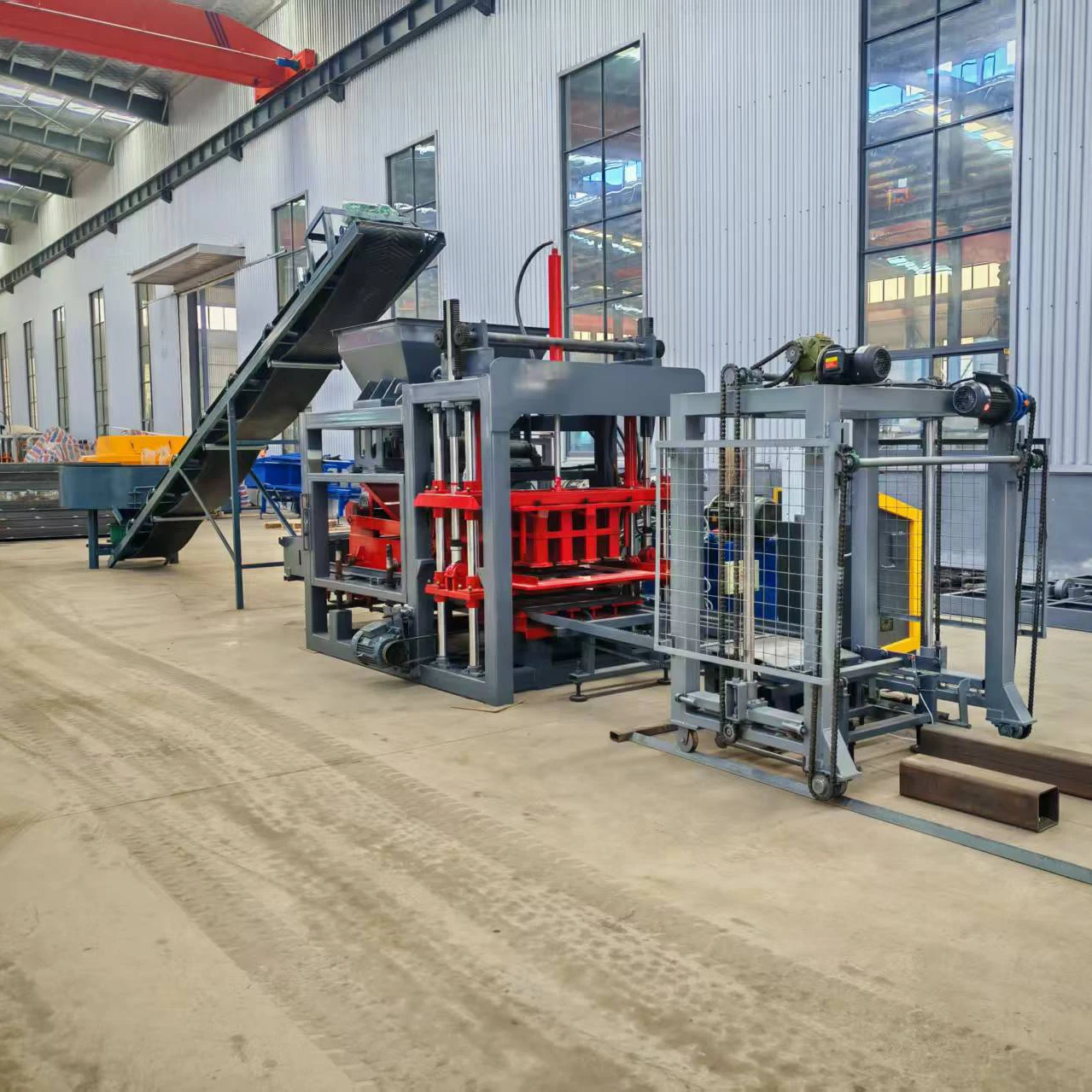
Description
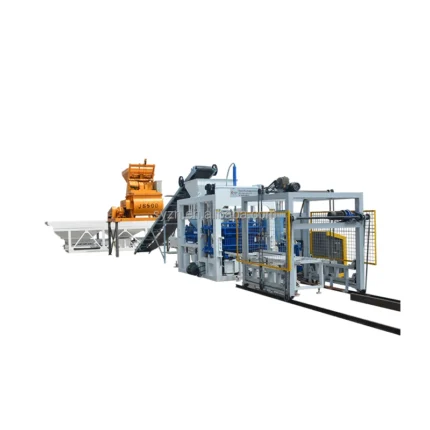
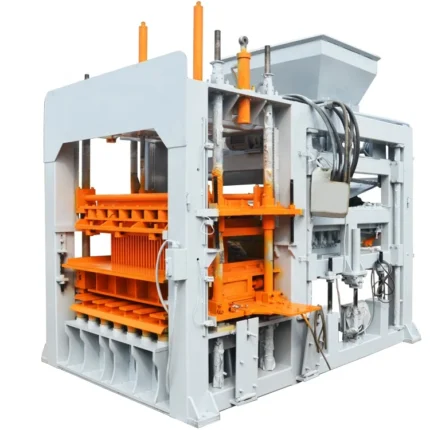
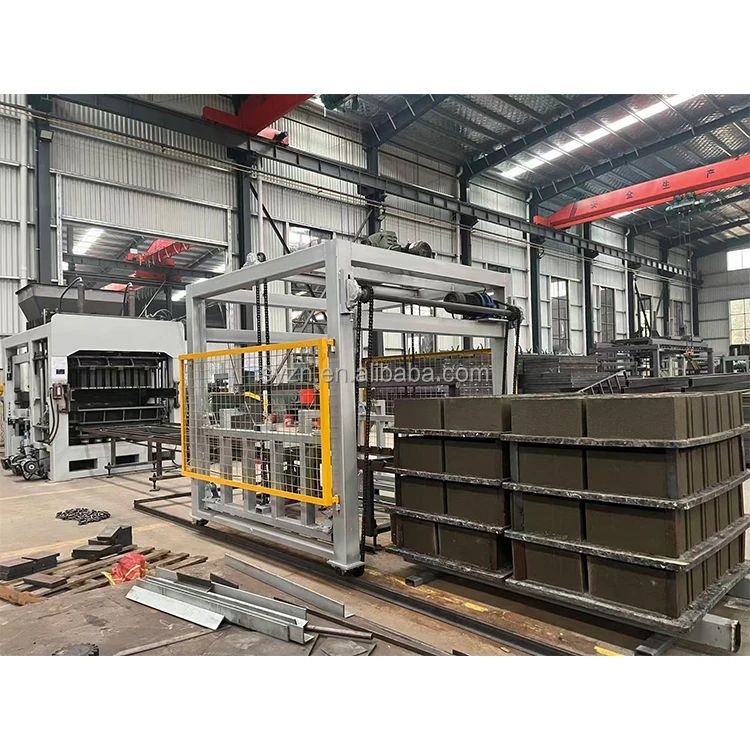
Matched System Configuration — the QT4-15A is specified as a complete press, mould, pallet and handling unit rather than a standalone machine, so automation scope and cycle timing align with your actual block format and site layout.
Technical Specifications
| Parameter | Value |
|---|---|
| Model | QT4-15A |
| Product Type | Fully Automatic Concrete Block Making Machine |
| Overall Dimensions (L×W×H) | 4100×1600×2600mm |
| Rated Pressure | 16-21MPa |
| Main Vibration Form | Platform Vibration |
| Vibration Frequency | 4200 r/min |
| Vibration Force | 55kN |
| Pallet Size | 880×550mm |
| Molding Cycle | 25-30s (basis not stated in source — confirm block format / material / thickness) |
| Overall Power | 18.45kW |
| Demolding Method | Hydraulic |
| Total Mass | 4T |
| Factory Area Required | 300m² |
| Control System | PLC (implied by fully automatic designation — verify against manufacturer catalog) |
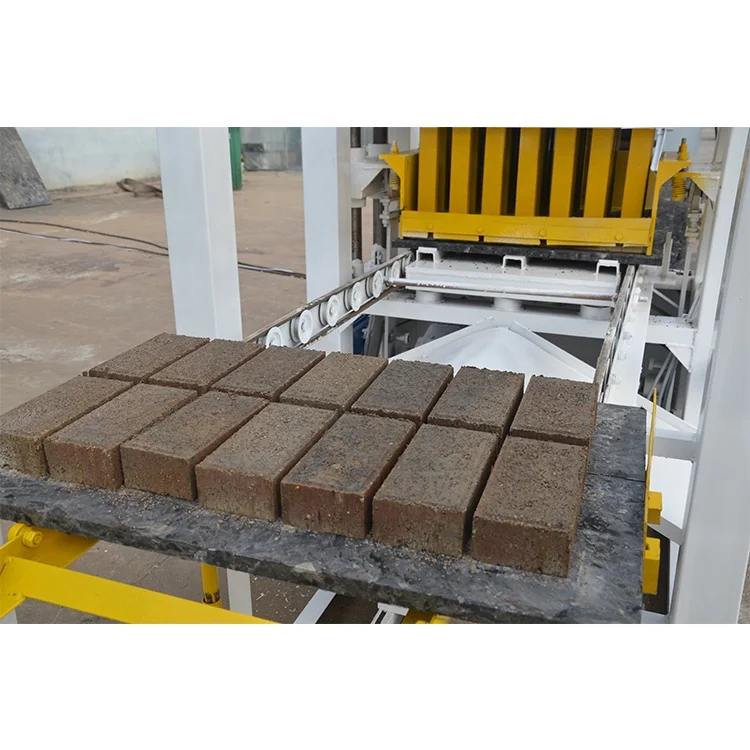
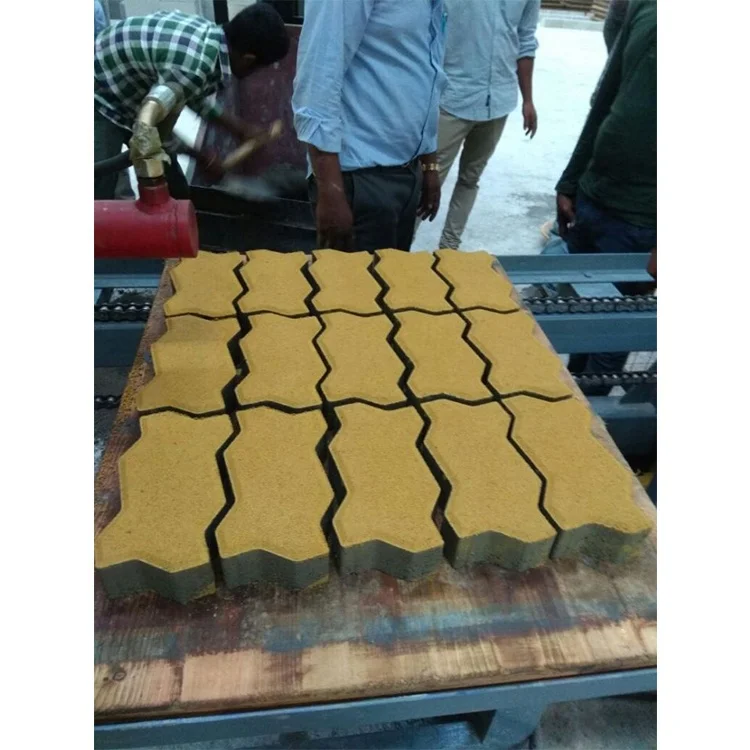
| Applied Products | Concrete blocks, hollow/solid blocks, pavers, interlocking blocks, curbstone, colored pavers |
| Raw Materials | Crushed stone, sand, cement, dust, fly ash, gravel, slag |
Application Suitability
| Application | Material or Output |
|---|---|
| Hollow block production for residential and commercial walls | Crushed stone, sand, cement, fly ash |
| Solid block manufacturing for load-bearing structures | Gravel, sand, cement blends |
| Paving block and colored paver runs for driveways and walkways | Fine aggregate, cement, pigment |
| Interlocking block production for retaining walls and landscaping | Crushed stone, sand, cement |
| Kerbstone and curb units for road and site infrastructure | Coarse aggregate, cement |
What the QT4-15A Molding Cycle Actually Means for Your Daily Output
A 25-30 second cycle tells you nothing until you know which block format, pallet load, and upstream feeding speed that number assumes.
The automatic QT4-15A block making machine PLC controlled is often quoted with a single cycle time, but plant owners quickly discover that real throughput varies format by format. A hollow block may fill the pallet in one press, while interlocking pavers require a different compaction sequence and longer hold time. If the mixer, pallet feeder, and stacking station are not synchronized to the press cycle, the machine sits idle between strokes, and the quoted cycle becomes irrelevant [NEED_CITE: synchronization requirements for automatic block production lines].
How PLC Control Removes Operator Variability
On a manual or semi-automatic press, the operator decides when to feed, when to vibrate, and when to strip. Each decision introduces variation. The PLC system on the automatic QT4-15A block making machine PLC controlled replaces those decisions with timed sequences, so every pallet receives the same feed volume, vibration duration, and hydraulic pressure. This matters most when you run multiple formats in a single shift — the controller recalls the recipe for each mould, reducing the chance that a paver run gets the hollow block settings by mistake.
Where Automation Stops and Where It Can Extend
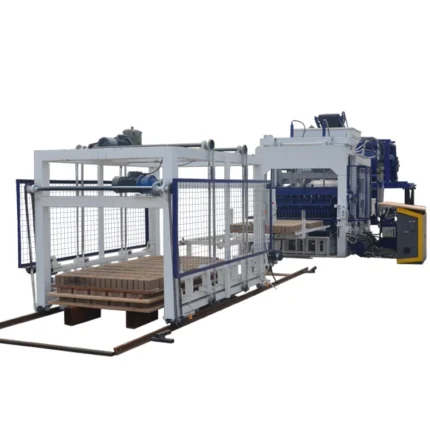
The designation "fully automatic" can cover different scopes depending on configuration. Some setups include automatic pallet feeding and stacking, while others leave pallet handling and cubing to manual labour downstream. Before ordering, confirm which stations are inside the automation envelope and which remain manual, because a press that cycles every 25-30 seconds will still bottleneck if pallets are fed or removed by hand [NEED_CITE: automation scope definitions for block press installations]. The upgrade path from semi-automatic operation typically starts with pallet feeding automation, then extends to stacking and cubing as throughput demands grow.
Reading the Pressure and Vibration Specs Together
The rated pressure of 16-21MPa and vibration force of 55kN work as a pair. Pressure alone compresses the mix, but vibration is what settles fine aggregate into voids and achieves uniform density across the 880×550mm pallet area. At 4200 r/min platform vibration, the frequency is high enough to fluidize the mix without segregating coarse aggregate to the bottom of the mould. For interlocking pavers and colored face-mix products, this balance directly affects surface finish and edge definition. If your local aggregate is predominantly fine sand, the vibration force may need adjustment through the PLC to avoid over-compaction and surface cracking.
The Cost of Misconfigured Automation Scope
When the pallet feeder is omitted from the quotation but assumed to be included, the press waits for an operator to load each pallet by hand. The 25-30 second cycle stretches well beyond what was planned, and daily output falls short of the capacity calculation used to justify the investment. Similarly, if stacking and cubing are manual, cured blocks pile up faster than workers can sort them, forcing the press to pause [NEED_CITE: output losses from unsynchronized block handling]. These gaps are rarely visible in a spec sheet — they only appear once the line is running on your floor.
Why Source This Machine Through a Matched-System Approach
Block machinery as a single focus means the QT4-15A press, its moulds, pallets, and handling equipment are specified together against your target block format and local mix design, not pulled from separate catalogues. Configuration is set against your actual aggregate and strength requirement, so vibration force and hydraulic pressure match what your materials can produce. Mould design covers the formats your market sells, including custom drawings when standard options do not fit. The automation level is selectable, allowing a start at semi-automatic with a defined upgrade path as output grows. Installation support includes on-site commissioning and operator training so the PLC sequences are validated with your specific mix before full production begins.
Documentation & Verification
- Factory test record run on your specified block format and mix before dispatch
- Hydraulic and electrical schematic matching your confirmed voltage and frequency
- PLC display language and control menu verified to operator requirement before production
- Mould drawing and format list with pallet dimensions and changeover procedure
- Operation and maintenance manual in the language confirmed at order stage
Installation, Commissioning & Support
- 300m² factory area accommodates press, pallet circulation, and stacking zone for the QT4-15A
- 18.45kW total power requires a dedicated circuit matching your confirmed voltage and frequency
- Machine ships dismantled for container loading and reassembled on prepared foundation
- Commissioning includes PLC sequence validation with your raw material and target block format
- Operator training covers mould change procedure, PLC recipe recall, and daily maintenance checkpoints
- Wear parts list provided with first replacement intervals for hydraulic seals and vibration components
What to Include in Your Inquiry
To size the automation scope correctly, share your target block formats with daily output targets per format, the local raw materials and aggregate gradation available at your site, and your existing voltage and frequency supply. If you already have pallet racking or forklifts, provide the pallet dimensions and handling equipment specs so the feeding and stacking stations can be matched. Specify the PLC display language your operators need and whether upstream mixing and downstream cubing are already in place or need to be included.
Frequently Asked Questions
Q: How is the QT4-15A output capacity determined for different block formats?
A: The 25-30 second molding cycle is a base figure that must be recalculated for each block format, mix design, and pallet load. A hollow block may complete in one cycle, while interlocking pavers can require extended vibration. Ask for a capacity table that lists output per format rather than a single cycles-per-hour number.
Q: Which automation functions are included and what is the upgrade path?
A: The fully automatic designation can cover pallet feeding, stacking, and cubing to varying degrees. Confirm which stations are inside the automation scope before ordering. The platform supports upgrades from semi-automatic operation, adding pallet feeders and stackers as throughput requirements increase.
Q: How are voltage, frequency, and PLC language confirmed before shipment?
A: These must be specified at order stage and verified before production. Voltage and frequency must match your site supply to avoid commissioning delays. The PLC display language is set to your operator requirement and confirmed in the pre-shipment documentation package.
Q: How does PLC control maintain consistency when switching between block formats?
A: The PLC stores separate recipes for each mould, controlling feed volume, vibration duration, and hydraulic pressure per format. When the operator selects the active recipe, the system applies the stored parameters, reducing the risk of settings carryover from a previous production run.