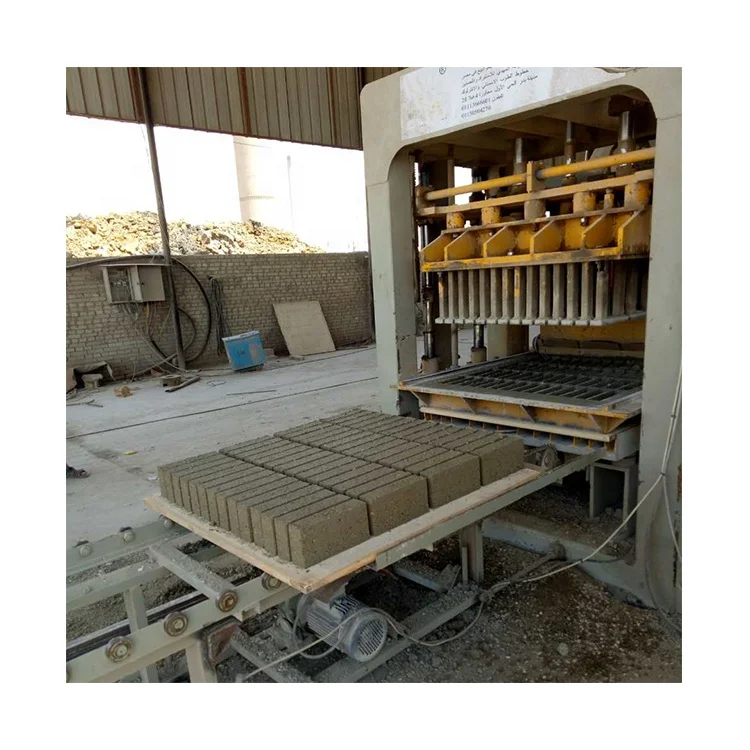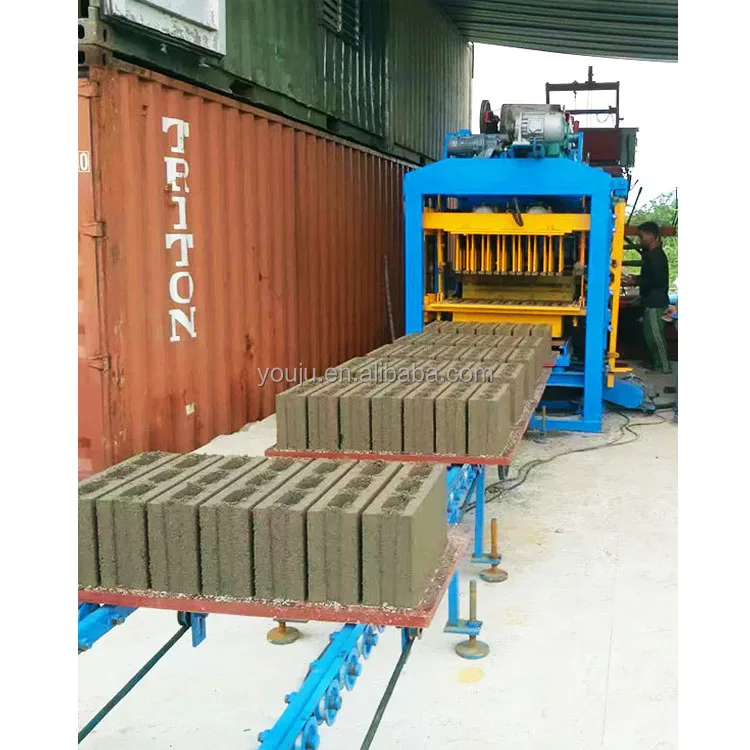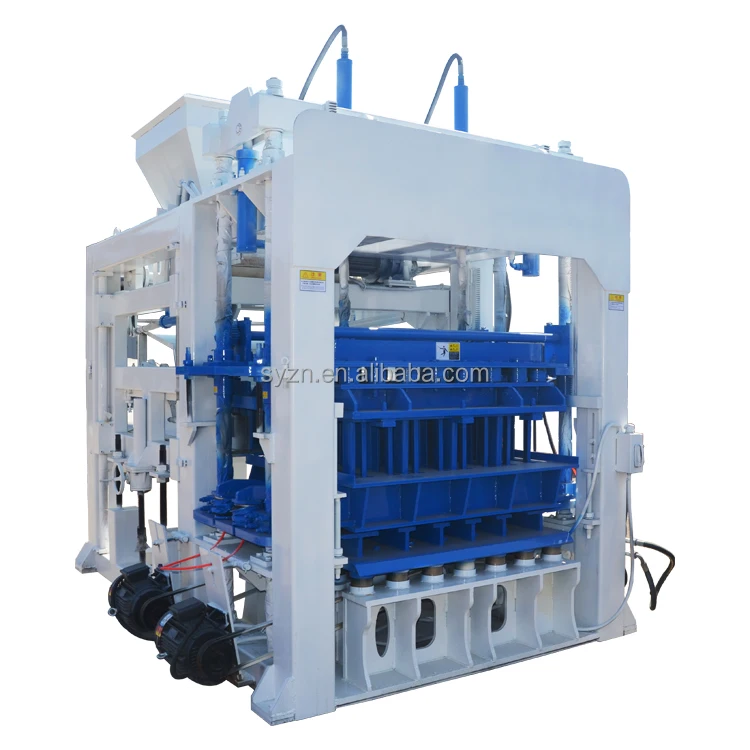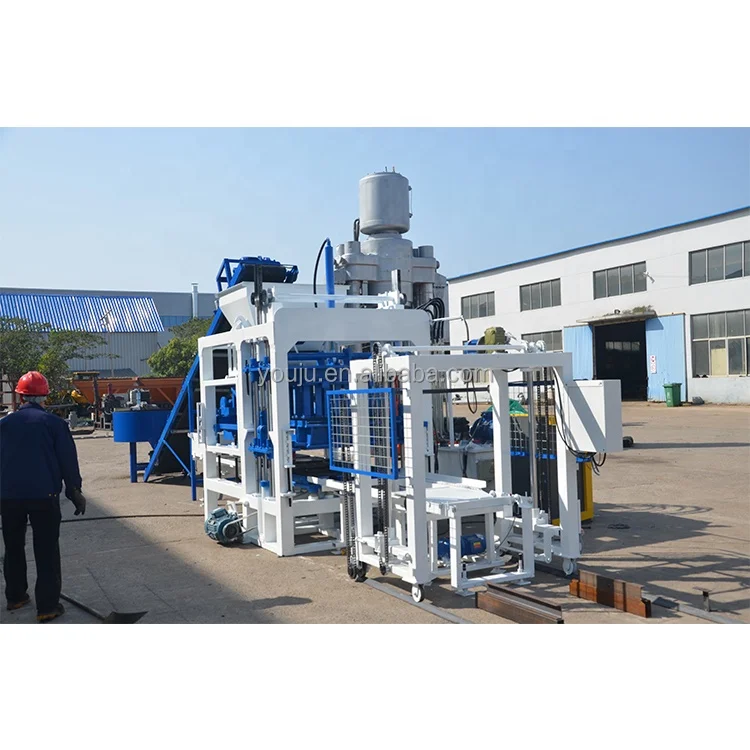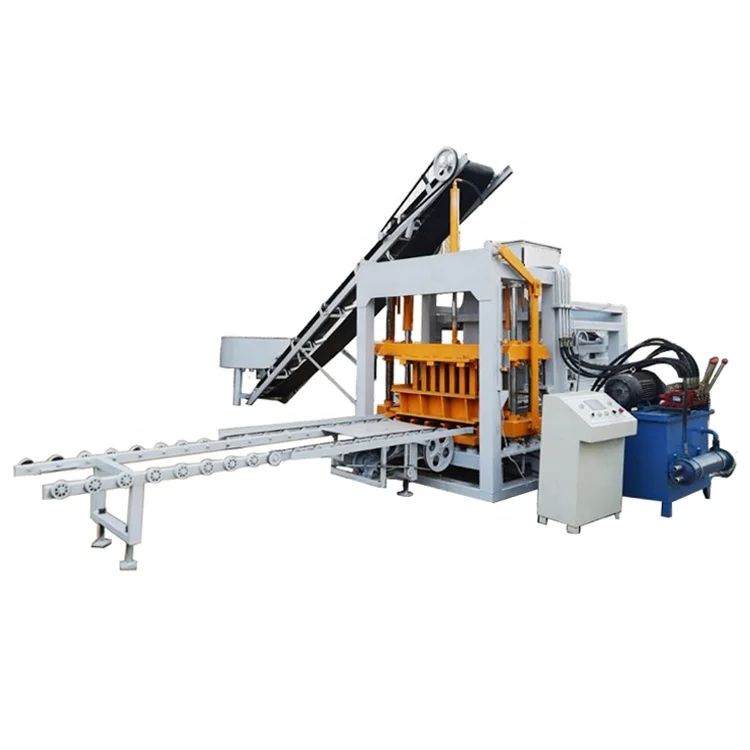


Description
Matched System Design — the QT4-20 press, moulds, pallets, and control logic are specified together against your local aggregate and target block format, preventing the cycle-time mismatch that occurs when stations are sourced separately.
Technical Specifications
| Parameter | Value |
|---|---|
| Model | QT4-20 |
| Product Type | Hydraulic Concrete Block Making Machine |
| Overall Dimensions (L×W×H) | 7100×1600×2610 mm |
| Rated Pressure | 16–21 MPa |
| Main Vibration Form | Platform Vibration |
| Vibration Frequency | 4600 r/min |
| Pallet Size | 950×500 mm |
| Molding Cycle | 15–25 s (basis not stated in source — confirm block format / material / thickness) |
| Overall Power | 27.5 kW |
| Control System | PLC with non-contact proximity switch monitoring |
| Hydraulic System | Integrated hydraulic drive |
| Automation Level | Semi-automatic (upgrade path to full automation available) |
| Mould Format Compatibility | Hollow block, solid block, paver, grass growing block, curbstone, standard brick |
Application Suitability
| Application | Material or Output |
|---|---|
| Hollow block production for commercial and residential walls | Sand, cement, fly ash, and crushed stone aggregates |
| Solid brick manufacturing for load-bearing structures | Cement, gangue, slag, and industrial waste residue |
| Paver and curbstone production for municipal infrastructure | High-density concrete mixes with fine aggregate |
| On-site block production for housing development projects | Locally sourced sand and cement with site-specific moisture content |
Why the PLC Language Question Must Precede the Order
Confirming the PLC display language and voltage before production starts eliminates the commissioning delay that strands machines on site for weeks.
I once watched a fully functional QT4-20 sit idle in a workshop for eighteen days because the PLC interface defaulted to a language the local operators could not read, and the voltage frequency did not match the plant’s transformer. The buyer had focused entirely on cycle time and pallet size during negotiation, assuming the control system would adapt itself [NEED_CITE: common commissioning delays caused by unconfirmed PLC language and voltage settings]. When you specify an automatic QT4-20 block making machine, the control logic and electrical configuration must be locked in writing before the first weld is made.
Automation Logic That Follows the Operator
The QT4-20 uses a PLC with non-contact proximity switch monitoring to track every stage of the pressing cycle without mechanical contact wear. This means the machine detects pallet position, mould alignment, and stack height through solid-state sensors rather than limit switches that degrade in dusty environments. For a plant owner moving from manual operation, this level of monitoring removes the guesswork from cycle consistency.
Building Automation in Stages
A semi-automatic configuration lets you start production with manual pallet handling while the PLC manages the press cycle and vibration timing. As volume grows, automatic pallet feeding, stacking, and cubing modules can be integrated into the same control architecture without replacing the core press. This upgrade path means your initial investment in the PLC controlled concrete block machine is not discarded when production scales.
Pressure and Vibration as a Single Equation
The 16–21 MPa hydraulic pressure and 4600 r/min platform vibration are not independent specifications — they must be balanced against the compressibility of your specific mix design. A fly-ash-heavy mixture requires different pressure-vibration timing than a crushed-stone aggregate [NEED_CITE: relationship between hydraulic pressure, vibration frequency, and aggregate type in block density]. The QT4-20’s integrated hydraulic drive allows these parameters to be adjusted together rather than forcing the operator to compensate for a mismatch at the control panel.
What Happens When Automation Is Specified Blindly
Plant owners who select automation features from a catalogue without mapping them to their actual workflow often find that the automatic stacker operates at a cycle speed the curing rack system cannot absorb, leaving pressed blocks queued on the line. The pallet size chosen for the press may not match the forklift tines already in the yard, requiring a separate capital purchase. These mismatches do not appear in the quotation stage but surface during the first week of production, where they cancel out the labour savings the automation was supposed to deliver [NEED_CITE: hidden costs of mismatched automation components in block production lines].
Configuration Anchored to Your Production Reality
The QT4-20 is specified against the buyer’s actual mix design, local aggregate availability, and target block format rather than a default catalogue configuration. Every mould is designed or selected for the formats your market actually purchases, and custom mould drawings are accommodated. The automation level is chosen based on your current labour structure and future volume plan, so a semi-automatic start can transition to full automation without a machine swap. Voltage, frequency, and PLC language are confirmed in a signed document before production begins. Installation support includes operator training on the specific control logic your machine carries.
Documentation & Verification
- Line layout and capacity calculation stating the exact block format assumed for each output figure
- Voltage, frequency, and PLC display language confirmation sheet signed before production
- Mould drawing and format list matched to your local market block dimensions
- Hydraulic and electrical schematic reflecting your confirmed power supply specification
- Factory test record demonstrating cycle performance on your specified block format
- Wear parts and mould list with part numbers provided at quotation stage
Installation, Commissioning & Support
- Foundation plan based on the QT4-20’s 7100×1600 mm footprint and dynamic vibration load
- Dedicated electrical circuit sized for the 27.5 kW total power draw and confirmed voltage
- Machine arrives dismantled for 40 ft high-cube container loading with reassembly guidance on site
- First-run commissioning includes vibration and pressure calibration to your local aggregate mix
- Operator training covers PLC interface navigation, proximity switch diagnostics, and mould change procedure
- Wear parts inventory list provided so first replacement orders can be placed without production interruption
What We Need to Configure Your Machine
To size the QT4-20 correctly for your plant, we need your target block formats with dimensions, your daily output requirement per format, and the composition of your local raw materials including aggregate type and moisture range. We also need your site voltage and frequency, preferred PLC display language, and the dimensions of your existing curing area and pallet handling equipment so the pallet specification integrates with what you already operate.
Frequently Asked Questions
Q: How is the QT4-20 output capacity verified per block format?
A: Every capacity figure we provide states the exact block format, mould cavity count, and cycle time assumed. A hollow block at 400×200×200 mm produces a different hourly output than a paver at 200×100×60 mm because the mould geometry and pressing time differ. We do not quote a single cycles-per-hour number without attaching it to a specific product.
Q: Can I add automatic pallet feeding and stacking later?
A: Yes. The QT4-20 PLC architecture supports integration of automatic pallet feeding, stacking, and cubing modules after initial commissioning. The upgrade uses the same proximity switch monitoring and control logic, so the transition does not require replacing the press or rewriting the automation sequence.
Q: How do you prevent commissioning delays from electrical mismatches?
A: Voltage, frequency, and PLC display language are captured on a signed confirmation sheet before production begins. This document is referenced during assembly and tested at the factory, so the machine arrives configured for your plant’s electrical supply and your operators’ language from the first power-on.
Q: How is vibration matched to my specific raw material?
A: The 4600 r/min platform vibration and 16–21 MPa hydraulic pressure are adjusted together based on your mix design and local aggregate. A porous fly-ash mix requires different timing than a dense crushed-stone mix, and the integrated hydraulic drive allows both parameters to be tuned as one system during commissioning.
Q: How long does a full mould change take on the QT4-20?
A: Mould change time depends on the format transition and operator familiarity. The machine architecture supports quick-release mould mounting, but the actual duration varies between a simple hollow-to-solid block swap and a transition to a complex paver pattern. We provide the procedure during operator training so your team can plan format rotation into shift scheduling.