

Small Block Plant Setup Under 100000 USD Turnkey for Sale
Buying the cheapest single block machine is the fastest way to burn your budget.
A complete small block plant setup under 100000 USD is fully achievable when you treat the forming machine as just one component of a balanced system—mixing, batching, curing, and site preparation must share the budget, not get starved by it.
I remember walking into a dusty yard outside Lagos where a buyer had parked a second-hand forming machine he picked up locally. No mixer. No proper batching. Just a wheelbarrow and a garden hose. He was blaming the machine for producing blocks that crumbled in his hands. The real problem was that the mixing ratio was guesswork, and the cement content swung wildly from batch to batch [NEED_CITE: impact of inconsistent water-cement ratio on concrete block compressive strength]. That scene replays across emerging markets every week. A small block plant setup under 100000 USD works—but only when the budget is split like a system, not thrown at a single shiny machine.
Let me walk you through what actually fits inside this budget, which machine type matches which grid condition, and where the hidden costs quietly kill first-year profits.
What Does a Complete Small Block Plant Under $100K Actually Include?
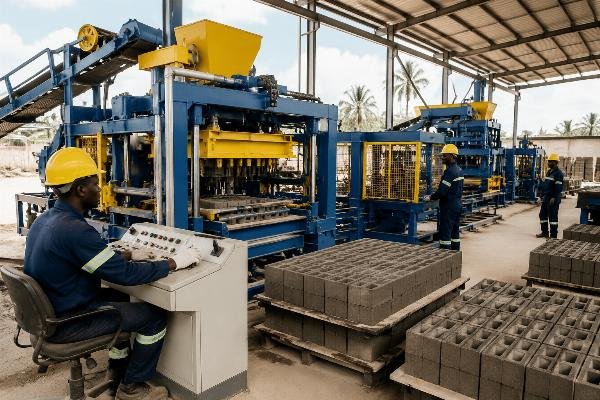
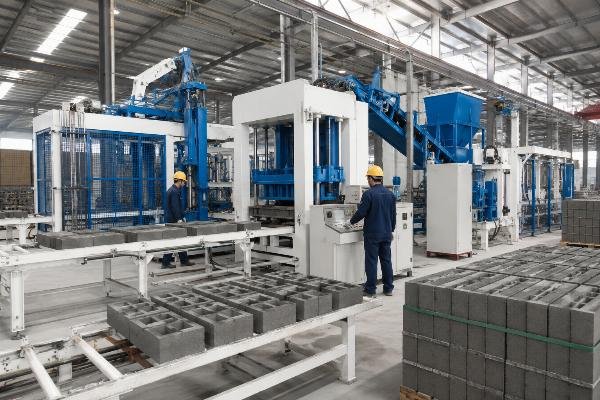
A turnkey small block plant setup under 100000 USD is never just the block machine—it is the forming unit, the mixing system, the batching setup, the pallet circuit, and the curing space working as one chain.
Too many first-time buyers fixate on the forming machine price and treat everything else as an afterthought. Then they wonder why daily output collapses or why blocks crack during curing. The forming machine is the heart, but the mixer is the lungs and the batching system is the bloodstream. Without them, the heart beats on nothing.
A realistic budget allocation for a small block plant setup under 100000 USD looks like this:
| Budget Segment | Typical Share | What It Covers |
|---|---|---|
| Forming Machine | Noticeably dominant share | Main block maker, hydraulic unit, control panel |
| Mixing & Batching | Substantial share | Pan or twin-shaft mixer, cement silo, aggregate bins |
| Moulds & Pallets | Moderate share | Multiple mould sizes, PVC or bamboo pallets |
| Curing & Site Works | Moderate share | Curing area prep, water supply, simple rack system |
| Installation & Training | Meaningful share | On-site commissioning, operator training, spare parts starter kit |
[NEED_CITE: typical cost breakdown structure for small-scale concrete block production lines]
A West African buyer once came to us with a quote from a European supplier that priced the forming machine alone at nearly the entire budget we were working within for a full line. He assumed the mixer and batching could be sourced locally for almost nothing. In reality, local sourcing ended up costing him several times what a matched system would have, because the local mixer could not handle the cycle time the machine demanded.
The lesson is simple: the forming machine should not eat more than a controlled portion of the budget. If it does, you are buying a heart with no body to support it.
QT4-25 vs QT6-15: Which Machine Fits Your Budget and Grid?
For a small block plant setup under 100000 USD, the QT4-25 mobile egg-layer suits unstable grids and low-labor sites, while the QT6-15 semi-automatic line fits stable power and higher decoration demand.
This is where most buyers get stuck. They see a fully automatic line and assume it is the only serious option. Then they install it in an area where voltage drops every afternoon, and the PLC board fries within weeks. Meanwhile, their neighbor runs a QT4-25 on a noisy generator and produces steadily.
Here is how the two machines compare in real field conditions:
| Parameter | QT4-25 Mobile Egg-Layer | QT6-15 Semi-Auto Static Line |
|---|---|---|
| Grid Requirement | Tolerant of fluctuations | Needs stable three-phase supply |
| Automation Level | Manual mould change, semi-auto cycle | Semi-auto cycle with PLC control |
| Daily Output Range | Moderate output, scalable with shifts | Substantially higher per-shift output |
| Operator Count | Minimal crew needed | Larger crew for feeding and stacking |
| Mould Flexibility | Quick mould swap for different shapes | Interlock and color feeder compatible |
| Best Fit | Rural sites, unstable power, starter budgets | Peri-urban yards, stable grid, decorative products |
[NEED_CITE: operational performance comparison of mobile vs static block machines in emerging market conditions]
An East African client running a QT6-15 with a color feeder produces interlocking bricks for a resort project. The grid in his area is reasonably stable, and he invested in a voltage stabilizer as insurance. His output per shift is noticeably higher than a QT4-25 yard, and the decorative range lets him charge premium prices. But he also runs a larger crew and pays more in electricity.
On the other hand, a buyer in a remote West African town runs a QT4-25 on a diesel generator. He moves the machine across the yard to lay blocks directly on the ground, eliminating pallet costs entirely. His crew is small, his overhead is low, and his payback timeline has been remarkably short because his operating cost per block is minimal.
Neither is universally better. The right choice depends on your grid, your labor cost, and whether you need decorative range or just volume.
How to Split Your $100K Budget Across Equipment, Site, and Training?
A disciplined small block plant setup under 100000 USD follows a rough proportion where equipment takes the largest share, site and moulds take a substantial share, and installation plus working capital reserve take the rest.
Buyers who blow their entire budget on the machine and show up on site with nothing left for pallets, cement silos, or operator training are the ones who call us six months later asking for emergency spare parts because their machine has been sitting idle.
Here is a field-tested allocation approach:
- Equipment core (machine, mixer, batching, silo): This is the dominant share. It covers the forming unit, the mixing system, and the material feeding circuit. Skipping the silo to save money is a false economy—bulk cement is noticeably cheaper per block than bagged cement over time [NEED_CITE: cost comparison of bulk cement silo versus bagged cement in small-scale block production].
- Moulds, pallets, and wear parts: A moderate share. You need at least two or three mould sizes to serve different market segments. Pallets are a recurring cost—budget for replacement cycles from day one.
- Site preparation and curing setup: A meaningful share. A leveled concrete yard, a water curing system, and simple stacking racks are not optional. Blocks that dry unevenly crack, and cracked blocks destroy your reputation faster than any competitor can.
- Installation, training, and spare parts reserve: The final share. On-site commissioning by experienced technicians prevents the classic mistake of local electricians wiring the panel wrong and burning the PLC. A starter spare parts kit—sensors, seals, a spare motor—keeps you running during the learning curve.
A Latin American client upgraded from a manual setup to a semi-auto line. He reserved a portion of his budget for a transition period where the old line kept running while the new one was being installed and tested. The overlap cost him a bit more upfront, but it prevented a total production halt. The old equipment was later sold locally, offsetting part of the investment.
What Hidden Costs Kill Small Block Plants in Year One?
The three silent budget killers in a small block plant setup under 100000 USD are废品率 from poor mixing, premature mould wear from abrasive local aggregate, and motor burnout from voltage instability.
These costs do not show up on the invoice. They show up in the yard, in the rejection pile, and in the midnight phone call saying the machine stopped.
Rejection rate from inconsistent mixing. When the mixer is undersized or the batching is done by eye, the water-cement ratio swings block to block. Some come out too wet and slump. Others come out too dry and crumble. The rejection pile grows, and nobody tracks it as a cost—it just feels like "bad luck." In reality, it is a mixing system problem, not a machine problem [NEED_CITE: relationship between batching accuracy and concrete block rejection rate].
Mould wear from abrasive aggregate. In regions where river sand contains high silt or crushed stone has sharp edges, mould liners wear out fast. Buyers who bought the cheapest moulds find themselves replacing them within months. The fix is not necessarily the most expensive mould—it is matching the mould material to the local aggregate abrasiveness and adjusting the mix design to reduce wear.
Motor and electrical burnout from unstable voltage. This is the most expensive surprise. A voltage spike can destroy a main motor or a PLC board in seconds. In areas with unreliable grids, a voltage stabilizer or a soft-start panel is not optional—it is insurance that pays for itself the first time it saves a motor. We have seen buyers skip the stabilizer to save a small amount, then replace a main motor for several times that saving.
A Middle East buyer in a dusty coastal area learned this the hard way. Salt-laden air corroded his electrical contacts within months. Simple sealed enclosures and routine contact cleaning—a negligible cost—would have prevented most of the downtime.
How Fast Can a $100K Plant Pay Itself Back?
A well-configured small block plant setup under 100000 USD, running at steady daily output with controlled material cost, can recover its investment within a relatively short cycle—typically measured in months rather than years.
Payback speed depends on three variables you can control: daily output volume, cost per block, and local selling price. You cannot always control the selling price—market rates are market rates—but you can control the other two.
Daily output is a function of machine type, shift length, and crew efficiency. A QT4-25 running two shifts with a small crew produces a moderate but steady volume. A QT6-15 on a single shift can match or exceed that, and on two shifts the gap widens noticeably.
Cost per block is driven by cement consumption, aggregate sourcing, and rejection rate. Buyers who invest in a proper batching system and a cement silo see their per-block cost drop substantially compared to those mixing by hand with bagged cement [NEED_CITE: impact of mechanized batching on per-unit cement consumption in block production].
Selling price is influenced by block quality and product range. A buyer offering consistent, well-cured blocks commands a better price than one whose blocks crack on site. Adding decorative or interlocking products through additional moulds or a color feeder opens premium segments that plain blocks cannot reach.
A South Asian client running a QT6-15 line reported that his gross margin per block was healthy enough to cover operating costs and debt service simultaneously. His payback timeline fell within the shorter end of the typical range because he kept his rejection rate low through disciplined batching and invested in curing from day one.
The math is straightforward: if your per-block margin is solid and your daily volume is steady, the investment recovers itself. The buyers who struggle are the ones whose margins get eaten by rejection, rework, and emergency repairs—the hidden costs we discussed above.
Conclusion
A small block plant setup under 100000 USD is not a compromise—it is a disciplined system build. The forming machine matters, but the mixer, the batching, the curing, and the site preparation matter just as much. Match your machine to your grid and your market, split the budget like a system rather than a shopping list, and guard against the hidden costs that silently destroy first-year margins. When these pieces align, the payback follows.
Leave a Reply