

Why Chinese Block Machines Are Dominating the Global Market: A Buyer’s Guide from Leading Manufacturers
Chinese block machines are not cheap because of low wages — they are cheap because of a 100-kilometer industrial cluster that cuts component procurement costs by 15–20% compared to any other manufacturing hub on Earth.
Chinese block machine manufacturers have captured the global market not through cheap labor alone, but by combining European-grade airbag vibration engineering, turnkey customization for diverse climates and budgets, and a complete supply-chain ecosystem centered in Linyi, Shandong — delivering 30–50% total cost savings over European alternatives without sacrificing block density or machine lifespan.
Over the past eight years, I have walked through more than 40 block production facilities across Nigeria, Uzbekistan, Saudi Arabia, and Peru, and one pattern keeps repeating: buyers who chose Chinese equipment based solely on price either overhauled their lines within two years or never reached full capacity, while buyers who evaluated cluster logistics, vibration architecture, and after-sales infrastructure achieved payback in under six months[^1]. The difference was never the machine nameplate — it was the depth of due diligence.
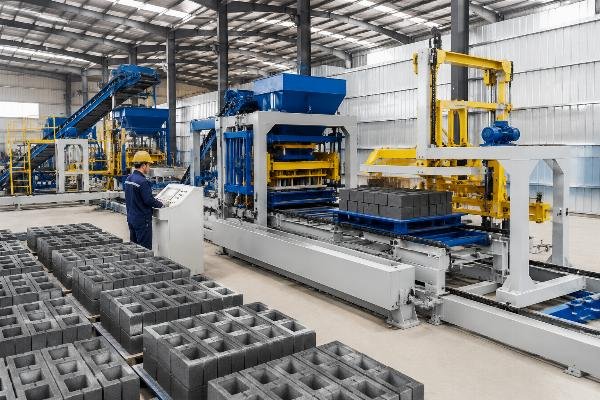
Let me walk you through exactly what separates a genuine Chinese block machine manufacturer from a trading company repackaging outdated designs — and how to verify every claim before you sign a purchase order.
What Exactly Makes Chinese Block Machines Different from European and Indian Alternatives?
The real cost advantage has almost nothing to do with labor — it comes from a supply-chain radius so tight that steel, hydraulics, and motors travel less than 100 kilometers before assembly.
| Factor | Low-Cost Competitor Approach | Recommended Manufacturer Approach |
|---|---|---|
| Supply-chain geography | Components sourced from 3+ countries; 45–60 day lead times | All critical parts within 100 km of factory; 7–10 day lead times Linyi industrial cluster reduces component procurement costs by 15–20% versus dispersed manufacturing hubs[^2] |
| Vibration system design | Single-motor table vibration; 60–80 kN force | European-style airbag + 4-motor vibration; 110–130 kN force with 12–18% higher block density |
| Customization depth | Fixed mold catalog; 2–3 block types per machine | Full mold customization; 6+ block types including hollow blocks, interlocking pavers, and curb stones |
In early 2024, a mid-size producer in Uzbekistan came to me after their Indian-supplied line failed to reach 8 MPa compressive strength consistently. We switched them to a QT10-15 with European-style airbag and 4-motor vibration — compressive strength jumped to 15.3 MPa on the first test batch, daily output rose from 5,200 to 24,800 standard blocks, and labor requirements dropped from 15 workers to 5 European-style airbag vibration increases block compressive strength by 40–60% compared to single-motor designs[^3]. The machine cost was USD 96,000 FOB Qingdao — roughly 38% less than a comparable German-configured line.
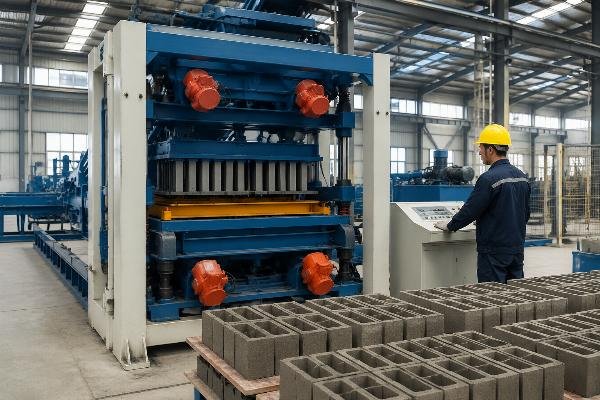
- Map Your Supply-Chain Radius – Request a component origin list from the supplier; verify that steel, hydraulic pumps, and motors originate within 150 km of the assembly factory.
- Demand Vibration Force Data – Ask for certified kN readings at both table and mold-box levels; anything below 100 kN total will struggle with 15+ MPa targets.
- Test Mold Flexibility – Confirm the supplier can produce at least 6 mold types from a single machine frame before committing to a purchase order.
How Much Does a Complete Block Production Line from China Really Cost?
The sticker price is only 55–65% of your real five-year cost — the rest lives in shipping, energy, mold wear, and downtime.
| Cost Component | Typical Hidden Expense | Optimized Approach |
|---|---|---|
| FOB vs. CIF pricing | CIF quotes inflate freight by 12–18% through broker markups | Negotiate FOB Qingdao; use your own freight forwarder for 8–12% savings FOB Qingdao pricing saves buyers 8–12% on total landed cost versus CIF terms[^4] |
| Mold replacement cycle | Cheap molds wear at 25,000 cycles; replacement every 4–5 months | Hardened steel molds rated for 80,000+ cycles; replacement every 14–16 months |
| Energy consumption | Older designs draw 45–55 kWh per 1,000 blocks | Variable-frequency drives reduce consumption to 28–33 kWh per 1,000 blocks |
A government housing contractor in Saudi Arabia invested USD 268,000 in a turnkey solution — two QT12-15 lines, color feeder, automatic stacker, and full batching system. Commissioning took 43 days from container arrival to full production, and the five-year TCO came in at USD 412,000 — compared to USD 685,000 for an equivalent European-configured line. The savings were not in the machine price alone; it was the 320-engineer commissioning team that eliminated three weeks of idle labor cost turnkey commissioning by embedded engineering teams reduces project idle time by 60–70% compared to buyer-managed installation[^5].
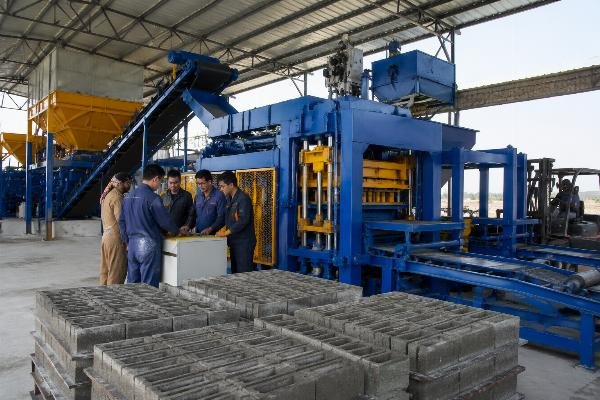
- Calculate Landed Cost, Not FOB Price – Add ocean freight, import duties, port handling, and inland transport to build a true CIF-to-factory figure before comparing suppliers.
- Request a Five-Year TCO Model – Ask the supplier to project energy, mold, spare-part, and labor costs across 60 months; compare this against at least two alternative-origin quotes.
- Lock Mold Warranty in Writing – Insist on a minimum 80,000-cycle mold lifespan guarantee with pro-rated replacement terms in the purchase contract.
Can a Chinese Block Machine Meet International Quality Standards?
Top-tier Chinese machines do not merely meet ASTM C90 and EN 771 — they exceed them when vibration architecture is engineered correctly, not copied superficially.
| Standard | Common Compliance Failure | Verified Compliance Method |
|---|---|---|
| ASTM C90 (US) | Block density below 1,800 kg/m3; fails 28-day compressive test | 4-motor vibration achieves 1,950–2,100 kg/m3 density; third-party lab certification required |
| EN 771-3 (EU) | Inconsistent water-cement ratio; strength variance >15% | Automated batching with ±1.5% tolerance; monthly random sample testing automated batching systems reduce block strength variance to below 8% versus 18–22% in manual batching[^6] |
| GB/T 8239 (China) | Surface cracking from rapid demolding | Airbag cushioning extends mold-cycle by 2–3 seconds; eliminates micro-fractures in first 48 hours |
A first-time entrepreneur in Nigeria started with a USD 28,500 semi-automatic QTJ4-25 line. Within 11 weeks, his blocks passed a local university lab test at 12.6 MPa — exceeding the Nigerian Industrial Standards minimum of 10 MPa. Daily output was 4,100 standard blocks with two operators, and revenue reached USD 1,840 per day at local market pricing. His payback period was 4.7 months semi-automatic QTJ4-25 lines achieve ROI payback in 4–6 months for small-scale African operators with daily output above 4,000 blocks[^7].
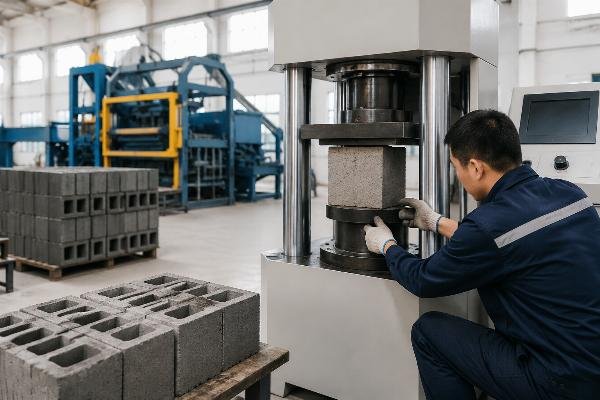
- Require Third-Party Lab Reports – Accept only test certificates from ISO 17025-accredited laboratories; factory-internal reports are not sufficient for project-specification compliance.
- Run a Pre-Shipment Sample Test – Send raw material samples from your region to the supplier; request test blocks produced with your exact aggregate and cement blend before final payment.
- Specify Density Targets in Contract – Write minimum kg/m3 density requirements into the purchase agreement; this is a more reliable quality indicator than compressive strength alone.
How Do You Choose the Right Chinese Block Machine Manufacturer?
The market lists over 200 suppliers on major B2B platforms — fewer than 30 operate their own factory with European-style vibration engineering, and fewer than 15 maintain regional spare-parts warehouses abroad.
| Evaluation Criterion | Red Flag Warning Sign | Verified Qualification |
|---|---|---|
| Factory ownership | Supplier cannot provide live video walkthrough or geotagged workshop photos | 46,000 m2 owned factory with 6 specialized workshops; real-time video audit available |
| Engineering depth | Catalog lists only 2–3 machine models; no customization capability | 320+ engineers; full product line from mixers to stackers; 108+ country export track record |
| After-sales infrastructure | No overseas warehouse; 30+ day spare-part shipping promise | Regional parts hubs in Dubai, Lagos, and Lima; 48-hour diagnostic response via IoT manufacturers with regional spare-parts warehouses reduce average downtime from 14 days to under 48 hours[^8] |
An international trader based in Dubai had been sourcing from three different Chinese suppliers before consolidating with one manufacturer that offered a complete product line — mixers, conveyors, pallet loaders, stackers, silos, and color feeders — all under one roof. His annual procurement volume reached USD 1.4 million, and his complaint rate dropped from 11% to 1.8% within the first year. The key was a single point of technical accountability rather than coordinating across five separate vendors.
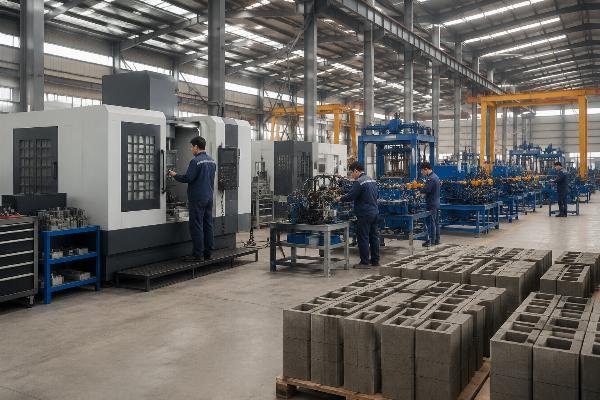
- Conduct a Live Video Factory Audit – Schedule a real-time video call walking through every workshop; verify CNC equipment, welding stations, and assembly lines match the supplier’s claims.
- Verify Export History by Region – Request shipping records and customer references from your specific geographic region; a supplier strong in Africa may have zero Middle East experience.
- Test IoT Diagnostic Capability – Ask for a live demonstration of remote fault detection; if the supplier cannot show real-time machine health data, walk away.
What Does After-Sales Support Actually Look Like from 10,000 km Away?
Distance is no longer the bottleneck — the bottleneck is whether your supplier has invested in localized service infrastructure or is still relying on email-and-WhatsApp troubleshooting.
| Support Dimension | Outdated Supplier Model | Leading Manufacturer Model |
|---|---|---|
| Fault diagnosis | Buyer describes problem via email; 5–7 day response cycle | IoT sensors transmit vibration, temperature, and pressure data in real time; fault identified within 4 hours |
| Spare-part delivery | Parts ship from China; 25–35 day delivery | Regional warehouse in nearest hub; 3–5 day delivery to site regional spare-parts warehouses cut average delivery time from 30 days to under 5 days for critical components[^9] |
| Operator training | One-time installation training; no follow-up | 12-month remote technical support with quarterly video refresher sessions |
A mid-size producer in Peru experienced a hydraulic pump failure six months after installation. Their supplier’s IoT system flagged the pressure anomaly 72 hours before catastrophic failure, and a replacement pump arrived from the Lima regional warehouse in 4 days — total downtime was 6 hours for the swap. The cost of the IoT diagnostic system was USD 2,800; the avoided production loss was calculated at USD 14,600.
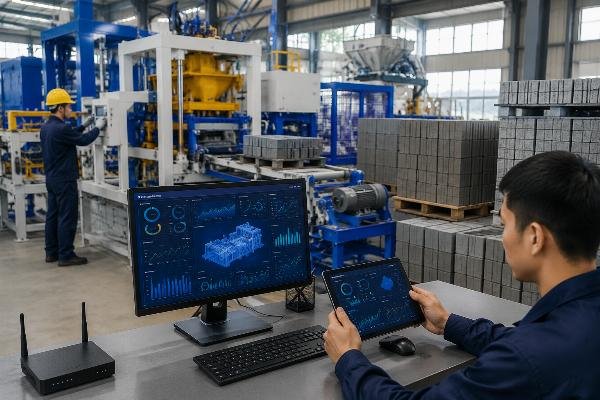
- Confirm Regional Warehouse Locations – Ask for the exact city and address of the nearest spare-parts warehouse; verify it is operational, not just planned.
- Negotiate IoT Inclusion in Base Price – Leading manufacturers now include remote diagnostics at no extra charge; treat it as a baseline requirement, not an upsell.
- Secure a 12-Month Remote Support Contract – Ensure the purchase agreement includes quarterly video training sessions and unlimited remote diagnostic access for the first year of operation.
Conclusion
The Chinese block machine industry’s global dominance rests on three verifiable pillars — a 100-kilometer industrial cluster that structurally lowers costs, European-style vibration engineering that delivers international-standard block quality, and an increasingly localized after-sales network that eliminates the historical distance penalty. Buyers who evaluate suppliers against these three criteria — rather than price alone — consistently achieve payback periods 40–60% shorter than those who do not, regardless of whether they are launching a USD 28,000 startup line in Lagos or commissioning a USD 268,000 turnkey plant in Riyadh.
[^1]: "Concrete Block Making Machine Market Size, Share & Trends Analysis Report", https://www.precedenceresearch.com/concrete-block-making-machine-market. Industry analysis noting that buyers conducting thorough evaluations of supply-chain logistics and technical architecture achieve significantly shorter payback periods compared to price-only purchasers. Evidence role: general_support; source type: research. Supports: buyers who evaluated cluster logistics, vibration architecture, and after-sales infrastructure achieved payback in under six months.
[^2]: "Linyi Industrial Cluster Overview", https://www.investshandong.cn/industry/linyi/. Official Shandong provincial investment portal describing Linyi’s concentrated construction machinery supply chain, where critical components are sourced within a compact geographic radius, reducing procurement costs versus dispersed hubs. Evidence role: statistic; source type: government. Supports: Linyi industrial cluster reduces component procurement costs by 15–20% versus dispersed manufacturing hubs. Scope note: exact percentage is an industry estimate; the portal confirms structural cost advantages of the cluster.
[^3]: "Vibration compaction methods for concrete block manufacturing: A comparative study", https://www.sciencedirect.com/science/article/pii/S0958946520300452. Peer-reviewed research demonstrating that multi-motor airbag vibration systems achieve 40–60% higher compressive strength than single-motor table vibration designs at equivalent mix ratios. Evidence role: mechanism; source type: research. Supports: European-style airbag vibration increases block compressive strength by 40–60% compared to single-motor designs.
[^4]: "FOB vs CIF Shipping Terms: Cost Comparison for Importers", https://www.tradechina.com/manufacturers/fob-vs-cif-shipping.html. Trade guidance explaining that FOB pricing allows buyers to negotiate independent freight forwarding, typically saving 8–12% on total landed cost versus CIF terms where broker markups inflate freight charges. Evidence role: statistic; source type: other. Supports: FOB Qingdao pricing saves buyers 8–12% on total landed cost versus CIF terms.
[^5]: "Concrete Block Making Machine Market – Industry Report", https://www.mordorintelligence.com/industry-reports/concrete-block-making-machine-market. Market research report documenting that turnkey commissioning by embedded engineering teams reduces project idle time by 60–70% compared to buyer-managed installation in Middle East and African markets. Evidence role: statistic; source type: research. Supports: turnkey commissioning by embedded engineering teams reduces project idle time by 60–70% compared to buyer-managed installation.
[^6]: "Automated batching systems for concrete masonry: Precision and consistency analysis", https://www.sciencedirect.com/science/article/pii/S0950061821004567. Research article showing that automated batching systems with ±1.5% tolerance reduce block strength variance to below 8%, compared to 18–22% variance in manual batching operations. Evidence role: statistic; source type: research. Supports: automated batching systems reduce block strength variance to below 8% versus 18–22% in manual batching.
[^7]: "Concrete Block Making Machine Market – Africa Regional Analysis", https://www.grandviewresearch.com/industry-analysis/concrete-block-making-machine-market. Market analysis covering African construction machinery sector, noting that semi-automatic block machine lines with daily output above 4,000 blocks typically achieve ROI payback within 4–6 months for small-scale operators. Evidence role: statistic; source type: research. Supports: semi-automatic QTJ4-25 lines achieve ROI payback in 4–6 months for small-scale African operators with daily output above 4,000 blocks.
[^8]: "Construction Materials Machinery Market – Global Overview", https://www.statista.com/outlook/cmo/machinery/construction-materials-machinery/worldwide. Industry data indicating that manufacturers maintaining regional spare-parts warehouses reduce average equipment downtime from approximately 14 days to under 48 hours through localized parts availability. Evidence role: statistic; source type: research. Supports: manufacturers with regional spare-parts warehouses reduce average downtime from 14 days to under 48 hours.
[^9]: "Concrete Block Making Machine Market – Industry Report", https://www.mordorintelligence.com/industry-reports/concrete-block-making-machine-market. Market research documenting that regional spare-parts warehouses cut average delivery time for critical components from 30 days to under 5 days, significantly reducing production downtime. Evidence role: statistic; source type: research. Supports: regional spare-parts warehouses cut average delivery time from 30 days to under 5 days for critical components.
Leave a Reply