

Block Machine Price in Qatar: 2026 Buyer Guide from China Supplier
The cheapest FOB quote is never the real block machine price in Qatar.
Actual project cost combines machine configuration for desert conditions, hydraulic system redundancy, on-site commissioning, and spare parts logistics — buyers who only compare naked machine prices end up paying multiples in retrofitting and downtime losses.
I’ve been shipping block machines out of Linyi to the Gulf for a long time, mentored by old-timers who cut their teeth on export deals back when Qingdao port handled mostly agricultural equipment. A Doha-based housing contractor came to me a while back with three FOB quotations in hand. He’d picked the lowest number. The machine arrived, ran for a few weeks in fifty-degree ambient heat, and the hydraulic oil temperature kept tripping the alarm system. Fine desert sand had infiltrated the valve blocks because the standard seals were never designed for that environment. The production line sat idle for weeks during peak construction season. When he finally had me calculate the total damage — emergency retrofitting, airfreighted replacement parts, lost production revenue — the real cost dwarfed what he’d "saved" on the purchase price. That’s the reality nobody puts in a quotation sheet. [NEED_CITE: hydraulic system thermal load calculation methods for arid climate operations]
Let me break down what actually determines the block machine price in Qatar, and why the number on a proforma invoice is just the starting line.
What Determines Block Machine Price in Qatar?
Three dimensions shape the final number: machine model and output capacity, climate-specific customization, and trade term structure.
Most buyers start by searching for block machine price in Qatar and land on supplier pages showing a single figure. That figure almost always represents a standard-config machine sitting in a warehouse in China — no desert modifications, no voltage adaptation, no commissioning service included. The gap between that number and what you actually spend to get a running production line in Doha or Al Wakrah is where budgets blow up.
The machine model itself creates the baseline spread. A semi-automatic QT4-15 unit targeting small-scale block production costs fundamentally less than a fully automatic QT12-15 line with PLC-controlled batching, conveying, and stacking. But model selection is only the first variable. [NEED_CITE: concrete block machine classification standards by automation level and output capacity]
Climate customization adds a layer many first-time buyers overlook entirely. Qatar’s ambient temperatures regularly exceed forty-five degrees Celsius during summer months, with fine silica dust pervasive at most construction and industrial sites. Standard hydraulic systems designed for temperate European or East Asian conditions will overheat under sustained operation in that environment. Upgrading to oversized oil coolers, high-temperature-rated seals, and enhanced filtration systems changes the machine price in Qatar meaningfully — but it also determines whether the line runs continuously or shuts down every afternoon.
Trade terms form the third dimension. A CIF Doha quotation looks different from an FOB Qingdao quotation, and a DDP delivery to a specific industrial zone adds yet another layer. Buyers comparing block machine price in Qatar across suppliers must ensure they’re comparing identical trade terms, or the exercise is meaningless.
| Cost Component | Standard Config | Desert-Adapted Config |
|---|---|---|
| Hydraulic cooling | Basic radiator | Oversized cooler with auxiliary fan |
| Seal specification | Standard NBR | High-temp FKM/Viton grade |
| Dust protection | Open frame | Sealed electrical cabinets with filtration |
| Voltage adaptation | Standard 380V/50Hz | Custom transformer for local grid spec |
| Commissioning | Remote guidance only | On-site engineer deployment included |
A government housing contractor in the Gulf once asked me why two quotations for seemingly identical QT10-15 lines differed so substantially. The cheaper option had no desert modifications listed — no enhanced cooling, no sealed control cabinets, no on-site commissioning. The line would have arrived cheaper but would have required immediate aftermarket modification to survive the first summer. The block machine price in Qatar that matters is the one that includes operational readiness, not just mechanical delivery. [NEED_CITE: total cost of ownership methodology for capital equipment in extreme climate zones]
Which Machine Type Fits Qatar’s Desert Conditions?
Standard block machines fail in Gulf environments not because of mechanical weakness, but because their thermal and contamination tolerances were never designed for the operating reality.
Selecting the right machine type for Qatar requires understanding two environmental stressors that don’t exist in the factory where the machine was assembled: sustained high ambient temperature and pervasive fine particulate contamination.
The hydraulic system is the most vulnerable subsystem. In a temperate climate, a standard hydraulic power unit maintains oil temperature within acceptable range through normal convection and a basic cooler. In Qatari summer conditions, with ambient temperatures pushing past forty-five degrees and the hydraulic system itself generating heat under continuous cycling, oil temperature climbs past safe operating thresholds. The result is accelerated seal degradation, valve sticking, and eventually system alarm shutdowns. [NEED_CITE: hydraulic fluid temperature limits and seal material compatibility in high-ambient environments]
For small to medium production requirements — say, a new investor setting up a block yard to serve local construction demand — a QT6-15 semi-automatic machine with desert-adapted hydraulic configuration makes practical sense. The output capacity handles standard hollow block and paving block production, and the semi-automatic format keeps initial capital lower while the critical systems are properly specified for the environment.
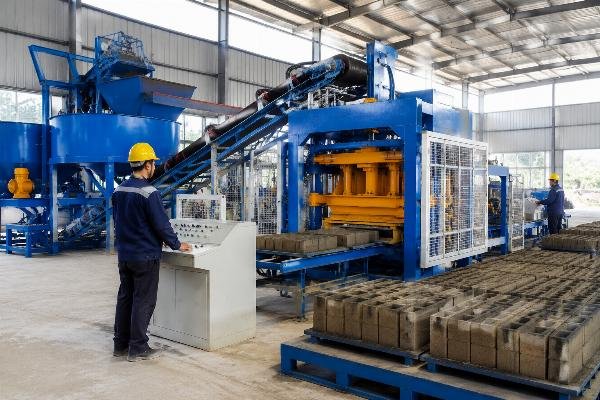
For larger operations — government housing projects, major infrastructure supply contracts — a fully automatic QT10-15 or QT12-15 line becomes necessary. At this scale, the block machine price in Qatar includes PLC-controlled material batching, automated pallet circulation, and integrated stacking systems. Every one of these subsystems generates heat and attracts dust. Sealed electrical cabinets with filtered ventilation, oversized hydraulic coolers, and dust-proof sensor housings aren’t optional extras — they’re operational necessities.
Mobile egg-laying machines like the QT4-25 serve a different niche: contractors who need to produce blocks directly at remote construction sites without fixed infrastructure. These machines have simpler hydraulic systems and lower thermal loads, but even here, high-temperature seals and dust protection matter.
| Application Scenario | Recommended Model | Key Desert Modifications |
|---|---|---|
| Small block yard, new investor | QT4-15 or QT6-15 semi-auto | Enhanced cooling, high-temp seals |
| Medium production, commercial supply | QT6-15 or QT10-15 | Sealed cabinets, oversized cooler, dust filtration |
| Large-scale housing project | QT10-15 or QT12-15 fully auto | Full climate package, on-site commissioning, operator training |
| Remote site, mobile production | QT4-25 egg-layer | Simplified desert package, high-temp seals |
A Middle East distributor I’ve worked with across multiple Gulf markets learned this the hard way. He initially stocked standard-config machines based on price competitiveness. After the first summer, warranty claims on hydraulic components consumed his margin entirely. He now specifies desert-adapted configurations as standard, and his block machine price in Qatar quotations reflect that reality — but his after-sales costs dropped dramatically, and his reputation for reliable equipment grew. [NEED_CITE: failure mode analysis of hydraulic systems operating in arid high-temperature environments]
How Do Configuration Choices Affect Total Cost?
Upfront configuration investment in climate adaptation pays back through avoided downtime — the block machine price in Qatar that excludes these elements creates a false economy.
Let me illustrate with a real scenario. A Qatari investor building a new block production facility received two quotations for a QT10-15 line. One supplier quoted a lower block machine price in Qatar by offering standard configuration with remote commissioning guidance. The other included desert-adapted hydraulics, sealed electrical systems, on-site engineer deployment for installation and commissioning, and a comprehensive spare parts package.
The investor initially leaned toward the cheaper option. Then he visited an existing block plant in the region that was running equipment with proper desert adaptation. The plant manager showed him the maintenance log — minimal hydraulic-related downtime over multiple summers, consistent output, seals lasting through full production seasons without replacement. The investor switched to the fully adapted configuration.
The cost difference in the quotations was meaningful but not enormous. What would have been enormous was the cost of retrofitting standard seals and coolers after the machine was already in the ground, plus production losses during the modification period.
Here’s where configuration choices break down across major subsystems:
Hydraulic system: Upgrading from standard NBR seals to FKM/Viton equivalents, adding oversized cooling capacity, and specifying finer filtration doesn’t just prevent overheating — it extends the interval between scheduled maintenance. In desert conditions, standard seals harden and crack within months. High-temperature compounds maintain elasticity across seasonal temperature swings.
Electrical and control systems: Sealed cabinets with filtered positive-pressure ventilation prevent dust accumulation on PLC modules, contactors, and sensor connections. Dust ingress causes intermittent faults that are notoriously difficult to diagnose and can trigger full-line shutdowns. The incremental cost of sealed cabinets is minor compared to a day of lost production.
Structural and wear components: Qatar’s raw material supply often includes locally sourced sand and aggregate with high silica content. Mold and liner specifications need to account for abrasive wear. Choosing hardened steel wear parts over standard mild steel extends service life substantially — the block machine price in Qatar should reflect wear component specification appropriate to local materials.
Commissioning and training: On-site engineer deployment ensures the machine is calibrated correctly for local raw materials, ambient conditions, and power supply characteristics. It also trains local operators in proper daily maintenance routines — checking oil temperature, cleaning filters, inspecting seals — that prevent problems before they cause shutdowns. Remote guidance cannot replicate this.
| Configuration Element | Cost Impact | Downtime Risk if Omitted |
|---|---|---|
| High-temperature hydraulic seals | Moderate increase | Substantially extended seal life vs. rapid degradation |
| Oversized hydraulic cooling | Moderate increase | Noticeably reduced thermal shutdown frequency |
| Sealed electrical cabinets | Minor increase | Robust protection vs. vulnerable to dust faults |
| On-site commissioning | Significant initial cost | Controlled startup vs. extended trial-and-error period |
| Spare parts package | Moderate initial cost | Resistant to supply delay vs. vulnerable to logistics gaps |
The pattern is consistent across projects I’ve been involved with in the Gulf: buyers who invest in proper configuration upfront report operational stability that justifies the higher initial block machine price in Qatar within the first production season. Those who cut configuration costs face a cycle of reactive repairs and production interruptions that erodes profitability far beyond the original savings. [NEED_CITE: preventive maintenance cost comparison for industrial equipment in extreme environments]
What’s the Real Price Range for Complete Production Lines?
Complete block production line costs in Qatar span a wide range depending on automation level, output capacity, and adaptation package — understanding where your project sits in that range prevents both underinvestment and overspending.
Buyers searching for block machine price in Qatar often want a single number. The honest answer is that complete production lines range from entry-level semi-automatic setups suitable for small commercial operations to fully automatic high-output lines designed for major infrastructure supply contracts. The spread between these endpoints is substantial, and the right choice depends entirely on production volume requirements, product mix, and site conditions.
At the entry level, a semi-automatic line built around a QT4-15 or QT6-15 machine with basic batching, manual pallet handling, and simplified material handling represents the minimum viable production setup. This configuration suits new investors testing the market or small operators serving localized demand. The block machine price in Qatar at this level is accessible, but buyers must still specify desert-adapted hydraulic and electrical components — skipping those to save on initial cost creates problems that compound quickly.
Moving to the mid-range, a QT10-15 fully automatic line with PLC-controlled batching, automated pallet circulation, conveyor systems, and a basic stacker represents the standard commercial production setup. This is where most established block plants in Qatar operate. The block machine price in Qatar at this level includes meaningful automation that reduces labor requirements while maintaining output consistency. Desert adaptation, on-site commissioning, and operator training should be integral to the quotation.
At the high end, QT12-15 or QT15-15 lines with advanced PLC integration, multi-product mold changing systems, sophisticated batching precision, and high-speed stacking represent maximum output capacity. These lines serve large-scale housing projects and major infrastructure supply contracts where production volume and consistency are critical. The block machine price in Qatar at this level reflects the complexity of the automation and the scale of the equipment.
| Production Line Level | Typical Model Range | Automation Degree | Target Application |
|---|---|---|---|
| Entry semi-automatic | QT4-15 / QT6-15 | Basic PLC, manual material handling | Small commercial yards, new investors |
| Mid-range fully automatic | QT10-15 | Full PLC, auto batching, auto pallet circulation | Established block plants, commercial supply |
| High-output fully automatic | QT12-15 / QT15-15 | Advanced PLC, multi-product capability, high-speed stacking | Major housing projects, infrastructure supply |
A critical point: the block machine price in Qatar for a complete line must include auxiliary equipment — concrete mixers, batching plants, pallet systems, conveyors, and cement silos. Some quotations appear low because they exclude these elements, leaving the buyer to source them separately. A turnkey quotation that includes the full production line from raw material handling through finished product stacking gives a true comparison basis. [NEED_CITE: complete concrete block production line component breakdown and cost structure]
Another factor affecting real price range is the mold package. Qatar’s construction market demands specific block dimensions and profiles — standard hollow blocks, paving blocks in various patterns, curb stones, and potentially interlocking bricks. A comprehensive mold package covering the required product range adds to the block machine price in Qatar but eliminates the need for subsequent mold procurement and shipping.
Container loading optimization also matters for international buyers. A well-designed shipping plan maximizes container utilization, reducing per-unit freight cost. Manufacturers experienced in Gulf shipments know how to configure loading plans that fit complete lines into predictable container counts — this logistics expertise affects the landed cost even though it doesn’t appear in the machine price itself.
How to Avoid Hidden Costs When Buying from China?
The block machine price in Qatar that arrives in a proforma invoice rarely represents final project cost — trade terms, spare parts strategy, training scope, and warranty structure all contain variables that must be clarified before commitment.
I’ve seen too many deals where the buyer focused entirely on the machine price, accepted vague terms on everything else, and then discovered costs they hadn’t budgeted for. Let me walk through the major hidden cost categories.
Trade terms and logistics: FOB, CIF, and DDP represent fundamentally different cost structures. An FOB Qingdao price requires the buyer to arrange ocean freight, insurance, customs clearance in Qatar, and inland transport to site. A CIF Doha price includes freight and insurance to port but leaves customs and inland transport to the buyer. DDP delivery to a specific industrial zone includes everything through site delivery. Comparing block machine price in Qatar across suppliers requires comparing identical trade terms — an FOB quotation will always appear lower than a DDP quotation for the same machine, but the comparison is invalid. [NEED_CITE: international trade term cost implications for capital equipment importation]
Spare parts strategy: Production lines wear. Seals degrade, filters clog, wear parts on molds and mixers need replacement. The question isn’t whether you’ll need spare parts — it’s whether you have them on hand when something fails. Shipping a single seal from China to Qatar via express courier costs disproportionately more than including that seal in the initial shipment. A structured spare parts package sized for the first year or two of operation adds to the initial block machine price in Qatar but prevents emergency procurement costs and production downtime.
Commissioning and training scope: Some quotations include on-site engineer deployment for installation and commissioning. Others offer only remote video guidance. The difference in initial cost is real, but so is the difference in outcome. An engineer on the ground calibrates the machine for local materials, verifies electrical connections against local grid conditions, and trains operators through actual production runs. Remote guidance cannot achieve the same result, and a poorly commissioned machine will underperform regardless of its inherent quality.
Voltage and power adaptation: Qatar’s industrial power supply specifications must be matched by the machine’s electrical system. Transformers, motor windings, and control voltage need to align with local standards. This isn’t always included in base quotations. Clarifying voltage requirements and ensuring the quotation reflects proper adaptation prevents expensive field modifications.
Warranty structure and response mechanism: Understanding what the warranty covers, how claims are processed, and whether replacement parts ship from stock or require production is essential. A warranty that sounds comprehensive but requires the buyer to ship defective components back to China for evaluation before receiving replacements creates unacceptable downtime. Clarify the mechanism before committing.
| Hidden Cost Category | Risk if Not Clarified | Mitigation Approach |
|---|---|---|
| Trade term mismatch | Budget overrun on logistics and customs | Compare identical terms across quotations |
| Spare parts gap | Emergency procurement at premium cost | Include structured spare parts package in initial order |
| Commissioning scope | Poor calibration, extended startup period | Specify on-site engineer deployment |
| Voltage mismatch | Field modification cost and delay | Confirm local power spec and include adaptation |
| Warranty mechanism | Extended downtime during claims | Clarify parts shipment and response timeline |
A Gulf-based distributor I’ve supplied across multiple projects now includes a standardized checklist in his procurement process. Every quotation he requests specifies trade term, spare parts package scope, commissioning format, voltage requirement, and warranty response mechanism. His block machine price in Qatar comparisons are now apples-to-apples, and his projects start production on schedule without surprise costs emerging mid-installation. [NEED_CITE: procurement checklist for capital equipment importation in GCC markets]
Conclusion
The real block machine price in Qatar is determined by configuration matching desert conditions, automation level matching production requirements, and complete commercial terms matching project logistics. Buyers who evaluate quotations on machine price alone invite costly retrofitting, extended downtime, and operational frustration. Proper hydraulic adaptation, sealed electrical systems, on-site commissioning, structured spare parts, and clear trade terms transform an initial investment into a production asset that performs reliably through Gulf summers. The quotation that appears highest on paper often delivers the lowest total cost in operation.
Leave a Reply