

Block Machine Supplier for Egypt: China Factory Direct
Most buyers assume cheap equipment means compromised quality. The reality is that Chinese factories cut costs through supply chain scale and process optimization, not by stripping core components.
Sourcing a block machine supplier for Egypt directly from a Chinese factory typically reduces total procurement costs by a substantial margin compared to European or Turkish alternatives, while delivering turnkey solutions engineered for local conditions—unstable grids, extreme heat, and abrasive dust.
I spent my early years on the shop floor in Ningbo, tightening bolts on QT6-15 semi-automatic lines before joining installation crews heading to East Africa. One job in Dar es Salaam stands out: the client’s site voltage swung wildly between surges and brownouts, burning through contactors in the control cabinet and shutting the entire line down for days. The local contractor pointed at penalty clauses in the contract while I crouched beside the panel with a multimeter, tracing each relay. The root cause turned out to be a missing voltage stabilization module on their generator setup. That field reality shaped how I scope every project now—asking about power source, stabilizer specs, and dust exposure before discussing machine specs. [NEED_CITE: impact of voltage fluctuation on industrial motor lifespan per IEEE standards]
If you are evaluating a block machine supplier for Egypt, the following sections break down model selection, technical adaptations for Egyptian operating conditions, and commercial terms you should expect.
Why Source Block Machines Directly from China for the Egyptian Market?
Direct factory procurement eliminates intermediary markups and enables customization that off-the-shelf European or Turkish inventory cannot match for emerging-market conditions.
When a block machine supplier for Egypt operates as a direct manufacturer rather than a trading company, the cost structure shifts fundamentally. European brands carry overhead from legacy engineering teams, localized compliance layers, and regional distribution networks—costs embedded in every unit shipped. Turkish manufacturers, while geographically closer to North Africa, often price their equipment at a premium reflecting their positioning as a bridge between European standards and regional demand. Chinese factories, by contrast, benefit from concentrated supply chains in provinces like Shandong, where steel, hydraulics, and electrical components cluster within a compact logistics radius. [NEED_CITE: comparative TCO analysis of block making equipment across manufacturing regions]
| Cost Component | European Brand | Turkish Brand | Chinese Factory Direct |
|---|---|---|---|
| Base Equipment Price | Premium tier | Mid-high tier | Competitive tier |
| Customization Flexibility | Limited to catalog options | Moderate | Full spec adaptation |
| Certification Documentation | Comprehensive | Comprehensive | CE/SGS/ISO available |
| Spare Parts Lead Time | Extended shipping | Moderate | Readily available |
| On-Site Installation Support | High daily rate | Moderate rate | Included in package |
A private investor in Giza recently compared quotes for a semi-automatic line. The European option carried a base price roughly double the Chinese factory quote, and that was before factoring in the cost of a dedicated voltage stabilizer—which the European supplier treated as a separate accessory line item, while the Chinese block machine supplier for Egypt bundled it into the turnkey package. The total landed cost difference, including freight and customs, narrowed slightly but remained substantial enough to redirect the budget toward additional pallet inventory and raw material stockpile. [NEED_CITE: Egypt construction equipment import cost breakdown including freight and customs]
The key insight: price advantage comes from manufacturing scale and supply chain density, not from cutting corners on motors, hydraulic pumps, or PLC controllers.
How to Choose the Right Block Machine Model for Your Egyptian Project?
Model selection depends on daily output targets, automation level preference, and available floor space—not on brand reputation alone.
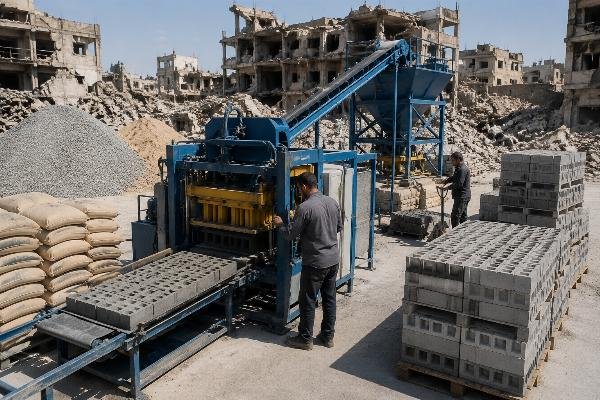
A responsible block machine supplier for Egypt should present a clear selection matrix rather than pushing the most expensive unit. The QT series covers a spectrum from manual-operated entry models to fully automatic PLC-controlled lines, and each tier serves a distinct investor profile.
| Model Series | Automation Level | Approximate Daily Output | Ideal Buyer Profile |
|---|---|---|---|
| QT4-25 | Manual / Mobile egg-layer | Low output, starter operations | First-time entrepreneurs, rural sites |
| QT4-15 / QT6-15 | Semi-automatic | Moderate output | Private investors upgrading from manual |
| QT10-15 / QT12-15 | Fully automatic | High output | Government contractors, established plants |
| QT15-15 | Fully automatic, heavy-duty | Maximum output | Large-scale housing projects, industrial investors |
Shandong Shiyue Intelligent Machinery, headquartered in Linyi near Qingdao Port, manufactures across this full range. Their facility spans a substantial footprint with a dedicated engineering team, and they have exported to markets across multiple regions—experience that informs which configurations survive harsh operating environments. [NEED_CITE: block machine model selection criteria based on production capacity requirements]
A government housing contractor in Upper Egypt needed a fully automatic line capable of producing standard hollow blocks and interlocking pavers within a tight tender deadline. They required formal certification documentation, a clear production capacity guarantee, and a delivery timeline that aligned with their construction phase schedule. The QT10-15 configuration matched their output requirement, and the factory’s ability to provide CE and SGS certification alongside the commercial invoice simplified the tender submission process.
Conversely, a private investor in Alexandria started with a QT6-15 semi-automatic line. His previous manual operation could not meet growing demand from local masonry contractors, but his budget and site footprint ruled out a fully automatic installation. The semi-automatic configuration let him scale output without committing to the infrastructure investment a larger line demands—conveyor systems, automated batchers, and expanded curing areas could be added later.
What Are the Key Technical Adaptations Needed for Egypt’s Operating Environment?
Standard export configurations fail in Egypt without targeted modifications for voltage instability, ambient temperature, and particulate exposure.
This is where a block machine supplier for Egypt must demonstrate field experience rather than catalog knowledge. Egyptian industrial sites frequently operate on generator power or experience significant grid voltage fluctuation. Ambient temperatures in southern regions regularly exceed thresholds that strain standard motor insulation ratings. And dust from desert environments and raw material handling infiltrates electrical enclosures that lack adequate sealing.
| Environmental Factor | Standard Configuration Risk | Required Adaptation |
|---|---|---|
| Voltage fluctuation | Contactor burnout, PLC damage | Dedicated voltage stabilizer, surge protection |
| High ambient temperature | Motor overheating, hydraulic fluid degradation | Enhanced motor insulation class, cooling upgrades |
| Dust and particulate | Control cabinet failure, sensor obstruction | Elevated IP rating enclosures, filtered ventilation |
| Raw material abrasiveness | Mold wear, mixer component erosion | Hardened mold steel, wear-resistant liner plates |
During an installation in Aswan, the site relied on a diesel generator that produced voltage spikes whenever heavy loads cycled on and off. The control cabinet—shipped with standard component ratings—experienced repeated contactor failures within the first weeks of operation. The solution involved installing an industrial-grade automatic voltage regulator upstream of the main distribution panel, upgrading contactors to higher surge-tolerance ratings, and adding filtered breather vents to the enclosure to keep desert dust out while allowing heat dissipation. [NEED_CITE: electrical protection requirements for industrial machinery in unstable grid environments]
Hydraulic systems in block machines face their own challenges under extreme heat. Standard hydraulic fluid viscosity breaks down at elevated temperatures, leading to reduced pressure stability and accelerated seal wear. A block machine supplier for Egypt serving the Upper Egypt market should specify high-temperature-rated hydraulic fluid and, where possible, recommend shaded or ventilated housing for the hydraulic power unit.
Mold durability is another critical adaptation point. Egyptian raw materials often include sandy aggregates with high silica content, which accelerate wear on standard mold surfaces. Hardened steel molds with extended service life between replacements become essential for maintaining production economics.
What Commercial Terms and Support Should You Expect from a Chinese Factory?
A reliable block machine supplier for Egypt provides transparent pricing structures, documented delivery timelines, and comprehensive post-arrival support—not just a proforma invoice.
The commercial engagement with a Chinese factory should follow a clear progression: initial specification confirmation, formal quotation with Incoterms clearly stated, production scheduling with milestone updates, pre-shipment inspection, and post-arrival installation support. Any block machine supplier for Egypt operating professionally will provide documentation suitable for letter of credit processing and customs clearance.
Delivery timelines for complete production lines typically fall within a moderate range from order confirmation to port departure, depending on configuration complexity and customization requirements. Fully automatic lines with customized mold sets and specialized control configurations require longer production cycles than standard semi-automatic units. A credible supplier will provide realistic timelines rather than aggressive promises that collapse under scrutiny.
| Commercial Element | What to Expect |
|---|---|
| Quotation Format | Detailed FOB or CIF with itemized breakdown |
| Payment Terms | Standard international trade terms, L/C compatible |
| Production Updates | Milestone photos and progress reports |
| Pre-Shipment Inspection | Factory acceptance test with client or third-party presence |
| Installation Support | On-site engineer dispatch for commissioning and training |
| Spare Parts Supply | Recommended spare parts list with initial order |
| After-Sales Access | Remote technical support and parts ordering channel |
A construction equipment distributor in Cairo sought exclusive representation for a Chinese block machine supplier for Egypt. The negotiation covered territory exclusivity, container-volume pricing structures, private-label options for the local market, and—critically—a committed spare parts inventory held locally. The distributor’s concern was not just machine price but the ability to service sold units without waiting weeks for parts shipped from China. The factory’s willingness to support a local spare parts stockpile, combined with marketing materials adapted for Arabic-speaking customers, determined whether the partnership moved forward.
Operator training is another non-negotiable element. Shipping a sophisticated PLC-controlled line to a site where operators have never worked with automated block equipment invites catastrophic misoperation. A professional block machine supplier for Egypt includes on-site commissioning that covers not only machine startup but also operator training on daily maintenance routines, mold changeover procedures, and basic troubleshooting. [NEED_CITE: importance of operator training in block machine production line success]
Conclusion
Direct sourcing from a Chinese block machine supplier for Egypt delivers cost advantages rooted in manufacturing scale, not quality compromise, provided the supplier demonstrates field-tested adaptation to local operating conditions.
Model selection must align with actual production targets and site constraints, technical specifications must address voltage, temperature, and dust realities, and commercial terms must include genuine post-arrival support—not just equipment delivery. The difference between a successful installation and a costly failure lies in whether the supplier treats Egypt as a shipping destination or as an operating environment requiring engineered solutions.
Leave a Reply