

Buy Concrete Block Machine Full Line Package for Sale
Bigger machines do not guarantee better returns — mismatched configurations create bottlenecks that waste capital before the first pallet is stacked.
Buying a concrete block machine full line package is not about comparing spec sheets; it is about matching equipment configuration to your local power grid, raw material availability, and site conditions to avoid costly downtime. A true full line covers everything from raw material feeding to finished product stacking — mixer, batcher, conveyor, pallet system, stacker, and silo — all capacity-matched to deliver consistent daily output within your shift pattern and curing constraints.
I still remember a shipment we sent to West Africa years back. The client ordered a standard-config line, and we built it to spec. Within weeks, voltage fluctuations at the site burned out the main mixer motor. The transformer went down for half a day at a stretch, and the entire concrete block machine full line package sat idle. The client was furious — and rightfully so. That single incident reshaped how I approach every order from regions with unstable grids. Now, before a single drawing is finalized, I ask about voltage fluctuation ranges, backup generator availability, and dust exposure levels. Those conversations determine whether配电柜里 gets a stabilizer and soft-start units added. [NEED_CITE: root causes of industrial equipment failure in Sub-Saharan manufacturing environments per African Development Bank infrastructure assessments]
That field-learned discipline is what separates a working plant from a costly paperweight. Let us walk through what actually matters when you evaluate a concrete block machine full line package for your market.
What Exactly Is Included in a Concrete Block Machine Full Line Package?
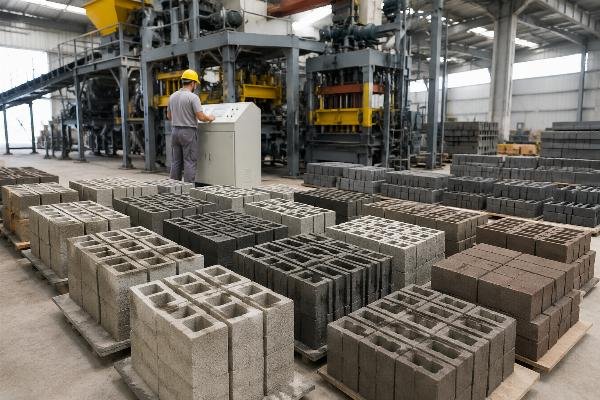
A genuine full line package is an integrated production ecosystem, not just the block machine sitting alone on a pallet. Many first-time buyers mistake the main molding unit for the entire investment. In reality, the block machine is only one node in a chain that must flow seamlessly from raw material storage to cured product stacking.
The complete system typically comprises these integrated modules:
| Module | Function | Configuration Dependency |
|---|---|---|
| Cement Silo | Bulk cement storage and controlled discharge | Site footprint, cement delivery frequency |
| Batching Machine | Precise aggregate and cement proportioning | Raw material type, block density target |
| Concrete Mixer | Homogeneous mixing of dry-hard concrete | Mixer type matched to block machine cycle time |
| Belt Conveyor | Material transfer from mixer to block machine hopper | Distance, elevation difference, dust control needs |
| Block Machine (Main Unit) | Molding and initial compaction | Daily output target, product type range |
| Pallet Feeder / Loader | Supplies pallets to the molding station | Pallet material, automation level |
| Product Stacker | Transfers wet blocks to curing racks | Curing method, stacking height, block weight |
| PLC Control Cabinet | Centralized automation and diagnostics | Local voltage, operator skill level |
The critical insight here is capacity matching. [NEED_CITE: production bottleneck analysis in concrete product manufacturing per industry trade association publications] If your block machine molds blocks faster than the mixer can supply material, the machine idles. If the stacker cannot keep pace with the output conveyor, wet blocks pile up and deform. Every component must be sized to the same throughput rhythm.
I once reviewed a project where a buyer purchased a high-output block machine from one vendor and a mismatched mixer from another. The mixer batch cycle was nearly twice as long as the machine’s molding cycle. The result? The expensive main machine sat waiting for material during nearly half its operating hours. That concrete block machine full line package was never a full line — it was an orphaned press with undersized support equipment.
When you request a quote, insist on a complete system diagram with matched capacities. Any concrete block machine full line package worth investing in will show you how every module syncs to your target daily output within your planned shift hours and curing timeline.
How Do You Match Line Capacity to Your Market Demand and Site Conditions?
Capacity planning must start from your local construction cycle, not from the manufacturer’s maximum speed rating. A machine rated for a certain output per hour means nothing if your curing yard cannot handle the daily volume, or if your market only absorbs a fraction of that production.
The capacity matching process follows a logical sequence:
- Determine daily market absorption — How many blocks does your local construction season actually consume? Government housing tenders, private residential projects, and road paving contracts each have different volume profiles. [NEED_CITE: affordable housing construction volume data per UN-Habitat regional reports]
- Define shift structure — Will you run single-shift, double-shift, or continuous? Each shift pattern changes the required hourly output dramatically.
- Account for curing constraints — Dry-hard concrete blocks need curing time before they can be handled. Natural curing in hot climates may require different rack rotation than steam curing in temperate zones. Your curing yard size directly limits how many blocks can be in the pipeline at once.
- Select machine class accordingly — A fully-automatic high-output line makes sense for large government contracts with guaranteed volume. A semi-automatic or egg-laying mobile unit may deliver faster ROI for a private investor serving scattered small-scale demand.
| Market Profile | Recommended Line Class | Rationale |
|---|---|---|
| Government tender, high volume, guaranteed offtake | Fully-automatic PLC line | Maximizes throughput, minimizes labor cost per block |
| Private investor, scattered demand, quick payback priority | Semi-automatic or mobile egg-laying | Lower capital entry, flexible deployment |
| Established plant upgrading from manual | High-output automatic with expanded curing | Replaces labor-intensive process, scales existing yard |
| Distributor stocking for resale | Modular configuration options | Allows end-buyers to select based on their conditions |
A client in East Africa once ordered a top-tier fully-automatic line for a housing project. The machine was magnificent. But the curing yard was sized for half the daily output. Blocks stacked too high, crushed each other, and rejection rates spiked. The concrete block machine full line package was technically perfect — but the site infrastructure was not planned around it.
Always map your curing capacity, raw material supply rhythm, and market absorption rate before locking in machine class. The right concrete block machine full line package is the one whose output matches your actual pipeline — not the one with the highest number on the brochure.
Why Do Most Full Line Failures Happen in the First Six Months?
Power instability, untrained operators, and absent preventive maintenance — not equipment defects — cause the majority of early-stage production losses in emerging markets. This is the uncomfortable truth that spec sheets never mention.
I have walked through plants across multiple regions where brand-new lines sat underutilized or completely stopped within months of installation. The root causes were remarkably consistent:
Power grid instability. In many parts of West Africa and South Asia, voltage can swing well outside the tolerance range that standard motors expect. Without stabilizers and soft-start protection, motors burn out repeatedly. Each burnout means downtime, replacement cost, and delayed project delivery. [NEED_CITE: industrial power quality challenges in developing economy manufacturing per energy sector research publications]
Dust-laden environments. In arid regions and on unpaved industrial plots, fine dust infiltrates hydraulic systems, clogs filters, and accelerates wear on seals and valves. A line designed for a clean European factory floor will struggle without upgraded filtration and enhanced sealing. I have seen hydraulic oil turn black within weeks in dusty yards — the filtration system was simply not rated for that environment.
Operator skill gaps. A fully-automatic PLC-controlled line requires operators who understand diagnostic screens, alarm codes, and basic troubleshooting. When the first alarm pops up and no one on site knows what it means, production halts until a remote technician intervenes — or worse, someone overrides the safety interlock and damages the machine.
| Failure Category | Typical Symptom | Preventive Measure |
|---|---|---|
| Power instability | Motor burnout, PLC resets, sensor errors | Voltage stabilizer, soft-start units, backup generator spec matching |
| Dust contamination | Hydraulic valve sticking, filter clogging, seal wear | Upgraded air and oil filtration, enhanced sealing on moving parts |
| Operator error | Overridden alarms, incorrect recipe input, missed lubrication | On-site commissioning training, multilingual HMI, spare parts inventory |
| Missing spare parts | Extended downtime waiting for shipped components | Initial spare parts package included at order, local stock recommendation |
A distributor in the MENA region told me that his clients’ biggest complaint in year one was never about the machine quality — it was about waiting weeks for a single replacement sensor. The concrete block machine full line package had been shipped without a recommended spare parts list, and the local market had no compatible components available.
When you evaluate a concrete block machine full line package, ask explicitly: Does the supplier include on-site installation and operator training? Is there a recommended initial spare parts list? Can their technical team respond remotely or on-site when alarms occur? These are not after-sales extras — they are the difference between a running plant and a parked one.
How to Evaluate Suppliers: Red Flags and Green Flags When Buying a Full Line Package?
Field-tested customization experience, on-site commissioning support, and lifetime parts availability — not the lowest FOB price — are the real indicators of a reliable full line supplier. The market is full of vendors who can quote you a machine. Far fewer can deliver a system that actually runs in your specific conditions.
Here is a practical evaluation framework:
| Evaluation Dimension | Red Flag | Green Flag |
|---|---|---|
| Configuration approach | Sends identical spec sheet to all inquiries | Asks about local voltage, raw materials, site layout, and dust conditions before quoting |
| Certification | No verifiable third-party certification | CE/SGS/ISO certified with documentation available for tender submissions |
| Installation support | Expects buyer to self-install from manual | Sends engineers for on-site commissioning and operator training |
| Spare parts | No initial spare parts recommendation | Provides lifetime parts availability and initial spare parts package |
| Reference projects | Cannot provide verifiable installation references | Has field-installed lines across multiple regions with site photos and client feedback |
| Pricing transparency | Quotes suspiciously low FOB with hidden costs | Provides clear breakdown including shipping, installation, and training scope |
I have reviewed proposals where the FOB price looked remarkably attractive — until the buyer realized that installation support, control system customization for local voltage, and the initial spare parts package were all billed separately at premium rates. The concrete block machine full line package that appeared cheapest at signing ended up costing substantially more by the time it was actually running.
Conversely, suppliers who invest time upfront to understand your site conditions — who ask about your transformer capacity, your cement brand, your block size preferences, and your curing method — are signaling that they have actually commissioned lines in environments like yours. That field knowledge is what prevents the voltage burnout scenario, the dust-clogged hydraulics scenario, and the mismatched mixer scenario.
A supplier’s willingness to customize — adding stabilizers for unstable grids, upgrading filtration for dusty sites, adjusting pallet dimensions for local availability — is the strongest signal that they understand what a concrete block machine full line package actually means in practice.
What Is the Real Total Cost of Ownership for a Block Plant in Emerging Markets?
Equipment purchase price represents only a portion of your first-year investment — shipping, installation, training, raw material sourcing, labor, and spare parts complete the true cost picture. Buyers who focus exclusively on the machine price routinely underestimate their actual capital requirement.
The total cost structure breaks down into several layers:
| Cost Layer | Components | Typical Weight in Year-One Investment |
|---|---|---|
| Equipment | Block machine, mixer, batcher, conveyor, pallet system, stacker, silo, control cabinet | Moderate portion — not the majority |
| Shipping | Container loading optimization, freight, insurance, customs clearance | Noticeable — varies significantly by destination and container utilization |
| Installation & Commissioning | Engineer dispatch, on-site assembly, electrical connection, calibration | Moderate — includes travel, accommodation, and labor |
| Training | Operator training, maintenance training, recipe development | Lower direct cost — high impact on production ramp-up speed |
| Raw Material Sourcing | Aggregate testing, cement supply contracts, admixture trials | Ongoing operational cost — affects block quality and cost per unit |
| Spare Parts Inventory | Initial recommended stock, wear parts, sensors, hydraulic components | Lower initial outlay — prevents costly downtime |
| Facility Preparation | Foundation work, electrical infrastructure, curing yard layout | Site-specific — often underestimated |
A private investor in Latin America once shared that his equipment cost was only a fraction of his total first-year spend. The foundation work alone — pouring reinforced concrete bases for the main machine and silo — cost a significant additional amount. Electrical infrastructure upgrades to handle the full line’s power draw added more. And the curing yard expansion to handle the actual daily output was another capital outlay he had not budgeted for.
When calculating ROI, model the full picture: equipment cost plus shipping plus installation plus raw material plus labor versus your local brick selling price. [NEED_CITE: return on investment framework for small-scale manufacturing in emerging markets per development economics research] A concrete block machine full line package that costs moderately more upfront but includes proper voltage adaptation, on-site training, and an initial spare parts package will reach profitable production faster — and stay there — compared to a cheaper package that leaves you exposed to preventable failures.
Conclusion
A concrete block machine full line package is a site-specific production system, not an off-the-shelf commodity. Matching equipment configuration to your local power conditions, raw material profile, curing constraints, and operator skill level determines whether your investment generates returns or generates repair bills. Evaluate suppliers on their field customization experience, certification credibility, and after-sales responsiveness — not on brochure specs or headline prices.
Leave a Reply