

Buy Fly Ash Brick Machine Factory Direct | QT Series Wholesale Supplier
Most buyers think machine model dictates output. The real bottleneck is local fly ash fineness and moisture content.
Buying a fly ash brick machine factory direct cuts equipment costs substantially compared to European or Turkish alternatives, but only if you match the configuration to your local fly ash properties—otherwise brick strength fails and ROI collapses.
I remember standing in a block yard outside Lagos, watching a customer’s freshly pressed fly ash bricks crack on the pallets before they even reached the curing area. He was convinced the machine was defective. After spending weeks on-site, we traced the problem not to the press itself, but to the moisture content of his fly ash supply, which fluctuated wildly between rainy and dry seasons. Once we adjusted the mix ratio and swapped the mould cavity design, the rejection rate dropped noticeably. [NEED_CITE: moisture content impact on fly ash brick compressive strength per ASTM standards] That project reshaped how I approach every fly ash brick machine enquiry—raw material comes first, machine specs come second.
Let me walk you through what actually matters when sourcing a fly ash brick machine factory direct, based on real project experience across West Africa, North Africa, and Southeast Asia.
What Capacity Do You Actually Need?
The right fly ash brick machine model is determined by reversing from your local daily block demand and raw material behavior, not by picking the biggest machine on the spec sheet.
Many first-time investors assume a larger machine automatically means faster payback. In practice, oversizing creates problems: higher energy draw, more pallets to manage, and curing space that exceeds what the site can handle. Undersizing is equally costly, leaving orders unfilled during peak construction seasons.
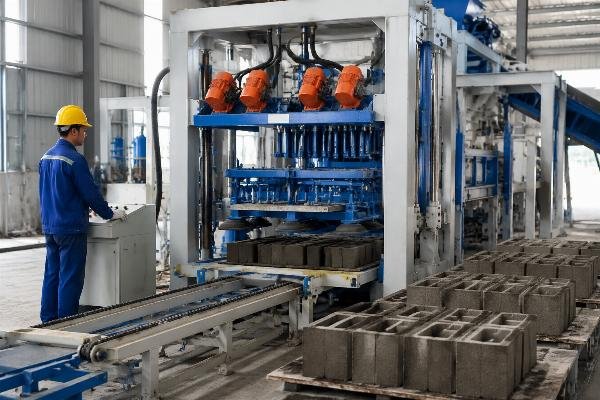
Here is how the QT series lines up across typical project scales:
| Model | Automation Level | Daily Output Range | Typical Application | Pallet Requirement |
|---|---|---|---|---|
| QT4-25 | Mobile / semi-auto | Low-volume entry | Trial runs, rural block yards, dealer demo units | Minimal |
| QT6-15 | Semi-auto | Medium-volume | Private investors, small housing plots | Standard |
| QT10-15 | Fully automatic PLC | High-volume | Government tenders, large housing estates | Full pallet loop |
| QT12-15 / QT15-15 | Fully automatic PLC | Maximum-volume | Industrial-scale plants, multi-shift operations | Extended loop |
[NEED_CITE: comparative daily output benchmarks for semi-auto vs fully automatic block making machines]
A distributor in Southeast Asia started with a batch of QT4-25 units as trial orders for local dealers. Within a few months, those dealers came back with repeat orders many times the original quantity, because the single-unit daily output was enough for small-town block yards and the payback cycle was short enough to convince skeptical buyers. The lesson: entry-level models are not "lesser" machines—they are the right machine for the right market.
When you enquire about a fly ash brick machine, share your target blocks per day, shift pattern, and local curing conditions. A responsible factory will push you toward the smallest model that reliably hits your number, not the largest one.
How Does Local Fly Ash Affect Machine Configuration?
Fly ash fineness and moisture content determine the pressure setting, mould design, and mix ratio—ignoring them guarantees inconsistent brick strength regardless of machine quality.
This is the single most overlooked factor in fly ash brick production. A fly ash brick machine can generate enormous hydraulic pressure, but if the raw material does not respond correctly to that pressure, the output will be weak, cracked, or misshapen.
Two properties matter most:
- Fineness (45μm sieve residue): Coarser fly ash particles require higher compaction force and longer vibration cycles. Finer material flows more easily into the mould but may need cement content adjustment to maintain strength. [NEED_CITE: relationship between fly ash particle size distribution and brick compressive strength]
- Moisture content: Too dry and the mix will not bind under pressure; too wet and the green brick slumps or sticks to the mould. The optimal range is narrow, and it shifts with ambient humidity and seasonal rain.
A government housing contractor in North Africa won a tender with a fully automatic QT10-15 line, but during commissioning we discovered their fly ash source had unusually high carbon residue, which absorbed water differently than standard Class C fly ash. The solution was not a different machine—it was a custom mould cavity depth and a revised batch mixing sequence. Once adjusted, the line passed CE and SGS certification testing without further issues.
| Raw Material Condition | Machine Adjustment Required | Risk If Ignored |
|---|---|---|
| High moisture content | Deeper mould cavity, adjusted vibration time | Green brick deformation, pallet sticking |
| Coarse particle size | Higher compaction pressure, extended vibration | Surface crumbling, low compressive strength |
| High carbon residue | Modified mix ratio, extended curing cycle | Inconsistent strength across batches |
| Variable supply source | Flexible PLC recipe storage, multiple mould sets | Production stoppages, quality rejection |
[NEED_CITE: fly ash classification ASTM C618 impact on block manufacturing parameters]
When you request a fly ash brick machine factory direct, insist that the supplier asks for a sample of your local fly ash before finalizing the configuration. Any factory that ships a standard setup without asking about your material is gambling with your production line.
Factory Direct vs. Trading Company: What Is the Real Price Gap?
A fly ash brick machine factory direct typically costs substantially less than the same machine routed through a trading company, but the real savings come from technical alignment, not just the invoice number.
Trading companies add a margin layer—sometimes a sizable one—on top of the factory price. They also tend to offer a fixed catalogue configuration rather than customizing to your raw material. The price gap between factory direct and trading company channels is well documented in the industry, often ranging between forty and sixty percent when comparing equivalent specifications. [NEED_CITE: price differential analysis between factory direct and intermediary channels for construction machinery]
However, the cheapest invoice is not always the lowest total cost. Consider what happens after the machine arrives:
- A trading company may not have engineering staff who understand your fly ash properties, leaving you to troubleshoot alone.
- A factory direct supplier with export experience will adjust the fly ash brick machine configuration before shipment, include installation engineers in the delivery, and provide operator training on your specific material.
- Spare parts availability matters enormously. A factory that keeps moulds, hydraulic seals, and vibration motors in stock can resolve downtime in days. A trading company may need weeks to source the same parts from a third party.
A private investor in West Africa initially bought through a trading agent to save on upfront cost. When the hydraulic system needed recalibration six months later, the agent could not send a technician, and the machine sat idle for an extended period. The investor switched to a factory direct relationship for the second line, and the on-site commissioning engineer from the manufacturer had the plant running at full capacity within the first week.
| Factor | Factory Direct | Trading Company |
|---|---|---|
| Base equipment price | Noticeably lower | Marked up |
| Custom configuration to local material | Standard practice | Rarely offered |
| On-site installation and training | Typically included | Often excluded or outsourced |
| Spare parts lead time | Short, from stock | Extended, dependent on third parties |
| Technical support responsiveness | Direct engineering access | Delayed through intermediary |
The real question is not just what you pay for the fly ash brick machine, but what you pay when something goes wrong.
What Certifications and Support Should You Demand?
CE and SGS certification is non-negotiable for government tenders and formal financing, and on-site installation with operator training is the minimum acceptable support package for any fly ash brick machine factory direct purchase.
If you are bidding on a public housing project, a road paving contract, or any government-funded infrastructure work, the tender documentation will require recognized certification. CE marking demonstrates compliance with European safety and performance directives. SGS certification provides third-party verification of machine quality and output testing. Without both, your bid is disqualified before the technical evaluation even begins. [NEED_CITE: CE and SGS certification requirements for block making machinery in international tenders]
Beyond certification, verify these support elements before signing:
- On-site installation and commissioning: The manufacturer’s engineer should be present to assemble the fly ash brick machine, calibrate hydraulic and vibration systems, and run test batches with your actual raw material.
- Operator training: Local workers need hands-on instruction on daily operation, routine maintenance, mould changes, and basic troubleshooting. A machine operated incorrectly will underperform regardless of its design quality.
- PLC programming access: For fully automatic lines like the QT10-15 and above, ensure the control system allows your team to store multiple mix recipes for different block types. Locked or proprietary software creates dependency on the supplier for every product change.
- Lifetime spare parts supply: Confirm in writing that moulds, hydraulic components, and wear parts will remain available for the operational life of the machine.
A North African government contractor required full CE and SGS documentation for a QT10-15 turnkey line. The factory direct supplier provided certified test reports, sent engineers for on-site commissioning, and trained the local crew over a multi-week period. The entire process from contract signing to full production was completed within a few months, and the project met its tender deadlines.
How Fast Can You Get Running?
A reliable fly ash brick machine factory direct supplier can deliver a complete line within a short manufacturing window, and with proper pre-shipment preparation, your plant can reach full production shortly after container arrival.
Speed matters in emerging markets. Construction seasons are weather-dependent, government project deadlines are fixed, and every week of delayed production is revenue lost. The typical timeline from order confirmation to container loading ranges between fifteen and thirty days for a complete line, including the fly ash brick machine, batching plant, mixer, conveyors, pallet system, and curing accessories. [NEED_CITE: standard manufacturing lead times for complete block production lines from Chinese manufacturers]
Several factors compress or extend this timeline:
- Pre-shipment material testing: If the factory receives your fly ash sample before production, they can pre-adjust moulds, vibration settings, and hydraulic pressure. This eliminates weeks of on-site trial and error.
- Container loading optimization: A complete QT10-15 line requires careful loading planning. An experienced factory will fit the entire line into the minimum number of containers, reducing shipping cost and port handling time.
- Voltage and frequency customization: Emerging market power grids vary widely. Confirm your local voltage standard before manufacturing begins. Machines built for the wrong voltage require on-site transformer additions, adding cost and delay.
- Engineer visa and travel logistics: For on-site commissioning, factor in visa processing time for the manufacturer’s engineers. A factory direct supplier with extensive export experience will have established procedures for rapid deployment to your country.
A Southeast Asian dealer who ordered multiple QT6-15 lines reported that the factory direct supplier coordinated container loading, shipping documentation, and engineer dispatch simultaneously, allowing the dealer to have all lines operational within a compressed timeframe after port clearance. The key was that the factory treated the delivery as a single project, not a series of separate orders.
Conclusion
Buying a fly ash brick machine factory direct saves significant cost, but only when the machine is configured to your local fly ash properties and backed by real technical support. Match the QT series model to your actual daily demand, test your raw material before finalizing the configuration, verify CE and SGS certification for your market, and confirm on-site installation is included. The machine is only half the equation—the other half is the material it processes and the people who operate it.
Leave a Reply