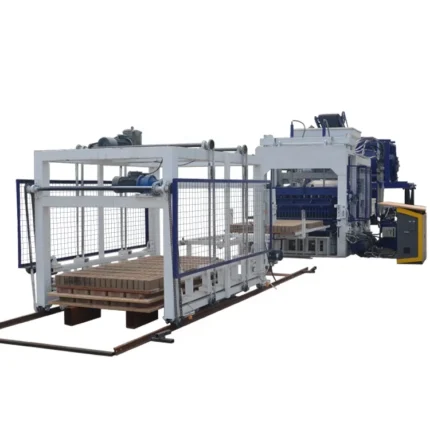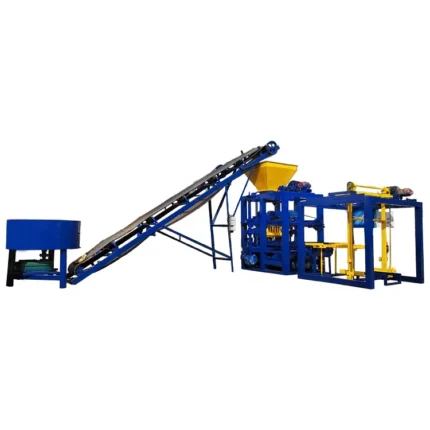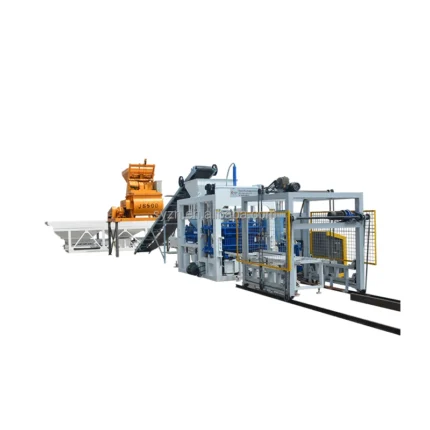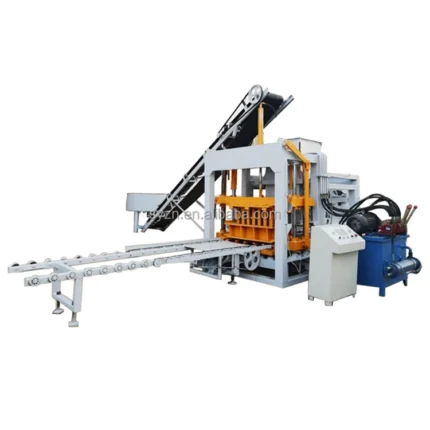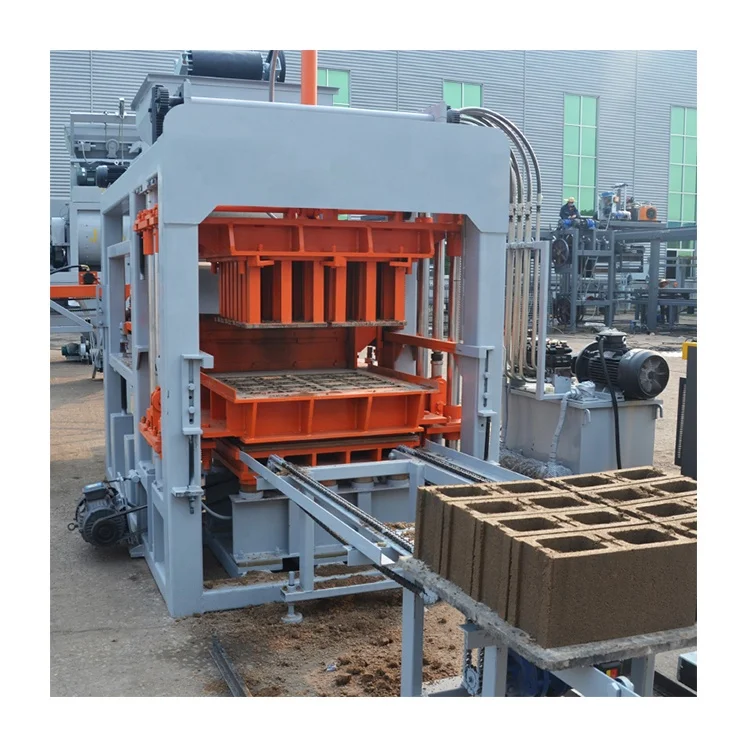
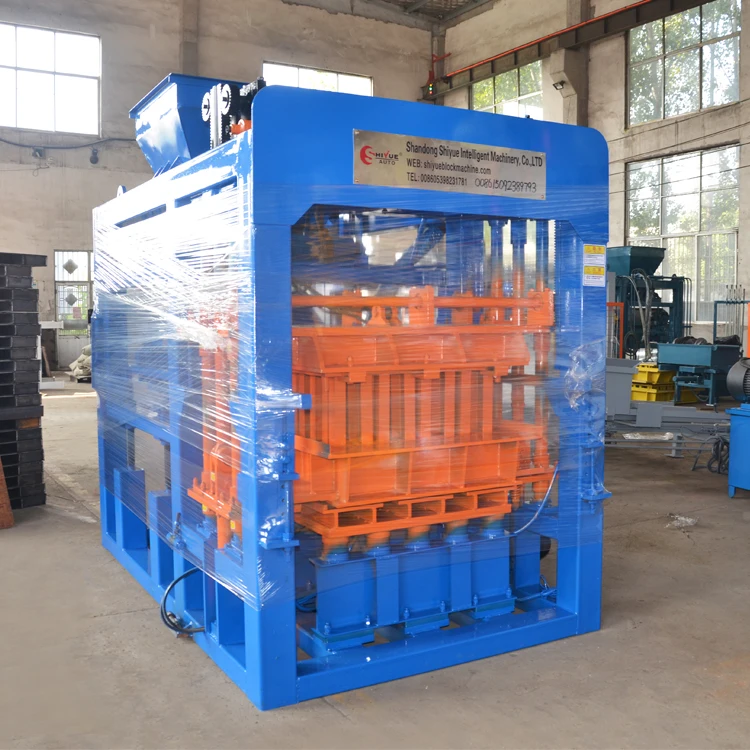


Description
Intelligent control integration — PLC parameters are configured against your local aggregate and target block format before dispatch, not set to catalogue defaults that compromise block strength.
Technical Specifications
| Parameter | Value |
|---|---|
| Model | QT6-15 |
| Product Type | Hydraulic Concrete Block Making Machine |
| Overall Dimensions (L×W×H) | 7400×1900×2660 mm |
| Molding Cycle | 15–25 s |
| Vibration Frequency | 4600 r/min |
| Exciting Power | 40–50 kN |
| Rated Power | 31.25 kW |
| Mixer Model | JQ350 |
| Pallet Size | 850×550×25 mm |
| Total Weight | 7 T |
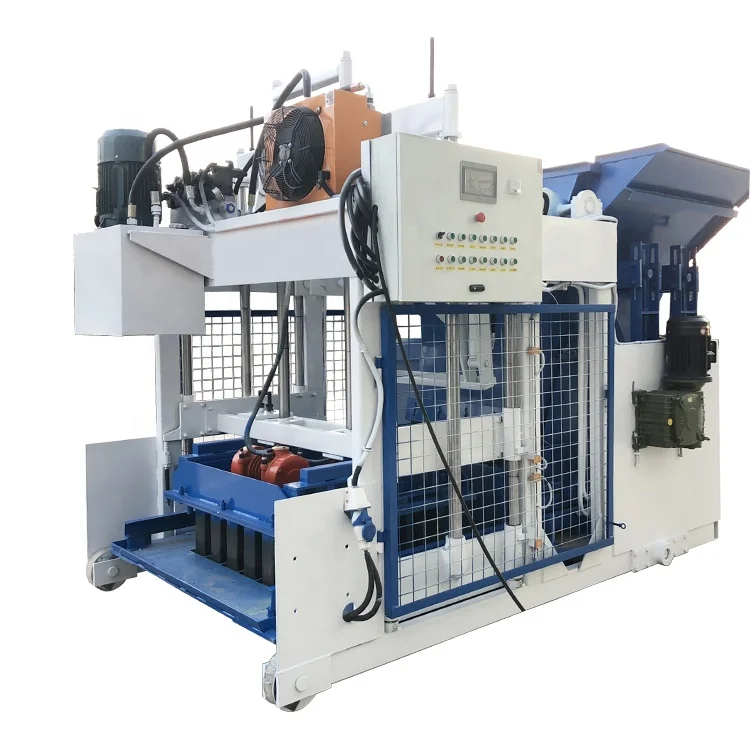
| Control System | PLC control system |
| Hydraulic Station | High-pressure hydraulic system included |
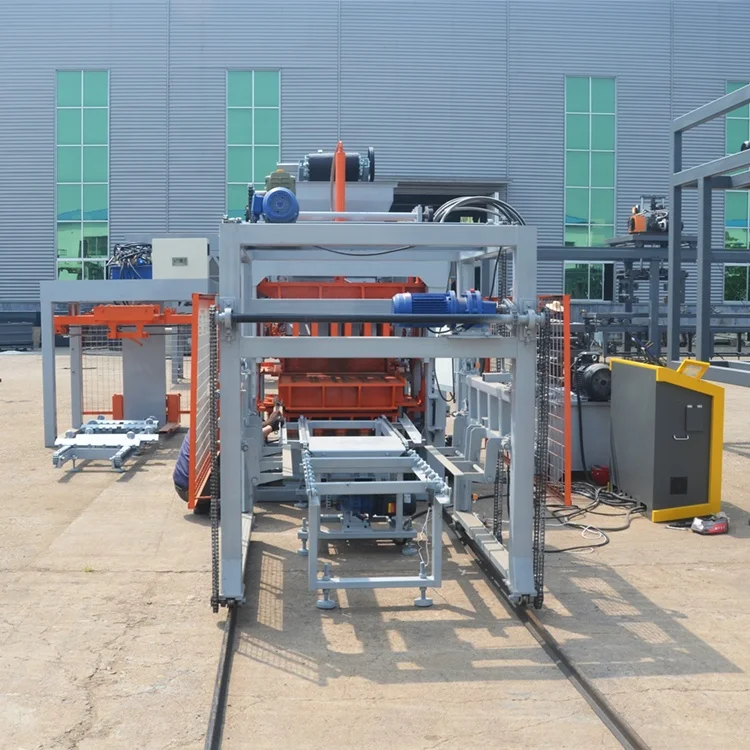
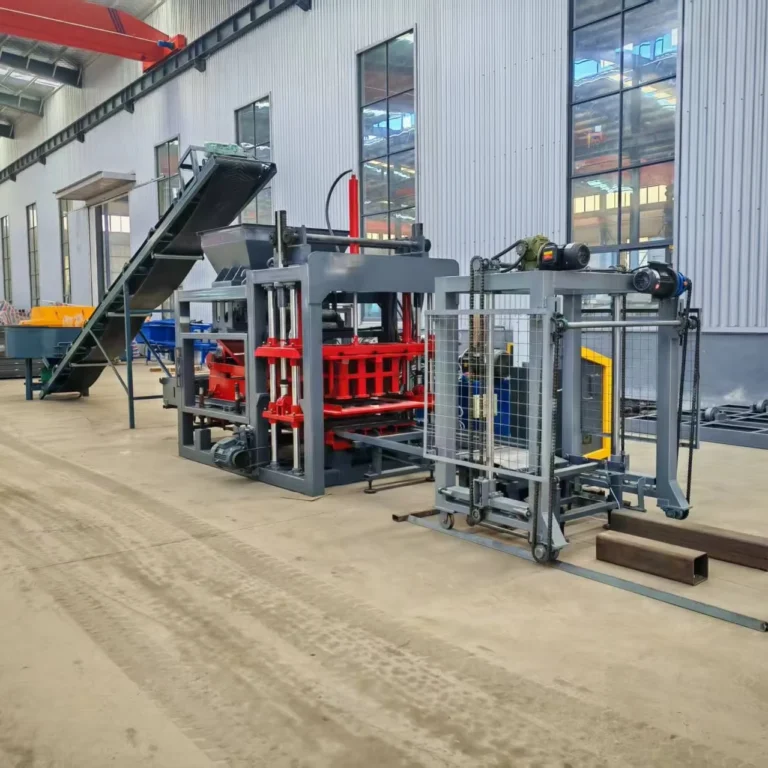
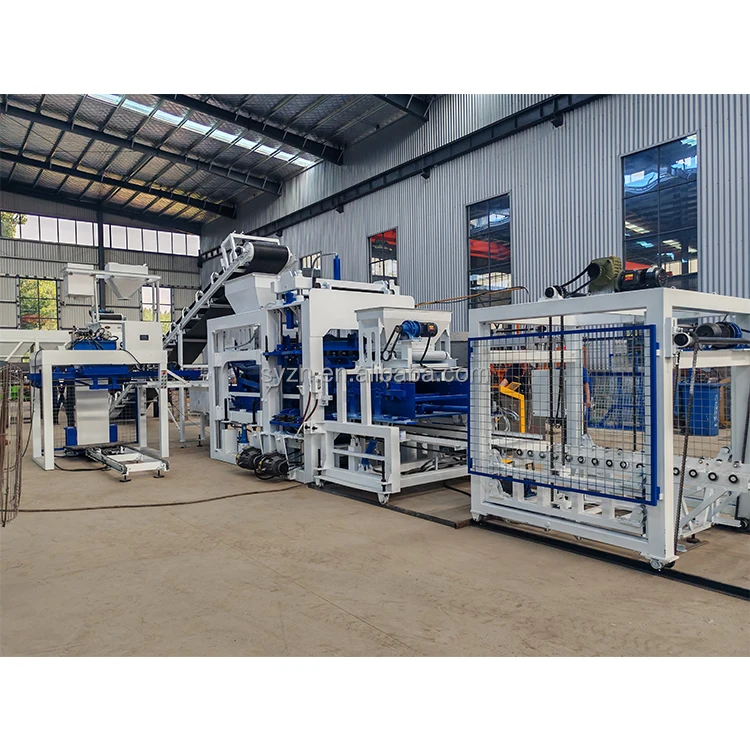
| Included Equipment | Block making machine, hydraulic station, PLC control system, pallet feeder, brick conveyor, block sweeper, manual hydraulic trolley |
| Output Capacity (Hollow Block 400×200×200 mm) | 1200–1680 pcs/h, 9600–13440 pcs/8hr (basis: 400×200×200 mm hollow block) |
| Output Capacity (Hollow Block 400×150×200 mm) | 1800–2400 pcs/h, 14400–19200 pcs/8hr (basis: 400×150×200 mm hollow block) |
| Output Capacity (Solid Brick 240×115×53 mm) | 3240 pcs/h, 16200–19440 pcs/8hr (basis: 240×115×53 mm solid brick) |
| Automation Level | Semi-automatic with PLC control, upgradeable |
Application Suitability
| Application | Material or Output |
|---|---|
| Hollow block production | Crushed stones, sand, cement, fly ash for structural walling |
| Solid brick manufacturing | Sand-cement mixes for load-bearing and partition walls |
| Paver production | Fine aggregate blends for pedestrian and light-traffic paving |
| Curbstone forming | Coarse aggregate with cement for road-edge and drainage kerbs |
What "Automatic" Really Means When the Mix Changes Mid-Shift
The PLC stores parameters per block format, but those parameters must be validated against the aggregate you actually feed into the mixer.
Many buyers compare an automatic QT6-15 block making machine against semi-automatic alternatives by looking only at the PLC screen and assuming consistency comes free with the hardware. On sites where the sand source shifts between river sand and crushed dust depending on the season, the vibration frequency and hydraulic pressure that produced strong blocks on Monday will yield crumbly output by Thursday. The PLC can only repeat what it was told — if the baseline recipe was never adjusted for your local material variability, the machine will faithfully reproduce a bad block thousands of times over. [NEED_CITE: aggregate moisture variation and concrete block compressive strength]
How the PLC Removes Operator Guesswork from the Molding Cycle
The PLC control system on this machine stores the molding cycle — vibration duration, hydraulic pressure hold, and demolding lift — as a recallable recipe for each block format. When an operator switches from hollow blocks to pavers, the system loads the corresponding parameters instead of relying on manual timing. This eliminates the variation that occurs when a new shift crew interprets the cycle differently, keeping the 15–25 second molding window consistent across production runs.
What Consistency Actually Looks Like Across a 10-Hour Shift
Batch-to-batch consistency is not a single metric — it shows up as uniform block height within the pallet, consistent surface density, and predictable demolding without edge spalling. The PLC tracks the vibration frequency at 4600 r/min and the hydraulic pressure throughout each cycle, logging deviations that an operator watching a pressure gauge would miss. When the same automatic QT6-15 block making machine produces hollow blocks at 08:00 and again at 17:00, the stored recipe ensures the compaction energy delivered to the mold is identical, provided the raw material feed has not drifted. [NEED_CITE: PLC recipe management in concrete product manufacturing]
Reading the Specs That Determine Block Strength
Vibration frequency and exciting power are the two numbers that most directly shape block density. At 4600 r/min, the vibration compacts the concrete mix into the mold cavity, but the 40–50 kN exciting force must be sufficient to drive that compaction through the full depth of a 200 mm hollow block. The hydraulic station supplements vibration with sustained pressure during the hold phase, locking the compacted particles together before demolding. Pallet size at 850×550×25 mm defines how many blocks ride on each board — a dimension that must match your existing curing racks and forklift capacity, or you will be replacing downstream handling equipment you did not plan to replace.
The Hidden Cost of Skipping the Voltage Conversation
Voltage and frequency mismatches are the most common cause of commissioning delays on exported block machinery. A PLC configured for 50 Hz running on a 60 Hz supply will cycle faster than its hydraulic station can respond, producing under-pressed blocks that fail strength testing. A 380V motor connected to a 220V site transformer will stall under load, burning out the winding within the first week. These are not edge cases — they are routine outcomes when the electrical specification is confirmed after the machine is already bolted to the floor. [NEED_CITE: industrial equipment voltage and frequency standards by export market]
Why the Line Matters More Than the Press
This machine ships with a pallet feeder, brick conveyor, and block sweeper as standard inclusions — components that determine whether the press runs continuously or sits idle waiting for an operator to manually place pallets. The PLC control system coordinates pallet feed timing with the molding cycle so the press is never starved. For buyers planning to add automatic stacking or cubing later, the semi-automatic configuration provides a defined upgrade path where additional automation stations integrate into the existing PLC architecture rather than requiring a control system replacement.
Documentation & Verification
- Line layout with capacity calculation stated per target block format
- PLC parameter sheet matched to your aggregate and mix design
- Voltage, frequency, and control language confirmation before production
- Factory test record run on your specified block format before dispatch
- Operation manual covering PLC recipe setup and fault diagnosis
Installation, Commissioning & Support
- Foundation must support 7 T total weight across 7400×1900 mm footprint
- Dedicated 31.25 kW power circuit with confirmed voltage and frequency
- Hydraulic station and PLC cabinet connected and calibrated on site
- Molding cycle parameters tuned to your local aggregate during first run
- Operator training on PLC recipe recall and basic fault clearing
- Wear parts list with hydraulic seals and vibration motor brushes identified
What to Prepare Before Requesting a Quote
Share the block formats your market sells — dimensions, target strength, and daily volume. Confirm your local voltage, frequency, and the language your operators need on the PLC display. Describe the raw materials available at your site, including aggregate type and any seasonal variation. If you have existing curing racks or forklifts, provide pallet dimensions so the 850×550 mm default can be verified or adjusted before production begins.
Frequently Asked Questions
Q: How does the PLC control system maintain consistency across different block formats?
A: The PLC stores a dedicated recipe for each mold — vibration duration, pressure hold time, and demolding speed — recalled by the operator at format changeover. This removes manual timing variation and ensures the molding cycle repeats identically across shifts, provided the raw material feed remains within the specification the recipe was tuned against.
Q: What automation upgrades are available from the base semi-automatic configuration?
A: The semi-automatic setup includes a pallet feeder and brick conveyor coordinated by the PLC. Buyers can add automatic stacking and cubing stations later, which integrate into the existing PLC architecture. This allows a plant to reduce manual handling incrementally as production volume grows, without replacing the core control system.
Q: How is voltage, frequency, and PLC language confirmed before shipment?
A: A confirmation sheet listing the buyer’s site voltage, supply frequency, and preferred PLC display language is signed before production begins. The factory test then runs the machine under those exact electrical conditions, and the test record is shared with the buyer before the machine is loaded for shipment.
Q: What training covers PLC operation and parameter adjustment?
A: On-site training during commissioning covers recipe selection for each block format, basic parameter adjustment for mix variation, and fault diagnosis from the PLC alarm log. Operators learn to identify when a deviation points to a material feed issue versus a mechanical wear item, reducing unnecessary service calls.
Q: How does the system handle mold change and format switching in production scheduling?
A: The PLC recalls the stored recipe for the new mold as soon as the operator selects the format. The physical mold swap time depends on the mold change system specified — a detail confirmed during the proposal stage. Production scheduling should account for both the mechanical changeover and a short run of test blocks to verify parameters before full-speed output resumes.