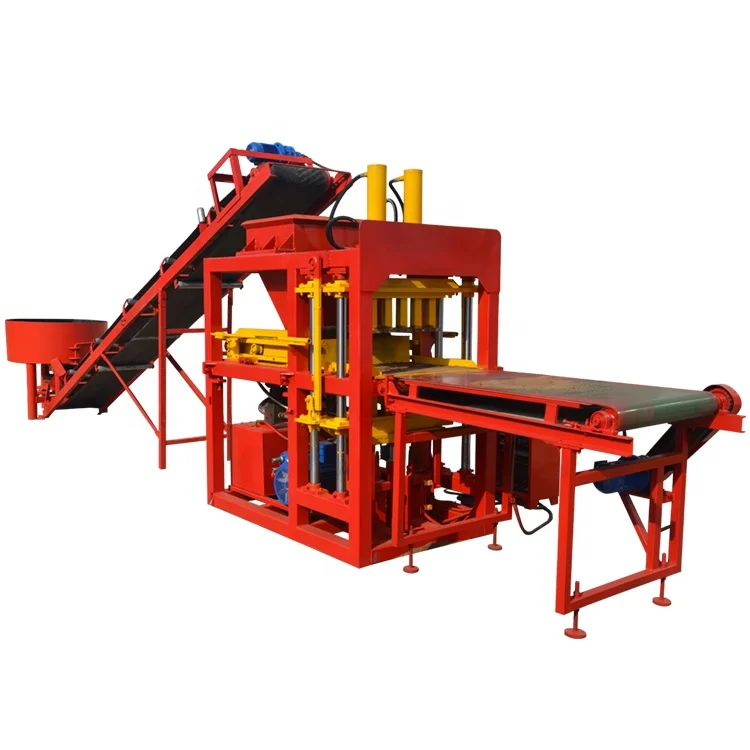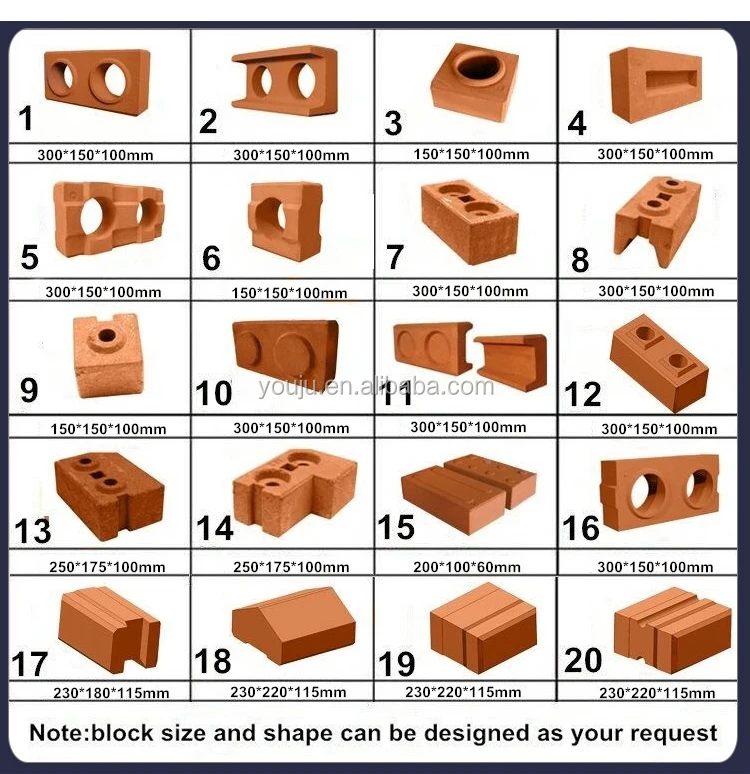
Description
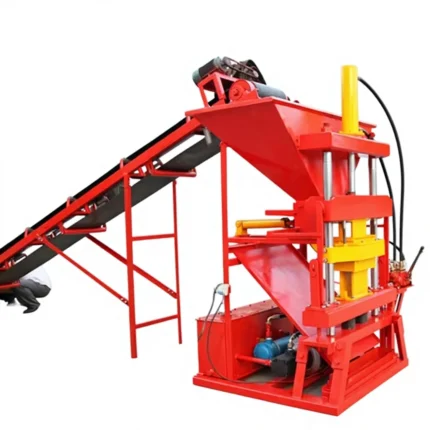
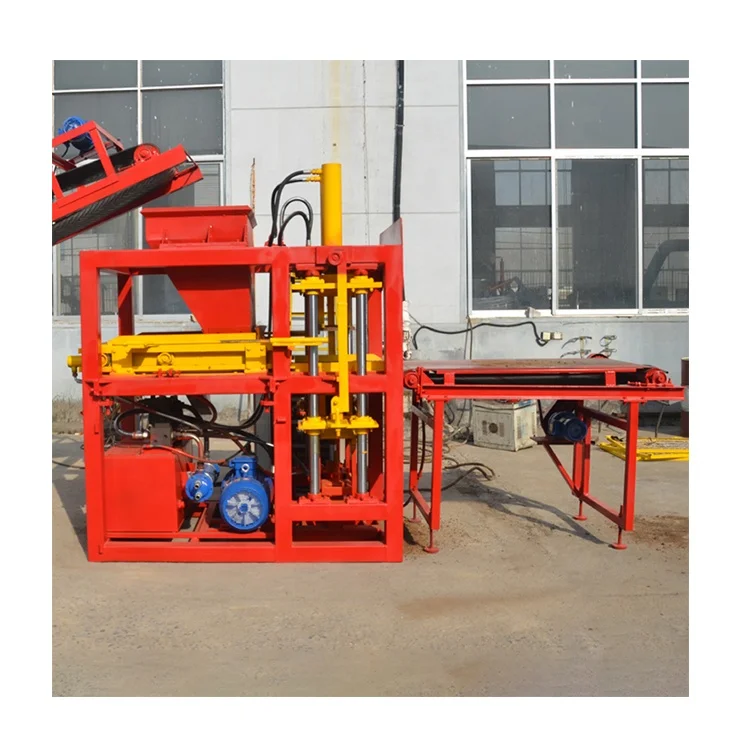
Upgrade Path — Start with a manual press and layer on automated pallet feeding, stacking and PLC-controlled batching as your volume grows, without replacing the core machine.
Technical Specifications
| Parameter | Value |
|---|---|
| Model | LY2-40 |
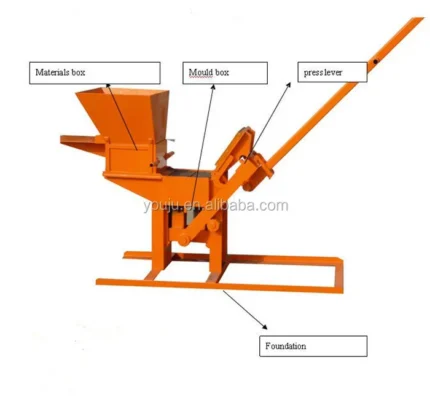
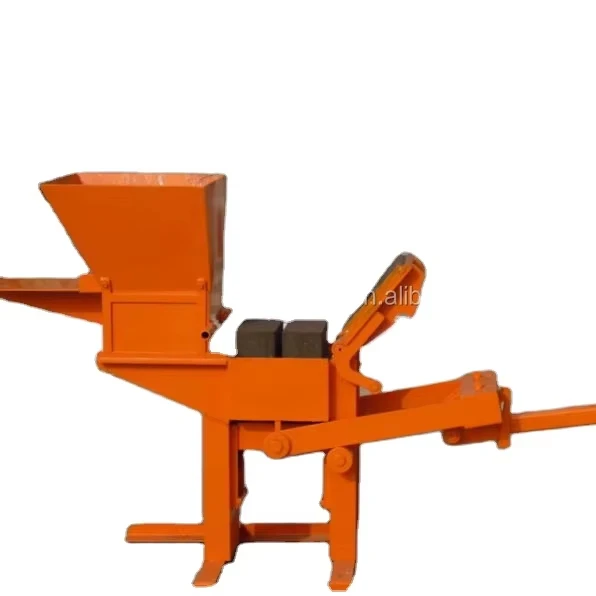
| Product Type | Manual Clay Interlocking Brick Machine |
| Rated Power (kW) | No Power, Completely Manual |
| Voltage & Frequency | Not applicable (manual operation) |
| Control System | Manual mechanical operation |
| Overall Dimensions (L×W×H) | 1600 x 700 x 1200 mm |
| Net Weight | 200-240 kgs |
| Output Capacity | 400pcs-1000 pcs/day (basis not stated in source) |
| Molding Cycle | 30-40s |
| Mould Format | Changeable moulds for various blocks |
| Hydraulic Pressure (MPa) | Not applicable (manual compression) |
| Vibration Force (kN) | Not applicable (no vibration system) |
| Automation Level | Completely manual |
| Stacking Method | Manual |
| Mobility | Steel wheel mobile base |
| Basic Equipment Included | JFA-1 Mixer or JQ350 Mixer |
| Warranty | 1 Year |
Application Suitability
| Application | Material or Output |
|---|---|
| No-power or off-grid construction sites | Soil-cement mix for interlocking bricks and cement hollow blocks |
| Small-scale interlocking brick workshops | Manual brick production using locally sourced soil and cement |
| Remote area building projects | On-site production of interlocking blocks without grid power |
What "1000 Pieces per Day" Leaves Out About Manual Presses
Daily output depends entirely on the block format, the operator’s stamina, and the curing logistics.
When a buyer sees 400-1000 pcs/day for the LY2-40, the missing variable is which block format that assumes. An interlocking brick, a hollow block, and a solid block all have different molding times, different handling requirements, and different curing footprints. Automation removes this variability by locking in cycle times and material ratios, but a manual press like the LY2-40 leaves throughput in the hands of the crew. [NEED_CITE: block format impact on daily output calculations]
From Manual Baseline to PLC-Controlled Consistency
The LY2-40 manual interlocking brick machine serves as the mechanical core of a production line that can grow. Its 30-40s molding cycle establishes the rhythm that every upstream and downstream station must match. When you add automated pallet feeding later, the feeder must deliver a new pallet within that same window, or the press sits idle.
Batching Control Where It Matters Most
Block strength inconsistency often traces back to manual mixing — one batch gets too much water, the next gets too little cement. The included JFA-1 or JQ350 mixer handles basic blending, but a PLC-controlled batching upgrade adds moisture sensing and ratio control. Every batch enters the press with the same composition, removing operator judgment from the equation. [NEED_CITE: PLC batching control and block strength consistency]
Reading the Specifications That Shape Your Upgrade
The completely manual operation means zero power draw at the press itself, which suits off-grid sites but also means every future automated station needs its own electrical supply planned. The 1600 x 700 x 1200 mm footprint defines the floor space the press occupies — any pallet feeder or stacker added later must fit around this envelope without disrupting the operator’s access.
The changeable mould system accepts multiple block formats, and when you upgrade to an automated mould change mechanism, compatibility with the existing mould mounting pattern becomes essential. The 200-240 kg net weight and steel wheel base give the LY2-40 mobility that a fixed plant lacks, but automated lines typically bolt the press to a foundation for vibration isolation during high-cycle operation.
The Hidden Cost of Skipping Automation Planning
A manual press purchased without a documented upgrade path often ends up replaced rather than upgraded. The mould mounting points may not accept an automated change system. The frame may lack the structural rigidity for hydraulic assist. The pallet height and feed angle may not align with standard automated feeders, forcing custom fabrication that costs more than planning ahead. [NEED_CITE: machine upgrade compatibility and retrofit costs]
Why Source the LY2-40 Here
The machine, mould, pallet, and handling equipment are specified as one matched system rather than assembled from separate suppliers. Configuration is set against the buyer’s actual mix design and local aggregate, not a catalogue default.
Mould design covers the formats the buyer’s market sells, including custom drawings. The automation level is selectable — a buyer can start with the manual LY2-40 and add stations as volume justifies the investment. Installation and commissioning support includes operator training so the crew knows the machine before the technician leaves site.
Documentation & Verification
- Line layout showing where pallet feeding, stacking, and curing stations connect to the LY2-40 press envelope
- Machine specification sheet confirming manual operation baseline and upgrade-compatible mounting points
- Mould drawing and format list for every block type the LY2-40 accepts with dimensions and cycle times
- Factory test record documenting molding cycle and block release before dispatch
- Operation and maintenance manual covering mechanical lever adjustment and mould change procedure
Installation, Commissioning & Support
- Level ground preparation for the 1600 x 700 mm base footprint with adequate clearance for manual pallet handling
- No electrical supply required for the LY2-40 press itself; plan separate circuits for future automated stations
- Machine arrives assembled on steel wheel base, ready for immediate placement and operation
- First-day commissioning verifies mould alignment, lever pressure, and block release quality across formats
- Operator training covers mould change procedure, mix ratio adjustment, and daily maintenance checkpoints
- Wear parts list identifies lever pivot points and mould wear surfaces for planned replacement scheduling
What to Share When Requesting a Quote
Provide your target block format, daily output goal, and local raw material availability. Confirm the voltage and frequency for any automated stations you plan to add later, and specify the PLC display language your operators need. State your curing area dimensions and existing forklift capacity so pallet size can be matched to your site.
Frequently Asked Questions
Q: What is the upgrade path from the LY2-40 manual press to semi-automatic and fully PLC-controlled operation?
A: The LY2-40 press remains in place while automated stations layer around it. Pallet feeding, material batching with PLC control, and automatic stacking can be added sequentially as volume grows. Each station is configured to match the 30-40s molding cycle so the press is never left waiting between cycles.
Q: How is daily output verified, and which block format does the stated capacity assume?
A: The 400-1000 pcs/day figure varies significantly between interlocking, hollow, and solid block formats. A capacity calculation should state the specific block format, wall thickness, and mix design assumed. Without this, the quoted output may not match your production reality once the line is running.
Q: Which automated stations can be added without replacing the LY2-40 press?
A: Automated pallet feeding, PLC-controlled batching and mixing, and automatic stacking or cubing stations can integrate with the manual press. The upgrade path depends on mould mounting compatibility and frame structural capacity. Requesting an upgrade-ready configuration at purchase ensures these connection points exist.
Q: What PLC control language options and voltage configurations are available for the automation upgrade?
A: PLC display language, voltage, and frequency must match your site conditions and operator requirements. Confirming these specifications before production prevents commissioning delays. Common options include multiple language interfaces and voltage configurations from 220V to 440V at 50Hz or 60Hz depending on your market.
Q: How does automated batching improve block strength consistency compared to manual mixing?
A: Manual mixing introduces batch-to-batch variation in water content and cement ratio, leading to inconsistent block strength. PLC-controlled batching measures each ingredient by weight and adjusts moisture based on sensor feedback, producing uniform blocks across every production run regardless of operator experience.