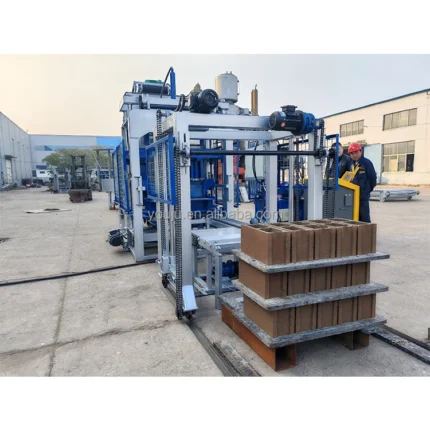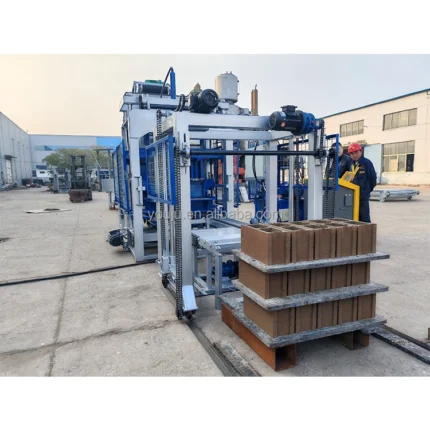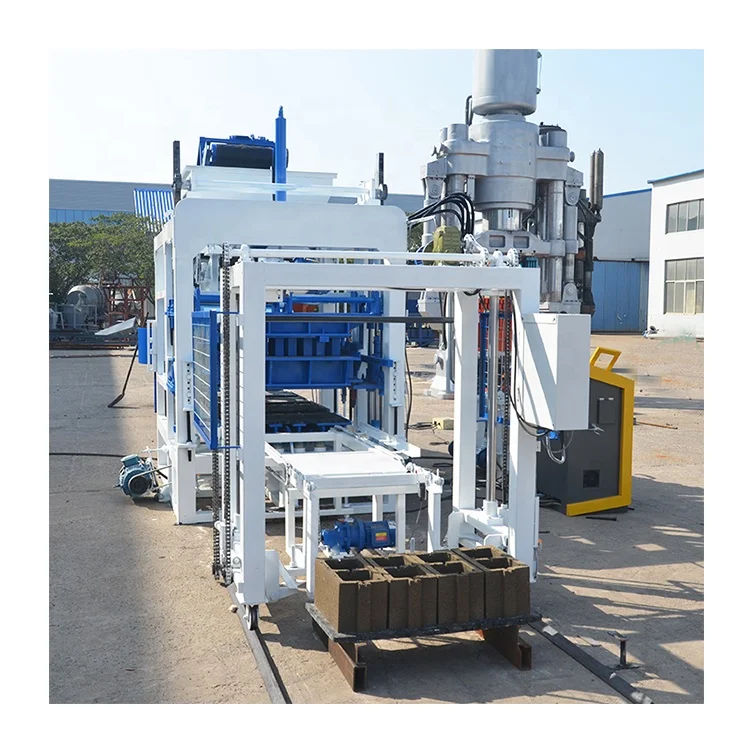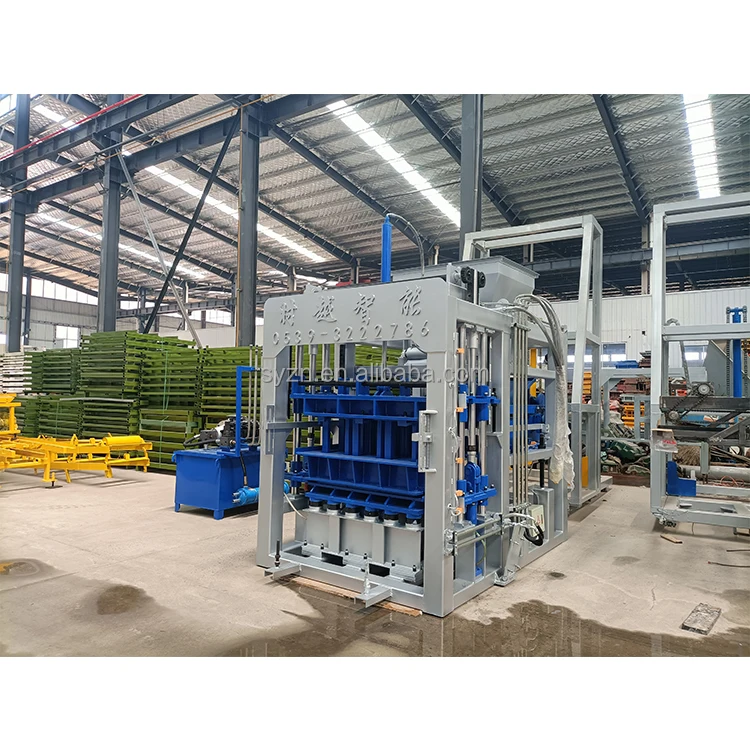



Description
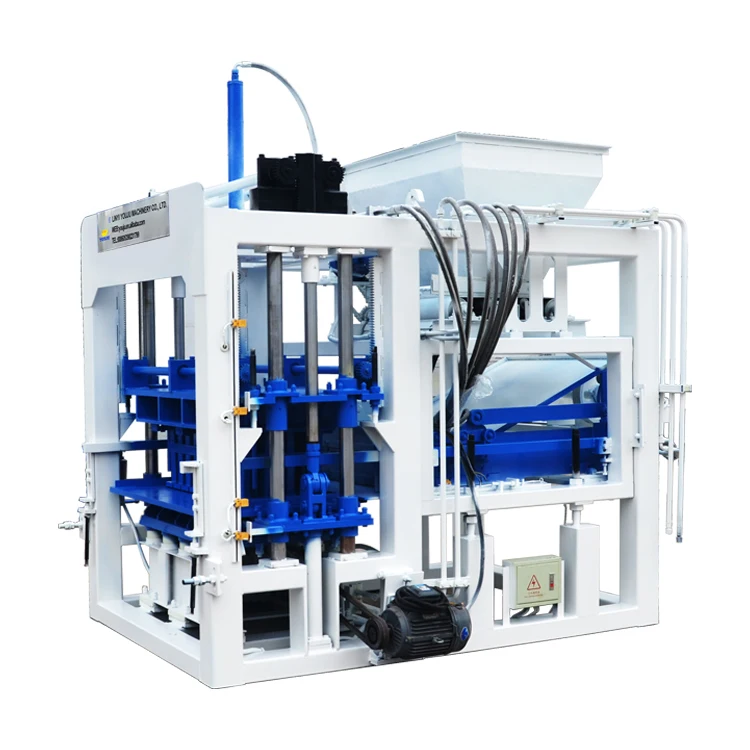
Controlled Parameter Matching — every hydraulic pressure, vibration sequence and cycle timing on the QTJ4-25 is managed through PLC logic rather than operator guesswork, so block density stays consistent shift after shift.
Technical Specifications
| Parameter | Value |
|---|---|
| Model | QTJ4-25 |
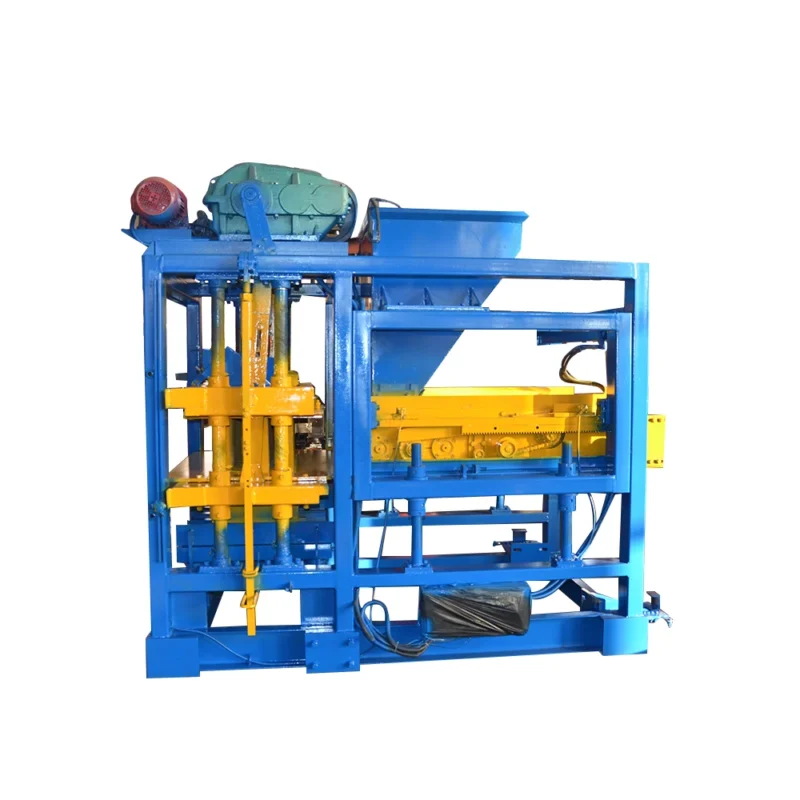
| Product Type | Stationary Hydraulic Concrete Block Making Machine |
| Rated Power | 17.9 kW |
| Control System | PLC (brand and I/O configuration to be confirmed) |
| Overall Dimensions (L×W×H) | 6400 × 1500 × 2700 mm |
| Net Weight | 2500 kg |
| Moulding Cycle | 25 s (basis not stated in source — confirm applicable block format) |
| Vibration Frequency | 2800 r/min |
| Exciting Force | 60 kN |
| Pallet Size | 850 × 550 × 20 mm |
| Hydraulic Station | Included (pressure rating to be confirmed) |
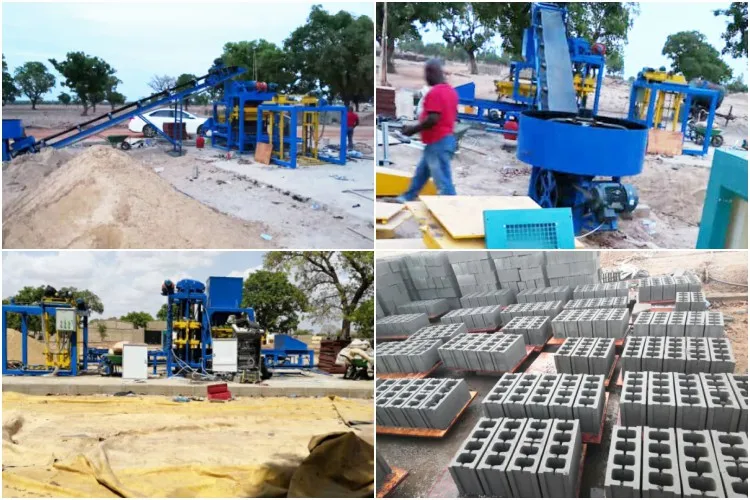
| Output Capacity | 960 pcs/h, 7680 pcs/day based on 400×200×200 mm hollow block, 4 pcs/mould |
| Mould Format Options | Hollow, Solid, Paver, Curbstone |
| Automation Level | Semi-automatic with manual pallet handling and stacking |
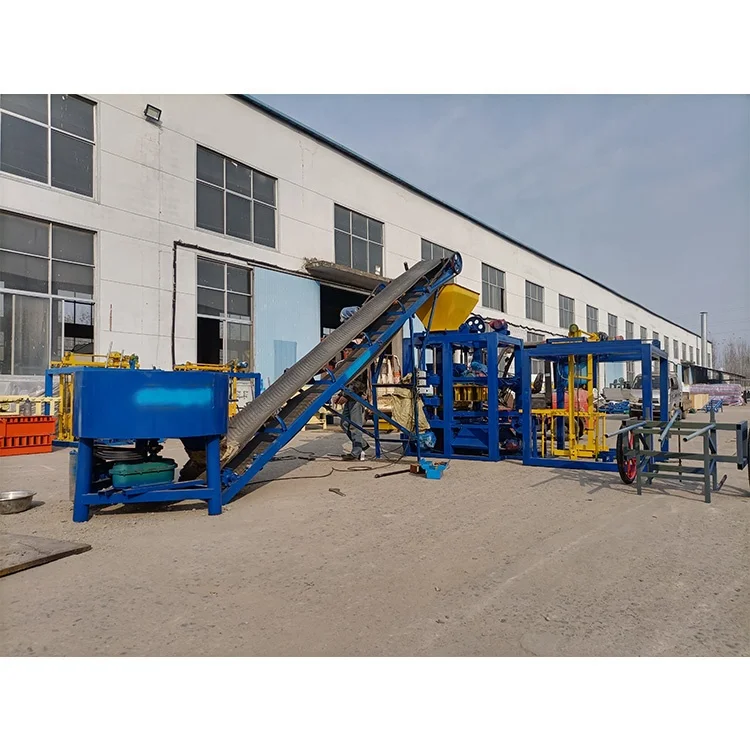
| Standard Configuration | Host machine × 1, Block mould × 1, JQ350 mixer × 1 |
Application Suitability
| Application | Material or Output |
|---|---|
| Hollow block production for building walls | Crushed stone, cement, sand with standard aggregate grading |
| Solid brick manufacturing | Cement-bound mix with fine aggregate |
| Paving block runs for walkways and yards | High-density mix with coarse aggregate |
| Kerb and curb stone forming | Stiff concrete mix with larger stone fraction |
| On-site contractor production | Locally sourced aggregate matched to structural requirement |
Why Your PLC Controlled Stationary Block Machine Needs Mix Data Before It Ships
The control system can only deliver consistency if the vibration force and hydraulic pressure are set against your actual raw material.
A few years back I worked on an order where the buyer received a machine configured for a standard river-sand mix. Their local aggregate turned out to be high in clay content. The PLC ran the same cycle, the same vibration sequence, the same pressing force — and every block came out under-strength. A full day’s production was scrapped before anyone noticed the pattern. That is the risk when a PLC controlled stationary block machine is commissioned without confirming the mix design first. The automation locks in repeatability, but repeatability of the wrong parameters only gives you a very consistent batch of bad blocks [NEED_CITE: effect of aggregate clay content on concrete block compressive strength].
How PLC Logic Replaces Operator Judgement
On a manual or relay-controlled press, the operator decides when the vibration is "enough" and when to release the mould. That judgement drifts across a shift as fatigue sets in. The QTJ4-25 puts the moulding cycle under PLC control, meaning the vibration duration, hydraulic dwell time and sequence transitions are executed identically for every single stroke. This is what separates a PLC controlled stationary block machine from its manual predecessors — not just the screen on the cabinet, but the removal of human timing from the forming process.
The Semi-Automatic Starting Point and Where It Leads
The QTJ4-25 ships as a semi-automatic line. Pallet feeding, block stacking and curing rack handling are done by hand at this configuration level. That is a deliberate entry point: the press itself is already under programmable control, so the operator is not managing cycle timing or pressing force. When daily volume grows and the manual pallet handling becomes the bottleneck, the control architecture is already in place to integrate automatic pallet feeders and stacking systems without replacing the core machine [NEED_CITE: typical automation upgrade paths for stationary block presses].
Reading the Specs That Actually Matter
The 60 kN exciting force paired with the hydraulic station determines how densely the concrete is compacted inside the mould. Higher compaction means higher block strength, but only when the vibration frequency of 2800 r/min is matched to the particle size of your aggregate. A fine sand mix responds differently to that frequency than a coarse crushed-stone mix, and the PLC parameters need adjusting accordingly. The 850 × 550 × 20 mm pallet size is another dimension that reaches beyond the machine itself — it dictates the curing rack spacing and the forklift tine width in your yard. Order a pallet size that does not fit your existing handling equipment and you create a bottleneck before the first block is cured. The 25 s moulding cycle is quoted without stating which block format it applies to, so any capacity planning must confirm the cycle time against the specific mould you intend to run most often.
What Happens When the Voltage Question Is Skipped
Buyers focus on the press and overlook the electrical specification until the machine arrives and will not start. A PLC cabinet wired for a voltage and frequency that does not match the local grid means the machine sits idle while transformers are sourced or the control panel is rewired. In humid or dusty environments, the cabinet sealing and component ratings matter just as much as the voltage itself. I have seen control boards fail within weeks because the ambient conditions were never part of the pre-shipment checklist. Confirming voltage, frequency and PLC display language in writing before production avoids a commissioning delay that no amount of on-site troubleshooting will shorten [NEED_CITE: industrial electrical compatibility requirements for export machinery].
What You Get from a Supplier That Builds the Line as One System
The QTJ4-25 is specified with its mould, pallet and mixer as a matched set rather than sourced from separate vendors and bolted together on your floor. Configuration is adjusted against your local aggregate and target block format, not left at a catalogue default. Mould design covers the formats your market actually buys, including custom profiles drawn to your specification. The automation level is selectable, so starting semi-automatic does not lock you out of future upgrades. Installation support includes operator training on the PLC interface, and mould and wear parts availability is confirmed before the machine leaves the factory.
Documentation & Verification
- Capacity calculation sheet stating the block format and cycle time assumed
- PLC I/O list and display language confirmed against your site requirements
- Hydraulic and electrical schematic matching the shipped configuration
- Factory test record covering cycle time, block dimensions and density for your chosen mould
- Mould drawing and format list for every mould included in the order
Installation, Commissioning & Support
- Floor space of 6400 × 1500 mm minimum with level concrete base for the 2500 kg host machine
- Dedicated power circuit matching confirmed voltage and frequency for the 17.9 kW rated load
- Machine shipped with hydraulic station pre-mounted; pallet feeder and stacker added as line grows
- PLC parameter set verified against your mix design during commissioning, not left at factory defaults
- Operator training covers PLC interface navigation, mould changeover procedure and daily maintenance checks
- Wear parts list and mould inventory supplied with reorder lead times stated before first production run
What to Include in Your Inquiry
Send your target block format with dimensions, the daily output you need to hit, and a sample or analysis of your local aggregate. State the voltage and frequency at your site, along with the preferred PLC display language. If you already have curing racks or forklifts, share the pallet dimensions they accept so the machine pallet size is matched from the start.
Frequently Asked Questions
Q: How is the 960 pcs/h figure derived, and which block format does it assume?
A: That capacity figure is based on producing 400×200×200 mm hollow blocks with 4 cavities per mould and the stated 25 s cycle time. If your primary format is a smaller solid brick or a paving block with a different cavity count, the cycle time and pieces per stroke will change, and the hourly output must be recalculated for your specific mould before you commit to a production target.
Q: Which PLC parameters can the operator adjust on-site?
A: The operator can modify vibration duration, hydraulic dwell time and cycle timing within the ranges set during commissioning. Core firmware parameters governing safety interlocks and sequence logic are locked to prevent accidental changes. The exact adjustable range depends on the PLC brand and programme configuration confirmed before shipment.
Q: Can the QTJ4-25 be upgraded later to automatic pallet handling?
A: The PLC architecture supports integration of automatic pallet feeding, stacking and cubing modules as a future upgrade. The semi-automatic configuration keeps manual pallet handling at the start, and the control system is designed to accept additional I/O for automated stations without replacing the main controller or rewriting the base programme.
Q: How is voltage and PLC language confirmed before the machine ships?
A: Voltage, frequency and PLC display language are confirmed in writing during the quotation stage and locked before production begins. The electrical schematic and PLC I/O list are included in the documentation package so you can verify the configuration matches your site supply before the machine is loaded for dispatch.
Q: What is the realistic mould change time between formats?
A: Mould change time depends on the format pair being switched and whether the operator has performed the procedure before. The mould mounting system on the QTJ4-25 uses standard bolting, and the PLC programme must be switched to the matching cycle parameters. First-time changeovers take longer until the operator builds familiarity with the tooling sequence.