

Buy Brick Machine OEM Manufacturer for Sale
True OEM customization for block making equipment means rewriting PLC logic, adapting hydraulic parameters, and selecting mold steel for your local aggregate—not just swapping a logo plate.
When sourcing a Brick Machine for OEM Buyers, the core evaluation must center on whether the manufacturer can deliver deep customization across voltage adaptation, mold standards, and aggregate compatibility, backed by full-chain turnkey capability from engineering drawings to on-site commissioning.
I still remember walking through a block plant in the Gulf region a few years back. The owner had sourced a Brick Machine for OEM Buyers from a low-cost supplier, and the PLC board had fried within weeks because nobody bothered to account for the local voltage fluctuation range. Workers stood idle, wages kept rolling, and the downtime cost dwarfed whatever they saved on the purchase price. That scene is not rare—it repeats across emerging markets every quarter. The real question when you evaluate a Brick Machine for OEM Buyers is never the sticker price; it is whether the factory has actually tested its control systems against unstable grids, calibrated hydraulic pressure for your specific sand moisture content, and built molds from steel that survives your local abrasive aggregate. [NEED_CITE: failure root-cause distribution in imported block machinery across emerging markets]
Let me walk you through what a serious OEM engagement actually looks like, how to verify capability before you commit, and which specs truly matter when you compare quotes.
What Customization Can an OEM Brick Machine Supplier Actually Deliver?
Genuine OEM customization spans the entire production chain—from PLC multi-language interfaces and voltage-frequency adaptation to mold steel metallurgy matched to your raw material profile.
Most buyers assume OEM means sticking their logo on a standard machine. The reality is far more demanding. A competent Brick Machine for OEM Buyers must address at least three layers of adaptation:
Electrical layer. Voltage and frequency vary dramatically across target markets. A machine built for one grid profile will fail in another. The manufacturer must rewire motor starters, adjust transformer taps, and reprogram PLC I/O mappings. In one case I observed, a distributor in West Africa received equipment rated for a stable grid, only to find the local supply swung wildly. The result was repeated controller resets and burned servo drives. Proper adaptation means the Brick Machine for OEM Buyers arrives with surge-tolerant components and firmware calibrated to the actual grid envelope. [NEED_CITE: industrial equipment voltage tolerance standards per IEC classification]
Hydraulic and mechanical layer. Aggregate characteristics—particle shape, moisture content, abrasiveness—differ by region. A mold designed for crushed granite will wear out prematurely if the local material is high-silica river sand. The manufacturer must adjust vibration frequency, pressing force curves, and mold steel grade accordingly. I have seen molds fail within months because the supplier used a generic steel grade unsuitable for the buyer’s abrasive feedstock.
Software and interface layer. Operators in different regions expect different languages, alarm conventions, and recipe structures. A Brick Machine for OEM Buyers worth its name allows the factory to rewrite PLC logic, translate HMI screens, and adjust automated cycle parameters to match local operator skill levels.
| Customization Layer | Shallow OEM | Deep OEM |
|---|---|---|
| Voltage Adaptation | Nameplate relabel only | Rewired control cabinet with local grid tolerance |
| Mold Steel Selection | Generic grade for all markets | Grade matched to local aggregate abrasiveness |
| PLC / HMI | Fixed language, fixed logic | Multi-language, rewritable recipe parameters |
| Hydraulic Calibration | Standard factory default | Pressure curve tuned to local material moisture |
The takeaway: if your Brick Machine for OEM Buyers supplier only offers logo engraving and color changes, you are not getting OEM—you are getting a reskin.
How to Verify an OEM Supplier’s Capability Before Placing an Order?
Verification must follow a structured five-step audit covering design review, trial molding, integrated testing, disassembly protocol, and shipping preparation—validated by physical evidence, not brochures.
I have shifted from quality inspection on the shop floor to trading, and I have learned that trust must be built on verifiable steps, not promises. When evaluating a Brick Machine for OEM Buyers manufacturer, insist on the following sequence:
Step one: Design review with your aggregate sample. Send representative raw material to the factory. A serious supplier will run lab tests, photograph the particle distribution, and document the recommended mold steel and vibration settings. If they skip this and quote off a catalog, walk away. [NEED_CITE: aggregate testing protocol for concrete block production raw material qualification]
Step two: Trial molding with your target product. The factory should produce sample blocks using your mold specifications, measure dimensional accuracy, compressive strength, and surface finish, then share the test report. This is non-negotiable.
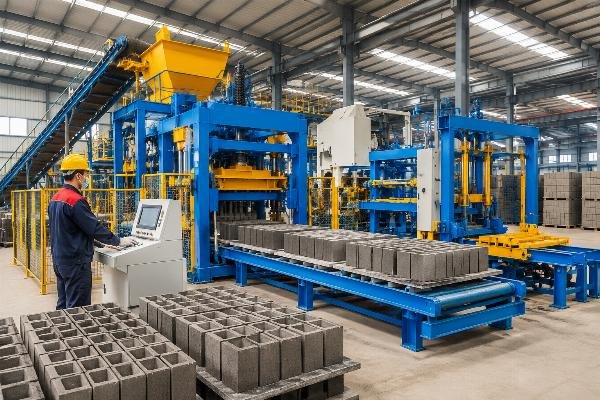
Step three: Integrated line commissioning at the factory. Before any component is packed, the entire line—mixer, conveyor, block machine, pallet system, stacker—must run together for a sustained cycle. Watch the video. Ask for timestamped footage. A Brick Machine for OEM Buyers that has never run as a complete system at the factory will almost certainly encounter integration problems on your site.
Step four: Disassembly and packing protocol. Proper OEM suppliers mark every component, photograph disassembly stages, and provide packing lists with photos. This reduces on-site reassembly errors dramatically. I once saw a Middle East distributor lose weeks on-site because electrical cables were not labeled during packing.
Step five: Pre-shipment electrical verification. The control cabinet must be powered up one final time before container sealing, with all I/O points checked against the adapted voltage specification.
A distributor in Southeast Asia once told me he switched suppliers after his previous Brick Machine for OEM Buyers source refused to run a full-line trial. The new supplier completed all five steps, and the on-site commissioning took a fraction of the expected time. Verification is not overhead—it is insurance.
What Are the Key Specs to Compare Across OEM Brick Machine Quotes?
The comparison matrix must cover output capacity, mold compatibility range, control system openness, spare parts interchangeability, and structural steel grade—never just unit price.
When I sit with buyers reviewing quotations for a Brick Machine for OEM Buyers, the first mistake is sorting by price. The second is looking only at the nominal cycle time. Here is what actually determines your total cost of ownership:
Output capacity under real conditions. Catalog numbers assume ideal material and continuous operation. Ask the supplier for output data based on your aggregate type and block size. A Brick Machine for OEM Buyers rated for high output on paper may deliver far less with wet, fine sand.
Mold compatibility and changeover time. Your product mix will evolve. Can the machine accept molds from third-party toolmakers? How long does a mold swap take? A machine locked to proprietary molds creates long-term dependency.
Control system openness. Can your local electrician access PLC parameters, or is the system sealed with proprietary passwords? A Brick Machine for OEM Buyers with an open-architecture PLC allows local troubleshooting and future upgrades without flying in the supplier’s engineer. [NEED_CITE: industrial PLC openness standards and maintenance accessibility guidelines]
Spare parts interchangeability. Standardized bearings, seals, and hydraulic components that follow international sizing conventions mean you can source replacements locally. Machines built with obscure proprietary parts trap you in a perpetual spare-parts dependency.
| Specification Dimension | Critical Evaluation Point |
|---|---|
| Real-World Output | Validated against your aggregate, not catalog ideal |
| Mold Compatibility | Open to third-party tooling, fast changeover |
| PLC Architecture | Open parameter access, local serviceability |
| Spare Parts Standardization | Internationally sized components, locally sourceable |
| Structural Steel Grade | Documented material certification, not verbal claim |
A construction equipment distributor in Latin America once compared three quotes for a Brick Machine for OEM Buyers. The cheapest option used non-standard hydraulic seals that could not be sourced locally. The mid-range option won the contract because its standardized components meant the distributor could maintain inventory without depending on overseas shipments for every minor repair.
How Does Turnkey OEM Delivery Reduce Your Total Cost of Ownership?
A turnkey package that includes on-site installation, commissioning, and operator training collapses the hidden costs of downtime, rework, and extended start-up timelines into a predictable delivery window.
The term "turnkey" gets thrown around loosely. In the context of a Brick Machine for OEM Buyers, it must mean the supplier takes responsibility from factory floor to first saleable block at your site. Here is what that actually involves:
Factory-integrated testing. As discussed, the complete line runs before disassembly. This eliminates integration surprises on-site.
Adapted documentation. Electrical schematics, hydraulic diagrams, and operator manuals in your language, calibrated to your voltage and product specs.
On-site installation supervision. The supplier sends engineers to guide foundation work, mechanical assembly, electrical connection, and system commissioning. For a Brick Machine for OEM Buyers, this is where the adaptation pays off—engineers who built the machine verify it live in your environment.
Operator training. Local workers learn not just button sequences but maintenance logic, alarm response, and recipe adjustment. A well-trained crew prevents the majority of early-stage breakdowns. [NEED_CITE: operator training impact on block machine uptime in emerging market installations]
Spare parts initialization. The turnkey package should include a recommended spare parts inventory sized for your first operational period, preventing the all-too-common scenario where a single failed seal halts production for weeks.
I watched a government housing contractor in East Africa commission a Brick Machine for OEM Buyers with full turnkey support. The supplier’s engineers stayed through the first production week, trained local operators, and left behind a maintenance schedule. The line reached full output within the projected timeline. Compare that to a neighboring project where the buyer assembled the line independently—commissioning dragged on, output was erratic, and the local team never fully understood the hydraulic adjustments needed for their laterite-rich aggregate.
The turnkey model is not about paying more upfront. It is about shifting risk from the buyer—who lacks technical depth on a specific machine—to the manufacturer who built it.
What MOQ and Lead Time Should OEM Buyers Expect from Chinese Manufacturers?
Mature OEM manufacturers offer flexible minimum order quantities and can deliver complete adapted lines within a compressed timeline, provided customization parameters are locked early in the process.
Buyers often worry that OEM customization means long waits and high minimums. The reality depends on the supplier’s production maturity. A factory with established modular platforms and experienced engineering teams can accommodate customization without the delays that plague smaller workshops.
For a Brick Machine for OEM Buyers, the critical path items are:
Custom mold fabrication. Molds are the longest single lead-time component. Once the design is approved and material is sourced, fabrication proceeds in parallel with machine assembly.
Electrical adaptation. Rewiring and PLC reprogramming can be completed during the mechanical assembly phase if the supplier plans ahead.
Integrated testing. This adds time but prevents far greater delays on-site.
A well-organized Brick Machine for OEM Buyers manufacturer can move from order confirmation to container loading within a compressed window, with the exact timeline depending on the depth of customization and current production queue. The key is locking your specifications—voltage, aggregate profile, mold drawings, PLC language—early, so the factory can sequence production without waiting for decisions mid-stream.
A distributor in the Middle East once told me his previous supplier quoted an aggressive delivery, then delayed repeatedly because electrical specifications were not finalized until late in the production cycle. His current Brick Machine for OEM Buyers partner locks all parameters at order confirmation, and deliveries have been consistently on schedule since.
Conclusion
Sourcing a Brick Machine for OEM Buyers is an exercise in risk management, not price negotiation. The manufacturers who deliver real value are those who invest in understanding your market’s voltage profile, aggregate characteristics, and operator skill level—and who back that understanding with turnkey execution from factory test to on-site production. Verify capability through structured audits, compare specifications beyond unit price, and insist on full-chain accountability. The machine that costs slightly more upfront but arrives adapted, tested, and supported will outperform the cheapest quote every single time.
Leave a Reply