

Buy Color Paving Block Machine Container Deal for Sale
Most buyers think the cheapest FOB quote wins the contract—until the first container arrives half-empty and freight eats the margin.
A properly structured color paving block machine container deal splits the full production line into function-based modules—main frame, mold sets, pallets, color feeders, and auxiliary units—so every cubic meter inside the 40HQ is utilized, hidden freight surcharges are eliminated, and the landed cost drops noticeably compared to a single-machine loading approach.
I still remember a Hanover Bauma fair evening years ago when a German buyer pulled me aside with a stack of invoices. He had ordered a complete paving line from a Turkish supplier, and the shipping bill alone nearly matched the machine price. The supplier had loaded the vibrator table, the mixer, and the pallet stacker into one container, leaving almost a third of the space wasted, while the mold pallets and color hoppers were sent separately in LCL at triple the per-CBM rate. We sat down with a loading plan sketch, reorganized the same line into three clearly defined modules, and the freight savings ended up covering the cost of an additional stacker unit [NEED_CITE: container utilization benchmark per ISO 668 for 40HQ high-cube]. That is the real math behind a color paving block machine container deal—not the machine tag price, but what lands at the port gate.
Let me walk you through how experienced buyers actually structure these shipments, spec by spec, module by module.
What Exactly Goes Into a Color Paving Block Machine Container Deal?
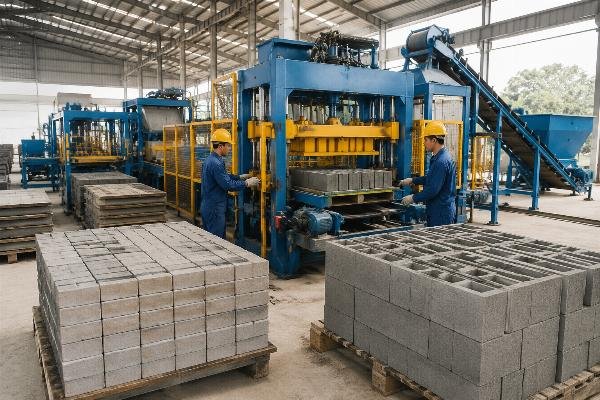
A complete container deal for color paving equipment covers far more than the main block-forming unit—it includes the mold matrix, pallet fleet, color feeder system, batch mixer, conveyor segments, and control cabinet, each quoted and loaded as a separable module.
When I first started breaking down quotations at the Canton Fair booth two decades ago, most overseas buyers asked for a single lump-sum price for "the whole line." The problem is that a lump sum hides the freight logic. Once you separate the line into its physical modules, three things happen: you can compare each module against competing quotes, you can choose which modules ship in the first container and which wait for the second, and you can negotiate Incoterms per module rather than for the entire package [NEED_CITE: modular quotation structure in construction equipment export standards].
Here is how a typical full-line color paving block machine container deal breaks down:
| Module | Typical Contents | Loading Priority | Quotation Separability |
|---|---|---|---|
| Main Frame Unit | Vibro-compress host, hydraulic station, PLC cabinet | First container, center-loaded | Standalone FOB price |
| Mold & Pallet Set | Decorative molds, standard molds, bamboo or PVC pallets | First or second container | Per-set pricing, buyer-comparable |
| Color Feeder System | Hopper, screw conveyor, dosing scale, pigment mixer | Second container | Separate SKU, optional add-on |
| Auxiliary Equipment | Batch mixer, belt conveyor, pallet loader, stacker | Second or third container | Itemized or grouped |
| Spare Parts Kit | Wear liners, seals, spare vibrator motors | Packed inside main frame | Bundled or line-item |
A Middle East distributor I worked with initially received a bundled quote where the color feeder was hidden inside the main machine price. Once we split it out, he realized the feeder alone was priced higher than a standalone unit from another source—and he used that leverage to renegotiate the entire color paving block machine container deal.
How Do You Split a Full Production Line Across Containers?
The most cost-efficient approach is a three-container logic: main frame in the first 40HQ, molds and pallets in the second, and auxiliaries plus color system in the third—adjusting downward to two containers for semi-automatic lines.
Container loading is not a packing exercise; it is a freight engineering task. The volumetric weight of a QT10-15 fully automatic line, if stuffed randomly, can waste nearly a third of a 40HQ’s usable CBM. I have watched loading crews at Qingdao port stack the pallets vertically instead of flat, burning space that should have held the color feeder hopper. The fix is a pre-shipment loading plan that maps every module to its exact container position before the machines even leave the production floor [NEED_CITE: container loading optimization methodology for heavy machinery exports].
The split logic works like this:
- Container One: The main frame, hydraulic power pack, and PLC control cabinet. These are the heaviest and most damage-sensitive items, loaded first and secured with welded floor brackets.
- Container Two: Mold sets and the full pallet fleet. Molds are nested and wrapped; pallets are stacked flat to ceiling height. This container often reaches maximum weight before maximum volume.
- Container Three: Color feeder system, batch mixer, belt conveyors, and the stacker. These are lighter but bulky, ideal for filling the remaining CBM.
A European buyer restructuring his order from a single-vendor lump shipment into this three-container model reduced his freight cost ratio noticeably—enough to redirect savings into a second mold set for a different paver pattern. The key is that each container carries a clear module identity, so if port delays hold up Container Three, production can still begin with Containers One and Two already on site.
Which Machine Specs Fit Your Paving Business—Semi-Auto vs. Fully-Auto?
Entry-level investors targeting quick payback should start with semi-automatic models like the QT4-25 or QT6-15, while scaled infrastructure projects require fully automatic PLC lines such as the QT10-15 or QT12-15 with integrated color feeding.
Choosing the right machine spec is the single biggest variable inside a color paving block machine container deal, because it determines not only the unit price but also how many containers the line occupies and what auxiliary equipment is needed.
| Parameter | Semi-Auto (QT4-25 / QT6-15) | Fully-Auto (QT10-15 / QT12-15) |
|---|---|---|
| Output Capacity | Low to medium daily output | High-volume continuous output |
| Labor Requirement | Manual pallet handling, basic operator skill | Automated pallet cycling, PLC-trained operator |
| Container Footprint | One to two containers for full line | Three containers typical for complete line |
| Color Feeder Integration | Optional, add-on basis | Standard integrated configuration |
| Best Buyer Profile | Private investors, new market entry | Government contractors, established plants |
A private investor in East Africa started with a QT4-25 egg-laying mobile unit shipped in a single container, validated the interlocking brick demand locally, and returned six months later to expand into a QT10-15 fully automatic line with color feeder—this time structured as a proper color paving block machine container deal across three containers. The initial semi-auto order served as a market probe; the second order was the real business.
Shandong Shiyue’s QT series covers this full spectrum, from the manual-friendly QT4-15 to the high-output QT15-15, all engineered for unstable voltage grids and high-dust environments common across emerging markets. The machines carry CE and SGS certification, which matters when your buyer needs to clear customs under strict import inspection regimes [NEED_CITE: CE SGS certification requirement for construction machinery imports in African and MENA markets].
How to Verify Quality and Avoid Hidden Costs Before Shipping?
Demand CE or SGS certification, request live mold-trial videos on your specific raw material, obtain steel grade reports for mold inserts, and lock after-sales spare parts terms in writing before the first container is sealed.
Hidden costs in a color paving block machine container deal rarely appear in the machine price—they surface in mold wear within months, pallet warping under tropical humidity, or a PLC board failure with no spare in stock. I have seen buyers receive machines that looked perfect on arrival, only to discover the mold steel was a lower grade than quoted, producing faded paver colors after a few thousand cycles.
Here is the verification checklist I walk every buyer through:
- Certification Documents: CE marking for European-bound shipments, SGS inspection reports for African and Middle Eastern ports. Without these, customs clearance can stall for weeks.
- Live Mold Trial Video: The manufacturer should run your specific aggregate mix—whether it is river sand, crusher dust, or recycled concrete—and film the output. Still photos are not enough.
- Mold Steel Material Report: Request the mill certificate for the mold insert steel. The grade determines wear life and color consistency in face-mix pavers.
- Pallet Specification: Bamboo, PVC, or plastic pallets each behave differently under climate stress. Confirm the material and thickness matches your environment.
- Spare Parts Clause: Define which wear parts ship free in the first container, which are priced at cost for the first year, and what the lead time is for emergency air shipments [NEED_CITE: spare parts clause best practice in international machinery trade contracts].
A South American contractor once skipped the mold steel report to save a few days on paperwork. Six months in, the decorative mold surface pitted badly, and the replacement mold cost several times the original inspection savings. The lesson is simple: verification cost is always smaller than replacement cost.
What’s the Real Lead Time from Order to Site Commissioning?
A complete color paving block machine container deal, from deposit to on-site commissioning, typically runs within a production and shipping window of one to two months, with full installation,调试, and operator training completed shortly after port arrival.
Lead time is where vague promises destroy project budgets. A government housing contractor in West Africa once told me his previous supplier quoted "fast delivery" but the machines sat at the port for weeks because the CE documents were incomplete. By the time the line ran, the rainy season had already delayed the paving contract.
The realistic timeline for a properly managed color paving block machine container deal looks like this:
- Production Phase: The main frame, mold sets, and auxiliary units are manufactured and assembled for testing at the Linyi facility. Full-line trial runs verify output, vibration frequency, and color dosing accuracy before disassembly.
- Shipping Phase: Containers are loaded per the modular plan, sealed, and dispatched from Qingdao Port. Ocean freight duration depends on destination—Southeast Asia ports receive shipments faster, while West African or Latin American ports add transit time.
- On-Site Commissioning: Shandong Shiyue dispatches engineers for installation, PLC parameter calibration, mold fitting, and hands-on operator training. The goal is not just to make the machine run, but to leave the local team capable of independent production, routine maintenance, and basic troubleshooting [NEED_CITE: turnkey installation and training protocol for block machine exports].
A distributor in the MENA region structured his first color paving block machine container deal around a semi-auto QT6-15 line with a decorative mold set and color feeder. The full cycle—from order confirmation to the first batch of interlocking pavers rolling off the line—took roughly the industry-standard window, and the on-site engineer stayed until the local crew could run three consecutive production days without intervention.
Conclusion
Winning a color paving block machine container deal is a loading and quotation architecture problem, not a price-tag problem. Buyers who split the line into modular containers, match machine specs to their actual scale, verify mold and pallet quality before shipment, and lock in turnkey commissioning terms consistently land at lower total cost and faster production startup than those who chase the lowest FOB number.
Leave a Reply