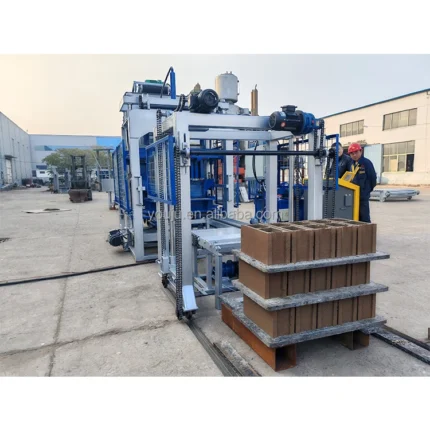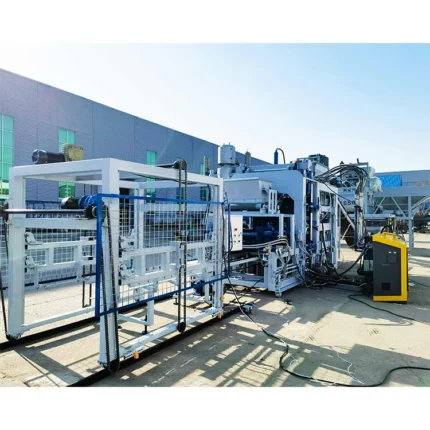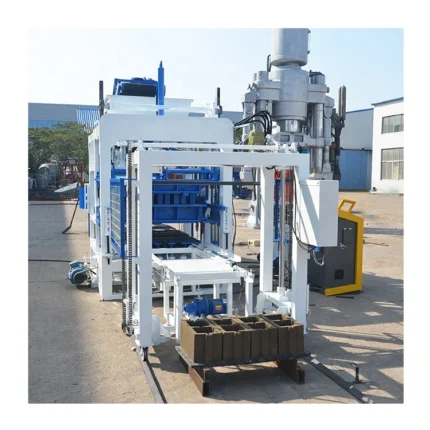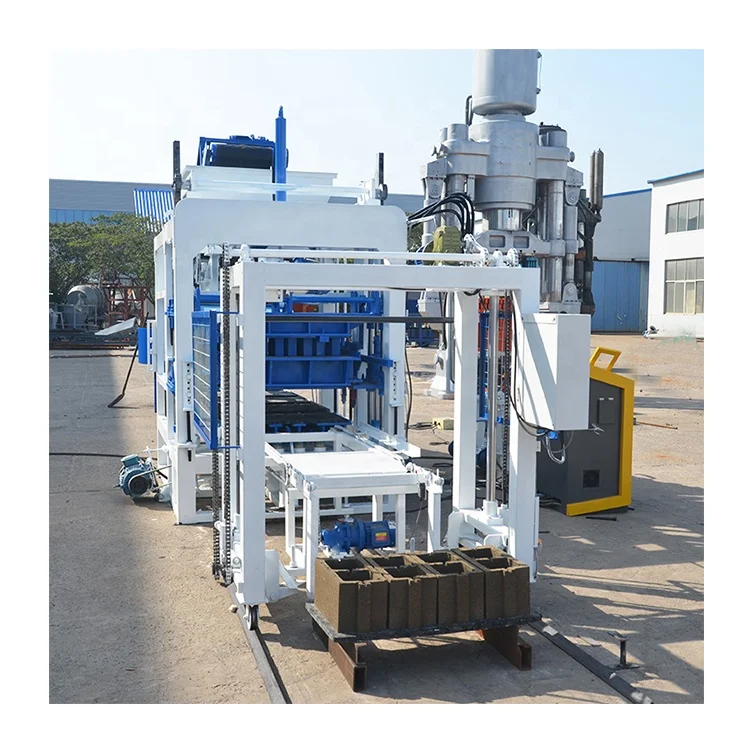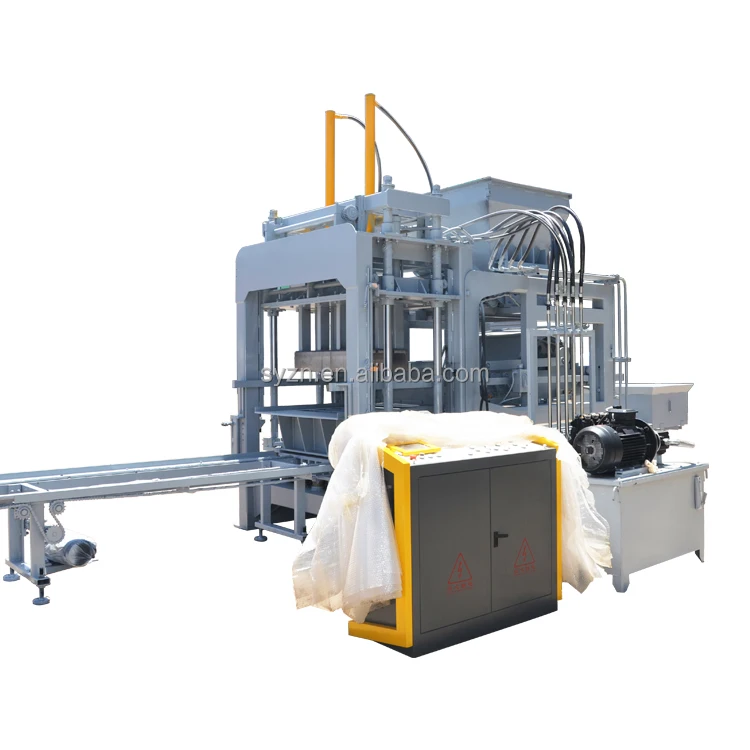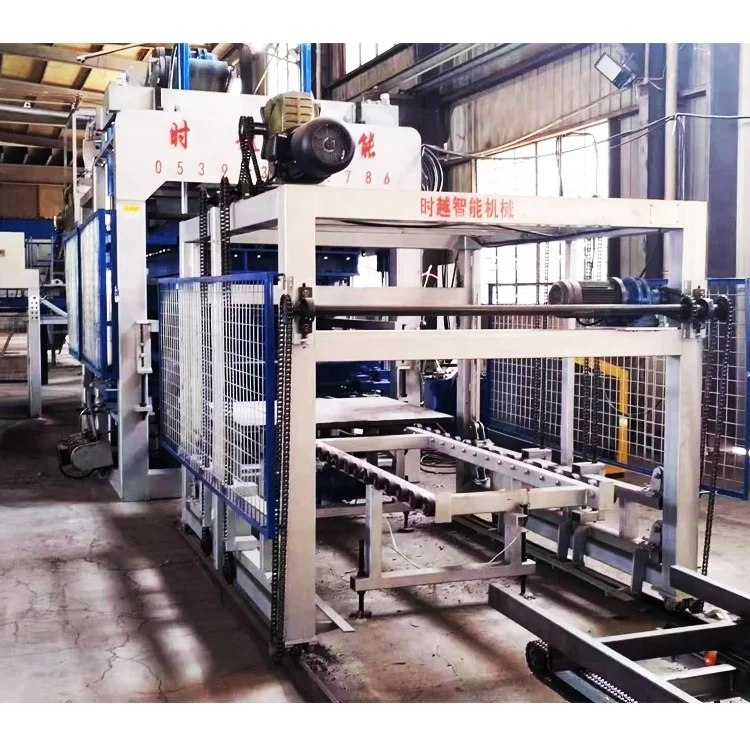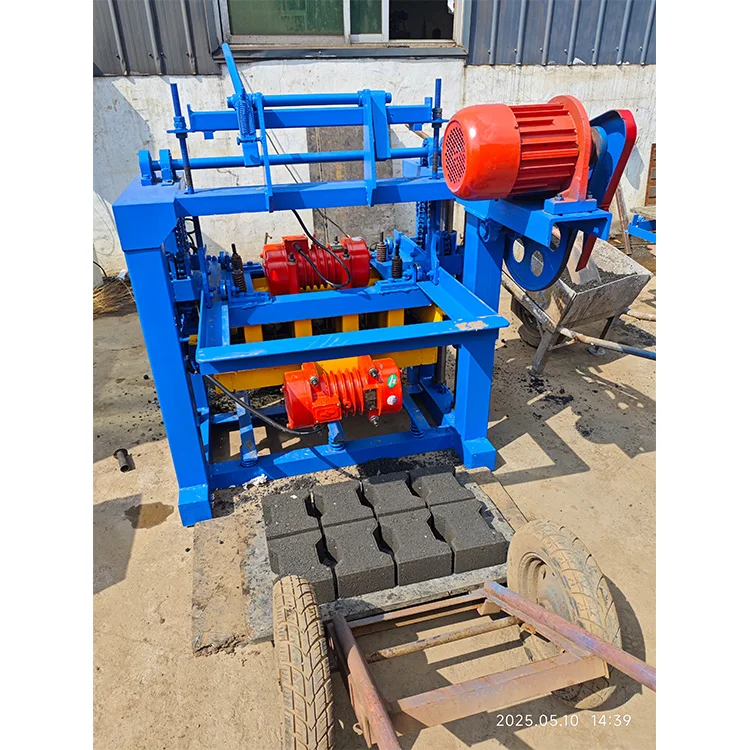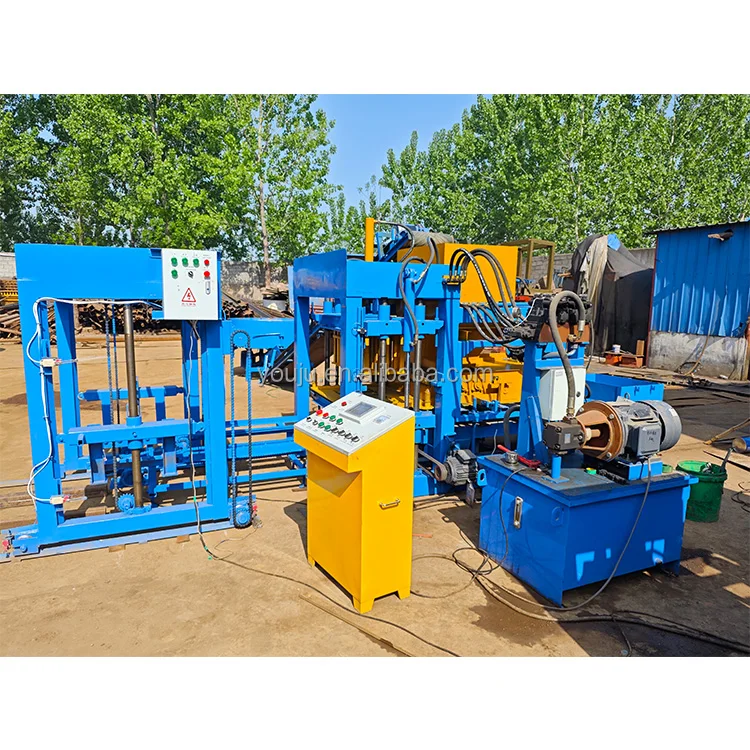

Description
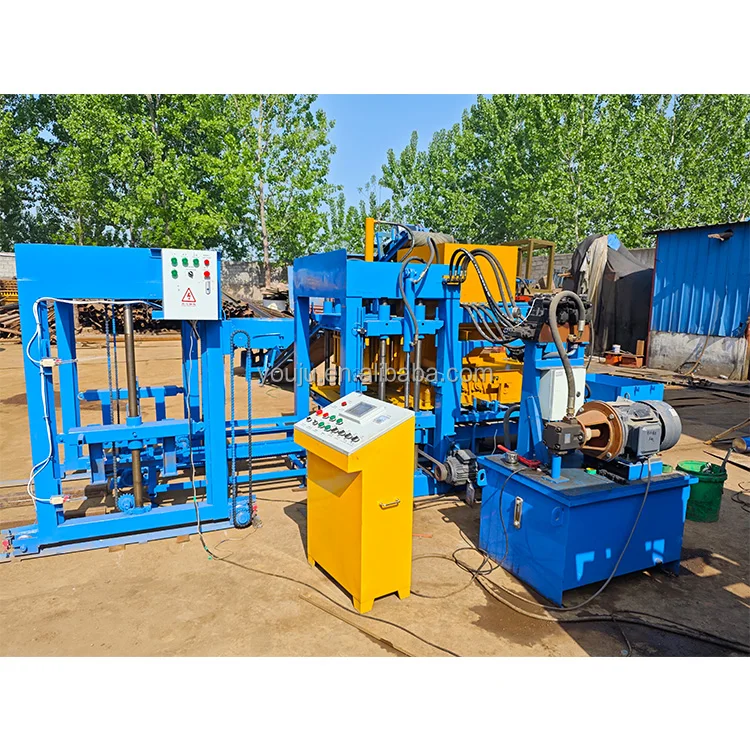
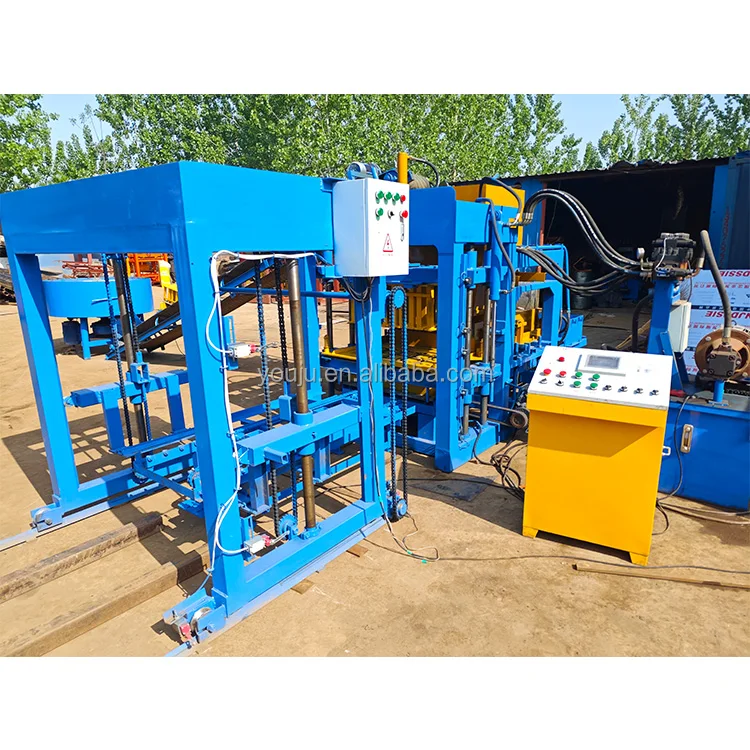
Consistent Cycle Control — PLC-regulated timing on the QTJ4-25 holds a repeatable 25-second molding cycle across shifts, removing manual guesswork from every press stroke.
Technical Specifications
| Parameter | Value |
|---|---|
| Model | QTJ4-25 |
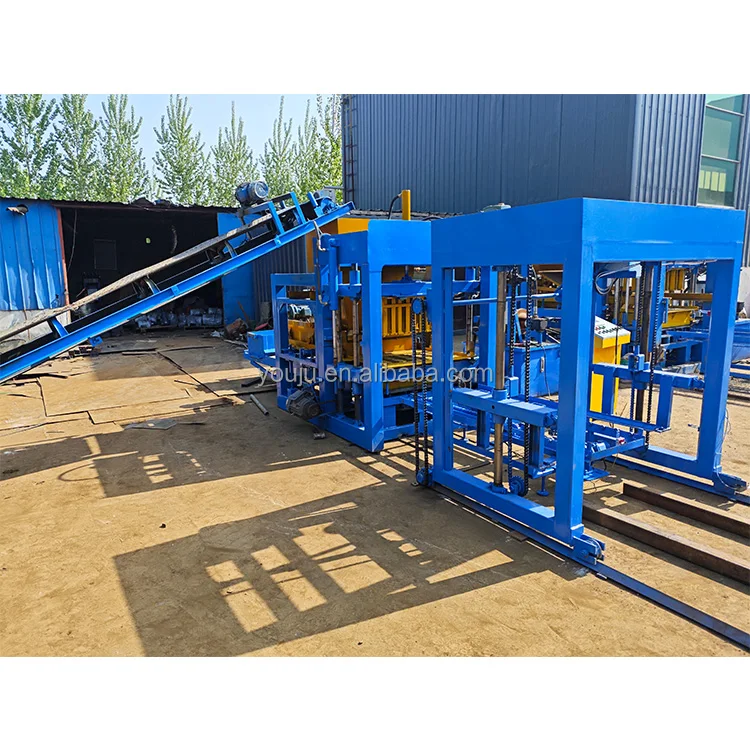
| Product Type | Semi-Automatic Hydraulic Concrete Block Making Machine |
| Rated Power | 17.9 kW |
| Vibration Force | 60 kN |
| Vibration Frequency | 2800 r/min |
| Molding Cycle | 25 s |
| Overall Dimensions (L×W×H) | 6400 × 1500 × 2700 mm |
| Total Mass | 2500 kg |
| Pallet Size | 850 × 550 × 20 mm |
| Output Capacity | 960 pcs/h, 7680 pcs/day (based on 400×200×200 mm hollow block, 4 pcs/mould) |
| Mould Format | Hollow, solid, paver, curbstone (interchangeable) |
| Automation Level | Semi-automatic, upgradeable |
| Hydraulic Station | High-pressure hydraulic system |
| Control System | PLC controlled (display language to be confirmed) |
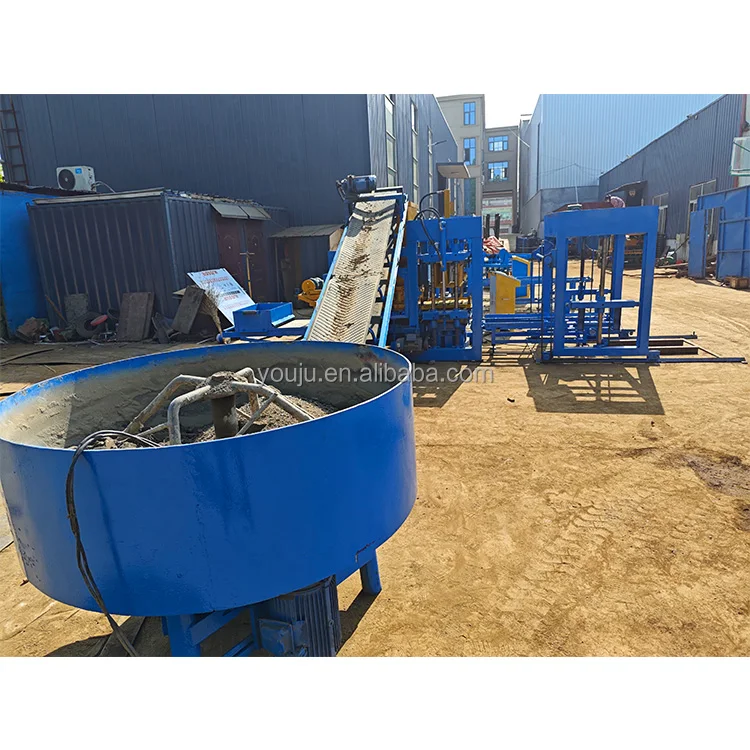
| Included Configuration | Host machine 1 set, block mould 1 set, JQ350 mixer |
| Stacking Method | Manual pallet-based, trolley transport to curing area |
| Certification | CE (referenced in documentation, verify for specific model) |
Application Suitability
| Application | Material or Output |
|---|---|
| Hollow block production for load-bearing and partition walls | Crushed stone, cement, sand aggregate mix |
| Solid block manufacturing for foundation and structural masonry | Dense concrete mix with local coarse aggregate |
| Paving block production for walkways and driveways | Fine aggregate with cement binder, pigmented or natural |
| Curbstone forming for road and landscape edging | High-strength mix with larger aggregate grading |
| Small-to-medium block plant operations | Semi-automatic workflow with manual pallet handling |
| Contractor on-site block production | Portable pallet-based setup using local raw materials |
Why the PLC Question Matters More Than the Cycle Time Claim
A stated cycle time only reflects reality when the control system actually enforces it across every shift and operator change.
Many block machine quotations advertise fast cycle times, but the PLC controlled semi-automatic block making machine buyer quickly discovers that without a programmable logic controller enforcing those intervals, the actual rhythm depends entirely on operator discipline. The QTJ4-25 addresses this by locking the 25-second molding cycle into the PLC program, so the vibration duration, hydraulic dwell, and upper mould compression follow the same sequence whether it is the first block of the morning or the last before shutdown. This consistency is what separates a laboratory-rated figure from a production floor reality [NEED_CITE: PLC programming standards for concrete block presses].
From Manual Timing to Programmable Repeatability
Operators running gravity-fed or manual block machines develop their own rhythm, which drifts over a long shift as fatigue sets in. The QTJ4-25 shifts that timing responsibility to the PLC, so vibration force and hydraulic pressure are applied for the same duration on every stroke. For a plant owner moving away from fully manual production, this single change removes the largest variable from block density and strength.
Building the Automation Foundation for Future Expansion
The semi-automatic base configuration of this PLC controlled semi-automatic block making machine is deliberately designed as a starting point rather than a ceiling. The press itself, its hydraulic station, and the PLC panel are specified to accept future integration of automatic pallet feeding, stacking, and cubing modules. A buyer who cannot justify full automation on day one can plan the upgrade without replacing the core press, protecting the initial investment while leaving room to reduce labour costs as production volume grows [NEED_CITE: modular automation integration in block making lines].
Reading the Specs That Actually Shape Block Quality
The 60 kN vibration force paired with the high-pressure hydraulic station determines how tightly the aggregate is compacted within the mould cavity. When these two forces are balanced against the buyer’s specific mix design, the resulting block achieves uniform density from top face to bottom face. The 2800 r/min vibration frequency sits in the range suited to standard concrete mixes with crushed stone aggregate, ensuring particles settle into voids rather than bouncing away from each other. The 850 × 550 mm pallet size directly dictates curing rack dimensions and forklift compatibility, so confirming this against the buyer’s existing curing area avoids costly pallet replacement after arrival. The 2500 kg total mass provides sufficient machine weight to absorb vibration energy into the block rather than dissipating it through frame movement.
When Automation and Control Are Mismatched to the Site
Choosing a machine with PLC control but failing to confirm the display language before production leads to operators who cannot interpret fault codes, turning minor stoppages into extended downtime. Selecting voltage and frequency without matching the local grid standard means commissioning delays and potentially damaged electrical components upon first power-up. Ignoring the pallet size in relation to existing curing racks and transport equipment forces the plant to rebuild infrastructure around the machine instead of the other way around. These mismatches rarely appear in quotations but surface immediately during installation [NEED_CITE: industrial equipment commissioning delays caused by specification mismatches].
Why Buyers Source This Class of Machine Here
Block machinery is the sole manufacturing focus, so the QTJ4-25 press, its moulds, pallets, and handling equipment are specified as one matched system rather than assembled from unrelated suppliers. Machine configuration is set against the buyer’s actual mix design, local aggregate, and target block format instead of defaulting to a catalogue standard. Mould design covers the formats the buyer’s market actually sells, with custom drawings available when standard dimensions do not match local demand. The semi-automatic starting point includes a clear automation upgrade path, allowing capacity growth without wholesale equipment replacement. Installation support extends through commissioning and operator training, ensuring the PLC parameters are tuned to the specific raw materials on site.
Documentation & Verification
- Capacity calculation document stating the exact block format assumed for the 960 pcs/h figure
- Hydraulic and electrical schematic provided for the local maintenance team before dispatch
- Factory test record on the buyer’s specified block format and mix ratio before shipment
- Mould drawing and format list confirming pallet and cavity dimensions against market requirements
- Voltage, frequency, and PLC display language confirmation sheet signed before production begins
- CE declaration documentation where applicable to the destination market
Installation, Commissioning & Support
- Foundation plan matched to the 6400 × 1500 mm footprint and 2500 kg operating mass
- Dedicated electrical circuit sized for the 17.9 kW rated power draw at the confirmed local voltage
- PLC parameter tuning during commissioning to match the buyer’s aggregate and mix design
- Mould change procedure training so format switches are completed within a practical shift window
- Hydraulic station inspection schedule aligned with local operating conditions and ambient temperature
- Wear parts and hydraulic seal list provided with recommended replacement intervals
What We Need to Move Your Inquiry Forward
To configure the QTJ4-25 for your production line, please specify the target block format and dimensions your market requires, along with the local aggregate type and mix proportions you plan to use. Confirm your site voltage, frequency, and preferred PLC display language so the control panel is built correctly before dispatch. Share your existing curing area dimensions and pallet handling equipment so the 850 × 550 mm pallet size can be validated against your infrastructure.
Frequently Asked Questions
Q: How is the 960 pcs/h output verified, and what block format does it assume?
A: This figure is calculated based on producing 400×200×200 mm hollow blocks at four pieces per mould with a 25-second molding cycle. Output for other formats such as solid blocks or pavers will differ based on the number of cavities per mould and the cycle time required for each specific format. A detailed capacity breakdown by format is provided with the quotation.
Q: What PLC language options are available, and can the display be set to the operator’s local language?
A: The PLC display language is confirmed during the order stage before the control panel is assembled. Common options include English, Spanish, Arabic, French, and Russian, with additional languages available depending on the PLC manufacturer’s interface library. Confirming this early prevents commissioning delays caused by operators unable to read fault codes.
Q: What automation upgrades can be added later without replacing the press?
A: The semi-automatic configuration supports future addition of automatic pallet feeding, stacking, and cubing systems. The hydraulic station and PLC are specified with spare input/output capacity to accommodate these modules. The upgrade is planned during initial configuration so mechanical mounting points and electrical interfaces are already in place.
Q: How does the hydraulic pressure and vibration force need to be matched to my local aggregate?
A: The 60 kN vibration force and hydraulic pressure settings are adjusted during commissioning based on the buyer’s actual mix design and aggregate grading. Coarser aggregate typically requires higher vibration energy, while finer mixes need careful pressure control to avoid surface cracking. Factory testing on a sample mix helps establish baseline parameters before shipment.
Q: What is the mould change procedure, and how long does a format switch take?
A: The interchangeable mould system allows operators to switch between hollow, solid, paver, and curbstone formats. The procedure involves releasing the mould clamps, lifting the current mould with the overhead crane or forklift, positioning the replacement mould, and recalibrating the PLC cycle parameters for the new format. Training covers the complete sequence during commissioning.