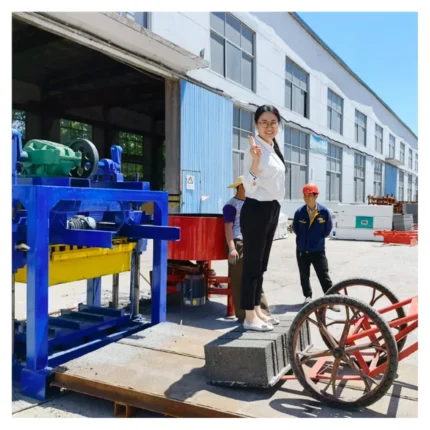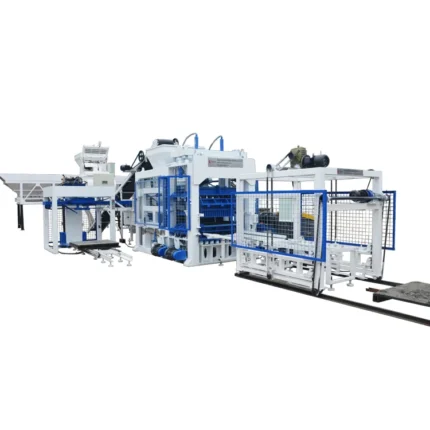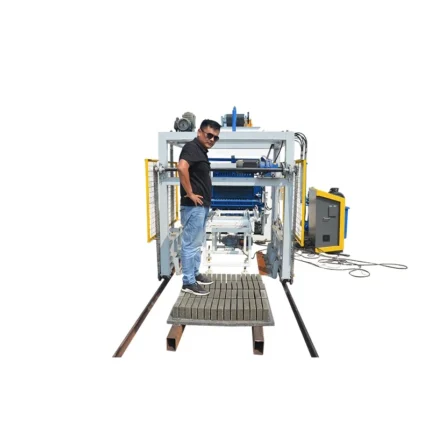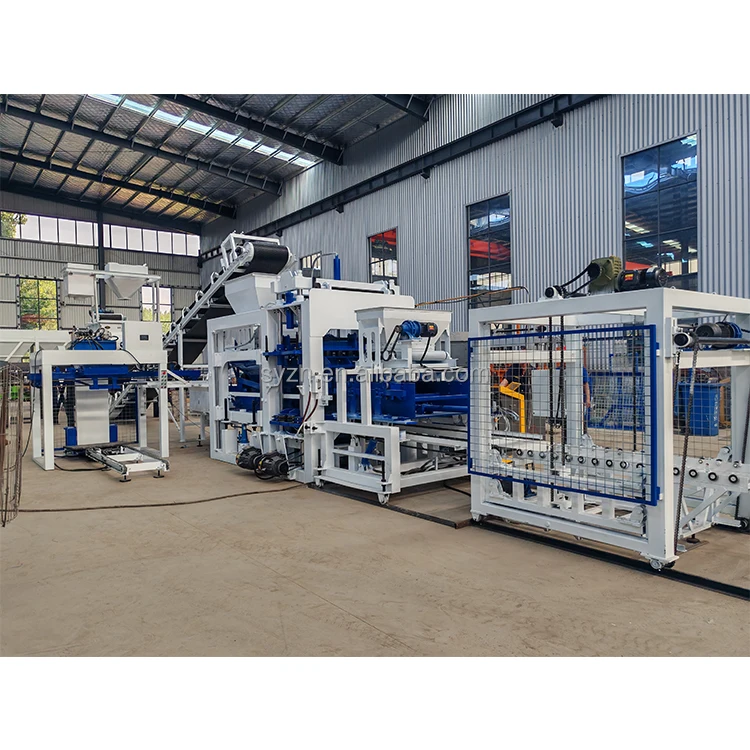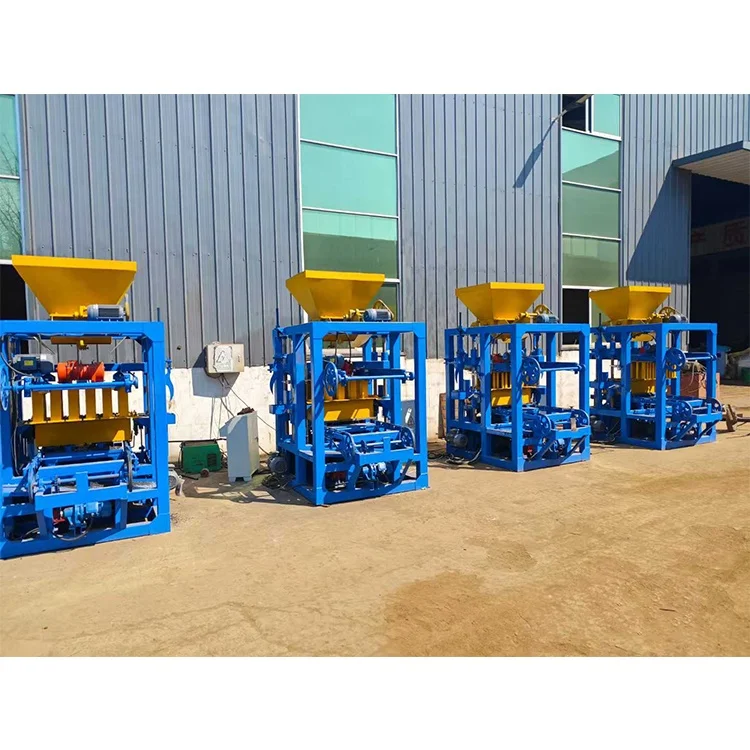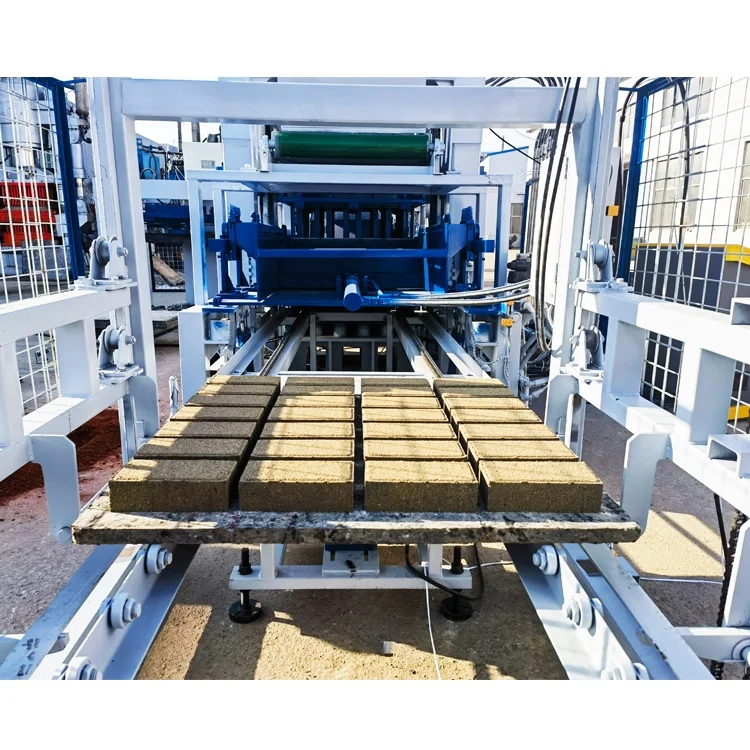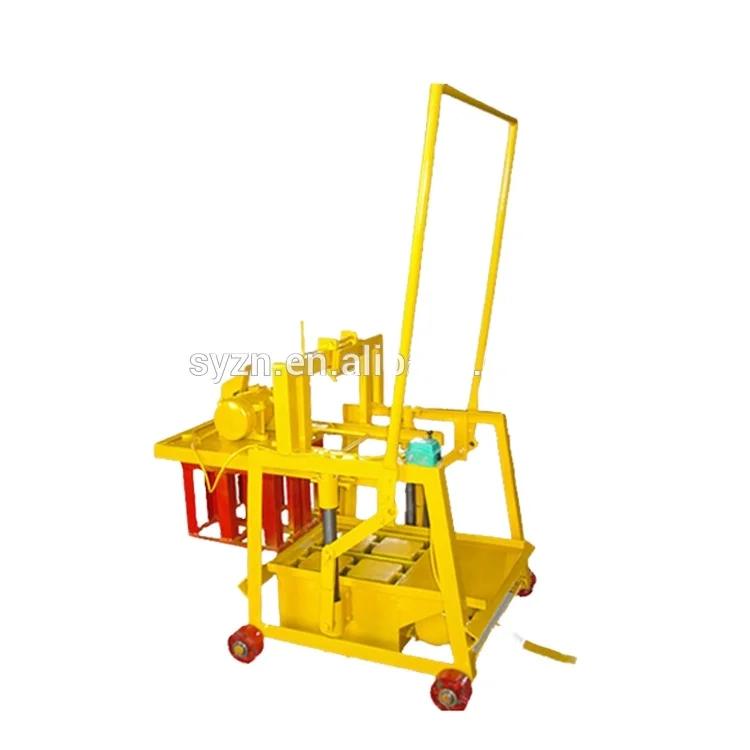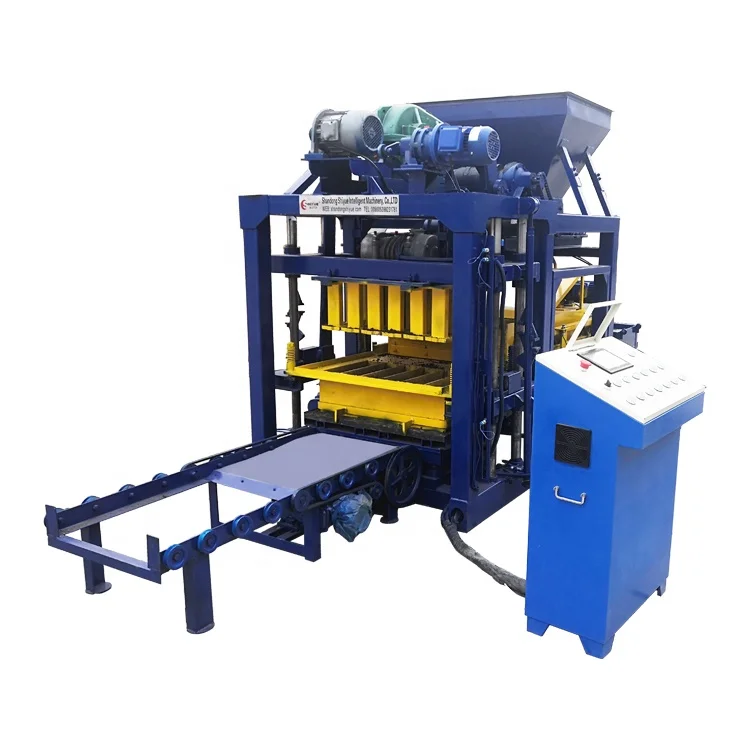


Description
Automation That Removes Operator Guesswork — The QTJ4-25 takes manual pallet handling, material feeding, and brick discharging out of the operator’s hands through PLC-controlled sequences, so block density stays consistent across every shift, not just the first hour.
Technical Specifications
| Parameter | Value |
|---|---|
| Model | QTJ4-25 |
| Product Type | Automatic Concrete Block Making Machine |
| Overall Dimensions (L×W×H) | 6400×1500×2700 mm |
| Molding Cycle | 25 s |
| Vibration Frequency | 2800–5100 r/min |
| Exciting Power (Vibration Force) | 60 kN |
| Total Power | 17.9 kW |
| Mixer Model | JQ350 |
| Pallet Size | 850×550×20 mm |
| Net Weight | 2500 kg |
| Control System | PLC control |
| Automation Features | Automatic plate-supplying, material-disturbing, brick-discharging |
| Raw Materials | Crushed stones, sand, cement, dust, fly ash |
| Output Capacity (390×190×190 mm hollow block) | 480 pcs/h, 3800 pcs/8 hr |
| Output Capacity (400×150×200 mm hollow block) | 600 pcs/h, 4800 pcs/8 hr |
| Output Capacity (240×115×53 mm solid brick) | 2100 pcs/h, 17000 pcs/8 hr |
| Voltage & Frequency | (basis to be confirmed with buyer site requirement) |
| Hydraulic Pressure | (basis to be confirmed) |
| Mould Change Time | (basis to be confirmed) |
| Stacking Method | (basis to be confirmed) |
| PLC Display Language | (basis to be confirmed) |
Application Suitability
| Application | Material or Output |
|---|---|
| Hollow block production for load-bearing walls | Crushed stone, sand, cement at 390×190×190 mm and 400×150×200 mm formats |
| Solid brick manufacturing for masonry | Sand, cement, fly ash at 240×115×53 mm standard brick format |
| Paver and building block production | Local aggregates including dust and fly ash blends |
| On-site block production for construction projects | Portable setup using site-sourced crushed stone and sand |
Why "Automatic" Means Nothing Without Format-Specific Capacity
Capacity figures only matter when tied to the exact block format you intend to produce.
I have walked onto job sites where the block machine was rated at impressive hourly numbers, but those numbers assumed a small solid brick format while the plant was running 8-inch hollow blocks. The daily tally ended up at less than half the quoted throughput. With the QTJ4-25, the 480 pcs/h figure applies specifically to 390×190×190 mm hollow blocks, and the 600 pcs/h figure applies to 400×150×200 mm hollow blocks — no hidden assumptions behind the automatic block making machine PLC controlled output claim. [NEED_CITE: block format assumptions in capacity quoting practices]
What PLC Control Actually Takes Off the Operator
On a manual or semi-automatic line, the operator decides when the pallet slides in, when the material drops, and when the brick pushes out. Each of those decisions introduces variation. The PLC-controlled sequence on the QTJ4-25 handles automatic plate-supplying, material-disturbing, and brick-discharging in a fixed timing loop. The operator monitors rather than triggers. This matters most during the second half of a shift when fatigue changes how a human runs a semi-automatic press.
Vibration Tuning Against Your Actual Aggregate
In Guangdong, I once spent two days chasing crumbly blocks because the local river sand had a different particle shape than the standard quartz sand used at the factory test. The vibration frequency on this automatic block making machine PLC controlled unit spans 2800–5100 r/min, and the 60 kN exciting power works through flat vibration combined with squeeze compression. [NEED_CITE: aggregate particle shape effects on vibration compaction] The range is wide enough to dial in against your specific crushed stone or fly ash blend rather than forcing you to change your material source.
Reading the Specifications That Determine Block Density
The 25-second molding cycle is the starting point for capacity planning, but block density depends on how vibration force and pressure interact during those 25 seconds. The 60 kN exciting power drives aggregate particles into tight arrangement while the squeeze compression locks them before the mix settles. Pallet size at 850×550×20 mm must match your curing rack spacing and forklift tine width — ordering a non-standard pallet size means rebuilding your curing area. The 17.9 kW total power requirement needs a dedicated circuit; sharing a line with a mixer or conveyor causes voltage dips that reset the PLC mid-cycle.
The Cost of Skipping the Voltage and Language Conversation
A machine arrives, the electrician opens the panel, and the motor plate reads 380V/50Hz while the site runs 440V/60Hz. Commissioning stalls for weeks while a transformer is sourced locally. The PLC display boots in a language the operator cannot read, so parameter adjustments happen by guesswork. I have seen entire startup schedules collapse because the voltage and language questions were left to "we will sort it on site." These are two-line items on a confirmation sheet, but they carry disproportionate weight when the machine is already in a container. [NEED_CITE: electrical standards by export destination market]
Why Buyers Source This Machine Here
Block machinery is the single focus, meaning the QTJ4-25 press, mould, pallet, and handling equipment are specified as one matched system rather than assembled from separate vendors. Configuration is set against your actual mix design and local aggregate, not pulled from a catalogue default. Mould design covers the formats your market actually sells, with custom drawings available when standard formats do not match. The automation level is selectable — you can start with automatic pallet feeding and brick discharging, then add stacking and cubing as volume grows. Installation support includes on-site commissioning and operator training so the first production run does not become a troubleshooting exercise.
Documentation & Verification
- Line layout with capacity calculation stating the block format assumed for each output figure
- Machine specification sheet confirming vibration frequency range and pallet dimensions
- Mould drawing and format list matching your target hollow block and solid brick sizes
- Voltage, frequency, and PLC display language written confirmation before production starts
- Factory test record showing cycle time achieved with your confirmed mix design
- Packing photographs and customs documentation support for container loading
Installation, Commissioning & Support
- Foundation must accommodate the 6400×1500 mm footprint with level tolerance for vibration table stability
- Dedicated 17.9 kW circuit required; shared supply risks PLC resets during motor startup surges
- Machine arrives partially dismantled; reassembly of hopper and pallet magazine on site
- First-run commissioning includes vibration frequency tuning against your local aggregate sample
- Operator training covers PLC parameter adjustment for mould changes between hollow block and solid brick
- Wear parts list provided with hydraulic and vibration component replacement intervals
What We Need to Configure Your Line
Send your target block format dimensions, daily output requirement, and the specific aggregate available at your site — crushed stone type, sand source, and whether fly ash is part of your mix. Confirm the local voltage and frequency, the language you need on the PLC display, and your existing curing rack dimensions so pallet size can be matched before production begins.
Frequently Asked Questions
Q: How is the output capacity of the QTJ4-25 verified, and which block format does each figure assume?
A: Each capacity figure is tied to a specific block format. The 480 pcs/h rate applies to 390×190×190 mm hollow blocks, the 600 pcs/h rate applies to 400×150×200 mm hollow blocks, and the 2100 pcs/h rate applies to 240×115×53 mm solid bricks. A line layout document stating these assumptions is provided before order confirmation.
Q: Can the PLC control language and voltage be confirmed to match my site before the machine ships?
A: Yes. Voltage, frequency, and PLC display language are confirmed in writing before production starts. This prevents commissioning delays caused by mismatched electrical supply or unreadable control screens when the automatic block making machine PLC controlled unit arrives at your site.
Q: What is the automation upgrade path if I start with automatic pallet feeding and later want automatic stacking?
A: The QTJ4-25 supports automatic plate-supplying, material-disturbing, and brick-discharging as a starting configuration. Automatic stacking and cubing can be added as downstream modules when production volume justifies the investment, without replacing the press itself.
Q: How is the vibration frequency matched to my local aggregate to ensure consistent block strength?
A: The vibration frequency range of 2800–5100 r/min with 60 kN exciting power is adjusted during commissioning against your confirmed mix design. Flat vibration combined with squeeze compression is tuned so that your specific crushed stone and sand produce uniform density across all block formats.
Q: What documentation confirms the machine was tested with my material before shipping?
A: A factory test record is generated using your confirmed mix design and target block format. This record shows the cycle time achieved, block density measured, and vibration settings used — not a generic test on standard quartz sand.