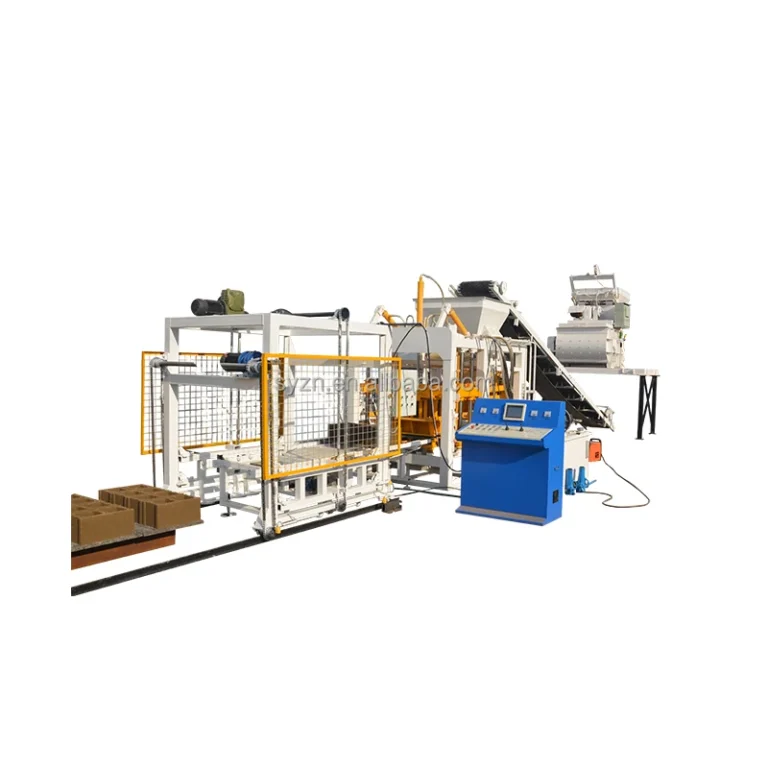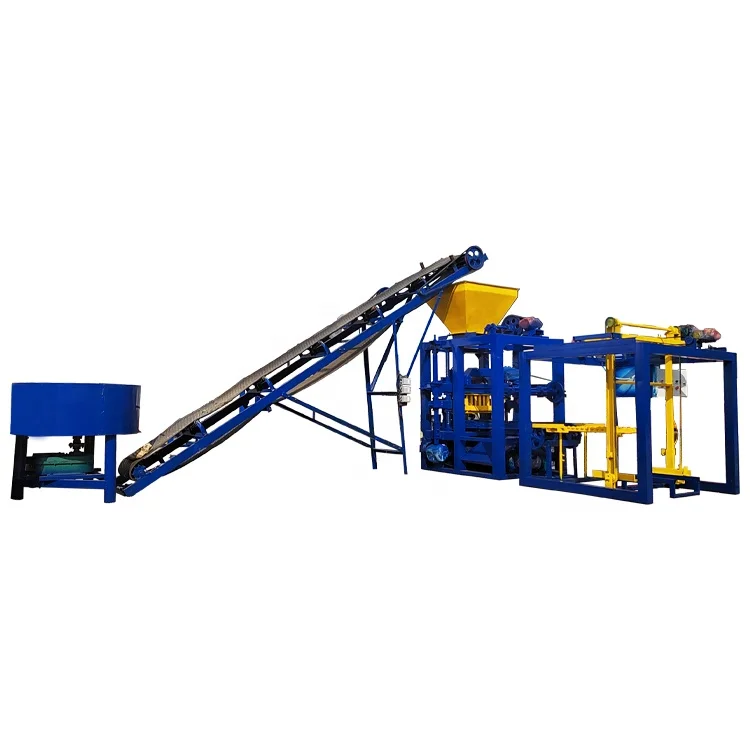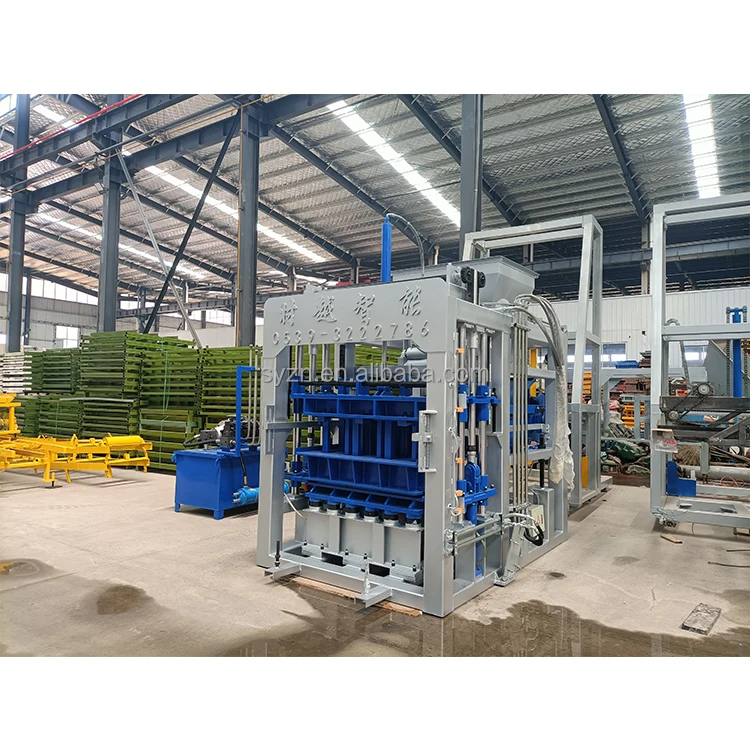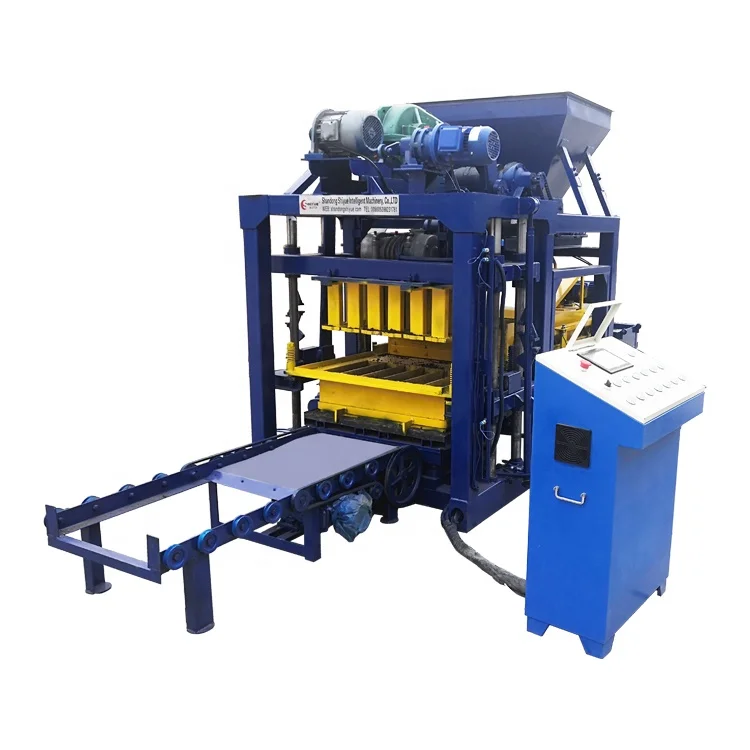


Description
Configuration set against your actual mix design and local aggregate — the QTJ4-25 block line is specified around the raw materials you can source, not a catalogue default, so your blocks reach target strength without reformulating your feed.
Technical Specifications
| Parameter | Value |
|---|---|
| Model | QTJ4-25 |
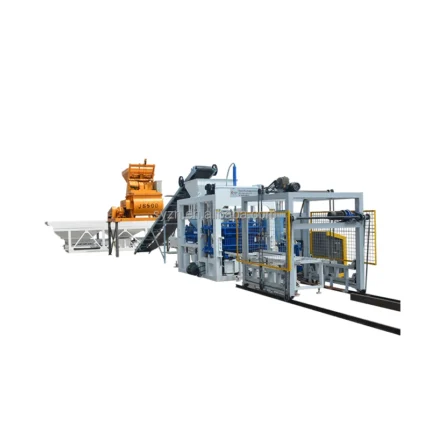
| Product Type | Automatic Concrete Block Making Machine |
| Overall Dimensions (L×W×H) | 6400×1500×2700 mm |
| Molding Cycle | 25 s (basis not stated in source — confirm block format / material / thickness) |
| Vibration Frequency | 2800–5100 r/min |
| Exciting Force | 60 kN |
| Total Power | 17.9 kW |
| Mixer Model | JQ350 |
| Pallet Size | 850×550×20 mm |
| Net Weight | 2500 kg |
| Control System | PLC |
| Automation Level | Automatic (plate-supplying, material-disturbing, brick-discharging) |
| Output Capacity | 480 pcs/h based on 390×190×190 mm hollow block (4 pcs/mould) |
| Output Capacity | 600 pcs/h based on 400×150×200 mm hollow block (5 pcs/mould) |
| Output Capacity | 2100 pcs/h based on 240×115×53 mm solid brick (18 pcs/mould) |
| Output per 8 hr Shift | 3800 pcs based on 390×190×190 mm hollow block |
| Output per 8 hr Shift | 4800 pcs based on 400×150×200 mm hollow block |
| Output per 8 hr Shift | 17000 pcs based on 240×115×53 mm solid brick |
| Applied Products | Hollow block (8 inch, 6 inch), solid brick |
| Raw Materials | Crushed stones, sand, cement, dust, fly ash |
Application Suitability
| Application | Material or Output |
|---|---|
| 8-inch hollow block production | Crushed stone, sand, cement blend; 3800 pcs per 8 hr shift at 390×190×190 mm format |
| 6-inch hollow block production | Fly ash and sand mix; 4800 pcs per 8 hr shift at 400×150×200 mm format |
| Solid brick production for local masonry | Cement and dust aggregate; 17000 pcs per 8 hr shift at 240×115×53 mm format |
| On-site block production for housing projects | Site-available crushed stone and sand; output scales with pallet turnaround speed |
What the Spec Sheet Cycle Time Actually Means on the Floor
A PLC controlled QTJ4-25 automatic block making machine lists a 25-second molding cycle, but that number only holds for a specific block format, material blend, and thickness. Real output depends entirely on which format you run and how your mix behaves under vibration.
Buyers often see a single cycles-per-hour figure and project that across every mould they plan to use. On a Middle East project I supported, the plant manager expected the same hourly count for 8-inch hollow blocks and solid bricks — only to find the solid brick cycle ran shorter while the larger hollow block cycle needed more vibration dwell. The discrepancy was not a machine fault; it was a quoting gap. Always ask for a capacity sheet that breaks output down format by format before you sign. [NEED_CITE: block format effect on cycle time in vibration press operations]
How PLC Automation Removes Operator Variables
The PLC controlled QTJ4-25 automatic block making machine handles plate-supplying, material distribution, and brick discharge without manual triggers. Each step in the cycle fires on a programmed timer, so the interval between one pallet leaving and the next arriving stays constant regardless of operator fatigue or shift changes. This consistency matters most when you run multiple block formats across a single shift — the PLC holds the vibration dwell and pressure timing for each mould profile loaded into memory.
The Language Setting That Can Stall a Commissioning
On a project where I provided technical support, the PLC display arrived showing English while the operators read only Arabic. The automatic stacking sequence was on that same screen, and nobody was willing to press buttons they could not read. Commissioning stalled for days until a remote language pack was loaded. Before production starts, confirm the PLC display language matches your floor team — it is a small line item that carries outsized weight during startup. [NEED_CITE: PLC interface language requirements for industrial machinery export]
Reading the Specs That Matter Beyond the Brochure
The vibration frequency range of 2800–5100 r/min paired with 60 kN exciting force determines how densely the concrete settles into the mould cavity. Higher frequency with lower amplitude suits thinner-walled hollow blocks where surface finish matters; lower frequency with higher amplitude compacts heavier solid brick mixes more thoroughly. The QTJ4-25 covers this spread, but the right point on the curve depends on your aggregate gradation and cement ratio. The 850×550×20 mm pallet size sets your curing area geometry — if your existing forklift and rack system were built around a different pallet dimension, you will be replacing downstream equipment or reconfiguring your yard before the first block cures. Total power of 17.9 kW including the JQ350 mixer means a standard three-phase supply handles the full line, but voltage and frequency must be confirmed for your site before the machine enters production.
What Happens When Automation Scope Is Left Ambiguous
A buyer who assumes "automatic" covers pallet handling, stacking, and curing rack movement will discover on delivery day that the machine stops at brick discharge. Wet blocks sit on pallets waiting for someone to carry them to the curing area. The PLC controlled QTJ4-25 automatic block making machine automates the press cycle itself — plate feeding, material distribution, and discharge — but downstream handling must be specified and quoted as part of the line. When that conversation happens after shipment, you are buying conveyors and stackers at a premium with a machine already waiting on the floor. [NEED_CITE: scope of automation in block making machine quotations]
Why Sourcing the Line as One Matched System Matters
The machine, mould, pallet, and handling equipment are specified together so the press is never waiting on an upstream feeder or a downstream stacker that cannot keep pace. Configuration is built around your local aggregate and mix design, not a generic default — so the vibration profile and hydraulic pressure suit the materials you actually buy. Mould design covers the formats your market sells, including custom drawings when a standard cavity does not match your specification. Automation level is selectable, meaning you can start with the press cycle automated and add stacking and cubing later as volume grows. Documentation arrives with the machine, not weeks after — line layout, capacity calculation per format, hydraulic and electrical schematics, and an operation manual in your confirmed language.
Documentation & Verification
- Line layout and capacity calculation stating block format assumed for each output figure
- Mould drawing and format list matching the block sizes your market sells
- Hydraulic and electrical schematic for your confirmed voltage and frequency
- PLC display language confirmation before production begins
- Factory test record run on your target block format before dispatch
Installation, Commissioning & Support
- Foundation pad leveled to accommodate 6400×1500 mm footprint and 2500 kg static load
- Dedicated three-phase circuit sized for 17.9 kW total draw including JQ350 mixer
- Machine ships dismantled; reassembly on site requires overhead clearance of 2700 mm minimum
- First-run parameter setting covers vibration dwell and cycle timing per loaded mould profile
- Operator training covers PLC navigation, mould change procedure, and daily greasing points
- Wear parts list identifies mould liners and vibration springs for first-year stock
What to Send with Your Inquiry
Share the block formats your market moves in highest volume — not just dimensions, but wall thickness and face finish requirements. Include a sample or lab report of your local aggregate so the mix can be tested against the vibration profile. State your site voltage, frequency, and the language your operators read, so the PLC controlled QTJ4-25 automatic block making machine arrives configured for day-one operation.
Frequently Asked Questions
Q: How is the 25-second cycle time verified, and does it apply equally to every block format?
A: The 25-second cycle is measured under specific conditions that depend on block format, material blend, and wall thickness. Hollow blocks at 390×190×190 mm and solid bricks at 240×115×53 mm do not share identical dwell times. A format-by-format capacity sheet shows the verified cycle for each mould you plan to run, so you can plan shifts around real numbers rather than a single brochure figure.
Q: What PLC display language options are available, and can it match my local language?
A: The PLC interface supports multiple display languages, but the correct one must be confirmed before the machine enters production. If the language is wrong on arrival, operators may avoid using automatic functions entirely, which defeats the purpose of the upgrade. State your required language during the quotation stage so the panel is set before dispatch.
Q: Can I start with the current automation level and add stacking and cubing later?
A: Yes. The machine automates plate-supplying, material distribution, and brick discharge at its base configuration. Automatic stacking and cubing can be added as a subsequent phase when your volume justifies the investment. The PLC architecture supports this expansion without replacing the core press controller.
Q: Which spare parts should I order with the machine to cover the first year?
A: Mould liners, vibration springs, and hydraulic seals are the primary wear items. A wear parts list is supplied with the quotation so you can order a first-year kit alongside the machine. Shipping spares in the same container avoids a separate air freight order when a mould liner needs replacing mid-season.