

Concrete Block Machine Price in USA: 2026 Buyer Guide for Sale
The equipment tag is just the tip of the iceberg — port delays, HTS misclassification, and on-site commissioning routinely double the real spend for first-time importers.
In 2026, a concrete block machine price in USA typically lands between a few thousand dollars for a standalone egg-layer and well into six figures for a fully automatic production line, but the FOB number you see on a quotation rarely reflects what you actually pay once the container hits the dock. Shipping, tariffs, inland haulage, and commissioning labor add layers that most buyers only discover after signing the contract.
I still remember a shipment that got held at a Gulf Coast port because the commercial invoice described the equipment as "industrial machinery" instead of specifying the HTS subheading for concrete mixing and molding equipment. The customs broker flagged it for a classification review, and the container sat on a chassis for weeks, racking up per-diems that ended up costing more than the freight itself. That kind of headache is preventable, but only if you understand the full cost structure before you wire any deposit. [NEED_CITE: HTS classification rules for concrete block making equipment under Chapter 84]
Let me walk you through what actually drives the concrete block machine price in USA, where the hidden charges hide, and how to pick the right configuration without overcommitting capital.
What Is the Actual Price Range for Concrete Block Machines in 2026?
Concrete block machines fall into three broad tiers, and the price gap between them is not linear — it reflects fundamentally different levels of automation, labor dependency, and output consistency.
At the entry level, you have egg-laying or manual-press machines that produce blocks on the ground or on simple pallets. These units are compact, often shipped in a single crate, and suited for small contractors or startups testing the market. The concrete block machine price in USA for this tier is the most accessible, but output is limited and product consistency depends heavily on operator skill.
The mid-range covers semi-automatic lines with a dedicated host machine, a basic batching system, and conveyor feeding. This is where most serious small-to-medium investors land. You get meaningful volume without the capital burden of a full plant, and the concrete block machine price in USA here reflects the addition of a mixer, pallet circulation, and sometimes a simple stacker.
At the top end, fully automatic lines with PLC-controlled cycles, multi-head batching, automated pallet handling, and integrated curing systems command a substantially higher concrete block machine price in USA, but they also slash labor cost per block and deliver tight dimensional tolerances that matter for commercial supply contracts.
| Tier | Automation Level | Typical Output Range | Labor Requirement | Price Positioning |
|---|---|---|---|---|
| Entry | Manual or egg-laying | Low daily output | High operator dependency | Most accessible |
| Mid-range | Semi-automatic with batching | Moderate daily output | Moderate | Mid-tier investment |
| Full line | Fully automatic PLC | High daily output | Low per-unit labor | Highest capital outlay |
A buyer in the Southeast once told me he wanted the top-tier line because "bigger is better." After walking his site and reviewing his projected order book, we sized him into the mid-range instead. His ROI timeline shortened noticeably because his facility rent and labor pool could not justify the full-line overhead. [NEED_CITE: ROI comparison between semi-automatic and fully automatic block production lines based on labor and facility costs]
The concrete block machine price in USA is not a single number — it is a function of your daily output target, your available labor, and your site constraints. Get those three variables right first, and the pricing conversation becomes much shorter.
What Hidden Costs Do USA Buyers Often Overlook?
The FOB price on your proforma invoice is only a fraction of what you will actually spend before the first saleable block comes off the line.
Ocean freight is the first add-on most people anticipate, but even here the details matter. A full container load is straightforward, but if your order does not fill a container, you pay for less-than-container-load shipping at a noticeably higher per-cubic-meter rate. Some buyers try to consolidate multiple orders into one container to spread the freight cost — a sensible move, but it requires careful coordination of lead times across suppliers.
Then comes customs duty, and this is where the HTS code becomes critical. Concrete block making equipment generally falls under a specific subheading within Chapter 84, but the exact classification depends on whether the shipment is a standalone machine or a complete production line with batching and conveying components. A misclassification can push your duty rate substantially higher, and correcting it after entry requires a post-entry amendment that takes time and may trigger an exam. [NEED_CITE: US Customs HTS classification guidelines for concrete block manufacturing equipment]
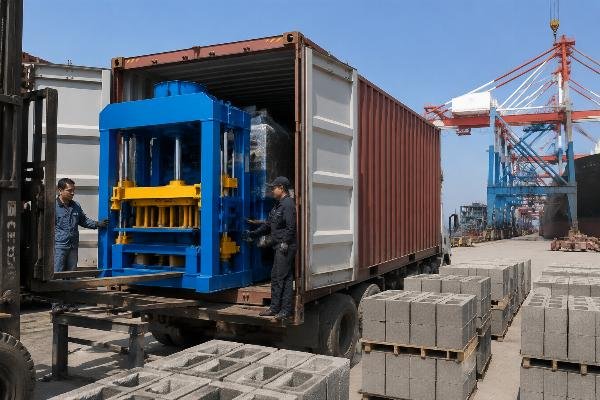
Port charges, chassis fees, and warehouse storage if the container is not pulled quickly — these line items are small individually but add up fast, especially at congested ports. Inland transport from the port to your facility is another variable: if your site is in a rural area with limited drayage options, expect the haulage quote to reflect that scarcity.
And then there is commissioning. A block machine is not plug-and-play. You need a technician to level the frame, calibrate the hydraulic pressures, tune the vibration frequency, and train your operators on mold changes and mix ratios. If you fly in a specialist from overseas, you are paying for flights, per diem, and potentially weeks of on-site time. Some manufacturers include commissioning in the package; others quote it separately. The concrete block machine price in USA looks very different depending on which model you are comparing.
| Cost Component | Often Quoted? | Typical Surprise Factor |
|---|---|---|
| Ocean freight | Yes | Moderate — LCL vs FCL gap |
| Customs duty | Partially — depends on HTS | High — misclassification risk |
| Port and drayage | Rarely itemized | Moderate — congestion surcharges |
| Commissioning | Sometimes | High — travel and duration |
| Spare parts buffer | Rarely | Moderate — early wear items |
A distributor in the Midwest learned this the hard way when his first container arrived without a complete set of wearing parts. The mold inserts wore faster than expected on his local aggregate mix, and he had to air-freight replacements at several times the original sea-freight-equivalent cost. [NEED_CITE: impact of spare parts planning on production continuity for imported block machines]
Build your budget around the landed and commissioned total, not the FOB sticker. That is the only number that tells you whether the investment works.
How to Choose the Right Machine Based on Your Production Goals?
Start with your market, not with the machine catalog — the concrete block machine price in USA only makes sense when measured against what your customers will actually pay per block.
The first question is volume. How many blocks do you need to produce per day to cover your fixed costs and hit your margin target? Work backward from your sales pipeline: if you have standing orders from a housing developer or a municipal paving contract, those numbers anchor your capacity requirement. If you are entering an open market with no committed buyers, start conservative.
The second question is product mix. Standard hollow blocks are the simplest. Interlocking pavers, curbstones, and decorative face-mix blocks require additional equipment — color feeders, specialized molds, and sometimes a secondary face-layer batching system. Each addition changes the concrete block machine price in USA meaningfully, so be clear about which products you will run in year one versus year three.
The third question is site reality. Ceiling height, power supply stability, raw material storage space, and curing area footprint all constrain your options. A fully automatic line needs a tall, clear-span building with stable three-phase power. If your facility has low ceilings or unreliable grid supply, a semi-automatic or egg-laying configuration may be the only practical choice — and it may also be the smarter financial decision, because forcing a full line into an unsuitable building creates bottlenecks that no amount of automation can fix.
| Decision Factor | Entry-Level Fit | Mid-Range Fit | Full-Line Fit |
|---|---|---|---|
| Daily volume target | Low | Moderate to high | High |
| Product variety | Standard blocks only | Multiple block types | Full range including pavers |
| Facility constraints | Minimal space needed | Moderate footprint | Large clear-span building |
| Power stability | Tolerant of fluctuations | Requires stable supply | Demands consistent three-phase |
| Labor availability | High manual labor OK | Moderate automation | Minimal manual labor |
A contractor in the Carolinas was initially quoted a full automatic line by a competitor. When we reviewed his actual order book and his building layout, the right fit was a semi-automatic configuration with room to add a second host machine later. He avoided overcommitting capital, and his payback period came in noticeably shorter than the full-line scenario would have delivered. [NEED_CITE: capacity planning methodology for concrete block production based on order pipeline and facility constraints]
The concrete block machine price in USA should be evaluated against your specific production context, not against a generic spec sheet. Match the machine to the market, and the numbers follow.
What Documents and Certifications Are Required for US Customs Clearance?
Missing paperwork does not mean a delayed shipment — it means a stranded container, and every day on a chassis is money you will never recover.
The commercial invoice must describe the equipment with enough specificity for a customs officer to assign the correct HTS code without guessing. "Block machine" is not enough. You need the manufacturer name, model designation, functional description (vibration molding, hydraulic pressing, or egg-laying), and the intended application. Vague descriptions trigger exams, and exams trigger delays.
The packing list must match the invoice line by line. If you are shipping a production line that includes a mixer, conveyors, pallet loaders, and a cement silo across multiple containers, each container’s contents must be itemized separately. Discrepancies between the packing list and what the customs examiner finds when they open the container lead to intensive inspections that can add weeks to your timeline.
CE or SGS certification is not a US customs requirement per se, but it serves as credible evidence of manufacturing standards and is often requested by local building inspectors or end-user clients. More importantly, having these certifications on file signals to your customs broker that the shipment is legitimate and well-documented, which smooths the entry process. [NEED_CITE: US Customs documentation requirements for imported industrial machinery]
A technical data sheet with electrical specifications, hydraulic pressures, vibration parameters, and material contact details helps your broker defend the HTS classification if questioned. Without it, the broker may default to a higher-duty generic classification "just to be safe," and you pay the difference.
| Document | Purpose | Risk if Missing |
|---|---|---|
| Detailed commercial invoice | HTS classification | Misclassification, higher duty |
| Itemized packing list | Cargo verification | Intensive exam, delays |
| CE/SGS certificates | Credibility and compliance | Client or inspector objections |
| Technical data sheet | Classification defense | Default to higher-duty code |
| Bill of lading | Title and release | Cargo cannot be pulled |
I have seen shipments held because the technical data sheet was in Chinese only. The customs officer could not verify the equipment function, the broker could not defend the classification, and the container sat until a translated version was produced and submitted. That delay cost the buyer a mid-four-figure sum in storage and per-diem charges — entirely avoidable with a bilingual document pack prepared before the vessel sailed. [NEED_CITE: consequences of incomplete bilingual documentation on US customs clearance timelines]
Prepare your document package with the same rigor you apply to the equipment specification. The concrete block machine price in USA includes the cost of getting it through the port, and that cost is controlled long before the container loads.
Why Do Chinese Manufacturers Offer Noticeably Lower Prices Than European Competitors?
The price gap is real, but the reason is not what most buyers assume — it is structural, not a reflection of cutting corners.
China’s concrete machinery industry is concentrated in specific manufacturing clusters where raw material suppliers, hydraulic component makers, steel fabricators, and electrical control panel shops operate within a tight geographic radius. This clustering drives down procurement costs for every manufacturer in the zone. A European producer sourcing the same hydraulic valves and steel plate from scattered suppliers across multiple countries carries a structurally higher input cost.
Labor cost differentials remain significant, even as Chinese wages have risen over the past decade. The assembly, welding, and wiring work that goes into a block machine is labor-intensive, and the hourly rate gap between a Chinese factory floor and a German or Turkish one still translates into a meaningful share of the final price.
Scale also matters. Manufacturers that export to over a hundred countries run high-volume production schedules that spread fixed costs — engineering, tooling, quality testing — across a large unit base. A smaller European workshop producing a few dozen machines per year cannot achieve the same unit-cost absorption.
| Cost Factor | Chinese Cluster Manufacturing | European Manufacturing |
|---|---|---|
| Supply chain proximity | Tight geographic clustering | Dispersed multi-country sourcing |
| Assembly labor rate | Noticeably lower | Substantially higher |
| Production scale | High volume, broad export base | Lower volume, regional focus |
| Unit fixed-cost absorption | Spread across large output | Spread across smaller output |
That said, low price does not automatically mean reliable performance. The key is verification. Ask for factory audit reports, request references from buyers in your region, and insist on a pre-shipment inspection — either by a third-party surveyor or via a live video commissioning run. A reputable manufacturer will welcome that scrutiny because their process can stand up to it. [NEED_CITE: verification methods for assessing quality of imported concrete block manufacturing equipment]
We have shipped equipment to buyers across multiple regions, and the ones who do their homework — visiting the factory or at least running a live video inspection — consistently report that the machine performs to expectation. The ones who skip verification and buy purely on the lowest quote are the ones who call back with problems. The concrete block machine price in USA from a Chinese source can deliver excellent value, but only when the buyer treats price as one input among several.
Conclusion
The concrete block machine price in USA is a layered figure — equipment cost, freight, duty, port charges, and commissioning all stack on top of each other, and the FOB number alone tells you very little about what you will actually spend.
Match your machine selection to your real market volume, product mix, and site constraints rather than chasing the highest automation tier. Prepare your customs documentation with the same precision you apply to your technical specifications. And when evaluating price quotes from different sourcing regions, look at the structural cost drivers behind the numbers rather than assuming that a lower price means a compromised product. Get those three things right, and your investment works the way it should.
Leave a Reply