

Concrete Mixer for Block Line: Factory-Direct Price & Turnkey Supply
Bigger is not better. A concrete mixer for block line that is oversized for your press creates more waste than it solves. The right mixer matches the cycle time of the block maker, handles local aggregate moisture variance, and delivers consistent density without bottlenecks.
Selecting a concrete mixer for block line requires matching its effective volume and discharge speed to the成型机 (block maker) cycle time, rather than simply choosing the highest motor power. Technical specifications such as mixing uniformity, liner hardness, and moisture control integration dictate final block strength and line efficiency more than raw capacity does.

When I first helped a contractor in West Africa source equipment, we focused on the press speed and ignored the mixing phase. The result was inconsistent mortar density because the local sand had high moisture variance. The line stopped frequently for manual adjustments. That field experience shifted my focus from standalone unit specs to system integration. Now, when evaluating a concrete mixer for block line, I look at how the batching logic communicates with the press PLC. [NEED_CITE: impact of aggregate moisture variance on concrete block compressive strength]
Why Does Mixer Selection Dictate Block Line Efficiency?
A mismatched mixer cycle creates a bottleneck that no amount of press speed can fix. Many investors assume that a faster block machine guarantees higher output, but if the concrete mixer for block line cannot prepare and discharge batches in sync with the press cycle, the machine idles. This idle time reduces overall plant efficiency and increases energy consumption per unit.
The core issue is synchronization. If the mixer takes longer to mix and discharge than the press takes to form and eject blocks, the press waits. Conversely, if the mixer is too fast but lacks precision, it may dump uneven loads, causing mold wear or weak spots in the blocks. In a Latin American expansion project, a client upgraded to a high-speed QT10-15 line but kept an older manual batching system. The mismatch in discharge timing caused significant downtime until we synchronized the mixer cycle with the press cycle. [NEED_CITE: relationship between batching cycle time and overall plant throughput]

Efficiency is not just about speed; it is about rhythm. A well-integrated concrete mixer for block line ensures that each batch arrives at the feed hopper with the correct consistency and volume, allowing the press to operate at its designed capacity without interruption.
What Are the Critical Technical Specifications for Block Mixers?
Focus on mixing uniformity and wear resistance rather than just motor kilowatts. While motor power is important, it is the geometry of the mixing blades and the hardness of the liner materials that determine the homogeneity of low-cement mixes often used in block production.
Key specifications to evaluate include:
- Mixing Uniformity Coefficient: This measures how evenly the ingredients are distributed. High uniformity is crucial for consistent block strength.
- Discharge Gate Sealing Technology: Poor sealing leads to material leakage and inconsistent batch weights.
- Liner Material Hardness: Measured in HB, harder liners resist abrasion from aggregates, extending service life and maintaining mixing efficiency.
| Specification | Basic Standard | High-Performance Requirement |
|---|---|---|
| Mixing Action | Single shaft or drum | Twin-shaft or planetary |
| Liner Material | Standard steel | High-chrome alloy or hardened steel |
| Discharge Control | Manual or pneumatic | Automated with seal monitoring |
| Moisture Compensation | None or manual | Automated real-time feedback |
In the Middle East, a precast producer struggled with high-strength pavers using a standard drum mixer. The shear force was insufficient for the finer aggregate mix required. Switching to a twin-shaft design with higher torque resolved the homogeneity issues. [NEED_CITE: effect of mixing action type on concrete homogeneity]
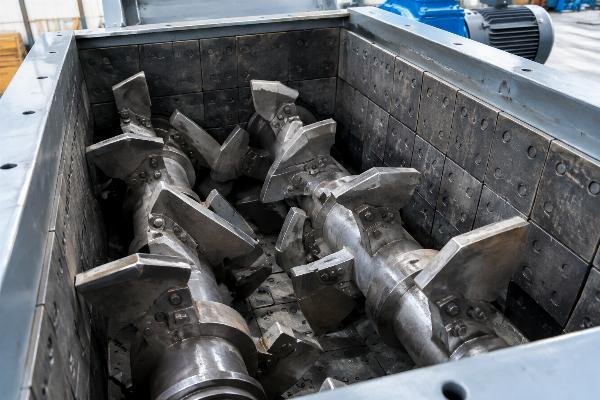
When specifying a concrete mixer for block line, request data on the mixing blade geometry and liner hardness. These details reveal the manufacturer’s attention to durability and mix quality.
How to Calculate the Right Mixer Capacity for Your Target Output?
Use a reverse-engineering method from daily block target to batch size. Instead of picking a mixer based on catalog capacity, start with your desired daily output and work backward. This ensures the concrete mixer for block line is neither underpowered nor wastefully oversized.
Follow these steps to calculate the required capacity:
- Determine Daily Block Target: Define the number of blocks you need to produce per shift.
- Calculate Hourly Output: Divide the daily target by the number of operational hours.
- Account for Cycle Time: Identify the cycle time of your block machine (e.g., 15 seconds per cycle).
- Estimate Batch Volume: Calculate the volume of concrete needed per hour based on block dimensions and density.
- Add Buffer: Include a 10-15% buffer for maintenance and minor delays.
For example, if a QT8-15 machine produces 2,000 blocks per hour, and each block requires 0.01 cubic meters of concrete, the hourly demand is 20 cubic meters. A mixer with an effective volume that can deliver this volume within the operational window, accounting for mixing and discharge time, is ideal.
At Shiyue, our engineers simulate this line balance using client-specific raw material data before quoting. This prevents the common error of oversizing, which wastes energy and increases batch variation. [NEED_CITE: methodology for sizing concrete batching plants for block production]
Twin-Shaft vs. Planetary: Which Mixing Action Suits Your Product?
Twin-shaft mixers suit high-volume standard blocks, while planetary mixers excel with complex, high-strength pavers. The choice of mixing action depends on the product type and the required shear force.
- Twin-Shaft Mixers: These use two horizontal shafts with overlapping blades to create intense shear and folding actions. They are ideal for standard concrete blocks where high throughput and uniformity are key. The concrete mixer for block line using twin-shaft technology typically offers faster cycle times.
- Planetary Mixers: These feature a central star-shaped rotor and counter-rotating tools. They provide thorough mixing for stiff mixes and are preferred for decorative pavers and interlocking bricks that require fine aggregate distribution and color consistency.
| Feature | Twin-Shaft Mixer | Planetary Mixer |
|---|---|---|
| Best For | Standard blocks, high volume | Pavers, interlocking bricks, complex mixes |
| Mixing Action | Shear and folding | Intense shear and kneading |
| Discharge Speed | Fast | Moderate |
| Maintenance | Moderate | Higher due to complex gear system |
A European distributor noted that clients producing colored interlocking bricks saw better color consistency after switching from a twin-shaft to a planetary mixer. The intense kneading action ensured even pigment distribution. [NEED_CITE: comparison of mixing efficiency for colored concrete products]
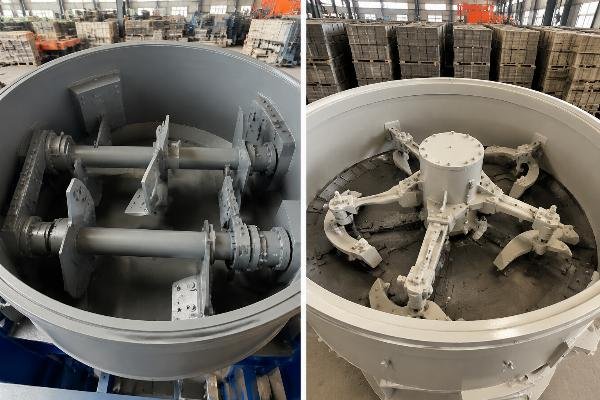
Choose the mixing action that aligns with your primary product. For most standard block lines, a twin-shaft concrete mixer for block line provides the best balance of speed and quality.
Integrating Moisture Control for Consistent Quality
Automated moisture compensation is non-negotiable for maintaining strength in varying weather conditions. Aggregate moisture content fluctuates daily due to rain, humidity, and storage conditions. Without real-time adjustment, water dosing becomes inaccurate, leading to weak or crumbly blocks.
Modern systems integrate moisture sensors in the aggregate bins and sand hoppers. These sensors send data to the PLC, which automatically adjusts the water added during mixing. This ensures the water-cement ratio remains constant, regardless of external conditions.
In West Africa, where sand moisture varied significantly, adding automatic moisture sensors and adjusting water dosing precision to within ±1% accuracy stabilized the mix density. This reduced rejection rates and improved block strength consistency. [NEED_CITE: importance of water-cement ratio control in concrete block manufacturing]
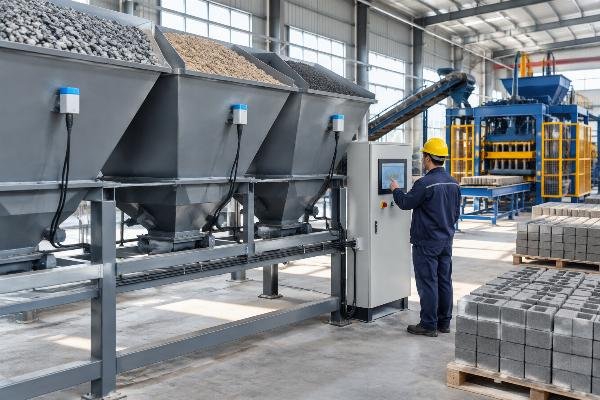
When investing in a concrete mixer for block line, ensure the batching system includes real-time moisture feedback loops. This feature pays for itself by reducing material waste and ensuring consistent product quality.
Conclusion
Synchronization drives efficiency. A concrete mixer for block line must be selected based on its ability to match the press cycle, handle local aggregate characteristics, and maintain consistent mix quality through precise moisture control. By focusing on technical specs like mixing uniformity and wear resistance, rather than just capacity, you ensure long-term reliability and ROI.


Leave a Reply