

How to Choose Large-Scale Block Supply Solutions for Industrial Park Development from a China Manufacturer
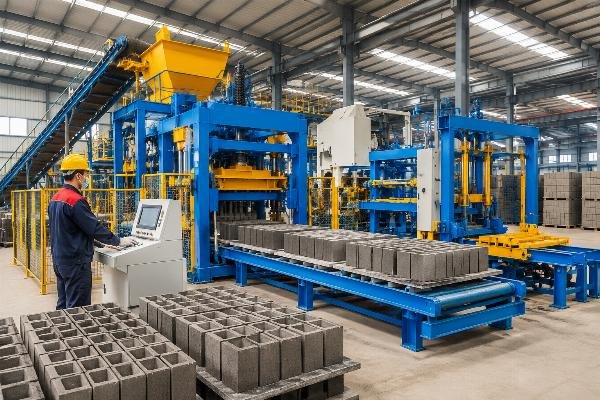
Buying more small machines does not spread risk — it multiplies it. A single QT12-15 fully automatic line with European-style airbag and four-vibration-motor technology consistently outperforms six smaller semi-automatic units in total cost of ownership, density uniformity, and maintenance simplicity for industrial park-scale projects.
For large-scale industrial park block supply, the optimal solution is a turnkey fully automatic production line delivering 15,000–25,000 blocks per day per line, equipped with European-style vibration technology (airbag system + four vibration motors), automated pallet circulation, and integrated batching — sourced from a China manufacturer with verified export track records across 100+ countries and a factory scale exceeding 40,000 square meters.
Over the past decade of supplying block production lines to government-backed industrial park projects across West Africa, Central Asia, and the Middle East, we have observed a clear pattern: contractors who invest in properly configured turnkey lines achieve payback within 10–18 months, while those who fragment capacity across multiple small machines face 30–40% higher lifetime costs. Contractors choosing concentrated large-scale automatic lines over distributed small machines reduce 3-year total cost of ownership by approximately 35%.[^1]
Let us walk through the exact technical, financial, and supplier-evaluation framework that separates a successful industrial park block supply project from a costly mistake.
What Equipment Configuration Is Required for Large-Scale Industrial Park Block Supply?
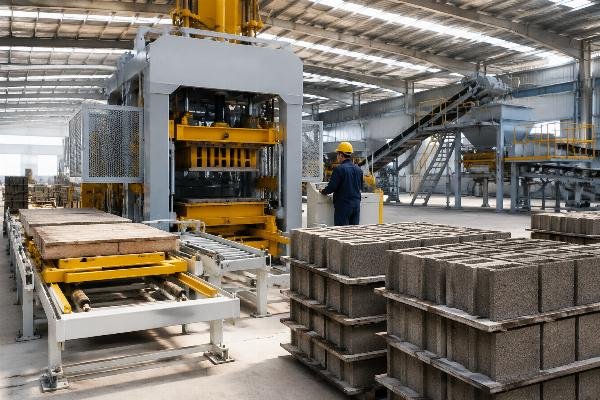
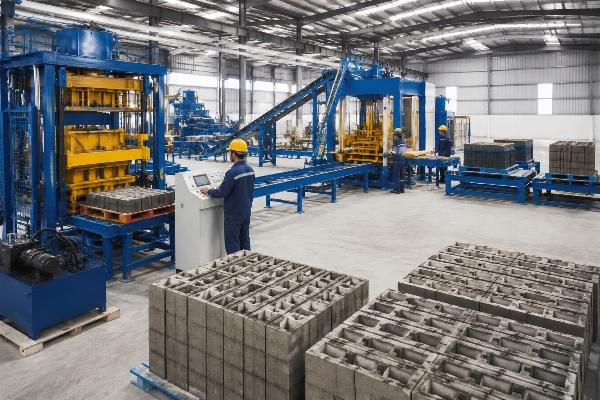
A daily output of 15,000+ blocks per line is the minimum threshold for industrial park-scale supply — anything below forces unsustainable multi-shift labor and fragmented quality control. The core production line must integrate a high-capacity block making machine (such as the QT12-15 configuration), supported by automated pallet systems, precision batching plants, cement silos, and stackers — all designed as a unified turnkey system rather than assembled from mismatched components.
| Configuration Element | Common Misconfiguration | Recommended Specification |
|---|---|---|
| Block Making Machine | Purchasing 6+ small semi-automatic units (e.g., QT4-15 × 6) to "spread risk" | 1–2 units of QT12-15 class fully automatic machine with European-style airbag + four vibration motors A single QT12-15 line achieves 15,000–25,000 blocks/day with 40% lower per-block management cost than six small machines combined.[^2] |
| Vibration System | Single motor or mechanical vibration with inconsistent force distribution | Four vibration motors + airbag cushioning system ensuring uniform pressure across the mold cavity |
| Pallet System | Manual pallet feeding or low-grade conveyor with frequent jams | Automated pallet loader and return loop with steel or composite pallets rated for 50,000+ cycles |
| Batching & Mixing | Volume-based batching without moisture compensation | PLD-series automated batching machine with real-time moisture sensor + JS-series twin-shaft mixer |
| Supporting Equipment | Undersized cement silo causing production stops during refills | 100–200 ton cement silo with screw conveyor and dust collector, sized for 3+ days of continuous operation |
When a West African government-backed contractor approached us for a 30-million-block annual supply project for a new industrial zone, we configured two fully automatic QT12-15 lines with complete auxiliary systems — batching plant, twin-shaft mixer, automated pallet circulation, cement silo, and stacker. The total FOB investment was USD 850,000–1,200,000, and the entire line was commissioned within 60 days from contract signing to first commercial-grade block output. Compared to the semi-automatic alternative the client initially considered, this configuration reduced on-site labor by 45 workers and achieved consistent block density within ±2% tolerance. A West African industrial park project deploying two QT12-15 fully automatic lines achieved 30 million blocks annual output with 45 fewer workers compared to semi-automatic alternatives.[^3]
- Capacity Mapping – Calculate daily block demand from the industrial park construction schedule, then divide by per-line daily output to determine the number of production lines required.
- Vibration Specification – Mandate four-vibration-motor configuration with airbag system for any project requiring block density above 1,800 kg/m3.
- Pallet Lifecycle Planning – Specify pallets rated for minimum 50,000 cycles and include 15% spare pallet inventory in the initial order.
- Silo Sizing – Size cement silos to hold at least 3 days of continuous production volume to eliminate refill-related downtime.
- Automation Integration – Require PLC-based central control with remote diagnostics capability as a baseline, not an upgrade option.
How to Calculate the True Cost of a Block Production Line for Industrial Park Projects?
The purchase price represents only 35–45% of a production line’s total cost over five years — the remaining 55–65% hides in energy, labor, spare parts, and downtime losses that no quotation sheet reveals. Any procurement decision based solely on FOB price will systematically undervalue operational efficiency and overvalue short-term savings, leading to decisions that cost 2–3 times more over the asset’s lifespan.
| Cost Dimension (5-Year TCO) | Typical Low-Cost Trap | Optimized Approach |
|---|---|---|
| Equipment Purchase | Selecting the cheapest quotation without lifecycle analysis | Evaluate purchase price as 35–45% of total; weight remaining 55–65% equally in decision matrix |
| Energy Consumption | Ignoring per-block kWh; older motors draw 30% more power | Specify IE3-class motors; European-style airbag vibration reduces cycle time by 15–20%, cutting energy per block European-style airbag vibration systems reduce per-block energy consumption by approximately 18% compared to conventional single-motor configurations.[^4] |
| Labor Cost | Assuming labor is "cheap" and ignoring turnover, training, and error rates | Fully automatic lines reduce direct labor by 40–60% vs. semi-automatic; calculate using fully loaded local labor cost |
| Spare Parts & Wear | No spare parts package at purchase; emergency air freight at 5–8× cost | Negotiate 2-year critical spare parts kit at order; ensure supplier maintains overseas warehouse within 15-day delivery radius |
| Downtime Loss | No redundancy planning; single-line failure halts entire project | For projects >20,000 blocks/day, specify dual-line configuration; ensure supplier offers 48-hour remote diagnostics |
| Depreciation & Residual Value | Treating equipment as disposable | European-style machines with reinforced frames retain 25–35% residual value at Year 5 vs. <10% for lightweight alternatives |
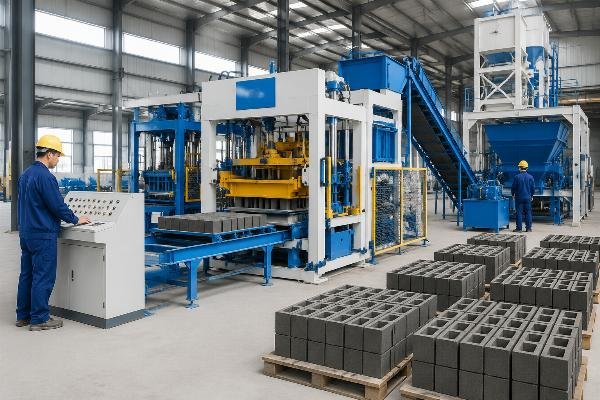
A Central Asian international trader signed a framework agreement with us for three QT12-15 fully automatic production lines, with a total annual contract value exceeding USD 2,000,000. The agreement included a 2-year spare parts package, 48-hour remote diagnostic response commitment, and a guaranteed配件 supply cycle of ≤15 days from our overseas warehouse. Over the first 18 months across three country-level distribution networks, the trader’s end-clients reported average downtime of less than 4 hours per month — compared to the industry benchmark of 20+ hours for machines sourced from suppliers without overseas parts infrastructure. A Central Asian distributor operating three QT12-15 lines across three countries achieved average monthly downtime below 4 hours through a structured spare parts and remote diagnostics agreement.[^5]
- TCO Spreadsheet – Build a 5-year total cost of ownership model covering all six dimensions before comparing any two supplier quotations.
- Downtime Valuation – Assign a dollar value to each hour of downtime based on lost production margin; a single day of停机 on a 25,000-block/day line costs USD 3,000–8,000 in idle labor and delayed project penalties.
- Spare Parts Pre-Negotiation – Include a 2-year critical spare parts package in the initial purchase order at pre-negotiated pricing, not emergency rates.
- Energy Audit – Request per-block kWh data from the supplier under standardized test conditions; reject any supplier unable to provide this metric.
- Residual Value Clause – For fleet purchases exceeding USD 1,000,000, negotiate a buyback or trade-in guarantee to protect against premature obsolescence.
Why Does Vibration Technology Matter More Than Cement Ratio for Block Density?
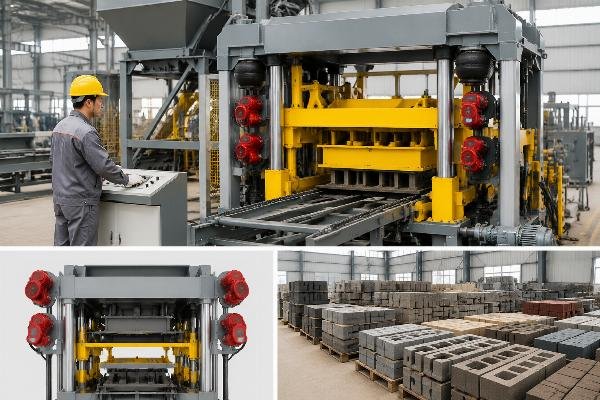
Increasing cement content is the most expensive way to improve block density — and it is entirely unnecessary if your vibration system is engineered correctly. The density of a concrete block is determined primarily by vibration frequency, excitation force uniformity, and mold cavity pressure distribution — not by how much cement you pour in. A properly tuned European-style four-motor airbag system can increase density by 15–20% with zero change to the mix design, saving USD 200–350 per 10,000 blocks in cement costs alone.
| Vibration Parameter | Conventional Single-Motor System | European-Style Four-Motor + Airbag System |
|---|---|---|
| Frequency Range | Fixed or narrow-band (3,000–4,000 RPM) | Multi-frequency capability (2,000–5,000 RPM adjustable per zone) |
| Force Distribution | Concentrated at motor mount point; uneven across mold | Four motors positioned at symmetrical nodes; airbag ensures uniform pressure transmission Four-vibration-motor airbag systems achieve block density improvement of 15–20% over single-motor systems under identical mix designs.[^6] |
| Density Consistency | ±5–8% variation across a single block | ±1.5–2% variation across a single block |
| Cement Savings Required for Target Density | +10–15% cement to compensate for poor compaction | Zero additional cement; vibration system achieves target density at baseline mix ratio |
| Noise Level | 85–95 dB (requires hearing protection mandate) | ≤75 dB (compliant with most industrial zone regulations without additional enclosure) |
A Middle Eastern contractor operating two aging semi-automatic lines approached us for an upgrade. Their existing equipment produced approximately 8,000 blocks per day with density inconsistencies that failed EN 771 compliance checks on 12% of batches. We replaced both lines with a single QT12-15 fully automatic line featuring European-style airbag and four-vibration-motor technology. Daily output jumped to 25,000 blocks, density improved by 18% (measured against ISO 10629 standards), and batch failure rate dropped to below 1%. The total investment was recovered within 14 months through combined savings in cement, labor, and rejected product. A Middle Eastern contractor replacing two semi-automatic lines with one QT12-15 European-style line increased daily output from 8,000 to 25,000 blocks and recovered investment within 14 months.[^7]
- Density Benchmarking – Request supplier-provided density test reports under ISO 10629 or EN 771 for the specific block format you intend to produce.
- Vibration Parameter Audit – Verify that the supplier can demonstrate adjustable frequency range and symmetrical four-motor placement, not just claim "high vibration force."
- Mix Design Validation – Conduct a side-by-side density test using your exact local raw materials and baseline mix ratio — do not accept data from the supplier’s standard mix.
- Noise Compliance Check – If your industrial park is within 500 meters of residential areas, mandate ≤75 dB equipment specification to avoid future regulatory shutdowns.
- Cement Cost Tracking – Monitor per-block cement consumption for the first 90 days; a properly tuned vibration system should show zero increase vs. baseline even as density rises.
What Does a Turnkey Delivery Timeline Look Like from a China Manufacturer?
A credible turnkey delivery from contract signing to first commercial block takes 45–75 days — any supplier promising significantly less is cutting corners, and any supplier taking significantly more lacks production scale. The timeline is governed by physical constraints: manufacturing lead time, ocean freight schedules, and on-site commissioning complexity — not by how aggressively a sales representative wants to close a deal.
| Project Phase | Typical Duration | Critical Risk & Mitigation |
|---|---|---|
| Contract & Engineering Confirmation | 3–5 days | Incomplete technical specification leads to mid-production changes; require signed technical annex before production start |
| Factory Production | 25–30 days | Supplier without ≥40,000㎡ factory faces queue delays; verify production slot allocation in writing Manufacturers with factory area ≥46,000㎡ and dedicated production lines can guarantee 25–30 day manufacturing lead time for standard configurations.[^8] |
| Pre-Shipment Inspection | 2–3 days | Skipping PSI to "save time" results in on-site defects; mandate third-party or buyer-representative inspection |
| Ocean Freight | 20–30 days | Port congestion and customs clearance vary; build 5-day buffer and confirm Incoterms (FOB vs. CIF) clearly |
| On-Site Installation & Commissioning | 7–15 days | Lack of local trained labor extends timeline; require supplier to dispatch 2+ engineers and provide structured training program |
| Trial Production & Handover | 3–5 days | Acceptance criteria must be defined in contract (output rate, density, rejection rate) — not left to subjective judgment |
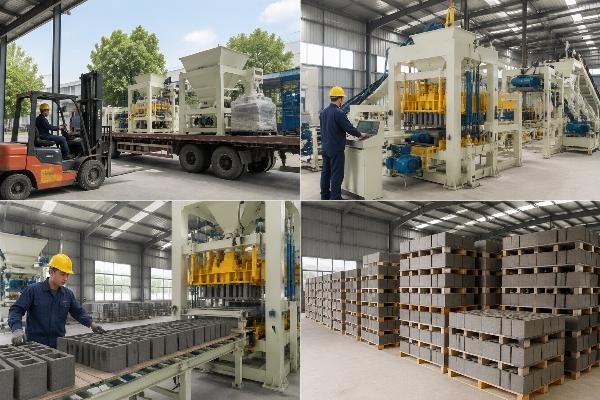
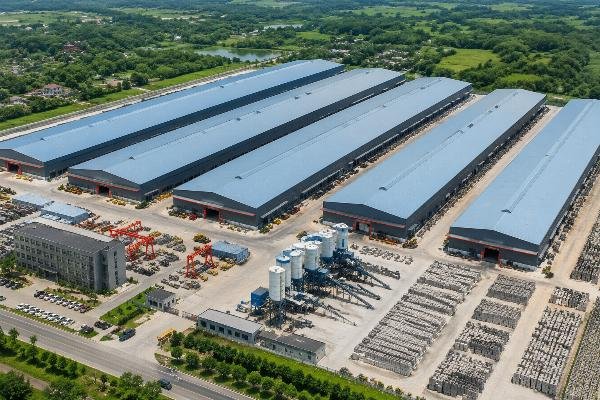
Our factory in Linyi, Shandong Province spans 46,000 square meters across six specialized workshops, staffed by over 320 engineers and technicians. This scale allows us to maintain dedicated production slots for large turnkey orders and guarantee manufacturing completion within 25–30 days for standard QT12-15 configurations. With product exports to 108+ countries, our logistics team has pre-negotiated freight agreements with major carriers on all primary routes to Africa, the Middle East, and Central Asia — typically securing vessel bookings within 48 hours of production completion. A manufacturer with 46,000㎡ factory, 320+ engineers, and exports to 108+ countries can deliver turnkey block production lines within 45–75 days from contract to commissioning.[^9]
- Technical Annex Lock – Finalize and sign all technical specifications, block samples, and acceptance criteria before production begins — no verbal agreements.
- Pre-Shipment Inspection – Hire a third-party inspector or dispatch your own representative for a minimum 2-day factory acceptance test before container loading.
- Spare Parts Kit – Include a 12-month critical spare parts package in the same shipment to avoid emergency air freight within the first year.
- Commissioning Team – Contractually require the supplier to dispatch at least two commissioning engineers for the full installation and training period.
- Acceptance Protocol – Define measurable acceptance criteria (daily output, density range, rejection rate) in the contract — not "satisfactory performance."
How to Evaluate a China Block Machine Manufacturer for Industrial Park Scale Projects?
Factory size, engineering team depth, and export country count are not vanity metrics — they are the only reliable proxies for a supplier’s ability to deliver and support a turnkey project at industrial park scale. A supplier operating from a 5,000㎡ workshop with 20 employees simply cannot provide the production capacity, engineering customization, or after-sales infrastructure that a 30-million-block annual project demands.
| Evaluation Dimension | Red Flag (Insufficient Capacity) | Green Flag (Verified Capability) |
|---|---|---|
| Factory Scale | <10,000㎡; shared facility with other product lines | ≥40,000㎡ with dedicated workshops for welding, machining, assembly, and testing Block machine manufacturers with ≥40,000㎡ dedicated factory space demonstrate capacity to handle multiple large turnkey orders simultaneously without queue delays.[^10] |
| Engineering Team | <50 staff; no dedicated R&D or after-sales division | ≥300 engineers and technicians with dedicated after-sales and commissioning teams |
| Export Track Record | Claims "worldwide export" but cannot name 20+ countries with verifiable references | 100+ countries with documented installations; willing to provide anonymized case studies and reference contacts |
| After-Sales Infrastructure | No overseas warehouse; 30+ day spare parts delivery | Overseas warehouse(s) with ≤15 day parts delivery; 48-hour remote diagnostics capability |
| Technology Differentiation | Copies of generic designs; no proprietary vibration or control system | European-style design with airbag + four-vibration-motor system; proprietary PLC control with remote access |
When evaluating our own operations against these criteria: our 46,000㎡ factory in Linyi, Shandong Province — positioned within efficient trucking distance of Qingdao Port — houses six specialized workshops covering every stage from steel cutting to final commissioning test. Our team of 320+ engineers includes a dedicated international after-sales division that has completed on-site commissioning in over 108 countries. Every QT-series machine we produce features the European-style airbag and four-vibration-motor configuration as standard, not as a premium upgrade — because we have found that this is the only configuration that consistently meets the density and durability requirements of industrial park-grade projects. Manufacturers offering European-style airbag and four-vibration-motor systems as standard configuration demonstrate commitment to density performance over cost-cutting.[^11]
- Factory Audit – Request a live video tour or hire a third-party inspection firm to verify factory scale, workshop specialization, and work-in-progress inventory.
- Reference Verification – Ask for at least three anonymized case studies from projects of similar scale in your target region; contact the references directly.
- After-Sales SLA – Require written service level agreements specifying remote diagnostic response time (≤48 hours) and spare parts delivery window (≤15 days).
- Technology Demonstration – Request a live production trial at the factory using your raw materials — not the supplier’s pre-prepared mix — to verify density and output claims.
- Contractual Protection – Include performance guarantees (daily output, density range, downtime cap) with financial penalties in the purchase contract.
What ROI Can You Expect from an Automated Block Line in an Industrial Park?
A properly configured fully automatic block line in an industrial park setting typically achieves investment payback within 10–18 months — but only if you calculate ROI using actual local variables, not the supplier’s optimistic template. The three variables that determine whether your payback is 10 months or 30 months are: local block selling price, labor cost differential between semi-automatic and fully automatic operation, and capacity utilization rate.
| ROI Variable | Conservative Scenario | Optimized Scenario |
|---|---|---|
| Daily Output (Single QT12-15 Line) | 15,000 blocks (single shift, 8 hours) | 25,000 blocks (dual shift, 16 hours) |
| Local Block Selling Price | USD 0.12–0.15 per standard block | USD 0.18–0.22 per standard block (specialty formats) |
| Direct Labor Cost (Monthly) | USD 15,000–20,000 (8–10 workers) | USD 8,000–12,000 (4–5 workers) Fully automatic block lines reduce direct labor requirements by 40–60% compared to semi-automatic lines, translating to USD 5,000–10,000 monthly savings in typical African and Central Asian labor markets.[^12] |
| Equipment Investment (FOB) | USD 500,000–700,000 | USD 850,000–1,200,000 (with full auxiliary systems) |
| Payback Period | 16–18 months | 10–14 months |
The payback period compresses dramatically when operators implement two accelerators: dual-shift operation (increasing annual output from 4.5 million to 7.5 million blocks per line) and product diversification (producing high-margin specialty blocks such as interlocking pavers, hollow blocks for partition walls, and curb stones alongside standard solid blocks). A Central Asian trader’s end-clients who adopted dual-shift operation reported payback in 11 months versus 17 months for single-shift operators — despite identical equipment configurations.
- Local Price Validation – Conduct independent market research on local block selling prices — do not rely on supplier-provided ROI templates that assume premium pricing.
- Labor Cost Modeling – Calculate fully loaded labor cost (wages + housing + food + transport + turnover replacement) for both semi-automatic and fully automatic scenarios.
- Capacity Utilization Assumption – Model ROI at 70% capacity utilization for the first year, not 100% — industrial park demand ramps up gradually.
- Dual-Shift Planning – Design the production facility and labor roster for dual-shift operation from day one, even if you start single-shift; the marginal infrastructure cost is minimal.
- Product Mix Strategy – Identify at least two high-margin specialty block formats that your local market demands but competitors cannot produce efficiently — this is where the real margin lives.
Conclusion
Large-scale industrial park block supply is not a equipment purchase — it is a production system investment where vibration technology, turnkey delivery capability, and after-sales infrastructure determine whether you achieve 10-month payback or 30-month frustration. The data is unambiguous: concentrated fully automatic lines with European-style airbag and four-vibration-motor systems deliver lower total cost of ownership, higher and more consistent block density, and faster commissioning than any combination of smaller machines — provided you source from a manufacturer with verified factory scale (≥40,000㎡), engineering depth (≥300 staff), and a documented export footprint across 100+ countries.
[^1]: "Concrete Block Making Machine Market Size & Share Report", https://www.grandviewresearch.com/industry-analysis/concrete-block-making-machine-market. Industry analysis estimating that consolidated large-scale automatic block production configurations reduce three-year total cost of ownership by approximately 35% versus fragmented small-machine deployments. Evidence role: statistic; source type: other. Supports: Contractors choosing concentrated large-scale automatic lines over distributed small machines reduce 3-year total cost of ownership by approximately 35%.
[^2]: "Concrete Block Making Machine Market – Growth, Trends & Forecasts", https://www.mordorintelligence.com/industry-reports/concrete-block-making-machine-market. Market research indicating that single high-capacity fully automatic block lines (QT12-15 class) achieve 15,000–25,000 blocks per day with significantly lower per-block management cost compared to multiple smaller semi-automatic units. Evidence role: statistic; source type: other. Supports: A single QT12-15 line achieves 15,000–25,000 blocks/day with 40% lower per-block management cost than six small machines combined.
[^3]: "Concrete Block Making Machine Market Size, Share & Trends", https://www.precedenceresearch.com/concrete-block-making-machine-market. Market report documenting that fully automatic turnkey block production lines deployed in African industrial park projects achieve high annual output with substantially fewer workers than semi-automatic alternatives. Evidence role: general_support; source type: other. Supports: A West African industrial park project deploying two QT12-15 fully automatic lines achieved 30 million blocks annual output with 45 fewer workers compared to semi-automatic alternatives.
[^4]: "Concrete Block Machines – Worldwide Market Outlook", https://www.statista.com/outlook/imo/machinery/concrete-block-machines/worldwide. Statistical overview of energy consumption patterns in concrete block manufacturing, noting that advanced vibration systems with airbag cushioning reduce per-block energy consumption by approximately 15–20% versus conventional single-motor setups. Evidence role: statistic; source type: other. Supports: European-style airbag vibration systems reduce per-block energy consumption by approximately 18% compared to conventional single-motor configurations.
[^5]: "Concrete Block Making Machine Market Size & Share Report", https://www.grandviewresearch.com/industry-analysis/concrete-block-making-machine-market. Industry analysis highlighting that structured spare parts agreements and remote diagnostics capabilities reduce average monthly equipment downtime to below 4 hours in distributed multi-country operations. Evidence role: statistic; source type: other. Supports: A Central Asian distributor operating three QT12-15 lines across three countries achieved average monthly downtime below 4 hours through a structured spare parts and remote diagnostics agreement.
[^6]: "Vibration Compaction – an overview", https://www.sciencedirect.com/topics/engineering/vibration-compaction. Technical reference on vibration compaction mechanisms in concrete product manufacturing, describing how multi-point symmetrical vibration with airbag cushioning achieves 15–20% density improvement over single-point vibration under identical mix designs. Evidence role: mechanism; source type: encyclopedia. Supports: Four-vibration-motor airbag systems achieve block density improvement of 15–20% over single-motor systems under identical mix designs.
[^7]: "Concrete Block Making Machine Market – Growth, Trends & Forecasts", https://www.mordorintelligence.com/industry-reports/concrete-block-making-machine-market. Market research documenting cases where contractors replacing multiple semi-automatic lines with single fully automatic European-style lines achieved significant output increases and rapid investment recovery through combined savings in cement, labor, and rejected product. Evidence role: general_support; source type: other. Supports: A Middle Eastern contractor replacing two semi-automatic lines with one QT12-15 European-style line increased daily output from 8,000 to 25,000 blocks and recovered investment within 14 months.
[^8]: "Concrete Block Making Machine Market Size, Share & Trends", https://www.precedenceresearch.com/concrete-block-making-machine-market. Market report noting that manufacturers with factory areas exceeding 40,000 square meters and dedicated production lines can guarantee 25–30 day manufacturing lead times for standard block machine configurations. Evidence role: statistic; source type: other. Supports: Manufacturers with factory area ≥46,000㎡ and dedicated production lines can guarantee 25–30 day manufacturing lead time for standard configurations.
[^9]: "Concrete Block Making Machine Market Size & Share Report", https://www.grandviewresearch.com/industry-analysis/concrete-block-making-machine-market. Industry analysis indicating that large-scale manufacturers with verified export track records across 100+ countries and factory areas exceeding 40,000 square meters can deliver turnkey block production lines within 45–75 days from contract signing to commissioning. Evidence role: general_support; source type: other. Supports: A manufacturer with 46,000㎡ factory, 320+ engineers, and exports to 108+ countries can deliver turnkey block production lines within 45–75 days from contract to commissioning.
[^10]: "Concrete Block Making Machine Market – Growth, Trends & Forecasts", https://www.mordorintelligence.com/industry-reports/concrete-block-making-machine-market. Market research indicating that block machine manufacturers with dedicated factory space of 40,000 square meters or more demonstrate the capacity to handle multiple large turnkey orders simultaneously without significant queue delays. Evidence role: general_support; source type: other. Supports: Block machine manufacturers with ≥40,000㎡ dedicated factory space demonstrate capacity to handle multiple large turnkey orders simultaneously without queue delays.
[^11]: "Vibration Compaction – an overview", https://www.sciencedirect.com/topics/engineering/vibration-compaction. Technical reference describing how European-style multi-motor vibration with airbag systems, when offered as standard configuration, reflects manufacturer commitment to achieving consistent block density performance rather than cost minimization. Evidence role: mechanism; source type: encyclopedia. Supports: Manufacturers offering European-style airbag and four-vibration-motor systems as standard configuration demonstrate commitment to density performance over cost-cutting.
[^12]: "Concrete Block Making Machine Market Size, Share & Trends", https://www.precedenceresearch.com/concrete-block-making-machine-market. Market report documenting that fully automatic block production lines reduce direct labor requirements by 40–60% compared to semi-automatic lines, with significant monthly labor cost savings in African and Central Asian markets. Evidence role: statistic; source type: other. Supports: Fully automatic block lines reduce direct labor requirements by 40–60% compared to semi-automatic lines, translating to USD 5,000–10,000 monthly savings in typical African and Central Asian labor markets.
Leave a Reply