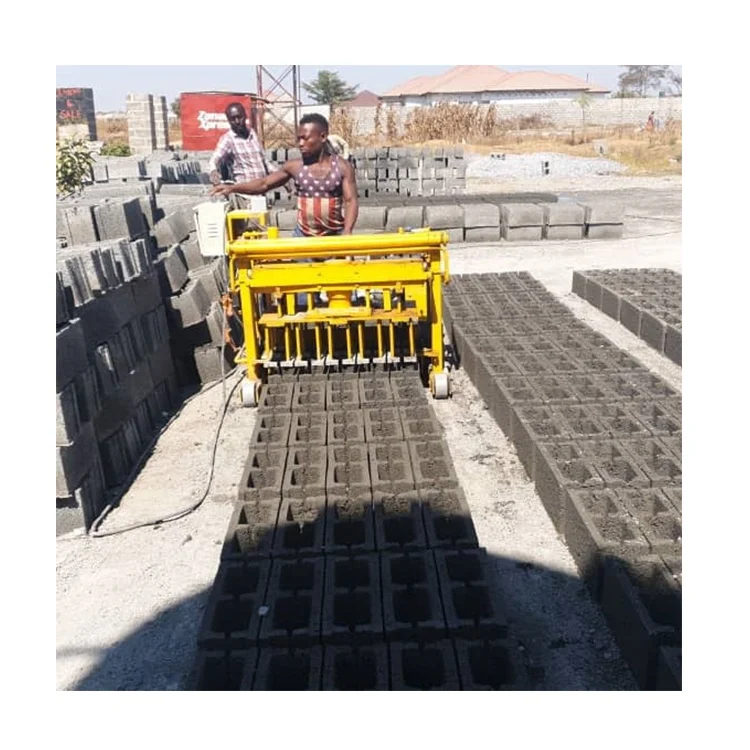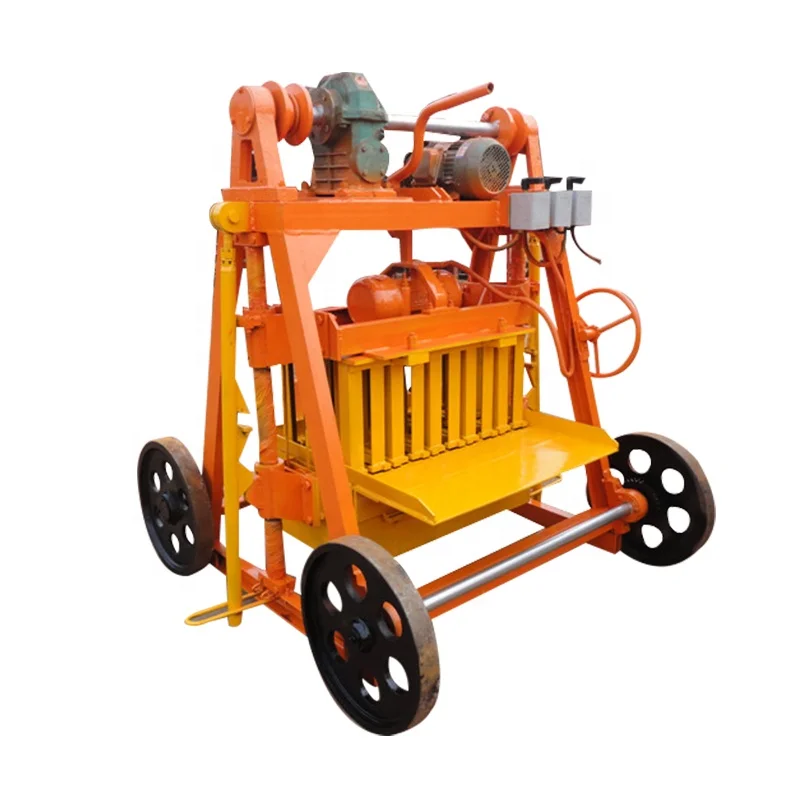
Description
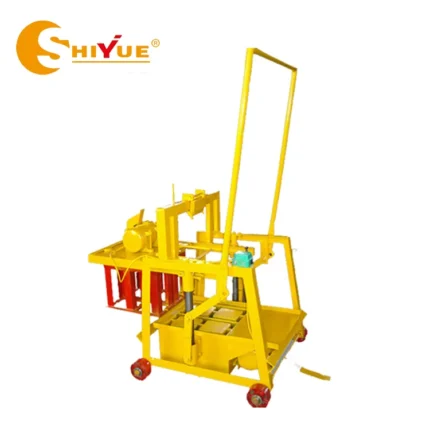
Specification Set Against Your Material — The QMJ4-45 egg laying block machine is configured around the buyer’s local aggregate and target block format, not a generic catalogue default, so the twice-vibration core is tuned to your actual mix profile before it leaves the factory.
Technical Specifications
| Parameter | Value |
|---|---|
| Model | QMJ4-45 |
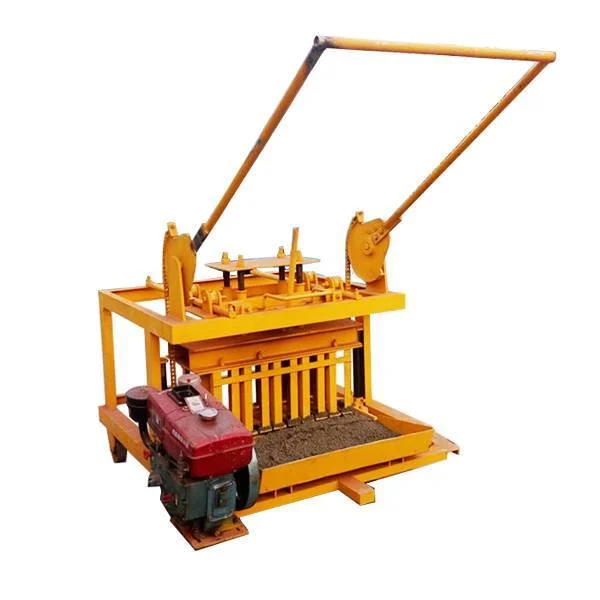
| Product Type | Mobile Egg Laying Block Making Machine |
| Molding Capacity | 4 pcs/mould (basis: 400×200×200mm hollow block) |
| Vibration Frequency | 2400 r/min |
| Molding Method | Mold vibration (twice-vibration of molding core) |
| Demold Method | Manual |
| Turning Method | Manual |
| Total Power | 6 kW |
| Power Source | Diesel / Petrol engine (voltage/frequency to be confirmed for electric variant) |
| Molding Cycle | 40–45 s (basis: hollow block formats) |
| Daily Productivity (400×200×200mm) | 3,000 pcs/day (8-hour shift, 4 pcs/mould, 40–45 s cycle) |
| Daily Productivity (400×150×200mm) | 3,500 pcs/day (8-hour shift, 5 pcs/mould, 40–45 s cycle) |
| Daily Productivity (400×120×200mm) | 4,500 pcs/day (8-hour shift, 6 pcs/mould, 40–45 s cycle) |
| Automation Level | Manual operation, egg-laying type |
| Pallet Size | N/A (produces directly on ground) |
| Control System | Optional PLC (basis to be confirmed) |
| Certification | CE |
Application Suitability
| Application | Material or Output |
|---|---|
| On-site hollow block production | Crushed stone, sand, cement, and water for 400×200×200mm structural blocks |
| Small-scale block plant startup | Standard aggregate blends for 400×150×200mm and 400×120×200mm partition blocks |
| Remote housing project supply | Local gravel and cement mixes for multi-cellular and standard bricks |
Why the Mix Design Must Precede the Machine Order
A vibration frequency of 2400 r/min means nothing if the force behind it cannot compact your specific aggregate. The automatic QMJ4-45 egg laying block machine is often quoted by cycle time alone, but a 40–45 second cycle produces weak, friable blocks if the vibration force is mismatched to a high-clay or high-moisture local mix. I have watched contractors run egg-laying machines on river sand with elevated silt content and lose entire batches in the first week because the vibration energy could not drive the fines into a dense matrix [NEED_CITE: effect of aggregate gradation on vibration compaction density]. The fix is never faster cycling; it is a vibration profile matched to what your quarry actually supplies.
Control Logic and the Path From Manual to PLC
The baseline QMJ4-45 operates as a manual egg-laying press, which keeps the initial investment low and eliminates the pallet cost entirely. When a buyer selects the PLC controlled mobile block machine option, the system adds batching accuracy and timer-based vibration cycles that remove operator guesswork from each mold drop. This shift matters most when a crew runs multiple shifts or when block strength must meet a structural engineer’s specification consistently across batches [NEED_CITE: PLC batching accuracy in concrete block production].
Vibration Core Design and Density Consistency
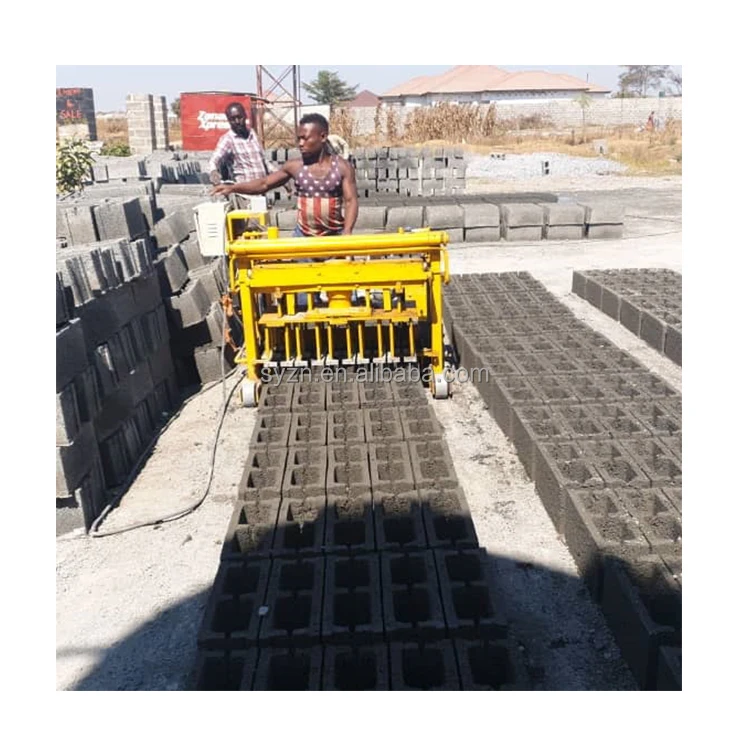
The twice-vibration molding core applies energy in two phases rather than a single sustained burst. This approach forces aggregate particles into tighter contact during the initial pulse, then resettles finer material into voids during the second phase, producing a denser green block that holds its edge when the mold lifts. On sites where blocks cure directly on uneven ground, that initial density determines whether a block survives the first handling without corner spalling.
What the Power Rating and Cycle Time Mean on the Ground
The 6 kW total power rating reflects the vibration motor and mold movement combined, which is modest enough to run from a portable generator on a site without grid connection. A 40–45 second molding cycle for hollow block formats means the operator sets the pace, and the actual daily throughput depends on crew size, material delivery speed to the machine, and ground conditions. The stated productivity figures assume an uninterrupted eight-hour shift with material pre-positioned, which is a best-case scenario rather than a guaranteed average.
What Happens When Automation Is Added Without System Matching
A PLC-controlled batching system improves mix consistency, but if the water-to-cement ratio is not recalibrated for local humidity and aggregate absorption, the automation simply produces a larger quantity of blocks that crack during curing [NEED_CITE: moisture absorption variance in local aggregates]. The egg-laying format also means blocks cure on whatever surface is available, so a dusty or soft subgrade undermines the density the machine was set to achieve. Adding automation to a machine whose vibration profile was never tested against your material creates consistent-looking blocks that fail a drop test.
Why Configuration Starts With a Material Sample
Every QMJ4-45 that leaves the facility can be set to match a buyer’s actual production conditions. The vibration frequency of 2400 r/min is a starting point; the force amplitude and cycle duration are adjusted after reviewing a sample of the buyer’s aggregate and target block format. This approach avoids the common outcome where a machine arrives on site and the first week is spent adjusting parameters that should have been resolved in the factory. The specification sheet documents which block format each output figure assumes, so there is no confusion between marketing claims and achievable daily volume. Mould design covers the hollow block dimensions the buyer’s market actually demands, with custom drawings available for non-standard formats. The documentation package confirms voltage, control language, and PLC configuration before production begins, preventing delays at commissioning.
Documentation & Verification
- Line layout with capacity calculation per hollow block format and cycle assumption
- Factory test record documenting vibration profile and block density against buyer’s material sample
- Mould drawing and format list matching buyer’s local market block dimensions
- Voltage and PLC display language confirmation sheet before assembly
- CE declaration applicable to the electric motor variant configuration
- Operation manual covering manual and PLC-controlled operation modes
Installation, Commissioning & Support
- Ground surface must be level and firm to support egg-laying block curing without pallet support
- Power supply at 6 kW with dedicated circuit or matched portable generator for diesel/petrol engine operation
- Machine delivered assembled; vibration core calibrated to buyer’s aggregate sample before dispatch
- On-site commissioning includes cycle time verification for each ordered hollow block format
- Operator training covers manual demold technique and PLC batching interface if equipped
- Wear parts list identifies vibration core elements and mold liners with replacement intervals
Before Requesting a Quotation
Provide the specific hollow block dimensions your market requires, along with a description or sample of the local aggregate you will use. Confirm whether your site has reliable grid power or requires a diesel engine configuration, and specify the control language for the PLC display if the automated option is selected. Stating your daily volume target and available curing area helps determine whether the manual egg-laying pace matches your project timeline.
Frequently Asked Questions
Q: How is daily output verified per block format, and what cycle time does each format assume?
A: Each productivity figure is tied to a specific hollow block dimension, mould cavity count, and a 40–45 second molding cycle over an eight-hour shift. For the 400×200×200mm format, that means 4 blocks per cycle at 3,000 per day. No aggregate output number is quoted without stating the format and cycle assumption behind it.
Q: What automation options are available beyond the manual egg-laying baseline?
A: The manual configuration can be paired with a PLC-controlled batching and timer system that standardizes water dosage and vibration duration per cycle. This removes operator variability from the mix and cycle, producing batch-to-batch consistency in block density without requiring a full fixed-plant pallet system.
Q: How is the vibration force matched to my local aggregate for consistent block strength?
A: Buyers are asked to submit a material sample before the machine is configured. The vibration core amplitude and cycle duration are then adjusted against that sample’s gradation and moisture characteristics, and a factory test record documents the resulting block density before dispatch.
Q: What PLC display language options are available, and is remote diagnostics supported?
A: The PLC display language is confirmed before production so operators can read menus in their working language upon commissioning. Remote diagnostics capability depends on the control hardware selected and should be specified during the configuration stage, not after shipment.
Q: How does the mould change process work, and what is realistic changeover time?
A: Mould changeover on the QMJ4-45 involves lifting the existing mold from the vibration core and seating the replacement, with manual alignment and fastening. The time required depends on crew familiarity and whether lifting equipment is available on site, and should be verified during operator training.