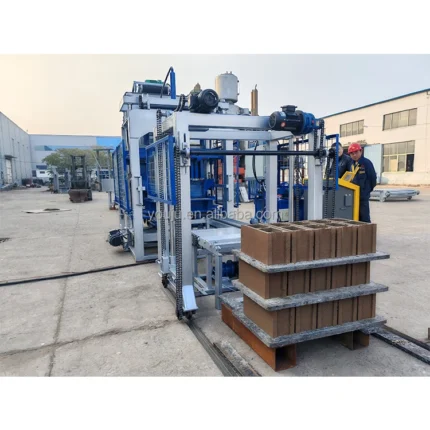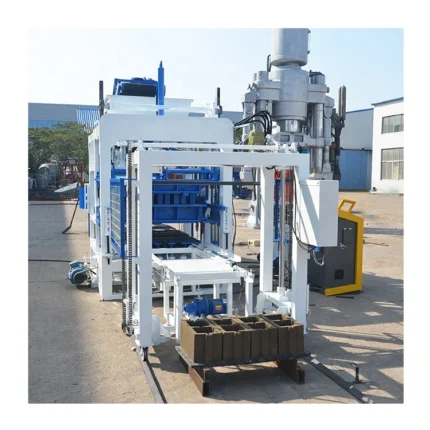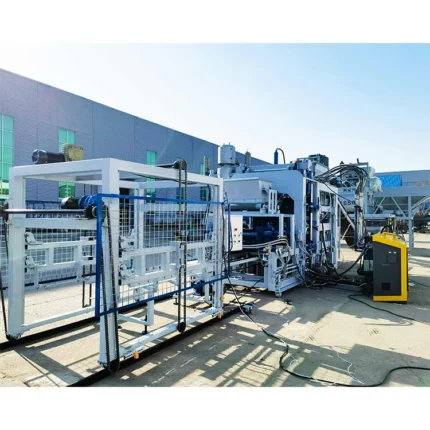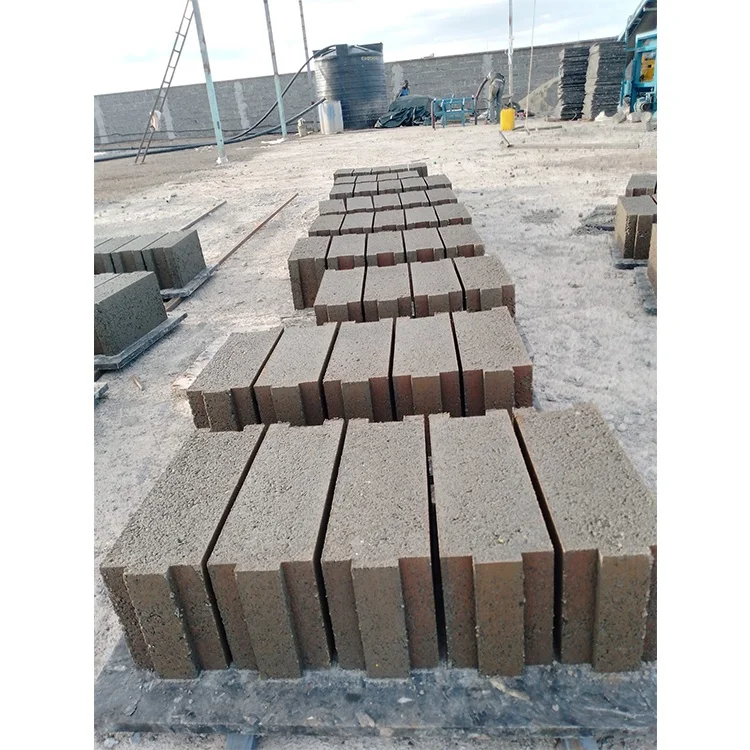


Description
Automation configured as a matched system — PLC, hydraulic pressure and vibration force are tuned together against your actual mix design rather than left as isolated catalogue defaults.
Technical Specifications
| Parameter | Value |
|---|---|
| Model | QT4-18 |
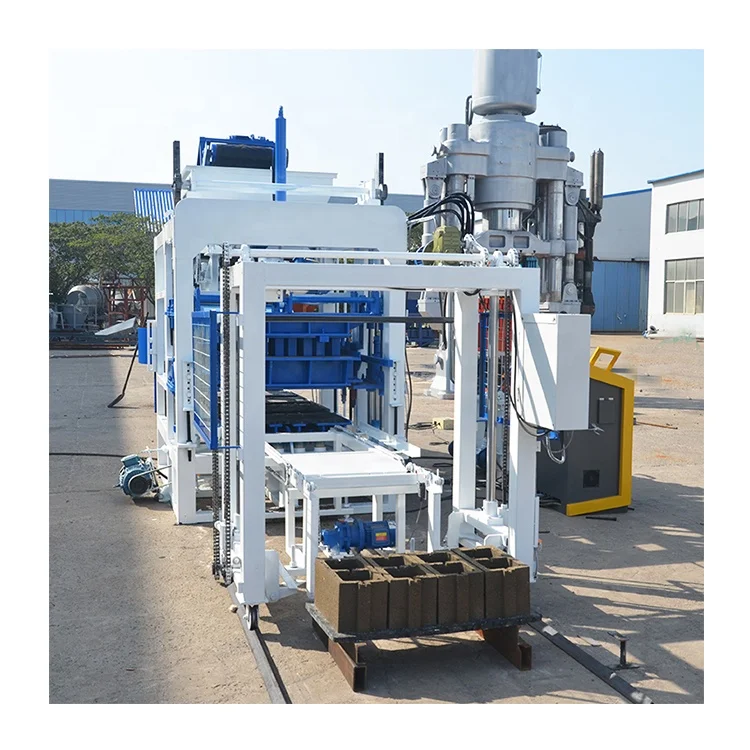
| Product Type | Automatic Concrete Block Making Machine |
| Machine Power | 27.5 kW |
| Hydraulic Pressure | 20 MPa |
| Main Vibration Form | Platform Vibration |
| Molding Cycle | 15–25 seconds (basis not stated in source) |
| Overall Dimensions (L×W×H) | 7100 × 1600 × 2610 mm |
| Machine Weight | 5800 kg |
| Voltage | According to local voltage |
| Control System | PLC (full automatic) |
| Mould Treatment | Precision line cutting, carburizing and heat treatment |
| Block Formats Supported | Hollow, porous, standard solid, color-face, interlocking, road curb, hydraulic, perforated blocks and through-body tiles |
| Theoretical Productivity — Hollow Block | 5,760–7,680 pcs/day (400×200×200 mm, 4 pcs/mould, 15–20 s cycle) |
| Theoretical Productivity — Porous Block | 25,200–33,600 pcs/day (240×115×90 mm, 14 pcs/mould, 15–20 s cycle) |
| Theoretical Productivity — Standard Block | 59,300–67,200 pcs/day (240×115×53 mm, 28 pcs/mould, 15–17 s cycle) |
| Key Features | Full automatic PLC control, platform vibration with hydraulic pressing, upgrade-ready automation path |
Application Suitability
| Application | Material or Output |
|---|---|
| Block production plants expanding format range | Hollow blocks, porous bricks, interlocking pavers and road curbs from crushed stone, sand, fly ash and cement |
| On-site construction production | Solid and perforated blocks mixed from locally sourced aggregate for housing and infrastructure projects |
| Concrete product manufacturers adding new lines | Color-face bricks and through-body tiles using pigmented surface layers on standard cementitious mixes |
| Building material distributors importing machinery | Standardised machine platform supporting multiple mould formats for resale or rental markets |
| Development contractors producing blocks locally | Site-specific block formats using pumice, volcanic scoria or lightweight aggregate available near the project |
Why Your PLC Display Language Matters Before the Machine Ships
An automatic concrete block making machine PLC controlled in a language your operators cannot read is a manual machine in practice.
I have watched commissioning stall for weeks because the PLC screen defaulted to a language the local team could not navigate, and the parameter labels on the HMI meant nothing to the person running the shift. Voltage mismatches compound the same problem — the control cabinet arrives wired for a supply frequency that does not exist on the buyer’s site, forcing a transformer retrofit before the press can even cycle. [NEED_CITE: voltage and frequency standards by export market]
Control Logic That Reduces Operator Variables
The QT4-18 stores cycle parameters per mould format inside the PLC, so when an operator selects the hollow block programme the vibration duration, hydraulic dwell and feed timing all shift to the pre-set values for that cavity count. This removes the guesswork that typically appears when a plant switches from solid bricks to porous blocks mid-shift and the operator manually adjusts timing based on feel. An automatic concrete block making machine PLC controlled at this level keeps batch-to-batch density consistent across format changes.
The Upgrade Path from Semi-Automatic to Full Line Integration
This press ships as a fully automatic unit, yet the automation level is modular — pallet feeding, stacking and cubing can be added as separate stations when the production volume justifies the investment. A buyer starting with manual pallet handling at the discharge end can later connect an automatic stacker without replacing the core press or rewriting the PLC programme. [NEED_CITE: modular automation in stationary block plant design]
Reading the Specs Against Real Production Conditions
Platform vibration at 20 MPa hydraulic pressure means the compaction force comes from two sources working together — the vibrating table densifies the mix from below while the hydraulic head compresses from above. The result is block strength that depends on both parameters being matched to your aggregate’s particle size and moisture absorption. The mould cavity counts drive the daily figures: four hollow blocks per mould at a 15–20 second cycle yields a stated 5,760–7,680 pieces per day, while 28 standard bricks per mould at 15–17 seconds shifts that figure substantially higher. These numbers hold only when the mix design, pallet surface and curing conditions match the assumptions behind the cycle time.
What Happens When Automation Specs Are Assumed Rather Than Confirmed
Plants that ordered full automatic operation without specifying pallet stacking and cubing discovered the press produced blocks faster than workers could move them, creating a bottleneck at the discharge end where green blocks sat uncured and cracked. Others received a PLC configured for the supplier’s domestic market language and spent the first production weeks navigating menus by icon recognition. [NEED_CITE: commissioning delays from unspecified control language and automation scope]
Why This Machine Is Specified Differently Here
Every output figure on this page is tied to a named block format, mould cavity count and cycle range — no single headline capacity number stands without its assumptions. The PLC display language, voltage and frequency are confirmed in writing before production begins, not discovered at the port of arrival. Mould drawings are provided so you can verify that the cavity layout matches the block dimensions your market actually purchases. The hydraulic and electrical schematics ship with the machine, giving your maintenance team the reference they need when the first wear parts replacement is due. Configuration is set against your submitted mix design and local aggregate sample, not a generic catalogue default.
Documentation & Verification
- Line layout showing capacity calculation per block format with cycle time stated
- PLC display language and voltage confirmation sheet signed before production
- Mould drawing and format list for buyer approval against market requirements
- Hydraulic and electrical schematic included for on-site maintenance reference
- Factory test record covering each mould format in the order scope
- Operation and maintenance manual with wear parts list and replacement intervals
Installation, Commissioning & Support
- Foundation plan sized to the 7100 × 1600 mm footprint and 5800 kg operating weight
- Power supply confirmed for 27.5 kW load with dedicated circuit and correct voltage and frequency
- PLC parameter set loaded for each ordered mould format before operator training begins
- Mould change procedure demonstrated on-site with cycle time verification per format
- Hydraulic wear parts list and first replacement schedule provided at handover
- Ongoing technical support for PLC troubleshooting and control system updates
What We Need to Configure Your Machine
Send the block formats your market sells, including dimensions and required strength class, along with the aggregate type and source available at your site. Confirm your local voltage, frequency and preferred PLC display language. Share your existing pallet size and curing area layout so the automation scope matches what is already on the ground.
Frequently Asked Questions
Q: How is daily output verified for each block format on the QT4-18?
A: Each productivity figure is calculated from the mould cavity count, block dimensions and stated cycle range for that specific format. Hollow blocks at four per mould and 15–20 seconds yield a different daily total than standard bricks at 28 per mould. We provide a written capacity sheet showing the calculation for every format in your order.
Q: What automation level does the QT4-18 ship with and can it be expanded later?
A: The press ships as a fully automatic unit with PLC-controlled cycle management, platform vibration and hydraulic pressing. Pallet feeding, stacking and cubing stations can be added as separate modules when your production volume grows, without replacing the core press or reprogramming the PLC.
Q: How are voltage, frequency and PLC language confirmed before the machine is built?
A: We request your site voltage, frequency and preferred HMI language at the inquiry stage and include them in a written confirmation sheet. Production does not start until this document is signed, so the control cabinet and PLC display match your local supply and operator requirements on arrival.
Q: How does the PLC maintain consistency when switching between block formats?
A: The control system stores vibration duration, hydraulic dwell and feed timing for each mould programme. When the operator selects a new format, the PLC applies the corresponding parameter set, reducing manual adjustment and keeping block density consistent across different product runs on the same shift.
Q: What is involved in changing moulds and how does it affect production time?
A: Mould change on the QT4-18 involves releasing the clamping mechanism, lifting out the current mould and securing the replacement, followed by loading the corresponding PLC programme. Precision line cutting and carburized mould surfaces are designed to withstand repeated change cycles while maintaining dimensional accuracy across formats.