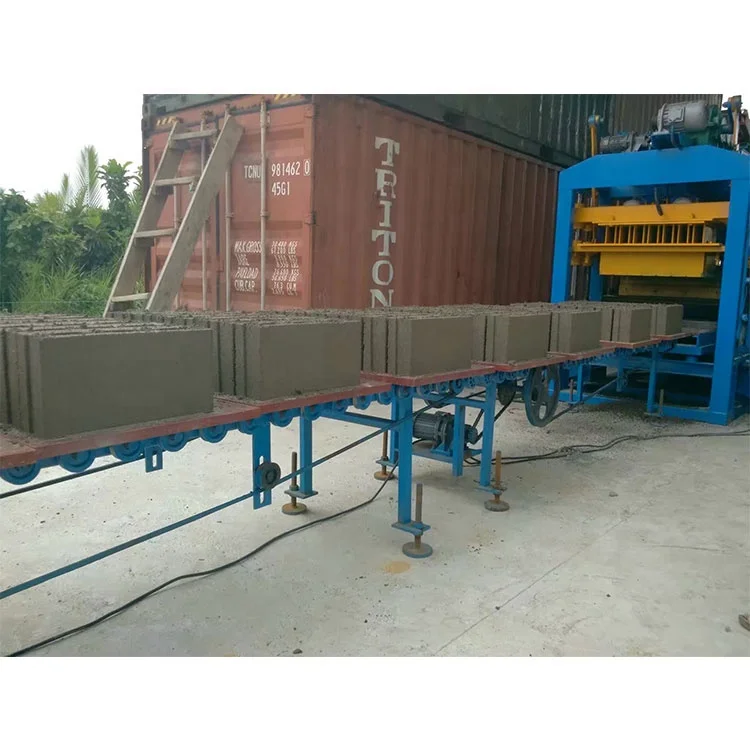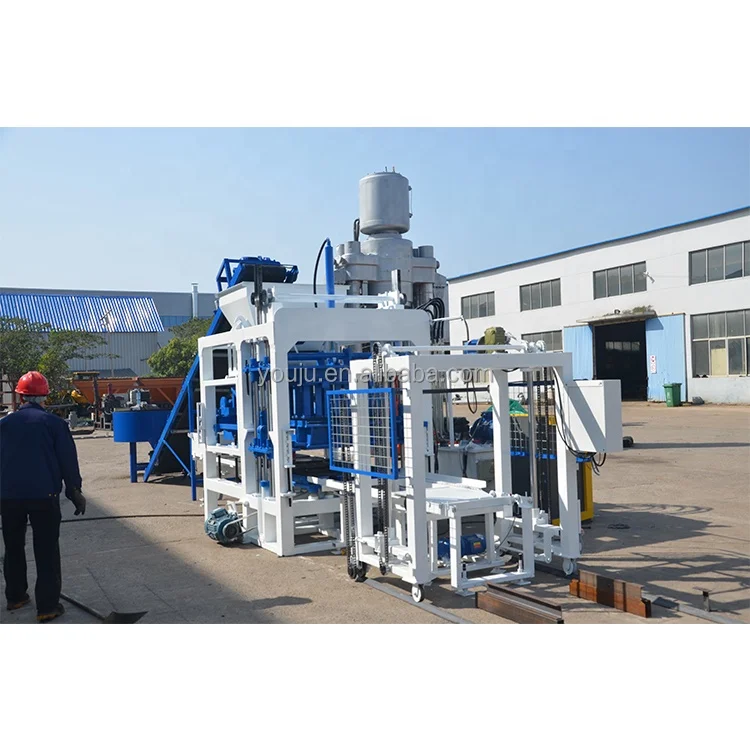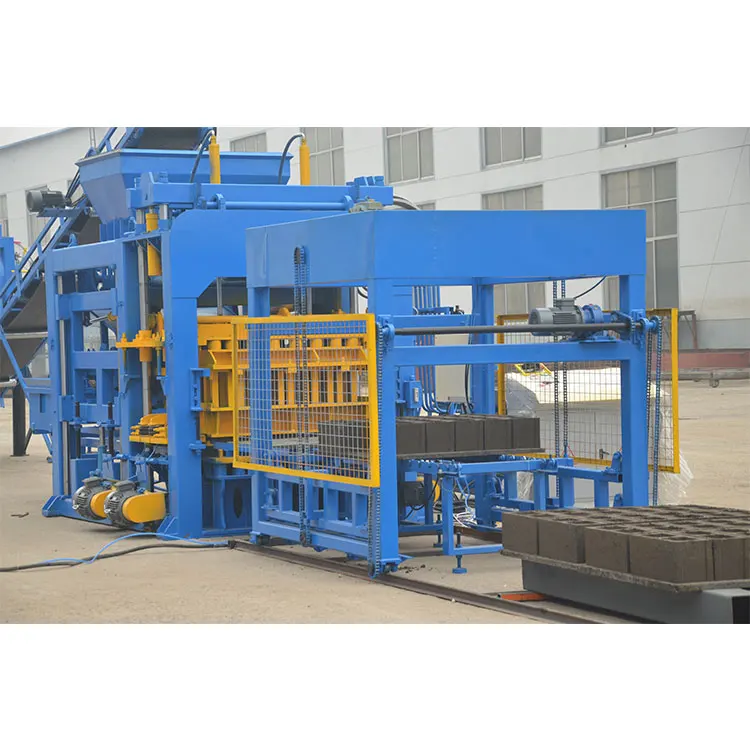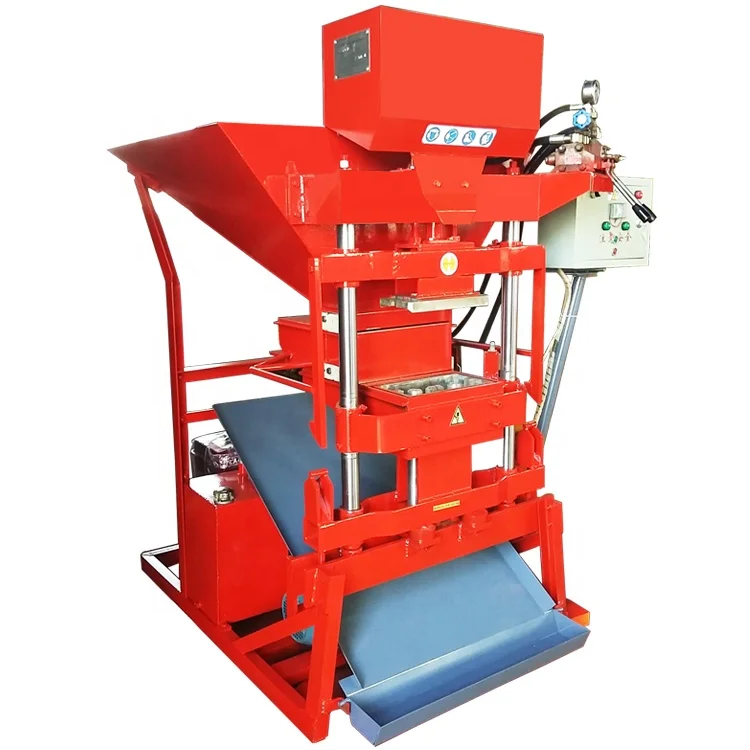


Description
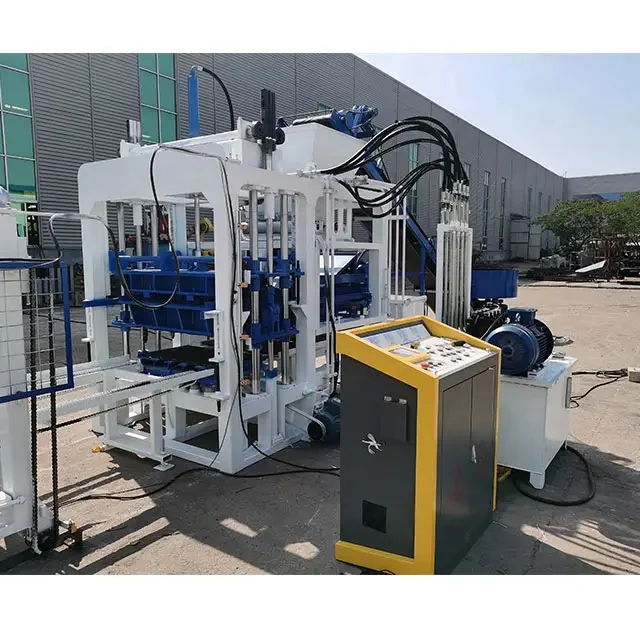
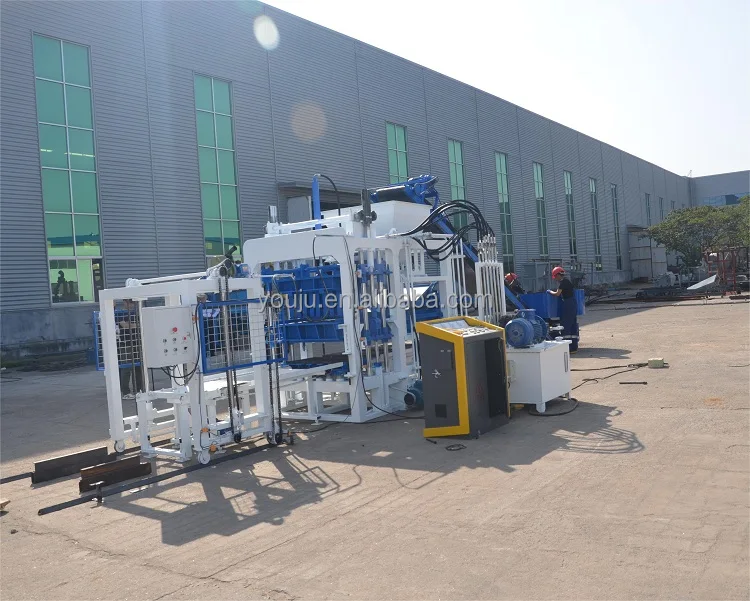
Integrated System Matching — Every QT4-18 component from the PLC logic to the hydraulic-cylinder pallet feeder is specified as one coordinated system, not assembled from mismatched suppliers.
Technical Specifications
| Parameter | Value |
|---|---|
| Model | QT4-18 |
| Product Type | Concrete Block Making Machine |
| Overall Dimensions (L×W×H) | 2500 × 1750 × 2200 mm |
| Rated Pressure | 16 MPa |
| Vibration Form | Platform Vibration |
| Pallet Size | 950 × 550 mm |
| Molding Cycle | 18–25 s |
| Overall Power | 27.5 kW |
| Control System | PLC with frequency converter |
| Electrical Components | Schneider |
| Mould Lifting Mechanism | Double-sided synchronous gears |
| Pallet Feeder Drive | Hydro-cylinder driven |
| Material Feeder System | Hopper, feeding box, feeding platform, conveyor system |
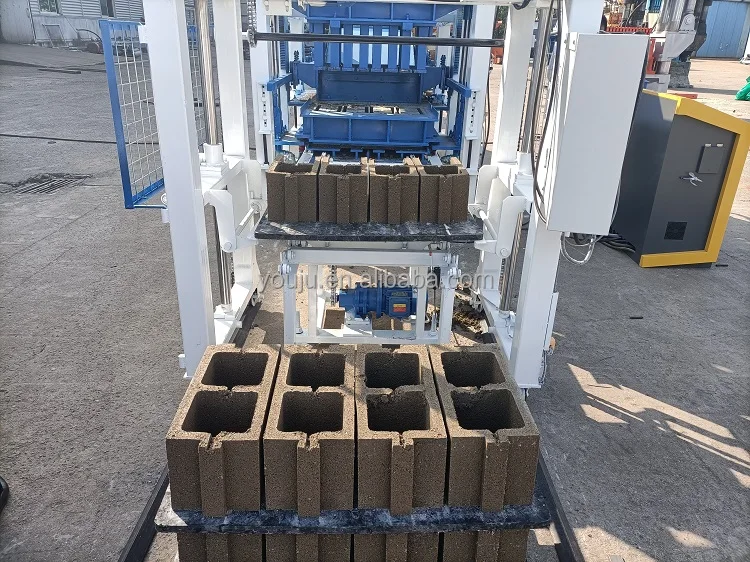
| Block Receiver | Frame, convey system, idler wheels, motor and reducer with triangle belt |
| Automation Level | Automatic with PLC-controlled cycle |
| Mould Change Method | Manual bolt release, conveyor-assisted removal and installation |
| Supporting Equipment Available | JQ500 pan mixer, 8 m / 6 m belt conveyor, stacker, block clamper, cement silo, batching plant, extra moulds, trolley |
| Output Capacity | (basis to be confirmed — depends on block format, material and thickness) |
| Voltage & Frequency | (basis to be confirmed — must match local supply) |
Application Suitability
| Application | Material or Output |
|---|---|
| Hollow block production | Crushed stone, sand, cement and fly ash mixes |
| Solid block manufacturing | Dense aggregate blends for load-bearing walls |
| Paving block runs | High-strength concrete with fine aggregate gradation |
| Kerbstone and interlocking brick | Stiff zero-slump concrete on standard 950 × 550 mm pallets |
| On-site contractor production | Local quarry sand and stone dust adjusted through PLC cycle tuning |
Why PLC Logic Must Match Your Local Aggregate Before the Price Is Set
An automatic QT4-18 block machine PLC controlled is only as consistent as the parameters tuned to your actual raw material.
I spent years on the assembly floor watching machines that ran perfectly on standard sand fall apart once they reached a site using local stone powder or crushed volcanic rock. Vibration dwell, hydraulic pressure hold time, and feeding box travel speed all shift when the aggregate changes. A PLC that stores one factory-default recipe produces weak blocks or cracked edges within the first shift [NEED_CITE: mix design influence on vibration parameters]. That is why our commissioning process starts with a sample of your local material, not a catalogue assumption.
How the Frequency Converter Manages Cycle Repeatability
The frequency converter inside the automatic QT4-18 block machine PLC controlled cabinet regulates the vibration motor ramp-up and ramp-down curve rather than switching it on at full speed instantly. This soft start prevents the mould from shifting on the platform during the first second of compaction, which is where most dimensional tolerance errors originate. Operators adjust the ramp profile directly on the HMI screen, and the PLC stores the setting per mould format so a changeover does not require re-tuning from scratch.
What the PLC Removes from the Operator and What It Adds to Consistency
In a semi-automatic line the operator judges when to cut vibration by ear and experience, introducing batch-to-batch drift across shifts. The automatic QT4-18 block machine PLC controlled system locks vibration duration, hydraulic pressure hold time, and feeding box passes into a stored recipe. Once the recipe is verified on your material during commissioning, every pallet that leaves the press carries the same compaction history [NEED_CITE: PLC recipe management in concrete block production]. The operator still monitors material flow and pallet supply, but the forming decision is no longer manual.
Reading the Spec Sheet Against Your Production Reality
The 16 MPa rated pressure works in tandem with platform vibration to compact the mix, and neither parameter alone determines block density. If your local aggregate is rounded river sand, you may need longer vibration dwell to achieve the same compaction as angular crushed stone at identical pressure. The 950 × 550 mm pallet size defines how many blocks form per cycle and must match your existing curing racks and forklift fork width — ordering the wrong pallet dimension creates a bottleneck at the stacking station. The 18–25 second molding cycle window reflects format range: thin paving blocks sit near the lower end while tall hollow blocks demand the full window for adequate compaction. The 27.5 kW total power draw must be checked against your site transformer capacity, especially when the JQ500 pan mixer and belt conveyor run simultaneously on the same supply.
The Hidden Cost of Skipping Configuration Verification
A machine wired for 380 V / 50 Hz arriving at a 440 V / 60 Hz site will burn out the vibration motor within days, and rewinding a stator on-site is rarely an option. If the PLC display language was never confirmed, your operator stares at alarm codes they cannot read, turning a simple sensor fault into a full-day shutdown [NEED_CITE: voltage and frequency standards by export market]. Skipping the factory test on your specified mould means the first production run becomes the test, wasting raw material and delaying your first delivery.
Why Sourcing This Press Here Matters
Block machinery is our single focus, so the automatic QT4-18 block machine PLC controlled arrives with its mould, pallet and handling equipment specified as one matched set rather than sourced separately. Configuration is set against your actual mix design and local aggregate, not a catalogue default. Moulds are designed and built for the formats your market sells, including custom drawings when your buyers request non-standard dimensions. The automation level is selectable — you can start with the base PLC press and add automatic stacking or cubing later as volume grows. Installation support includes on-site commissioning with your material and operator training on recipe management.
Documentation & Verification
- Factory test record documenting cycle times per block format with your specified mould
- PLC program printout and electrical schematic for post-commissioning troubleshooting
- Voltage and control language confirmation sheet signed before production begins
- Hydraulic circuit diagram with component part numbers for local sourcing
- CE declaration of conformity where applicable to your import market
Installation, Commissioning & Support
- 27.5 kW total load requires a dedicated circuit with adequate breaker rating at your site
- 2500 × 1750 mm footprint plus pallet return conveyor clearance defines minimum floor area
- Machine ships partially dismantled; reassembly covers hopper, feeder box and receiver frame
- First-run commissioning tests vibration and pressure settings on your local aggregate sample
- PLC recipe training covers mould changeover, parameter storage and alarm response
- Wear parts list covers mould liners, vibration springs and hydraulic seals with part numbers
Before You Request a Quotation
Tell us the block formats your market currently buys and the daily volume you need per format. Share a sample analysis or source description of your local aggregate so we can set the PLC recipes before the machine ships. Confirm your site voltage, frequency, and preferred PLC display language so the electrical cabinet is built correctly the first time.
Frequently Asked Questions
Q: Which PLC parameters can the operator adjust on the shop floor versus those locked at the factory?
A: Operators can modify vibration duration, feeding box pass count, and pressure hold time within safe ranges set during commissioning. Core safety limits such as maximum hydraulic pressure and mould travel bounds remain locked. This separation lets you fine-tune for daily material variation without risking damage to the double-sided synchronous gear system or the mould alignment.
Q: How does the frequency converter affect vibration consistency across different block formats?
A: The converter controls motor acceleration and deceleration curves rather than running the vibration motor at a fixed speed. For tall hollow blocks, a slower ramp prevents mould shift during the initial compaction phase. For thin paving blocks, a faster ramp shortens the molding cycle toward the lower end of the 18–25 second range, keeping the automatic QT4-18 block machine PLC controlled output steady across format changes.
Q: What is the upgrade path from the base configuration to fully automatic stacking and cubing?
A: The base press includes PLC-controlled forming, automatic pallet feeding via hydro-cylinder, and a block receiver conveyor. You can add an automatic stacker and cubing station later, provided the conveyor speed and pallet return timing are matched at each stage. We design the upgrade interface during the initial build so adding automation does not require rewiring the core PLC cabinet.
Q: Which automation functions reduce labour and which improve batch-to-batch consistency?
A: The hydro-cylinder pallet feeder and block receiver conveyor remove manual pallet handling, directly reducing operator count. The PLC recipe management locks vibration time and pressure parameters, improving consistency regardless of shift changes. These are separate benefits — one addresses labour cost, the other addresses product quality — and you can specify them independently based on your site priorities.
Q: Is remote diagnostics available on the PLC, and what connectivity does the site need to provide?
A: The PLC supports remote connection for fault diagnosis and recipe adjustment when a stable internet link is available on-site. You need to provide a wired Ethernet drop or cellular router near the cabinet. Remote access is optional and configured during commissioning; it does not affect normal machine operation if the connection is unavailable.