

QT10-15 Brick Machine Supplier for Colombia: China Factory Direct
Most buyers think a cheap FOB quote means a cheap project. The reality is that voltage adaptation, on-site commissioning, and local raw material testing can quietly add a substantial portion to your total investment — and skipping them is the single biggest reason brick lines fail in Latin America.
When sourcing a brick machine supplier for Colombia, the equipment’s ability to handle local voltage fluctuations, match regional raw materials like volcanic aggregate, and include full on-site installation matters far more than comparing unit prices. A reliable brick machine supplier for Colombia must provide CE/SGS certification, voltage-specific electrical configuration, and turnkey delivery with operator training — not just a competitive proforma invoice.
I still remember a QT6-15 line we shipped to a coastal city client a few years back. Factory acceptance testing passed without a hitch. The machine arrived, got wired up, and within the first week the frequency inverter burned out — twice. The client sent me a WhatsApp video of the smoking panel, and the message was not polite. The root cause was not the machine itself; it was the local grid swinging well outside the tolerance range the standard configuration assumed. We had to ship a custom voltage regulator and reprogram the PLC protection thresholds from scratch. Since that call, the very first question I ask any buyer in emerging markets is: how stable is your local power supply, and have you budgeted for a regulator? A brick machine supplier for Colombia who does not ask this question upfront is not a supplier you want to bet your project on.
That lesson shaped how I evaluate every inquiry that comes in from Bogotá, Medellín, or Barranquilla. What follows is a practical breakdown of what actually determines whether a brick production line Colombia project succeeds or stalls — based on what I have seen on the ground, not from a brochure.
What Types of Brick Machines Suit Colombia’s Market?
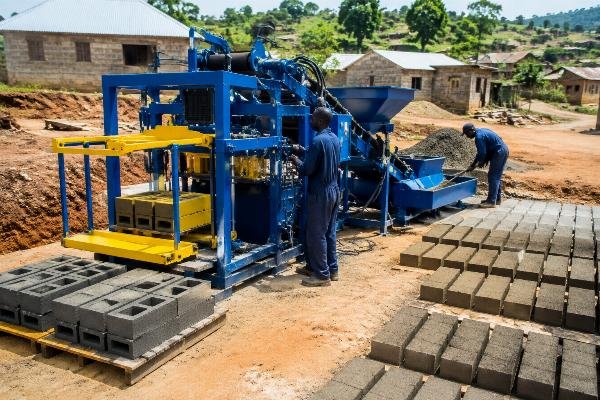
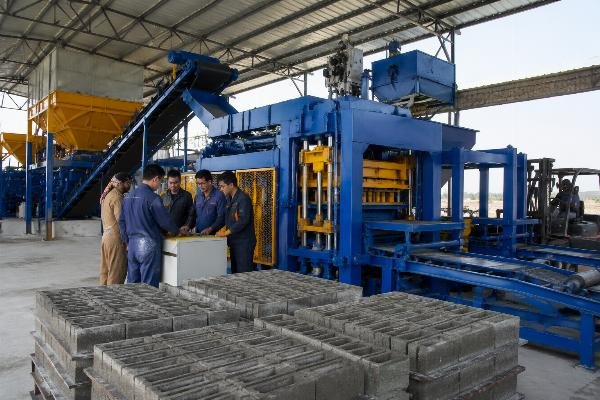
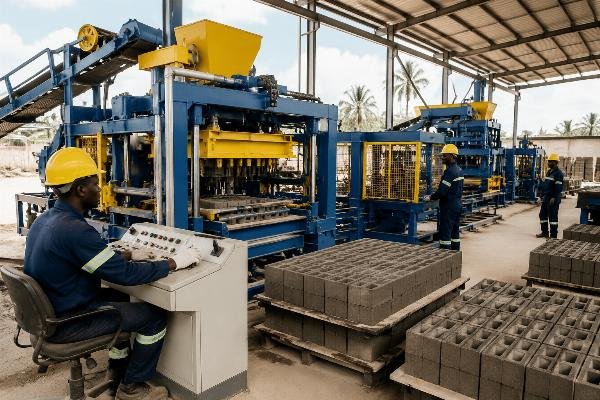
The right machine depends on your daily output target, available floor space, and whether you are supplying government tenders or retail walk-in customers. QT6-15 suits first-time investors; QT10-15 targets medium-scale commercial production; QT12-15 and above serve large contractors bidding on public housing projects.
Choosing among these models is not about which one looks most impressive in a catalog. It is about matching capacity to your actual market demand, labor availability, and utility infrastructure. Here is how the main models compare across the parameters that matter most to Colombian buyers:
| Parameter | QT4-25 (Mobile) | QT6-15 (Semi-Auto) | QT10-15 (Full-Auto) |
|---|---|---|---|
| Daily Output Range | Low-volume, site-cast | Moderate batch production | High-volume continuous output |
| Automation Level | Manual mold change, egg-laying | PLC-controlled cycle, manual pallet feed | Fully automatic pallet cycle, stacking, feeding |
| Operator Count Required | Minimal crew | Small trained team | Dedicated line operators plus maintenance |
| Floor Space Footprint | Compact, mobile positioning | Standard workshop layout | Large integrated line with silo and batching |
| Voltage Sensitivity | Lower, simpler controls | Moderate, standard inverter drives | High, multiple servo and frequency drives |
| Suitability for Government Tenders | Not typically accepted | Accepted for small lot sizes | Preferred for large-scale public housing |
[NEED_CITE: Colombian construction sector demand distribution by project scale per industry association data]
A private investor near Bogotá once came to us wanting the largest line available, convinced that bigger always meant better ROI. After reviewing his site photos, local labor pool, and the fact that he had no prior block-making experience, we recommended the QT6-15 instead. His reasoning for wanting the QT10-15 was purely emotional — he had seen one at a trade fair. The reality was that his facility could not accommodate the full pallet return loop, and his planned operator team of three people would have been overwhelmed by the PLC diagnostics. We ran a side-by-side projection: the QT6-15 with proper training would deliver acceptable waste rates, while the QT10-15 under his conditions would likely produce a noticeably higher rejection rate simply because the operators could not respond to fault codes fast enough. He went with the QT6-15, and his first-year waste rate stayed well within the acceptable range.
The takeaway is straightforward: a brick machine supplier for Colombia who pushes the biggest machine without asking about your site conditions, labor skill level, and target customer base is optimizing for their own invoice, not your production reality.
How to Adapt Machines to Colombia’s Voltage and Raw Materials?
Colombia’s standard grid specification is 220V/60Hz, but actual voltage at industrial sites — particularly in coastal and peri-urban zones — can fluctuate significantly. Any brick machine supplier for Colombia must configure the electrical system with appropriate voltage regulation and PLC protection, and must validate raw material recipes using local aggregate before shipment.
This is where most procurement mistakes happen. Buyers focus on the mechanical specs — mold size, cycle time, hydraulic pressure — and treat the electrical and material adaptation as afterthoughts. In Colombia, both are project-critical.
The electrical side first. Colombian industrial zones do not always deliver clean, stable power. Voltage sags, harmonic distortion from neighboring factories, and occasional phase imbalances are common enough that they should be treated as expected conditions, not exceptions. The standard approach is to specify an industrial-grade automatic voltage regulator sized for the total connected load of the brick line, including peak inrush current from the hydraulic pump motors. The PLC cabinet should also be configured with undervoltage and overvoltage trip thresholds tighter than the default factory settings, so the system shuts down gracefully rather than letting the inverter ride through a sag and damage its capacitors. [NEED_CITE: IEC voltage tolerance standards for industrial equipment in 60Hz grids]
We implemented this approach for a brick production line Colombia project in a coastal industrial park. The client’s existing facility had experienced multiple equipment failures from power quality issues before our line was installed. Our electrical team specified a regulator with a wider input tolerance band and added surge protection modules at each drive stage. The PLC firmware was also updated to log voltage events, giving the client’s maintenance team a diagnostic tool for future troubleshooting. The line has run without a single inverter failure since commissioning.
On the raw material side, Colombia’s geology offers options that differ significantly from the river sand and standard crushed stone common in Chinese production settings. Volcanic aggregate is widely available in the Andean region and is frequently used as a partial or full substitute for natural sand. However, volcanic rock has different absorption rates, particle shape characteristics, and density compared to river sand. If you simply run the same mix design that works in Linyi through a Colombian plant, you will get inconsistent block strength and surface finish.
The correct procedure is to send representative samples of your local aggregate, cement brand, and any admixtures to the brick machine supplier for Colombia before production begins. The supplier’s lab should run trial mixes, adjust the water-cement ratio, evaluate mold fill behavior, and test cured block compressive strength against Colombian NTC standards. Only after the recipe is validated should the machine be calibrated and shipped. [NEED_CITE: Colombian NTC standards for concrete masonry unit compressive strength]
A contractor in Medellín was bidding on a government affordable housing tender and had sourced local volcanic scoria as coarse aggregate. Without testing, his initial blocks failed the compressive strength requirement on the first batch. After we received his material samples, we adjusted the cement dosage and added a specific proportion of fine crushed stone to the mix. The revised recipe passed the NTC requirement on the second trial. The mold vibration parameters were also tuned — volcanic aggregate’s angular shape requires slightly different vibration frequency and duration compared to rounded river sand to achieve proper compaction. That adjustment took multiple mold trials to dial in, but it was done at the factory before shipment, not at the client’s site where every hour of downtime costs money.
What Is the Real Cost of a China Factory Direct Brick Line?
The FOB machine price typically represents only a portion of your total project investment. Freight, import duties, voltage adaptation equipment, on-site installation, commissioning, operator training, and initial spare parts inventory collectively form the true cost — and overlooking any of these line items will blow your budget.
Many Colombian buyers start their procurement process by collecting proforma invoices and sorting them by the bottom-line machine price. This approach is understandable, but it consistently leads to sticker shock later when the hidden costs emerge. A responsible brick machine supplier for Colombia should provide a transparent total-cost breakdown, not just a machine quote.
Here are the major cost components that sit outside the FOB price:
- Ocean freight and insurance: A full automatic brick line ships across multiple containers. Freight rates fluctuate, and insurance for high-value machinery is non-negotiable.
- Colombian import duties and VAT: Concrete block making machinery carries specific tariff classifications. Duty rates and VAT treatment should be verified with a local customs broker before ordering. [NEED_CITE: Colombian tariff classification for concrete block making machinery]
- Voltage regulation and electrical adaptation: As discussed above, the regulator, surge protection, and any custom PLC configuration represent additional equipment and engineering cost.
- Foundation and site preparation: The brick line requires a leveled concrete foundation with embedded anchor bolts. This civil work is the buyer’s responsibility and is often underestimated.
- On-site installation and commissioning: Sending engineers from China for installation, wiring, mold calibration, and trial runs involves travel, accommodation, and per-diem costs. This is where the brick machine supplier for Colombia either adds enormous value or becomes a source of delay.
- Operator training: A properly trained crew is the difference between a line that runs at rated output and one that produces waste and breakdowns. Training should be included in the supplier’s scope, not treated as an optional extra.
- Initial spare parts package: Wearing parts — mold liners, vibration springs, hydraulic seals, conveyor belts — should be ordered with the initial shipment. Waiting for a failed part to be express-shipped from China costs far more than stocking it from day one.
[NEED_CITE: total cost of ownership methodology for imported industrial machinery in Latin America]
A private block plant investor in the Bogotá periphery once shared his experience with me. He had previously purchased a semi-automatic line from a different Chinese supplier based purely on the lowest FOB price. The machine arrived, but the supplier had no engineer available to travel for installation. The investor spent months trying to commission the line with local electricians who had never worked on that specific PLC platform. The vibration system was misaligned, the mold clearance was wrong, and the block quality was inconsistent. He eventually paid a brick machine supplier for Colombia — a different company — to send a team to diagnose and correct the issues. The repair and recommissioning cost, combined with months of lost production, amounted to a significant fraction of what a proper turnkey package would have cost from the start.
The lesson is clear: when you evaluate a brick machine supplier for Colombia, request a full turnkey quotation that includes freight guidance, electrical adaptation, installation, training, and a recommended spare parts list. Compare total project cost, not just machine price.
How to Verify a Supplier’s Capability Before Ordering?
Before committing to any brick machine supplier for Colombia, require verifiable proof of export certification, documented experience in similar markets, and a contractually binding on-site commissioning clause. Marketing claims mean nothing without documentation.
The brick machine market is crowded, and not every company that lists a product online has the engineering depth to deliver a working production line in Colombia. Here is a practical verification checklist:
1. CE and SGS certification for the specific machine model.
Do not accept a generic certificate that covers a different model or an expired document. The certificate should match the exact model you are ordering, and the issuing body should be verifiable. [NEED_CITE: CE certification requirements for concrete block making machinery exported to international markets]
2. Documented installations in Colombia or comparable Latin American markets.
Ask for case references — not just country names, but verifiable project details. A credible brick machine supplier for Colombia should be able to provide contact information for at least one existing client in the region who can confirm the installation quality and after-sales responsiveness. If the supplier only shows factory photos and no field installation records, that is a red flag.
3. Contractual commitment to on-site installation and training.
The purchase contract should explicitly state the number of engineers the supplier will send, the duration of the on-site stay, the scope of commissioning activities, and the acceptance criteria for handover. Vague language like "installation support available" is not sufficient. The contract should also specify what happens if the machine fails to meet the agreed output and quality targets after commissioning — what is the remediation process, and who bears the cost of extended stays?
4. Raw material testing before shipment.
As discussed in the previous section, a competent brick machine supplier for Colombia will insist on receiving your local material samples and running trial mixes before finalizing the machine configuration. If a supplier is willing to ship without any material testing, they are prioritizing speed over your production success.
5. After-sales support structure.
Ask how remote technical support is delivered. Can their engineers access the PLC remotely for diagnostics? What is the typical response time for troubleshooting requests? Is there a local or regional spare parts warehouse, or will every replacement part ship from China?
A government contractor in Colombia was preparing a bid for a public housing project and needed a fully automatic block making machine Colombia line with full documentation. They shortlisted several Chinese suppliers and systematically requested the items on the checklist above. One supplier could not provide a valid CE certificate for the specific QT10-15 model being quoted — only for a smaller model in the same series. Another supplier had no verifiable references in Latin America at all. The supplier they ultimately selected provided current CE/SGS certificates, three verifiable references in Latin American countries, and a detailed installation and commissioning timeline in the contract. The project was delivered on schedule, passed the government inspection on the first submission, and the client has since placed a second order for an additional line.
Conclusion
Selecting a brick machine supplier for Colombia is an engineering decision, not a price comparison exercise. Voltage stability, raw material compatibility, total project cost transparency, and verifiable supplier credentials collectively determine whether your investment produces blocks or produces problems. Prioritize suppliers who ask detailed questions about your site conditions before quoting, who insist on material testing before shipping, and who commit to on-site commissioning in writing. The cheapest invoice rarely produces the cheapest project.
Leave a Reply