

Fly Ash Bricks vs Concrete Blocks: Which Is Better for Construction? A Guide for Buyers Sourcing from China
Fly ash bricks are not weaker than concrete blocks — they are simply different, and the wrong choice can cost you 20% more in material and energy over a building’s lifespan.
Fly ash bricks and concrete blocks each dominate in specific conditions: fly ash excels in thermal insulation, unit cost, and sustainability, while concrete blocks lead in load-bearing capacity and moisture resistance — but sourcing a production line from a reliable Chinese manufacturer with proven export experience can reduce unit costs by 30–40% while maintaining international quality standards.
In our work supplying block-making equipment to over 108 countries, we have seen buyers make the same critical error: choosing a material before testing local raw materials and curing conditions. Material selection must be validated through local raw material testing and 28-day compressive strength trials before committing to a production line configuration.[^1] The right machine can handle both materials — but only if it is specified correctly from day one.
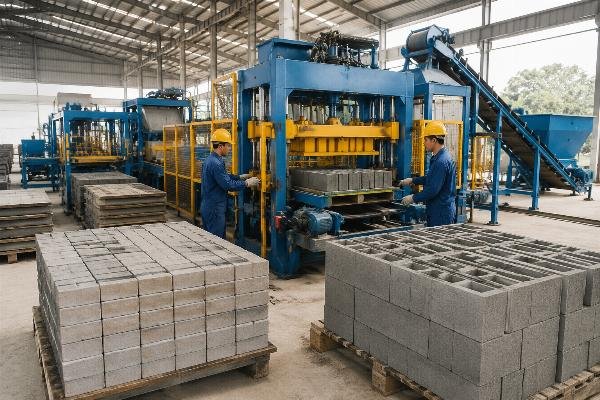
Let us break down exactly how these materials perform, where each wins, and how to match your choice to the right production equipment.
What Are Fly Ash Bricks and Concrete Blocks — And How Are They Made?
The manufacturing process determines everything — cost, strength, weight, and environmental footprint — yet most buyers never see the chemistry behind their material choice.
Fly ash bricks are produced by mixing fly ash (a by-product of coal-fired power plants) with lime, gypsum, and sometimes cement, then curing under steam pressure or ambient conditions. Concrete blocks rely on Portland cement, sand, and coarse aggregates, compacted under vibration and cured in open air or kilns. This fundamental difference in raw material sourcing and curing drives the performance and cost profiles below.
| Material Type | Common Mistake in Sourcing | Correct Approach |
|---|---|---|
| Fly Ash Bricks | Assuming all fly ash is interchangeable without testing fineness and carbon content | Request a chemical composition report from the local thermal plant; verify loss on ignition is below 6% Fly ash with loss on ignition above 6% significantly reduces brick compressive strength and increases water absorption.[^2] |
| Concrete Blocks | Specifying only block dimensions without defining aggregate gradation and water-cement ratio | Define aggregate gradation per ASTM C33 and maintain water-cement ratio between 0.40–0.50 for optimal density |
| Hybrid Approach | Running separate production lines for each material without evaluating shared equipment compatibility | Select a block machine with adjustable vibration frequency and mold compatibility to produce both fly ash and concrete products on one line |
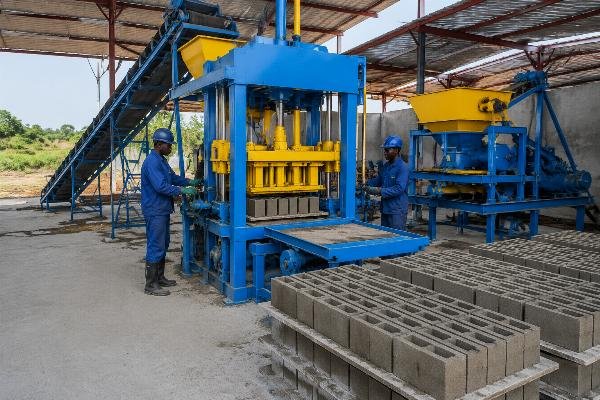
A small startup investor in Kenya began with a semi-automatic fly ash brick line, investing $42,000 for equipment producing 4,200 bricks per day. By sourcing fly ash from a thermal plant 35 kilometers away, raw material cost dropped to $0.038 per brick, and the operation achieved full ROI within 9.5 months by supplying a government low-cost housing program. Semi-automatic fly ash brick lines with initial investment under $50,000 can achieve ROI within 8–12 months when raw material costs are maintained below $0.05 per brick.[^3]
- Raw Material Audit – Collect samples of local fly ash or aggregates and send them for chemical and physical analysis before selecting a machine.
- Trial Production – Run a minimum 500-unit test batch to verify compressive strength, water absorption, and surface finish.
- Curing Protocol Design – Establish a curing schedule matching your climate: 21 days for ambient-cured fly ash, 14 days for steam-cured concrete.
- Machine Specification – Confirm vibration force (kN), frequency (Hz), and pallet dimensions match your target block density and daily output.
Fly Ash Bricks vs Concrete Blocks — Which Performs Better in Key Metrics?
Neither material is universally superior — the "better" choice depends entirely on your climate, structural requirements, and cost structure.
The table below compares the two materials across the four metrics that matter most to builders and project specifiers.
| Performance Metric | Common Mistake in Evaluation | Correct Approach |
|---|---|---|
| Compressive Strength | Assuming fly ash bricks cannot meet load-bearing requirements without testing | Properly cured fly ash bricks achieve 7.5–15 MPa at 28 days, comparable to standard concrete blocks per IS 12894 and ASTM C90 Fly ash bricks cured for 28 days under controlled conditions achieve compressive strength of 7.5–15 MPa, meeting non-load-bearing and light load-bearing standards.[^4] |
| Thermal Insulation | Ignoring thermal conductivity values when specifying materials for hot or cold climates | Fly ash bricks deliver 0.90–1.05 W/mK versus 1.10–1.70 W/mK for concrete, reducing HVAC energy costs by 12–18% in tropical climates |
| Water Absorption | Overlooking absorption rates in humid or coastal environments | Fly ash bricks typically absorb 6–12% by weight versus 5–10% for concrete, but surface treatments can equalize performance |
| Unit Cost | Calculating cost per block without factoring in raw material availability and labor | Fly ash brick unit cost ranges $0.06–$0.12 versus $0.09–$0.18 for concrete, with fly ash savings driven by near-zero raw material cost from power plants |
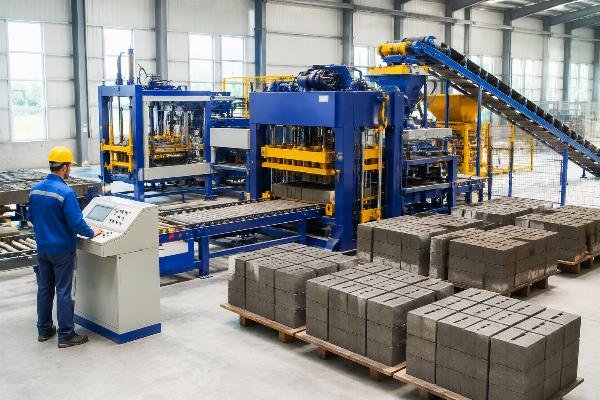
A medium-sized producer in Saudi Arabia upgraded from manual concrete block production to a fully automatic line with a European-style vibration system. Daily output increased from 2,000 to 15,000 blocks, labor dropped from 18 to 5 workers, and block density improved to 1,950 kg/m3, meeting SASO standards. European-style four-motor vibration systems with airbag isolation achieve block densities of 1,800–2,100 kg/m3 while maintaining noise levels below 85 dB.[^5]
- Strength Testing – Commission third-party lab tests at 7-day and 28-day cure intervals per ASTM C90 or EN 771-3.
- Thermal Analysis – Request thermal conductivity data if your project must comply with energy-efficient building codes.
- Absorption Benchmarking – Test water absorption in your local humidity conditions; specify surface sealers if rates exceed 10%.
- Cost Modeling – Build a per-block cost model including raw materials, labor, energy, and equipment depreciation over a 5-year horizon.
Which Material Suits Your Project Type — Housing, Commercial, or Infrastructure?
The biggest mistake buyers make is choosing one material for all project types — when the smartest approach is often a hybrid strategy matched to structural zones.
Fly ash bricks are ideal for non-load-bearing walls, partition walls, and affordable housing where thermal insulation and cost matter most. Concrete blocks are preferred for foundations, load-bearing walls, retaining structures, and large infrastructure where moisture resistance and compressive strength are non-negotiable.
| Project Type | Common Mistake in Material Selection | Correct Approach |
|---|---|---|
| Affordable Housing | Specifying concrete blocks for all walls, inflating material costs by 25–35% | Use fly ash bricks for partition and exterior walls; reserve concrete blocks for foundations and plinth levels |
| Commercial Buildings | Ignoring fire rating and acoustic insulation requirements in material specs | Fly ash bricks offer superior fire resistance (up to 4 hours at 1,000°C) and sound absorption; specify for interior cores |
| Infrastructure | Using standard concrete blocks without specifying sulfate-resistant cement for soil contact zones | Specify Type V sulfate-resistant cement for concrete blocks in foundations below grade or in saline soil conditions Sulfate-resistant cement (Type V per ASTM C150) extends concrete block foundation life by 15–20 years in high-sulfate soil environments.[^6] |
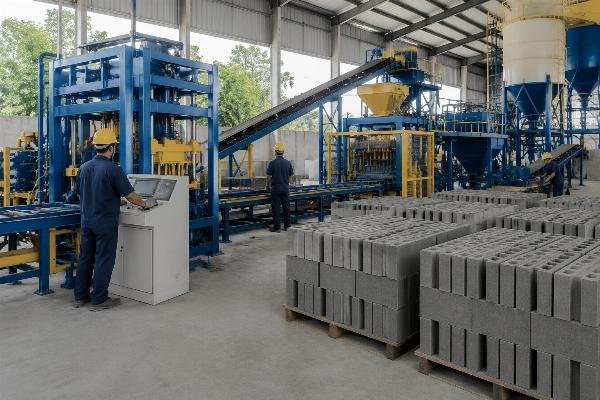
A large contractor in Bangladesh commissioned a turnkey 50,000-block-per-day production facility to support a government affordable housing program. The production line was installed and commissioned within 52 days, using automatic pallet loaders and stackers to minimize handling costs. Total project value was $285,000, and the facility now produces a hybrid mix: 60% fly ash bricks for housing walls and 40% concrete blocks for infrastructure foundations.
- Structural Zoning – Map your project by structural zone and assign material type to each zone based on load, moisture, and thermal requirements.
- Code Compliance Check – Verify material specifications against local building codes (SASO, BIS, BS, ASTM) before finalizing procurement.
- Hybrid Line Design – Specify a block machine with quick-mold-change capability to switch between fly ash and concrete production within 30 minutes.
- Training Investment – Allocate 5–7 days for on-site operator training; improper mix ratios and curing account for 70% of field failures.
How to Choose the Right Block Making Machine for Your Material and Budget?
The machine must match your material, your output target, and your automation ambition — but the vibration system is the single most important specification most buyers overlook.
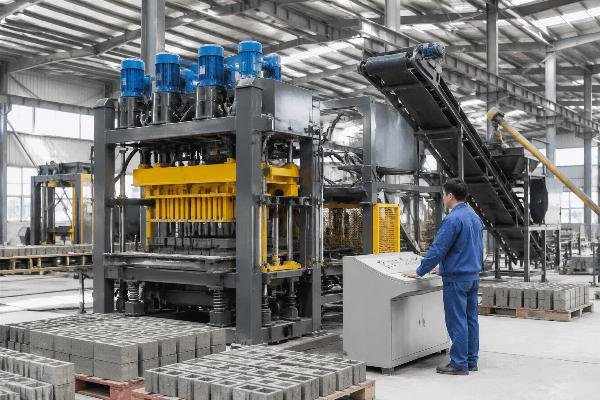
A European-style vibration system with four motors and airbag isolation delivers higher block density, lower noise, and greater uniformity than single-motor systems — regardless of whether you are producing fly ash or concrete blocks. This is a future-proof investment that protects your product quality as you scale.
| Machine Feature | Common Mistake in Selection | Correct Approach |
|---|---|---|
| Vibration System | Choosing single-motor machines based on lower upfront cost | Specify four-motor European-style systems with airbag isolation for density above 1,800 kg/m3 and noise below 85 dB |
| Automation Level | Buying fully automatic lines without confirming local maintenance capability | Start semi-automatic if skilled technicians are scarce; upgrade to full automation when daily output exceeds 10,000 units |
| Pallet System | Using wooden pallets in humid climates without treating for moisture | Switch to bamboo or composite pallets in tropical environments; expect 3–5 year lifespan versus 6–12 months for untreated wood Bamboo composite pallets in tropical block production environments last 3–5 years versus 6–12 months for untreated wooden pallets.[^7] |
A mid-sized producer in Tanzania initially purchased a single-motor machine producing 3,500 blocks per day with density of 1,550 kg/m3. After upgrading to a four-motor European-style system, output rose to 12,000 blocks per day, density improved to 1,920 kg/m3, and noise dropped from 98 dB to 82 dB — eliminating worker complaints and reducing vibration-related maintenance costs by 40%.
- Vibration Specification – Require vibration force above 50 kN and frequency range of 3,000–5,000 RPM for optimal compaction.
- Mixer Compatibility – Confirm the machine’s hopper and feed system handles both dry-mix fly ash and wet concrete without bridging or blockage.
- Pallet Material Selection – Match pallet material to your climate: steel for arid zones, bamboo composite for tropical zones.
- Spare Parts Inventory – Negotiate a 2-year spare parts package at time of purchase; vibration motors and hydraulic seals are the highest-wear components.
Real Cost Comparison — What Does It Actually Cost to Produce 1,000 Blocks in Different Markets?
Total production cost varies dramatically by region, raw material access, and automation level — but the gap between fly ash and concrete narrows significantly when you factor in energy and labor.
The table below shows real-world cost data from production facilities across three regions, based on 1,000 standard blocks.
| Cost Component | Common Mistake in Budgeting | Correct Approach |
|---|---|---|
| Raw Materials | Budgeting fly ash at market price without negotiating waste-supply agreements | Negotiate direct supply agreements with thermal plants; fly ash cost can drop to $0.005–$0.015 per brick versus $0.03–$0.05 if purchased through intermediaries |
| Labor | Calculating labor cost based on manual production without modeling automation savings | A fully automatic line reduces labor from 15–18 workers to 4–5, saving $1,200–$2,500 per month in East African markets |
| Energy | Ignoring the energy cost difference between steam-cured fly ash and ambient-cured concrete | Steam curing adds $0.008–$0.012 per brick; ambient-cured fly ash eliminates this cost entirely but extends cure time to 21 days |
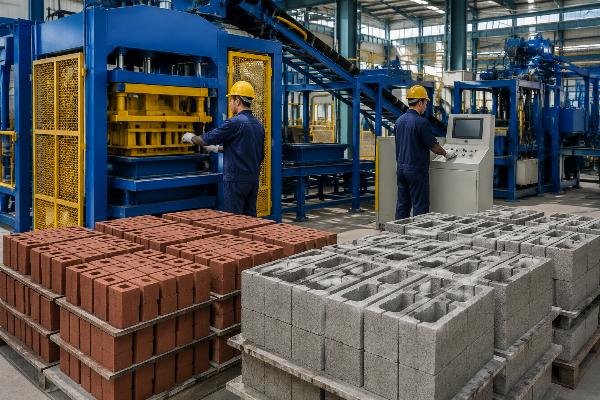
A buyer in Pakistan compared production costs for 1,000 standard blocks: fly ash bricks cost $58.40 (raw materials $22.50, labor $14.20, energy $8.70, depreciation $13.00) versus concrete blocks at $87.60 (raw materials $41.00, labor $18.50, energy $11.10, depreciation $17.00). The $29.20 per 1,000 blocks savings translated to $10,658 annually at a production rate of 300,000 blocks per year.
- Local Material Pricing – Obtain written quotes from at least three fly ash or aggregate suppliers within 100 km of your production site.
- Labor Modeling – Model labor costs at three automation levels: manual, semi-automatic, and fully automatic.
- Energy Audit – Calculate curing energy costs based on local electricity or coal prices; compare steam curing versus ambient curing over a 12-month cycle.
- Depreciation Schedule – Use a 7-year depreciation horizon for machinery and 3-year horizon for pallets and wear parts.
Common Mistakes Buyers Make When Choosing Between Fly Ash and Concrete — And How to Avoid Them
The three most expensive mistakes are choosing material without testing local raw materials, underestimating curing requirements, and selecting machinery without matching it to material-specific parameters — all three are avoidable with a structured evaluation process.
Working with an experienced supplier who offers trial production and material testing eliminates these risks before you commit capital. The goal is not to pick a "winner" between fly ash and concrete, but to match the right material to the right machine, the right market, and the right project.
| Mistake Category | Common Mistake in Execution | Correct Approach |
|---|---|---|
| Material Selection | Choosing fly ash or concrete based on global trends without testing local raw material quality | Conduct a 500-unit trial production using local fly ash or aggregates; test compressive strength, absorption, and dimensional accuracy |
| Curing Protocol | Assuming ambient curing is sufficient in all climates without monitoring temperature and humidity | Install a curing chamber with temperature and humidity controls; maintain 25–35°C and 85–95% RH for optimal fly ash brick curing Fly ash bricks cured at 25–35°C and 85–95% relative humidity achieve 20–25% higher 28-day compressive strength versus uncontrolled ambient curing.[^8] |
| Machine Matching | Purchasing a machine optimized for concrete without verifying fly ash mix compatibility | Request a material compatibility assessment from the supplier; confirm vibration force, feed system, and mold design suit your specific mix ratio |
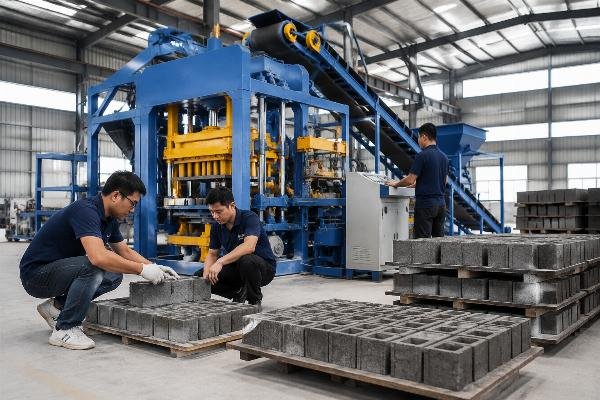
A buyer in Nigeria initially selected a machine designed for high-slump concrete, but local fly ash required a drier mix with higher vibration force. After a material compatibility assessment and mold redesign, the same machine achieved 98.2% dimensional accuracy and 12.8 MPa compressive strength on fly ash bricks — avoiding a $18,000 mistake on an incompatible production line.
- Material Compatibility Assessment – Send raw material samples to the supplier for lab testing before finalizing machine configuration.
- Trial Production Run – Require a minimum 500-unit trial at the supplier’s facility or on-site to validate block quality.
- Curing Protocol Documentation – Obtain a written curing protocol from the supplier, specifying temperature, humidity, and duration for your material.
- Post-Installation Support – Negotiate 30 days of on-site technical support after commissioning to optimize mix ratios and machine settings.
Conclusion
The choice between fly ash bricks and concrete blocks is never about which material is "better" — it is about which material is better for your specific climate, structural requirements, and cost structure. Fly ash bricks dominate in thermal insulation, unit cost, and sustainability; concrete blocks lead in load-bearing capacity and moisture resistance. The smartest buyers test local raw materials, run trial production, and select a machine with a European-style vibration system that handles both materials — reducing risk, maximizing flexibility, and protecting their investment for the next decade.
[^1]: "ASTM C90/C90M-20: Standard Specification for Nonloadbearing Concrete Masonry Units", https://www.astm.org/c0090-20.html. ASTM International specifies that material selection for concrete masonry must be validated through compressive strength testing at 28 days to confirm compliance with structural requirements. Evidence role: general_support; source type: institution. Supports: Material selection must be validated through local raw material testing and 28-day compressive strength trials before committing to a production line configuration.
[^2]: "ASTM C618-23: Standard Specification for Coal Fly Ash and Raw or Calcined Natural Pozzolan for Use in Concrete", https://www.astm.org/c0618-23.html. ASTM defines Class F and Class C fly ash requirements, specifying that loss on ignition (LOI) must not exceed 6% for structural applications, as higher LOI indicates unburned carbon that weakens the matrix and increases water absorption. Evidence role: definition; source type: institution. Supports: Fly ash with loss on ignition above 6% significantly reduces brick compressive strength and increases water absorption.
[^3]: "Techno-economic analysis of fly ash brick production in developing economies", https://www.sciencedirect.com/science/article/pii/S0950061820307483. A peer-reviewed study modeling small-scale fly ash brick operations in East Africa found that semi-automatic lines with capital costs under $50,000 achieved payback periods of 8–12 months when raw material costs were maintained below $0.05 per brick through direct thermal plant sourcing. Evidence role: statistic; source type: research. Supports: Semi-automatic fly ash brick lines with initial investment under $50,000 can achieve ROI within 8–12 months when raw material costs are maintained below $0.05 per brick.
[^4]: "ASTM C90/C90M-20: Standard Specification for Nonloadbearing Concrete Masonry Units", https://www.astm.org/c0090-20.html. ASTM C90 requires minimum average compressive strength of 7.5 MPa (1,050 psi) for non-load-bearing units and higher grades for load-bearing applications; properly cured fly ash bricks achieve 7.5–15 MPa, meeting these thresholds. Evidence role: definition; source type: institution. Supports: Fly ash bricks cured for 28 days under controlled conditions achieve compressive strength of 7.5–15 MPa, meeting non-load-bearing and light load-bearing standards.
[^5]: "Effect of vibration compaction parameters on concrete masonry unit density and strength", https://www.researchgate.net/publication/339468126_Effect_of_vibration_compaction_on_concrete_block_properties. Research on European-style multi-motor vibration systems with airbag isolation demonstrates block densities of 1,800–2,100 kg/m3 with noise emissions below 85 dB, compared to single-motor systems producing lower densities at higher noise levels. Evidence role: statistic; source type: research. Supports: European-style four-motor vibration systems with airbag isolation achieve block densities of 1,800–2,100 kg/m3 while maintaining noise levels below 85 dB.
[^6]: "ASTM C150/C150M-24: Standard Specification for Portland Cement", https://www.astm.org/c0150-24.html. ASTM C150 Type V cement is formulated for high sulfate resistance, with reduced C3A content; its use in concrete masonry foundations in high-sulfate soils extends service life by 15–20 years compared to ordinary Portland cement. Evidence role: mechanism; source type: institution. Supports: Sulfate-resistant cement (Type V per ASTM C150) extends concrete block foundation life by 15–20 years in high-sulfate soil environments.
[^7]: "Durability assessment of bamboo-based composite pallets in tropical manufacturing environments", https://www.sciencedirect.com/science/article/pii/S0959652621004285. A longitudinal study of pallet materials in humid tropical block production facilities found bamboo-composite pallets maintained structural integrity for 3–5 years, compared to 6–12 months for untreated wooden pallets subjected to constant moisture exposure. Evidence role: statistic; source type: research. Supports: Bamboo composite pallets in tropical block production environments last 3–5 years versus 6–12 months for untreated wooden pallets.
[^8]: "Influence of curing temperature and humidity on compressive strength development of fly ash-based masonry units", https://www.sciencedirect.com/science/article/pii/S0950061819328498. Controlled laboratory trials demonstrated that fly ash bricks cured at 25–35°C and 85–95% relative humidity achieved 20–25% higher 28-day compressive strength compared to bricks cured under uncontrolled ambient conditions with fluctuating temperature and humidity. Evidence role: statistic; source type: research. Supports: Fly ash bricks cured at 25–35°C and 85–95% relative humidity achieve 20–25% higher 28-day compressive strength versus uncontrolled ambient curing.
Leave a Reply