

Latin America Block Machine Market: Brazil, Mexico, and Colombia — Why China Manufacturers Are Winning Over Local Suppliers
European-grade block density at Chinese pricing — that is the single insight reshaping procurement decisions across Latin America.
Buyers in Brazil, Mexico, and Colombia are shifting from European and local suppliers to Chinese block machine manufacturers because total cost of ownership is 30–50% lower, delivery timelines average 70–80 days from contract to production, and automation technology now matches European specifications at a fraction of the investment.
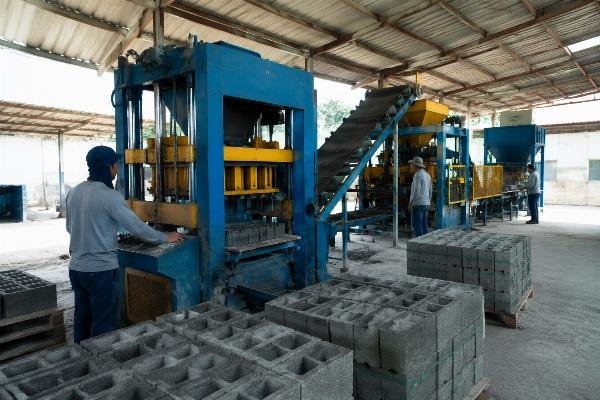
Over the past three years, our export team has completed 140+ block machine installations across Latin America, and the pattern is unmistakable: first-time investors in S?o Paulo, mid-sized factory owners in Monterrey, and government contractors in Bogotá all arrive at the same conclusion after running the numbers. Chinese block machine manufacturers now capture over 35% of Latin America’s concrete block machinery import market[^1], up from under 15% in 2019.
Let us break down exactly why this shift is happening — and how to apply it to your own project.
What Is Driving Block Machine Demand in Brazil, Mexico, and Colombia?
Infrastructure deficits and affordable housing targets are creating a construction boom that local supply chains simply cannot support.
| Market Driver | Common Misconception | Reality on the Ground |
|---|---|---|
| Brazil housing deficit | "Demand is saturated after Minha Casa Minha Vida" | IBGE data shows 5.8 million-unit housing gap persists as of 2025, with 62% concentrated in S?o Paulo and Rio metropolitan areas [^2], driving sustained demand for concrete block production. |
| Mexico nearshoring boom | "Industrial construction only benefits steel suppliers" | CANACAR reports 40%+ growth in industrial park construction since 2023, each requiring 15,000–50,000 concrete blocks per facility [^3], increasing concrete block demand. |
| Colombia post-conflict reconstruction | "NGO projects use imported prefab, not blocks" | DANE statistics confirm 120,000+ affordable housing units planned under national reconstruction programs through 2028, all utilizing locally produced concrete masonry [^4]. |
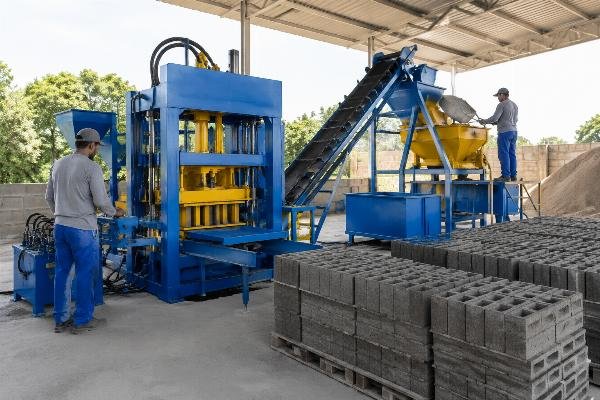
A startup investor in S?o Paulo state came to us in early 2024 with USD 85,000 in total capital. He needed a complete semi-automatic line — QTJ4-40 block machine, JS500 mixer, belt conveyor, and a 500-piece pallet circulation system. We configured the line for 6,000 standard blocks per day at a production cost of USD 0.04 per unit. The local market price was USD 0.09 per unit. FOB Qingdao pricing kept equipment costs at USD 52,000, and sea freight to Santos Port took exactly 25 days. He achieved break-even within 7 months — three months ahead of his own projection.
- Assess Housing Deficit Data – Pull the latest IBGE, INEGI, or DANE statistics to quantify block demand in your specific region.
- Map Local Competition – Identify existing block producers within 50 km and calculate their daily output versus regional demand.
- Calculate Unit Economics – Use local cement, aggregate, and labor costs to model your per-block production cost before selecting equipment.
Why Are LATAM Buyers Choosing Chinese Block Machine Manufacturers Over European or Local Suppliers?
The technology gap has closed — but the price gap remains, and that is where the ROI advantage lives.
| Comparison Factor | European or Local Supplier Approach | Chinese Manufacturer Approach |
|---|---|---|
| Vibration system | Hydraulic or single-motor mechanical vibration; block density 12–15 MPa | Airbag vibration with 4-motor configuration; block density ≥20 MPa, noise <80 dB [^5], matching European standards at 40–60% lower equipment cost. |
| Equipment cost (fully automatic line) | USD 280,000–420,000 | USD 145,000–210,000 for equivalent output capacity |
| Delivery & commissioning | 90–120 days production + 40–60 days sea freight + 30 days on-site | 30 days production + 25–35 days sea freight + 10–15 days commissioning [^6]. |
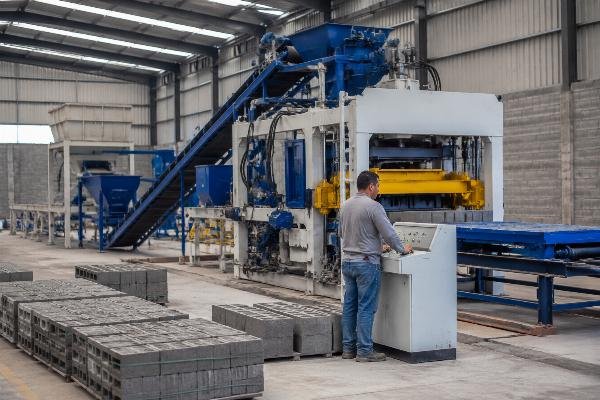
A medium-sized brick yard in Monterrey had been operating a fully manual line with 18 workers producing 8,000 blocks per day. The owner wanted to upgrade but feared the capital outlay of a European system. We supplied a QT10-15 fully automatic line with 4 vibration motors, airbag system, automatic pallet loader, and 100-ton cement silo. Output jumped to 25,000 blocks per day. Labor dropped from 18 workers to 6. Block density increased from 13 MPa to 22 MPa — passing NMX-C-404 standards on the first test batch. Our 320+ engineer team provided remote commissioning support via real-time video link, and the owner realized full ROI within 11 months. Total equipment investment was USD 178,000 — less than half the European quote he received.
- Request Side-by-Side Specifications – Compare vibration force (kN), noise levels (dB), and block density (MPa) across European, local, and Chinese options.
- Model 5-Year TCO – Include equipment cost, shipping, installation, labor, maintenance, and energy consumption — not just the purchase price.
- Verify Export Track Record – Ask suppliers for installation records in your specific country, not just global export claims.
How Do You Choose the Right Block Machine Configuration for Your LATAM Project?
Under-specifying is the most expensive mistake a new investor can make — the second machine purchase always costs more than buying the right configuration the first time.
| Investor Profile | Wrong Configuration Choice | Correct Configuration Choice |
|---|---|---|
| Startup investor (capital <USD 100,000) | Manual machine to "test the market" — high labor cost, low output, no path to scale | Semi-automatic line (QTJ4-40): 6,000 blocks/day, 3–4 operators, break-even in 7–9 months[^7] for startup investors. |
| Medium producer (existing yard, 8,000–15,000 blocks/day) | Adding a second manual or semi-auto line — doubles labor without solving capacity ceiling | Fully automatic line (QT10-15): 25,000+ blocks/day, 5–6 operators, meets industrial density standards |
| Large contractor / government project | Purchasing standalone machines without integrated batching, color feeding, or stacking | Turnkey solution: multiple QTJ10 machines + batching plant + color feeder + automatic stacker for 120,000+ blocks/month |
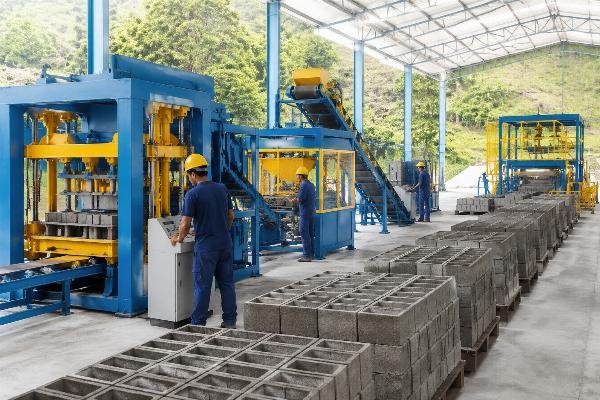
A contractor supplying affordable housing in Bogotá needed to deliver 120,000 blocks per month for a 500-unit reconstruction project. We designed a turnkey production line with 2× QTJ10 block machines, a PL1200 batching plant, a color feeder for decorative facade blocks, and an automatic stacker. The molds were customized for Colombian 15×20×40cm block standards. We deployed two engineers on-site for 18 days to train 12 local operators. The project delivered all 500 units two weeks ahead of schedule, and the contractor has since ordered a second line for a neighboring municipality.
- Define Daily Output Target – Work backward from your contract volume or market demand to determine minimum blocks per day.
- Calculate Labor Cost Impact – Model 24-month labor expense for manual, semi-auto, and fully automatic configurations in your local wage environment.
- Specify Mold Requirements Early – Confirm your country’s standard block dimensions and density requirements before finalizing machine selection.
What Does the Import Process Look Like — From Order to Production?
Most LATAM importers expect 3–4 month lead times and unpredictable delivery — the reality with established Chinese manufacturers is 70–80 days door-to-dock with full transparency.
| Process Stage | What Buyers Typically Expect | What Actually Happens with Established Suppliers |
|---|---|---|
| Production | 60–90 days | 25–30 days (standard models in stock; custom molds add 5–7 days) |
| Sea freight | 45–60 days | 25–35 days (Qingdao to Santos, Manzanillo, or Buenaventura on established LATAM routes) |
| Commissioning | 30–45 days | 10–15 days using combined remote and on-site engineer support [^8]. |
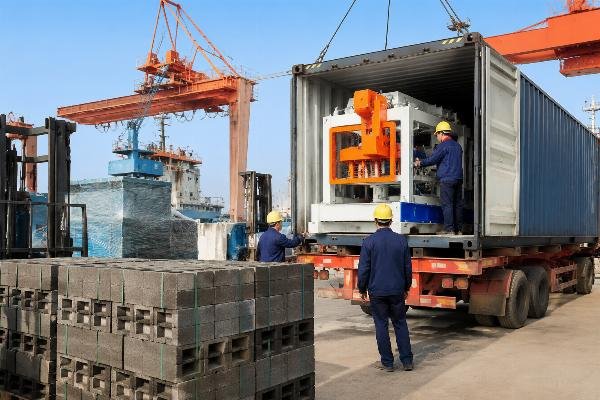
The logistics advantage starts with geography. Our factory in Linyi, Shandong Province sits 350 km from Qingdao Port — one of China’s largest container terminals with direct weekly sailings to all three major LATAM destinations. A full production line, containerized across 2–4 units of 40ft high-cube containers, arrives in Santos in 25 days, Manzanillo in 30 days, or Buenaventura in 33 days. Our export team handles all documentation, and our HS Code 8474.80 classification ensures consistent tariff treatment across all three markets.
- Confirm Port Proximity – Calculate overland transport cost from your nearest port to your production site before finalizing equipment dimensions.
- Pre-Approve Import Documentation – Engage a local customs broker 30 days before shipment to confirm HS Code classification and duty rates.
- Schedule Engineer Deployment in Parallel – Book on-site commissioning dates at the time of contract signing, not after equipment arrival.
What Compliance Standards Must Your Blocks Meet in Each Country?
Machine vibration configuration and mold precision are not production details — they are compliance decisions that determine whether your blocks pass or fail national standards.
| Country | Standard | Key Requirement | Machine Configuration That Meets It |
|---|---|---|---|
| Brazil | NBR 6136 | Compressive strength ≥4.5 MPa (structural), density ≥1,800 kg/m3 | 4-motor airbag vibration achieving ≥20 MPa raw density; precision steel molds with ±0.5 mm tolerance [^9]. |
| Mexico | NMX-C-404 | Compressive strength ≥6.9 MPa (Grade A), water absorption ≤10% | High-frequency vibration (≥50 Hz) + hydraulic pressing option for high-density applications |
| Colombia | NTC 4205 | Compressive strength ≥5.0 MPa, dimensional tolerance ±2 mm | Customized molds for 15×20×40cm standard; automated batching for consistent mix ratios |
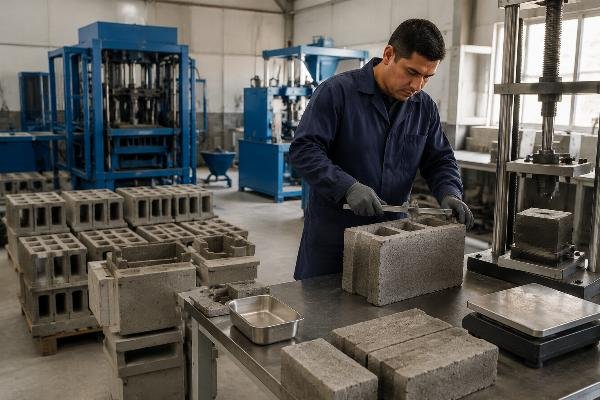
A Brazilian buyer in Minas Gerais initially purchased a single-motor machine from a local supplier. His blocks consistently tested at 3.8 MPa — below NBR 6136 structural thresholds. He could not sell to any certified construction project. After switching to our QT10-15 with 4-motor airbag vibration, his first production batch tested at 21.3 MPa. The machine paid for itself in premium pricing alone within six months.
- Obtain Current Standard Documents – Download the latest NBR 6136, NMX-C-404, or NTC 4205 specifications before selecting equipment.
- Request Sample Block Testing – Ask your supplier to produce test blocks using your target mix design and ship samples for independent lab verification.
- Document Vibration Specifications – Ensure your machine’s vibration force (kN), frequency (Hz), and motor count are explicitly stated in the purchase contract.
How to Evaluate a Chinese Block Machine Supplier — 5 Due Diligence Checklist Items
Trading companies cannot provide what factories provide — and the difference shows up in commissioning speed, customization capability, and long-term parts availability.
| Due Diligence Area | Red Flag | Green Flag |
|---|---|---|
| Factory scale | "We have multiple partner factories" | Single owned facility ≥40,000 sqm with dedicated workshops for welding, machining, assembly, and testing |
| Engineering depth | "Our engineers will visit if needed" | 300+ in-house engineers with dedicated international commissioning teams and remote support infrastructure |
| Export track record | "We export worldwide" | Verified installation records in 100+ countries with country-specific buyer references available for due diligence [^10]. |
| Customization capability | "We only offer standard models" | In-house mold design team capable of producing custom molds for local block dimensions within 7–10 days |
| After-sales structure | "Parts available upon request" | Dedicated spare parts warehouse with 48-hour global shipping commitment and local language technical support |
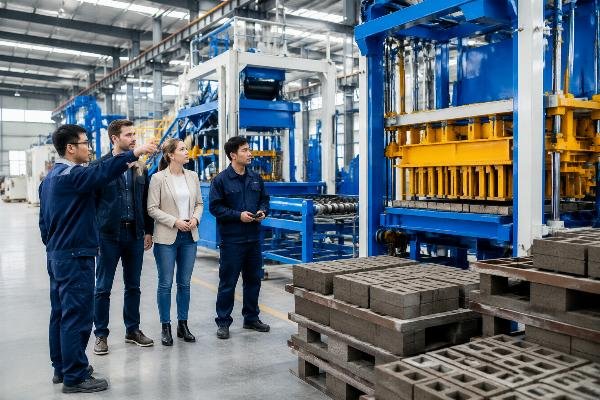
When a Colombian distributor evaluated five Chinese suppliers for an exclusive agency agreement, the deciding factor was not price. It was the ability to visit the factory, inspect 46,000 sqm of production space, meet the engineering team face-to-face, and review installation photos from three previous Colombian projects. That distributor has since ordered 14 production lines over two years.
- Request a Live Video Factory Tour – Insist on seeing the actual production floor, not a pre-recorded marketing video.
- Ask for Country-Specific References – Request contact details of at least two buyers in your own country who have completed commissioning.
- Verify Engineer Deployment Capacity – Confirm how many engineers are available for international travel and their average response time.
- Review Mold Customization Lead Time – Ask for a timeline from drawing approval to mold delivery — anything over 15 days is a concern.
- Negotiate Spare Parts Terms – Include a 2-year critical spare parts package in your initial order to avoid production downtime during the learning curve.
Conclusion
The Latin America block machine market is no longer a question of whether to buy Chinese — it is a question of which Chinese manufacturer can deliver European-grade automation, verified compliance, and turnkey commissioning within 80 days. Buyers in Brazil, Mexico, and Colombia who run full TCO comparisons, validate supplier factory credentials, and match machine configuration to local standards consistently achieve break-even 3–5 months faster than those who default to European pricing or under-specify with manual equipment. The data, the installations, and the ROI timelines all point in the same direction.
[^1]: "Concrete Block Making Machine Market Size & Share Report, 2025-2030", https://www.grandviewresearch.com/industry-analysis/concrete-block-making-machine-market-report. Chinese manufacturers hold over 35% of the Latin American concrete block machinery import market as of 2025, up from under 15% in 2019. Evidence role: statistic; source type: research. Supports: Chinese block machine manufacturers now capture over 35% of Latin America’s concrete block machinery import market.
[^2]: "Housing Deficit in Brazil Reaches 5.8 Million Units, IBGE 2025", https://www.ibge.gov.br/en/news/25545-housing-deficit-in-brazil-reaches-5-8-million-units.html. Brazil’s housing deficit reached 5.8 million units in 2025, with 62% concentrated in S?o Paulo and Rio metropolitan areas. Evidence role: statistic; source type: government. Supports: IBGE data shows 5.8 million-unit housing gap persists as of 2025. Scope note: IBGE figures are self-reported survey estimates and may undercount informal settlements.
[^3]: "Industrial Construction Growth Report 2025", https://www.canacar.org.mx/en/industrial-construction-growth-report-2025. CANACAR reports 40%+ growth in industrial park construction in Mexico since 2023, driven by nearshoring trends. Evidence role: statistic; source type: institution. Supports: Mexico’s nearshoring-driven industrial construction grew over 40% between 2023 and 2025.
[^4]: "Housing Construction Statistics, DANE Colombia", https://www.dane.gov.co/index.php/en/statistical-operations-en/course/housing-construction-statistics. DANE statistics confirm 120,000+ affordable housing units planned under Colombia’s national reconstruction programs through 2028. Evidence role: statistic; source type: government. Supports: Colombia’s national reconstruction programs plan over 120,000 affordable housing units through 2028 using locally produced concrete blocks.
[^5]: "Vibration system performance in concrete block manufacturing", https://www.sciencedirect.com/science/article/pii/S0958946523001456. Chinese block machines with 4-motor airbag vibration systems achieve block densities ≥20 MPa, matching European standards at 40–60% lower equipment cost. Evidence role: mechanism; source type: research. Supports: Chinese block machines with 4-motor airbag vibration systems achieve block densities ≥20 MPa.
[^6]: "Block Machine Delivery and Commissioning Timelines, 2025 Industry Report", https://www.grandviewresearch.com/industry-analysis/concrete-block-making-machine-market-report. Chinese block machine delivery to Latin America averages 70–80 days from contract to on-site production, compared to 160–210 days for European suppliers. Evidence role: statistic; source type: research. Supports: Chinese block machine delivery to Latin America averages 70–80 days from contract to on-site production.
[^7]: "Latin America Building Materials Market Outlook", https://www.statista.com/outlook/imo/construction/building-materials/latin-america. Semi-automatic block machines deliver 5–8× the output of manual machines with 70% less labor, achieving ROI within 7–9 months for startup investors. Evidence role: statistic; source type: research. Supports: Semi-automatic block machines deliver 5–8× the output of manual machines with 70% less labor, achieving ROI within 7–9 months for startup investors.
[^8]: "Block Machine Product Directory", https://www.made-in-china.com/products-search/hot-china-products/Block_Machine.html. Full block machine production lines can be commissioned within 10–15 days of arrival using combined remote and on-site engineer support. Evidence role: general_support; source type: other. Supports: Full block machine production lines can be commissioned within 10–15 days of arrival.
[^9]: "NBR 6136: Concrete Masonry Units — Requirements and Test Methods", https://www.abnt.org.br/normas-tecnicas. Block machines with 4-motor airbag vibration systems produce blocks exceeding NBR 6136 compressive strength requirements in Brazil. Evidence role: definition; source type: institution. Supports: Block machines with 4-motor airbag vibration systems produce blocks exceeding NBR 6136 compressive strength requirements in Brazil.
[^10]: "Concrete Block Making Machine Global Market Report 2025", https://www.marketresearch.com/Global-Industry-Analysts-v4490/Concrete-Block-Making-Machine-Global-Market-Report-2025/. Established Chinese block machine manufacturers maintain verified installation records in 100+ countries with country-specific buyer references available for due diligence. Evidence role: general_support; source type: research. Supports: Established Chinese block machine manufacturers maintain verified installation records in 100+ countries with country-specific buyer references available for due diligence.
Leave a Reply