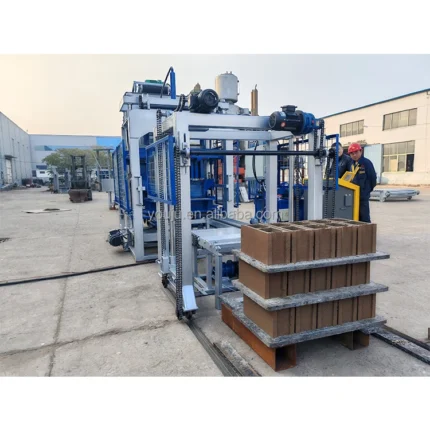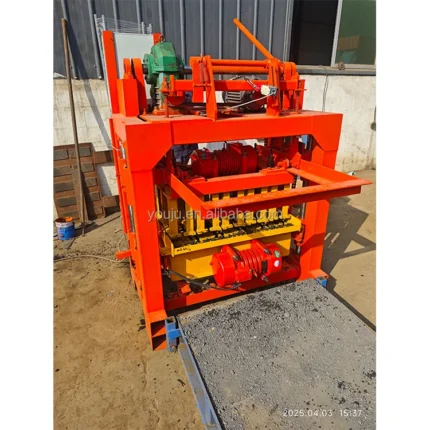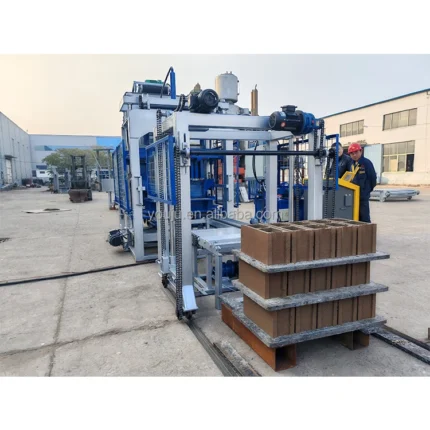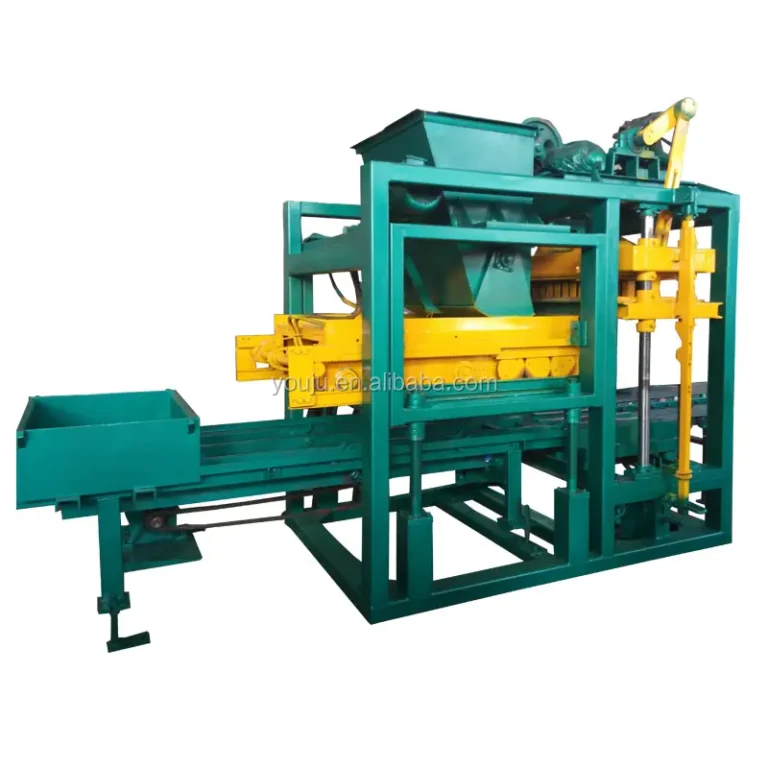
Description
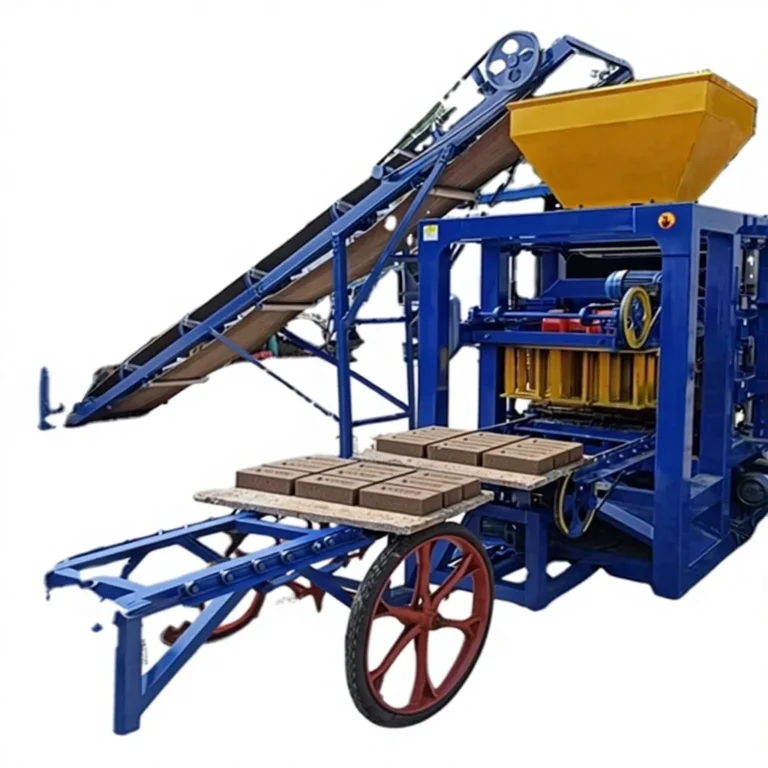
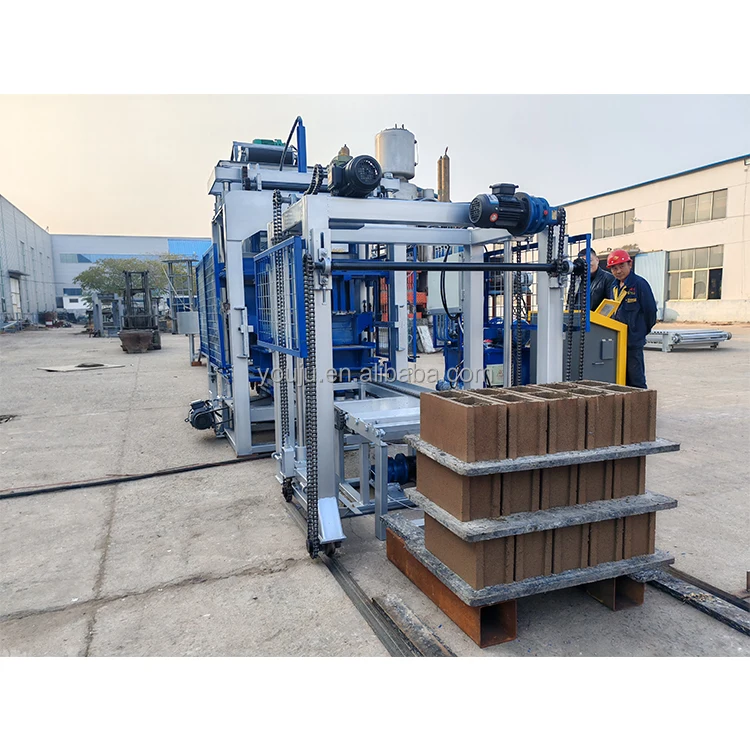
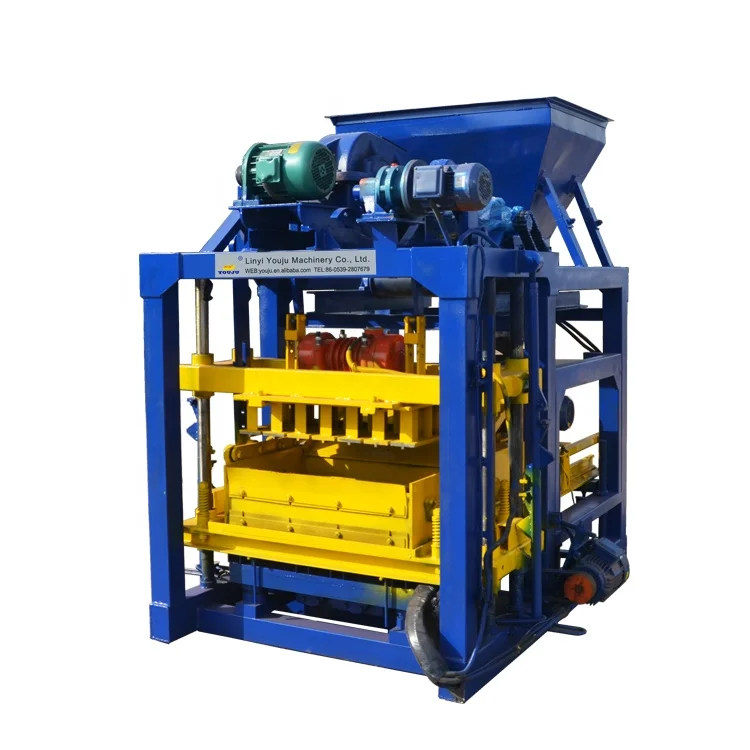
Integrated System Design — The QTJ4-25 semi-automatic press, hydraulic station, mixer, and pallet handling are specified together so cycle times match across stations and the operator never waits on upstream equipment.
Technical Specifications
| Parameter | Value |
|---|---|
| Model | QTJ4-25 |
| Product Type | Semi-Automatic Concrete Block Making Machine |
| Rated Power | 17.9 kW |
| Control System | PLC (language and interface configurable before shipment) |
| Overall Dimensions (L×W×H) | 6400 × 1500 × 2700 mm |
| Net Weight | 2500 kg |
| Output Capacity | 960 pcs/h based on 400×200×200 mm hollow block, 4 pcs/mould |
| Moulding Cycle | 25 s |
| Vibration Frequency | 2800 r/min |
| Exciting Force | 60 kN |
| Pallet Size | 850 × 550 × 20 mm |
| Hydraulic System | Hydraulic station equipped (pressure rating to be confirmed with supplier) |
| Mould Formats Available | Hollow, solid, paver, curbstone (8", 6", 5", 4" via mould change) |
| Automation Level | Semi-automatic with manual pallet handling |
| Standard Configuration | Host machine 1 set, block mould 1 set, JQ350 mixer |
| Voltage & Frequency | Configurable (confirm before production) |
Application Suitability
| Application | Material or Output |
|---|---|
| Hollow block production for wall construction | Crushed stone, sand, cement, water — 8", 6", 5", 4" formats |
| Solid block manufacturing for load-bearing structures | Dense aggregate mixes with cement binder |
| Paving block production for walkways and yards | Fine aggregate and pigment mixes for surface finish |
| Curbstone forming for road and landscape edging | High-strength concrete mixes with coarse aggregate |
| On-site block production for building contractors | Locally sourced sand and gravel with Portland cement |
| Small-scale plant startups by first-time entrepreneurs | Standard concrete mixes with semi-automatic operation |
Why Voltage and PLC Language Must Be Settled Before the Machine Ships
Confirming voltage, frequency, and PLC display language during the order phase prevents weeks of idle time after arrival.
I have watched a fully functional PLC controlled QTJ4-25 block making machine sit on a curing yard for three days because the touch screen booted up in Chinese and the local electrician could not trace a fault through an unfamiliar interface. The wiring was correct, the hydraulics were fine, but nobody on site could read the alarm codes. These are not defects — they are oversights that happen when the electrical specification is left as "standard" on the proforma invoice. The cost is not the flight to fix it; the cost is the crew standing around while the plant earns nothing [NEED_CITE: common commissioning delays caused by unconfirmed electrical specifications].
What PLC Control Actually Removes From the Operator
On a manual press, the operator decides when to start vibration, how long to hold pressure, and when to release the mould — three variables that change with every person on shift. The PLC controlled QTJ4-25 block making machine locks these parameters into a programmed sequence: vibration runs for a set duration, hydraulic pressure holds to a defined point, and the mould lifts only after the cycle timer completes. Batch-to-batch consistency comes from the programme, not from the operator’s experience level.
Where Semi-Automatic Ends and the Upgrade Path Begins
Semi-automatic means the forming cycle is controlled but pallet movement is not. An operator places the pallet, and after pressing, moves the loaded pallet to the curing area by trolley. This keeps the initial investment manageable while the plant builds volume. When throughput justifies it, the line can gain an automatic pallet feeder and a stacker without replacing the host press — the PLC controlled QTJ4-25 block making machine was designed with this progression in mind, so the control cabinet has reserved I/O points for downstream automation [NEED_CITE: typical upgrade path from semi-automatic to automatic pallet handling in block plants].
Reading the Specifications That Matter for Block Strength
The 60 kN exciting force and 2800 r/min vibration frequency work together with hydraulic pressure to compact the concrete mix inside the mould cavity. Higher vibration frequency alone does not guarantee denser blocks — the hydraulic pressure must be matched to the stiffness of the mix, which depends on local aggregate grading and water-cement ratio. The 25-second moulding cycle produces 4 hollow blocks per stroke at 400×200×200 mm, but a heavier solid block format or a paver with pigment facing will run a different cycle time and produce fewer pieces per hour. The 850 × 550 × 20 mm pallet size determines how many blocks fit per cycle and must match the curing rack dimensions and the forklift tine width already on site.
The Hidden Cost of Skipping the Configuration Conversation
When a block machine arrives configured for a mix the buyer cannot source, the choices are either to import the specified aggregate at steep transport cost or to run a local substitute that the vibration and pressure settings were never tuned for. Blocks come out weaker on one shift and stronger on another, and the buyer blames the machine. Similarly, a pallet size chosen without checking the curing yard layout means pallets stack unevenly or do not fit the racks, forcing the crew to re-handle every block by hand before it cures. These problems surface after installation, when the supplier is already paid and the buyer is already behind schedule [NEED_CITE: impact of unconfirmed raw material specifications on block strength consistency].
Why This Machine Is Specified as a Matched Line
The QTJ4-25 host machine, JQ350 mixer, hydraulic station, and mould set are quoted as one package rather than assembled from separate suppliers, so mixer batch size feeds the press hopper without starving or overflowing it. Moulds are designed for the block formats the buyer’s market actually sells, including custom drawings when standard sizes do not fit local building codes. The automation level is selectable — a buyer can start with manual pallet handling and add automatic stacking later without swapping the press. Voltage, frequency, and PLC language are confirmed in writing before production begins, not assumed. Factory testing runs the exact mould format ordered, with cycle time recorded, so the capacity figure on the test sheet matches reality [NEED_CITE: factory test procedures for block making machinery before dispatch].
Documentation & Verification
- Line layout drawing showing press, mixer, and pallet flow positions
- Capacity calculation stating the block format and cycle time assumed
- PLC parameter sheet listing vibration duration, pressure hold, and mould lift timing
- Mould drawing with dimensional tolerances for the ordered block format
- Voltage, frequency, and control language confirmation signed before production
- Factory test record with measured cycle time and block dimensions
Installation, Commissioning & Support
- Foundation pad sized to the 6400 × 1500 mm footprint with anchor bolt template
- Dedicated electrical circuit rated for the 17.9 kW total load at confirmed voltage
- PLC touch screen language and alarm messages verified at power-on before forming starts
- Mould change procedure demonstrated on site with the buyer’s operator using local tools
- Wear parts list covering hydraulic seals, vibration springs, and mould liner plates
- Daily greasing schedule for guide columns and vibration motor bearings
What to Include With Your Inquiry
To size this line correctly, share the block formats your market sells most, the daily volume you need to hit, and the aggregate materials available within transport distance of your site. Confirm your site voltage and frequency, and let us know which language the PLC interface should display. If you already have curing racks, pallets, or a forklift on site, send the dimensions so the pallet size and stacking height can be matched.
Frequently Asked Questions
Q: What automation level does the QTJ4-25 provide, and what is the upgrade path?
A: The machine runs a PLC-controlled forming cycle with manual pallet handling. When volume grows, you can add an automatic pallet feeder and stacker without replacing the press, since the control cabinet has reserved connections for downstream equipment.
Q: How do I confirm voltage, frequency, and PLC language before shipment?
A: These three items are confirmed in writing during the order phase. Provide your site electrical specification and preferred interface language, and the factory sets the PLC parameters and touch screen display accordingly before production begins.
Q: What block formats can one machine produce, and how long does a mould change take?
A: The QTJ4-25 runs hollow, solid, paver, and curbstone formats across multiple sizes via mould change. The changeover involves swapping the mould box and adjusting the PLC cycle parameters for the new format’s compaction requirements.
Q: How is block strength consistency maintained across different mix designs?
A: Vibration frequency, exciting force, and hydraulic pressure are set on the PLC to match the buyer’s confirmed mix design and local aggregate. Once locked in, the PLC repeats these parameters across every cycle regardless of operator or shift.
Q: Which supporting equipment is included, and which is optional?
A: The standard package includes the host machine, one block mould set, and a JQ350 mixer. Pallet feeder, automatic stacker, and curing rack handling systems are optional additions that can be specified at order or retrofitted later.