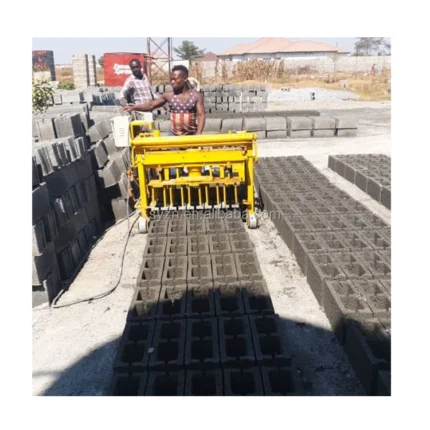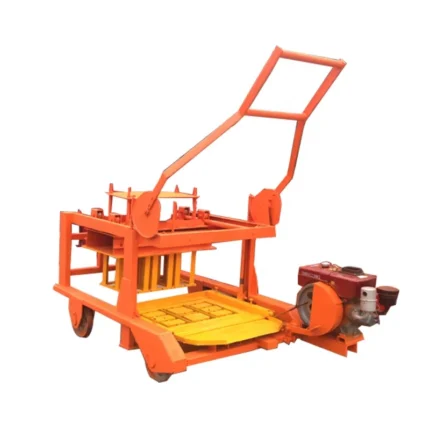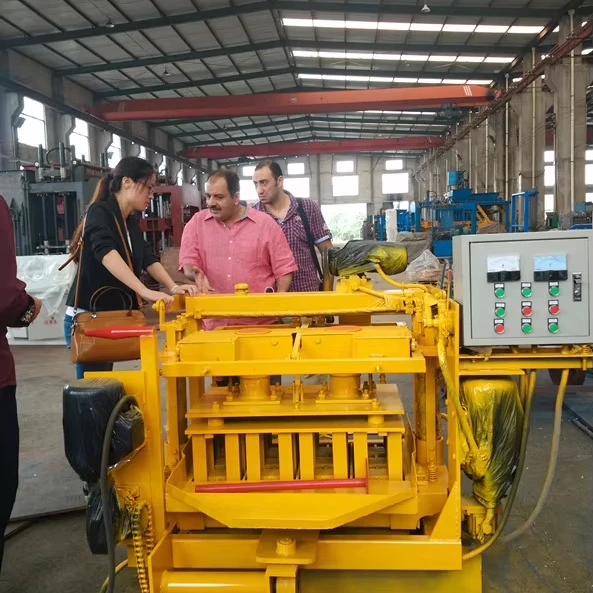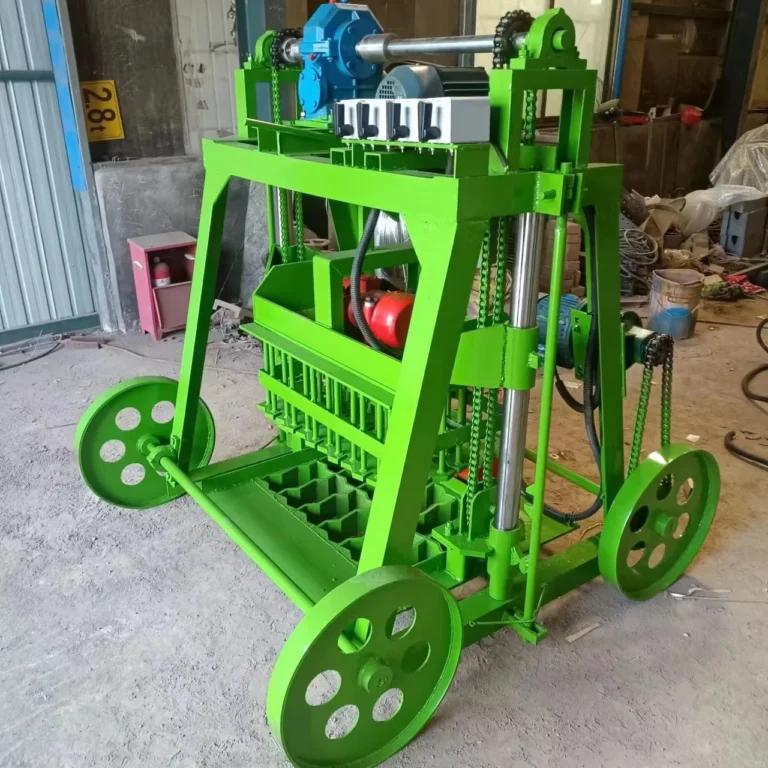
Description
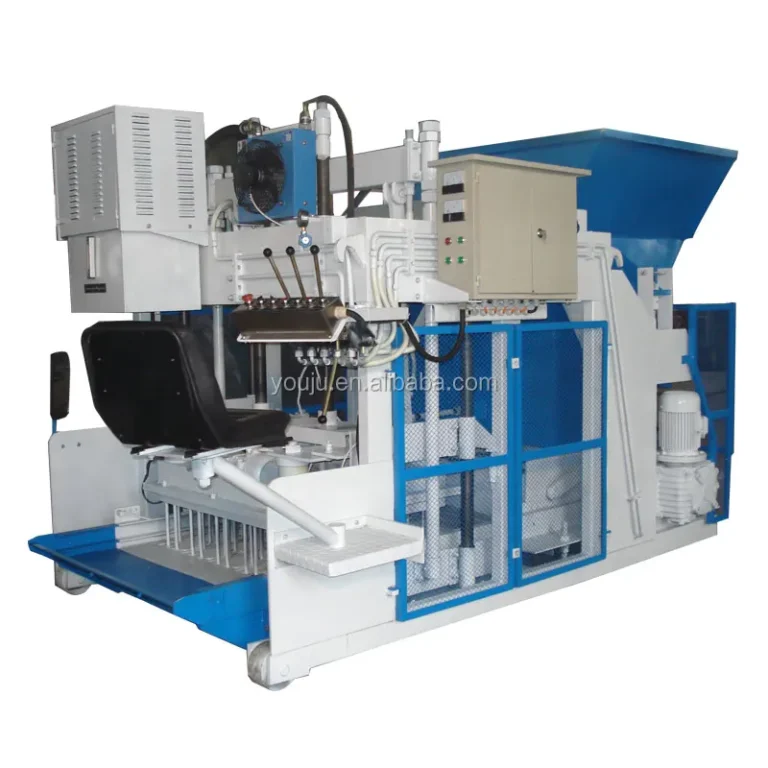
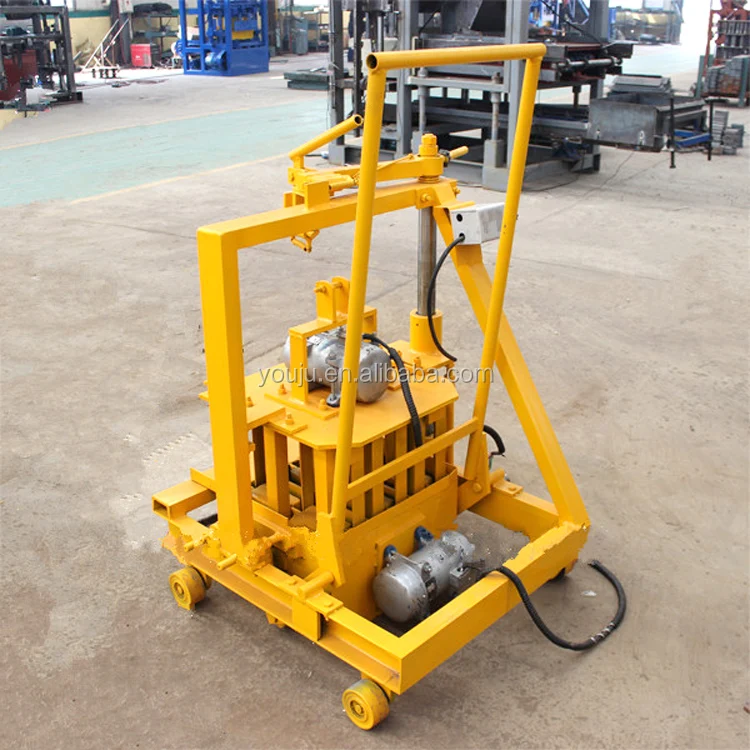
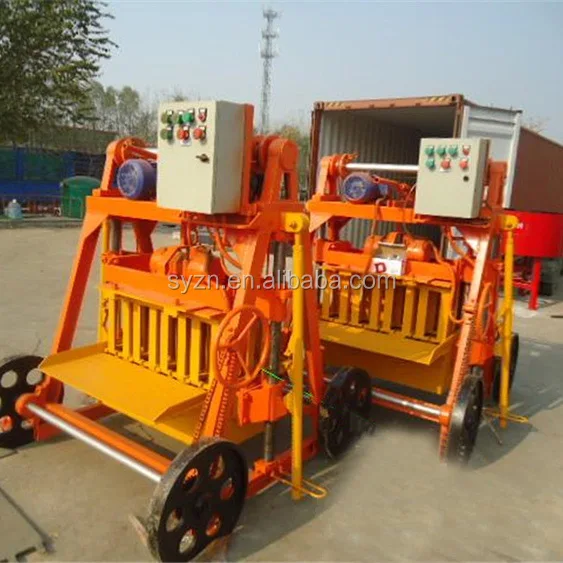
Automation Pathways — the QMJ4-45 mobile egg laying block machine delivers manual force control with jog operation today, while leaving a clear upgrade route to higher automation as your site output grows.
Technical Specifications
| Parameter | Value |
|---|---|
| Model | QMJ4-45 |
| Product Type | Mobile Egg Laying Block Making Machine |
| Rated Power | 7.4 kW |
| Voltage & Frequency | Configured to buyer’s local supply (confirm before production) |
| Control System | Manual force control with jog control |
| Overall Dimensions (L×W×H) | 1550×1335×1580 mm |
| Net Weight | 1 T |
| Mould Format | 400×200×200 mm (4 pcs/mould); 400×150×200 mm (5 pcs/mould) |
| Output Capacity | 2400 pcs/8h based on 400×200×200 mm hollow block (4 pcs/mould); 3200 pcs/8h based on 400×150×200 mm block (5 pcs/mould) |
| Cycle Time | 45 s (basis not stated in source) |
| Pallet Size | No pallets required (egg laying type) |
| Raw Material Compatibility | Concrete, sand, cement, fly ash, lime, gypsum |
| Vibration Method | Vibration (rated force not stated in source) |
| Orientation System | Four-pole guided with ultralong orientation bearing |
| Electrical Components | Imported electrical appliances and sealing parts |
| Automation Level | Semi-automatic (manual force + jog control) |
| Stacking Method | Manual (egg laying on ground) |
Application Suitability
| Application | Material or Output |
|---|---|
| On-site hollow block production for housing projects | Crushed stone, sand, cement with local aggregate |
| Small-scale solid block manufacturing | Concrete mix with fly ash or lime additive |
| Road block and kerb stone production at contractor yards | Dense concrete with coarse aggregate |
| First block plant for entrepreneurs entering the market | Cement, sand and locally available binder materials |
| Format changeover for multiple product specifications | Interchangeable moulds per block dimension |
What "2400 Blocks a Day" Leaves Out When Format Is Not Stated
Output only means something when tied to the exact block dimension, mould cavity count, and cycle time the buyer will actually run.
Many mobile block machine quotations quote a single daily figure that collapses all formats into one optimistic number. On the QMJ4-45 automatic mobile block machine, we state 2400 pieces per 8-hour shift based on 400×200×200 mm hollow blocks at 4 pieces per mould, and 3200 pieces per 8-hour shift based on 400×150×200 mm blocks at 5 pieces per mould. Shift to a thinner wall or a larger paving format and those numbers move. A buyer who plans around the higher figure without checking format assumptions will find real daily output falling short once production begins. [NEED_CITE: block format assumptions in capacity quotation practices]
Control Language and Voltage Before the Machine Ships
I once shipped an egg laying unit to a site in Kenya where the local supply frequency did not match what the motor was wound for. The crew stood idle while we arranged a replacement. That delay is entirely avoidable. On this PLC controlled egg laying block machine, the voltage, frequency, and control display language are confirmed in writing before the machine enters production, so the unit arrives ready to run on the buyer’s actual grid. This confirmation step is non-negotiable in our sales sequence.
The Upgrade Path From Jog Control to Higher Automation
The QMJ4-45 starts with manual force control and jog operation, which keeps the initial investment low for a first plant or a contractor producing on a single project site. As output requirements grow, the control system can move toward PLC-based operation with automatic batching feedback and remote diagnostics. This path means the buyer does not replace the entire press — only the control and handling stations change. The press frame, orientation system, and vibration assembly remain in service across automation tiers. [NEED_CITE: automation upgrade pathways in mobile block production]
Orientation Precision and Consistent Block Density
The four-pole guided movement with ultralong orientation bearing on this machine keeps the pressure head aligned with the mould cavity throughout each cycle. When the head drifts, one side of the block receives less compaction and exits the mould with lower density. On a 400 mm hollow block, even small misalignment produces measurable strength variation across the batch. The bearing surface distributes the load evenly, which matters most when running stiff mixes with low water content where the material resists flow and demands consistent downward force. The rated vibration force should be confirmed against the buyer’s specific mix design and local aggregate gradation, since a coarser aggregate requires more energy to consolidate than a fine sand blend.
When Voltage Confirmation Gets Skipped
The consequences show up on day one at the site. A motor wound for 380V/50Hz connected to a 440V/60Hz supply runs hot within the first hour and can fail before the commissioning engineer finishes initial settings. Imported electrical appliances and sealing parts inside the QMJ4-45 are rated for specific supply parameters, and swapping them after arrival means weeks of downtime while replacement components ship. I have watched contractors pay for generator rental at premium daily rates while waiting for a rewound motor, which erases whatever saving they expected from skipping the confirmation step. [NEED_CITE: voltage mismatch consequences on industrial motors at remote sites]
Why Buyers Source This Platform Through Our Configuration Process
Block machinery is our single product focus, so the machine, mould, pallet approach, and handling are specified as one system rather than pulled from separate catalogue pages. Configuration is set against the buyer’s actual mix design, local aggregate, and target block format instead of defaulting to a standard build. Mould design covers the formats the buyer’s market actually sells, with custom drawings where needed. The automation level is selectable, letting a buyer start with jog control and move upward without replacing the press. Installation and commissioning support includes operator training at the site.
Documentation & Verification
- Capacity calculation stating the block format and mould cavity count assumed for each output figure
- Voltage, frequency, and control display language confirmation sheet signed before production
- Mould drawing and format list for every block type in the buyer’s product range
- Factory test record on the buyer’s target block format before dispatch
- Operation and maintenance manual with wear parts list and mould replacement procedure
Installation, Commissioning & Support
- Foundation requires level concrete pad matching the 1550×1335 mm footprint with clearance for egg laying movement
- Dedicated circuit sized for 7.4 kW rated power plus startup surge at the confirmed local voltage
- Machine ships assembled; on-site setup covers orientation bearing check and jog control calibration
- First production run validates cycle timing and block density on the buyer’s actual mix
- Operator training covers mould change procedure and manual force control adjustment
- Wear parts list supplied with recommended replacement intervals for bearings and sealing parts
What to Include With Your Enquiry
Provide the exact block dimensions your market sells, including wall thickness for hollow formats and face dimensions for pavers. State the local voltage and frequency at the project site so the motor and control panel are built to match. Confirm the raw materials available locally — sand source, cement type, any fly ash or lime — so the mix design aligns with what you can actually procure.
Frequently Asked Questions
Q: How is daily output calculated per block format, and what does it assume?
A: Output is stated per specific block dimension and mould cavity count. For the QMJ4-45, 2400 pieces per 8-hour shift is based on 400×200×200 mm hollow blocks at 4 pieces per mould, and 3200 pieces per shift is based on 400×150×200 mm blocks at 5 pieces per mould. Cycle time, mix consistency, and operator pace all influence actual throughput on a given day.
Q: Can the control system be upgraded from jog control to PLC later?
A: Yes. The machine frame and vibration assembly remain in service while the control panel is replaced with a PLC unit. The upgrade path also allows addition of automatic batching feedback and remote diagnostics. Planning the electrical cabinet layout at initial order keeps the upgrade straightforward.
Q: Is voltage, frequency, and display language confirmed before production?
A: Every order includes written confirmation of the buyer’s local supply voltage, frequency, and preferred control display language before the machine enters the build stage. This prevents the situation where a machine arrives on site and cannot connect to the available power supply.
Q: What mould formats are available, and how long does a change take?
A: Standard moulds cover 400×200×200 mm and 400×150×200 mm formats, with custom moulds available to buyer drawings. Mould change time depends on the specific format and operator familiarity, and is confirmed during on-site training so the crew can plan format changeovers within a shift.
Q: What handling equipment can be added as output grows?
A: Raw material feeding, mixing stations, and automatic stacking systems can be integrated alongside the press as the buyer scales from manual egg laying to a higher-throughput line. The initial machine placement should leave floor space for future conveyor and stacking additions.