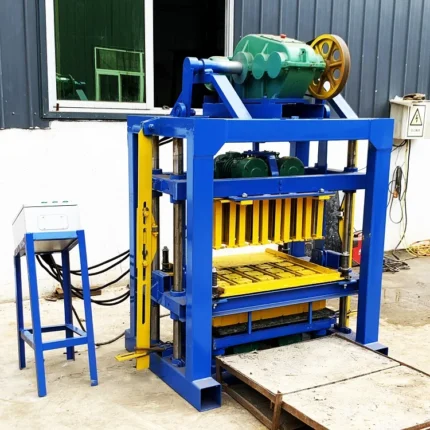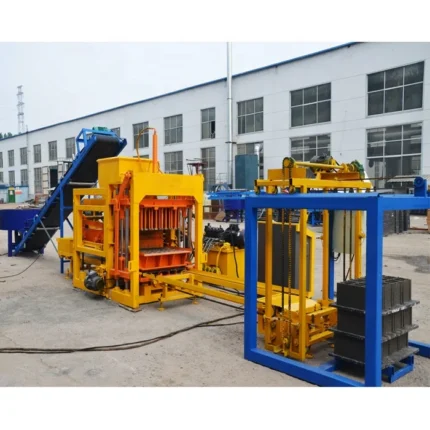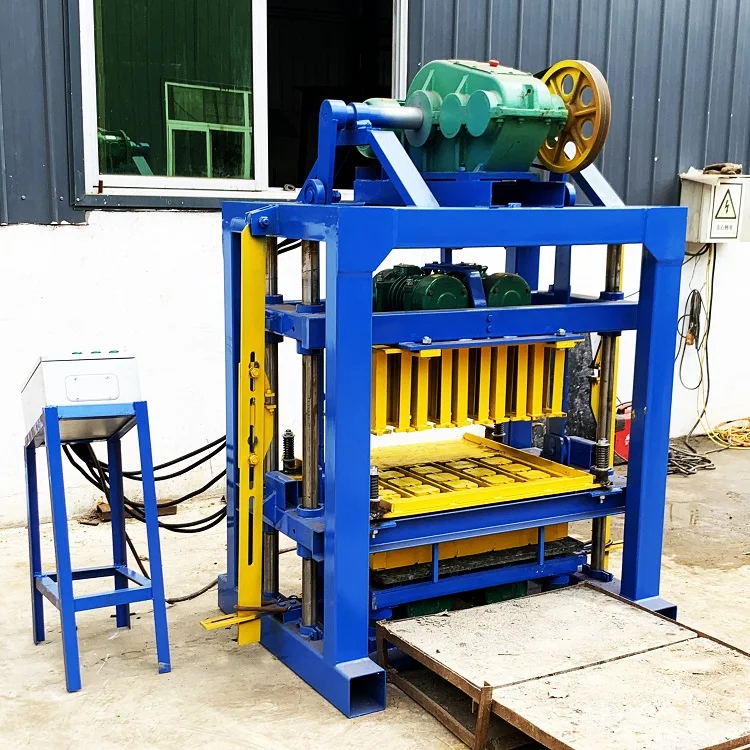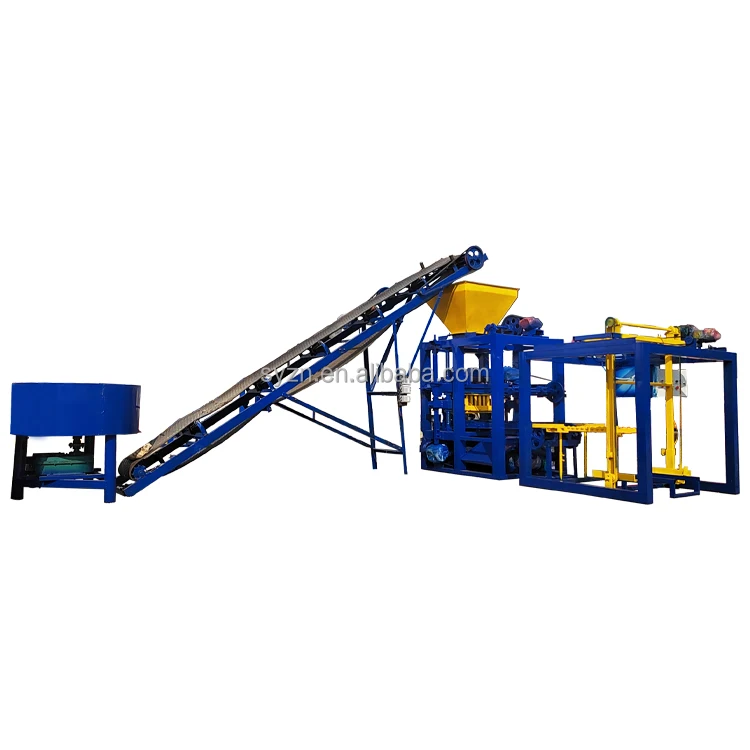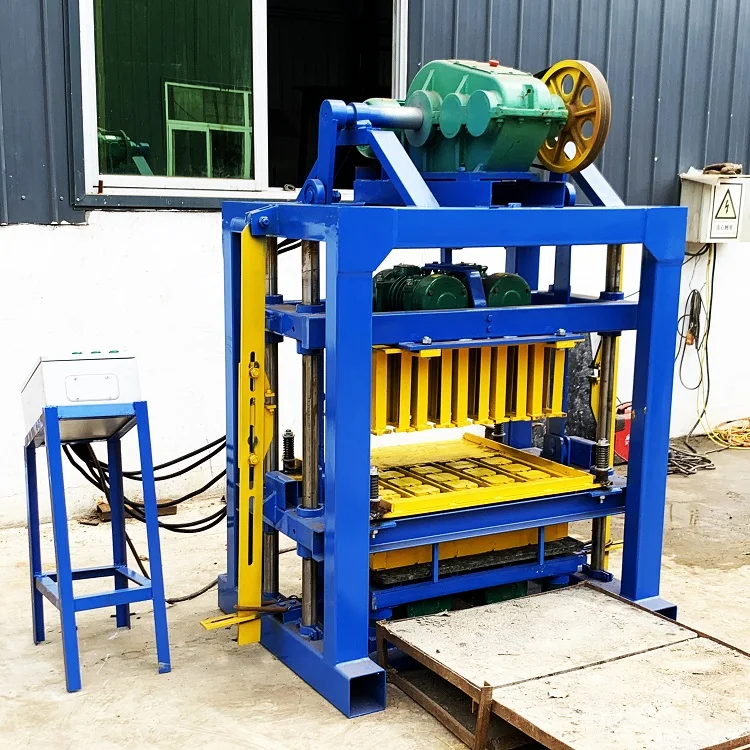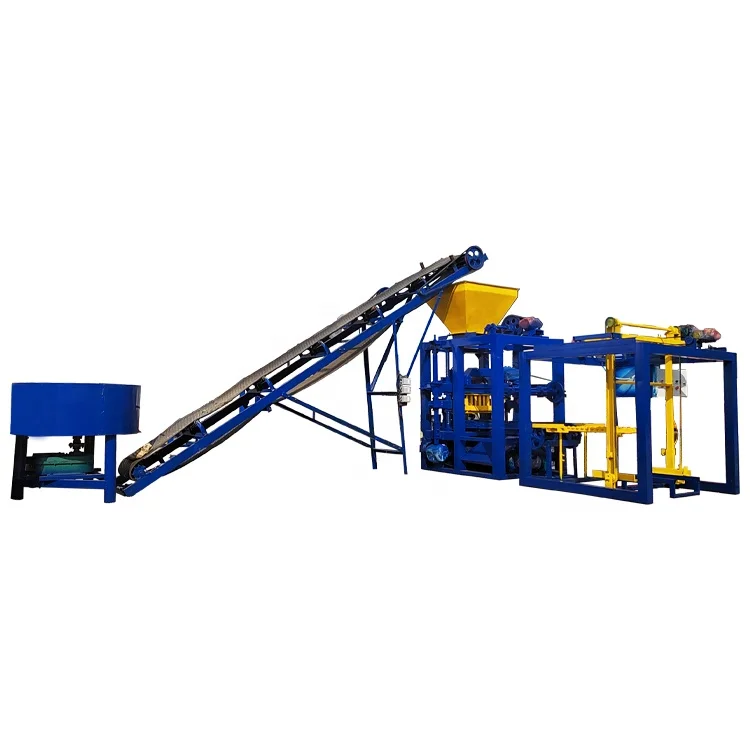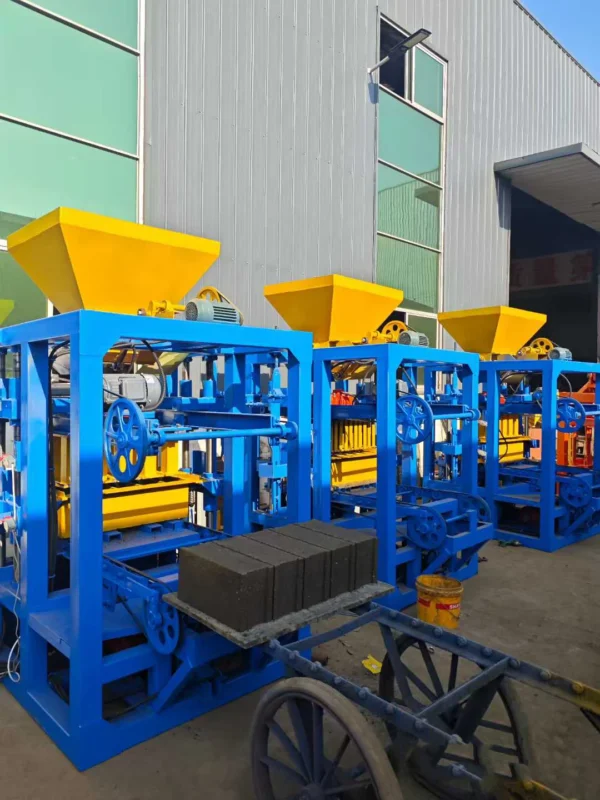


Description
Control Consistency — the QTJ4-24 relies on a PLC governing the full molding cycle, removing operator timing variation and delivering repeatable block density shift after shift.
Technical Specifications
| Parameter | Value |
|---|---|
| Model | QTJ4-24 |
| Product Type | Stationary Block Making Machine |
| Overall Dimensions (L×W×H) | 3600×1700×2560mm |
| Pallet Size | 850×450mm |
| Molding Cycle | 24-26s (basis to be confirmed per block format) |
| Overall Power | 11.95kW |
| Vibration Force | 45kN (2×3kW lower vibrators + 2×1.5kW upper vibrators) |
| Total Mass | 2T |
| Molding Method | Mechanical with integrated vibration |
| Control System | PLC (display language to be confirmed) |
| Material Feeding | Full-automatic spiral material distribution |
| Reducer | 350-type (for mold lifting) |
| Voltage & Frequency | Configurable to site requirement (confirm before production) |
| Automation Level | Semi-automatic, upgrade path available |
| Standards | CE declaration available, 1-year guarantee on whole machine (excluding spare parts) |
Application Suitability
| Application | Material or Output |
|---|---|
| Hollow block production | Cement, sand, and crushed stone aggregate |
| Solid block manufacturing | Standard concrete mix with local coarse sand |
| Interlocking brick production | Fine aggregate blends for tight dimensional tolerance |
| Paving brick forming | High-density concrete mix for surface abrasion resistance |
Why the PLC Question Matters More Than the Price Tag
An automatic stationary block making machine PLC controlled is only as reliable as the parameters locked into its program before it leaves the factory.
I once watched a buyer in West Africa lose an entire commissioning week because the PLC display was set to a language the local operator could not read, and the voltage had not been matched to the grid. The machine was mechanically sound, but the control layer was wrong for the site. That kind of mismatch does not show up in a quotation — it shows up when your team stands around a silent press waiting for an engineer to fly in [NEED_CITE:].
Removing Timing Guesswork from Every Cycle
The QTJ4-24 uses a programmable logic controller to govern each stage of the molding sequence — material feed, vibration onset, pressure hold, and mold release. When these intervals are managed by relay switches or manual switches, the operator becomes the variable. An automatic stationary block making machine PLC controlled eliminates that variable by executing the same timing logic on every cycle, which is what keeps block density uniform across a full production run.
Feeding Consistency Starts Before the Press Closes
The full-automatic spiral material distribution system meters the concrete mix into the mold cavity at a controlled rate. Uneven feeding is one of the most common causes of weak corners and density variation in stationary block production. By automating this step, the QTJ4-24 ensures the cavity fills uniformly before vibration begins, so the 45kN force works on a consistent material bed rather than compensating for gaps [NEED_CITE: industrial vibration compaction principles].
Vibration Architecture and Block Density
The 45kN vibration force is generated by four independent motors — two 3kW units mounted below and two 1.5kW units above the mold. This dual-layer arrangement compacts the mix from both directions simultaneously, which matters when you are producing hollow blocks with thin webs or paving bricks that need high surface density. The mechanical molding method pairs vibration with the weight and pressure of the mold head rather than a separate hydraulic circuit, keeping the system simpler to maintain on sites where hydraulic service expertise is limited.
Pallet Size and the Curing Area Reality
The 850×450mm pallet dimension dictates not only the block layout per cycle but also how those pallets move through your curing area. If your existing racks or forklifts are built around a different pallet size, the mismatch creates a bottleneck downstream of the press. Confirming this dimension against your curing infrastructure before the machine is built avoids a situation where finished blocks have nowhere to go.
The Cost of Leaving Control Details Until Arrival
Voltage, frequency, and PLC language are not optional extras — they are commissioning prerequisites. A press wired for 380V connected to a 415V grid will damage its motors within hours [NEED_CITE: voltage tolerance standards for industrial electric motors]. A PLC display in the wrong language means your operator is guessing at fault codes instead of reading them. These are not engineering failures; they are specification gaps that should have been closed during the order stage.
Why This Machine Is Specified With the Line in Mind
The QTJ4-24 is not quoted as a standalone press disconnected from everything around it. The pallet size, power draw, and automation level are matched against the buyer’s actual layout — including the curing racks and handling equipment already on site. Configuration is set against your local aggregate and mix design rather than pulled from a catalogue default, so the vibration force and feed timing make sense for what you are actually producing. The 350-type reducer on the mold lifting mechanism is selected for extended service intervals, reducing the frequency of maintenance stops. Every order ships with a documented wear parts list so the first replacement cycle does not become an emergency sourcing exercise [NEED_CITE:].
Documentation & Verification
- Line layout showing block format assumed for the quoted 24-26s cycle
- PLC program language and voltage specification confirmed before production
- Factory test record on your target block format before dispatch
- Machine specification sheet matched to your local aggregate and mix
- Wear parts and mold list with availability for first replacement cycle
- CE declaration and operation manual included with shipment
Installation, Commissioning & Support
- Foundation plan scaled to 3600×1700mm footprint and 2T operating mass
- Electrical hookup matching confirmed voltage, frequency, and 11.95kW load
- PLC display language and control parameters verified on-site at startup
- Operator training covering mold change procedure and fault code reading
- Spare parts kit aligned to 350-type reducer and vibrator motor service schedule
- Follow-up support for automation level upgrades from semi-automatic operation
What We Need to Quote Accurately
To specify this automatic stationary block making machine PLC controlled for your site, we need your target block format and dimensions, the local aggregate type and available mix proportions, your daily output requirement, and the existing voltage and frequency at your facility. If you already have pallets, curing racks, or handling equipment in place, share those dimensions so the line is configured around what you have.
Frequently Asked Questions
Q: How is the molding cycle time verified for my specific block format?
A: The 24-26s figure is a reference range. The actual cycle depends on block height, wall thickness, and mix characteristics. We confirm the achievable cycle on your target format during factory testing and state it in the capacity calculation before shipment, so your daily output projection is based on your product, not a generic assumption.
Q: What PLC display language options are available before shipment?
A: The control interface can be configured to the language your operators read. This is confirmed during the order stage — not after arrival — and locked into the PLC program before the machine leaves the factory. We verify the setting during on-site commissioning.
Q: How does the automation upgrade path work on this platform?
A: The QTJ4-24 starts as a semi-automatic press with PLC-governed molding. As your operation grows, pallet feeding, stacking, and cubing stations can be added to the same control platform. The PLC architecture supports these additions without requiring a full control system replacement.
Q: What voltage and frequency configurations does this machine support?
A: The motor set and control panel are built to match your site’s supply — whether that is 380V/50Hz, 415V/50Hz, 440V/60Hz, or another configuration. We confirm the exact specification during ordering and verify it on-site before energizing the machine.