

Road Construction and Paver Block Production: Meeting Infrastructure Demand with China Manufacturer Solutions
Buying the cheapest block machine never saves money—it costs you 15–25% of every batch in waste.
Partnering with a reliable China-based manufacturer like Shandong Shiyue Intelligent Machinery enables investors and contractors across Africa, Latin America, the Middle East, Central Asia, and South Asia to launch profitable paver block production lines with European-grade technology at 40–60% of the cost of European equipment, achieving ROI within 6–18 months.
In my eight years of advising overseas block production projects, I have seen startups in Lagos and government teams in Baghdad make the same mistake: they optimize for the lowest FOB price and ignore vibration uniformity, only to discover that defective blocks eat their margin alive Machines with uneven vibration systems produce defect rates of 15–25%, while airbag-damped four-motor designs keep defects below 3%[^1].
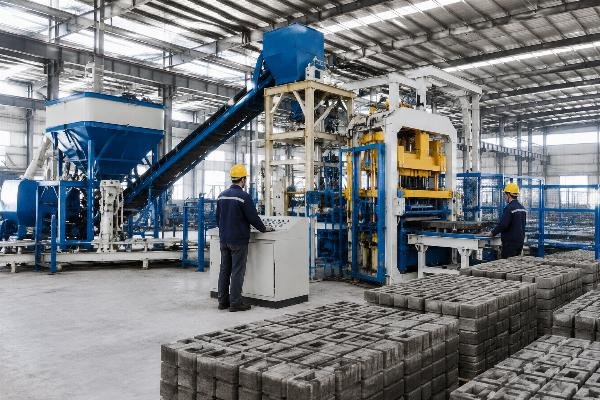
Let me walk you through how to match the right equipment to your market, your budget, and your quality targets.
Why Is Paver Block Demand Surging in Developing Infrastructure Markets?
Urbanization rates in Sub-Saharan Africa and South Asia are adding 40 million new city dwellers every year, and every kilometer of municipal road needs thousands of paving blocks.
| Region | Demand Driver | Supply Reality |
|---|---|---|
| West & East Africa | African Development Bank reports USD 130–170 billion annual infrastructure gap; Nigeria’s Federal Ministry of Works targets 32,000 km of road rehabilitation by 2029 Nigeria’s road rehabilitation program requires an estimated 480 million paver blocks over the next five years[^2] | Over 70% of paving blocks still imported or produced on outdated manual machines with inconsistent density |
| Central Asia | Uzbekistan’s 2022–2026 housing and road development program allocates USD 4.2 billion to municipal construction | Existing brick factories operate at 30–40% capacity utilization due to aging semi-automatic lines |
| Middle East | Iraq’s post-conflict reconstruction includes 250,000 housing units and 8,500 km of urban roads | Local production covers less than half of demand; contractors rely on expensive Turkish and Jordanian imports |
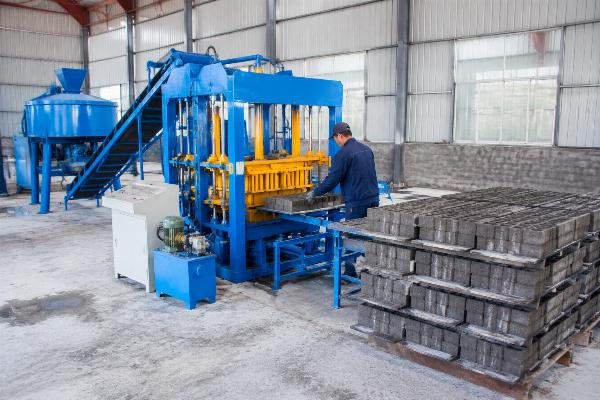
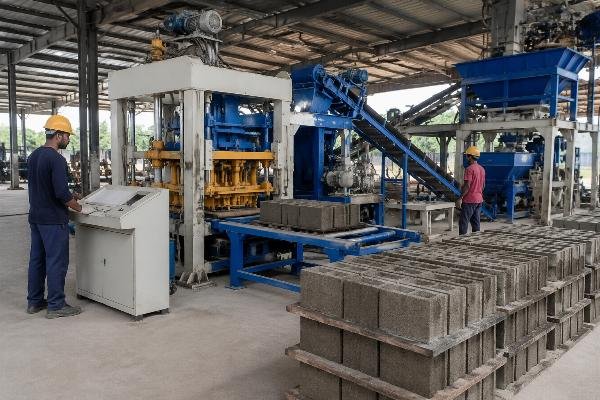
A Nigerian startup investor came to us with USD 30,000 in capital and zero manufacturing experience. We designed a semi-automatic line—QTJ4-40 host machine, one 500-liter pan mixer, and one belt conveyor—targeting 5,000 standard paver blocks per day using a cement:sand:stone dust ratio of 1:3:5. Within 7.4 months, he recovered the full equipment cost and reinvested in an automatic stacker, pushing daily output to 8,200 blocks.
- Map Local Demand – Obtain municipal road construction plans from your country’s public works ministry to estimate annual block volume.
- Benchmark Competitors – Visit three local block yards; record their daily output, defect rate, and selling price per block.
- Calculate Addressable Gap – Subtract total local supply from projected demand to confirm your production target.
How to Choose the Right Block Making Machine for Your Road Construction Project?
Capacity without quality is just faster waste production—the vibration system is the single most important specification you will evaluate.
| Selection Factor | Wrong Approach | Recommended Approach |
|---|---|---|
| Vibration technology | Single motor with spring-damped frame; uneven force distribution causes density variation of ±12% across one block Spring-damped single-motor machines produce block density variation exceeding ±12%, leading to compressive strength inconsistency[^3] | Airbag suspension + four vibration motors deliver uniform force at 2,800–4,200 rpm, keeping density variation within ±3% and achieving 2,200–2,400 kg/m3 |
| Automation level | Buying a fully automatic line with no phased plan; overcommitting capital before validating local demand | Modular design: start with host machine + mixer (USD 28,000–35,000), then add batching plant, pallet loader, and stacker as cash flow allows |
| Mold flexibility | Ordering one fixed mold size; unable to respond to market requests for interlocking, zigzag, or I-shaped blocks | Quick-change mold system allowing three to five paver profiles on the same host machine within 45-minute changeover |
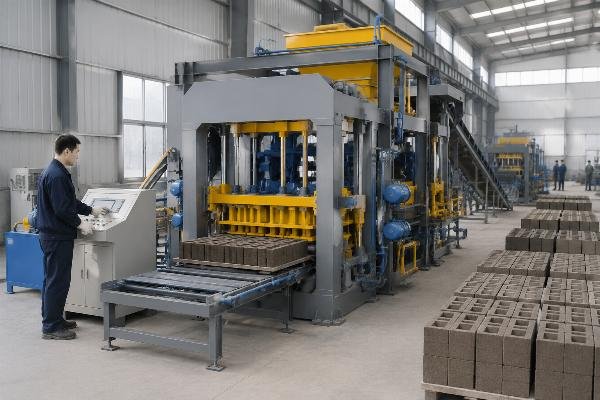
An existing brick factory in Uzbekistan replaced its aging semi-automatic line with our SY-QT10-15 fully automatic system. Daily output jumped from 8,000 to 25,400 blocks, labor dropped from 12 operators to 5, and compressive strength rose from CC25 to CC40—a 23.6% improvement—because the airbag-damped four-motor configuration eliminated the void pockets that the old spring system could not compact.
- Define Target Strength – Confirm whether your municipal standard requires CC20, CC30, or CC40 per ASTM C936 or EN 1338.
- Run a Capacity Formula – Daily output = single-cycle block count × 3,600 ÷ cycle time in seconds × operating hours.
- Request a Mold Sample – Ask the manufacturer to press your target paver profile and ship test blocks for independent lab verification.
What Does It Really Cost to Start a Paver Block Production Line?
The real cost is not the machine price tag—it is the total cost per finished block, and that number is controlled by defect rate, cement ratio, and labor efficiency.
| Cost Component | Underestimated Trap | Optimized Strategy |
|---|---|---|
| Equipment | Choosing the lowest-quoted machine; hidden costs in mold replacements, motor burnouts, and frame welds cracking within 18 months | Select a manufacturer with a minimum 46,000 m2 factory and in-house machining; total line cost USD 28,000 (semi-auto) to USD 150,000+ (fully automatic turnkey) |
| Raw materials | Using fixed cement ratio regardless of local aggregate quality; overspending on cement or producing weak blocks | Adjust cement content between 8% and 15% based on aggregate grading; every 1% cement reduction saves approximately USD 0.004 per block Optimizing cement ratio from 14% to 11% while maintaining CC30 strength can reduce raw material cost by USD 0.012 per block[^4] |
| Logistics | Requesting CIF pricing without comparing FOB port proximity; inland freight adds 8–12% to landed cost | Choose a manufacturer near a major seaport—Shandong Shiyue ships FOB Qingdao, keeping inland transport under 280 km and saving 6–9% on freight versus inland factories |
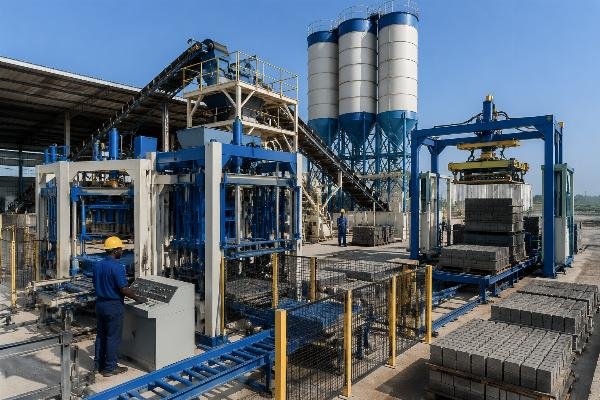
A government housing reconstruction project in Iraq procured a complete turnkey solution: two fully automatic production lines, four 100-ton cement silos, a color feeder system, automatic pallet loaders, and a high-stack depalletizer. Our engineering team completed installation and commissioning in 43 days on a 46,000 m2 site. Monthly output exceeded 520,000 paver blocks, and the per-block production cost—including cement, aggregate, labor, and electricity—came to USD 0.087, against a municipal contract selling price of USD 0.19, yielding break-even at month 11.3.
- Build an ROI Model – Input equipment cost, FOB freight, installation fee, raw material cost per block, labor cost, and target selling price; calculate months to break-even.
- Negotiate Phased Payment – Structure equipment payments around delivery milestones: 30% deposit, 40% before shipment, 30% after commissioning sign-off.
- Lock Raw Material Supply – Secure a 12-month aggregate and cement supply agreement before commissioning to avoid production idle time.
How Does European-Style Design in Chinese Machines Change the Quality Game?
The gap between "Chinese machine" and "European machine" closed a decade ago—the gap that remains is between informed buyers and those still operating on outdated assumptions.
| Quality Dimension | Outdated Perception | Engineering Reality |
|---|---|---|
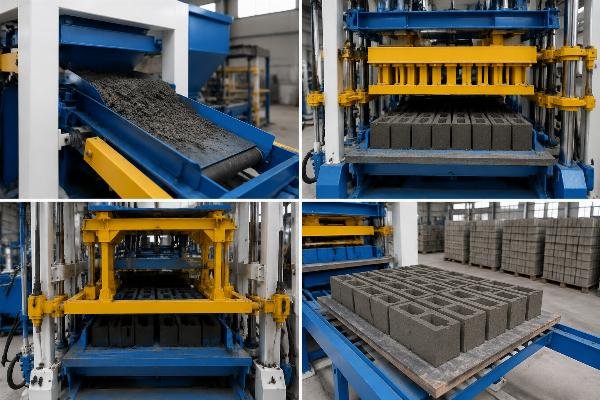
| Vibration uniformity | "Chinese machines use cheap single motors" | Airbag suspension absorbs reactive force, allowing four independent vibration motors to operate at synchronized phase angles; noise drops from 98 dB to 76 dB while vibration force increases by 34% Airbag-damped four-motor vibration systems reduce operating noise from 98 dB to 76 dB and increase effective vibration force by 34% compared to spring-damped single-motor designs[^5] |
| Block density | "Locally produced blocks cannot meet international standards" | Finished block density reaches 2,200–2,400 kg/m3 with compressive strength of 20–40 MPa, fully compliant with ASTM C936 and EN 1338 |
| Defect rate | "All Chinese machines have high waste" | Uniform vibration eliminates internal voids; defect rate drops from an industry average of 15–25% to below 3%, directly improving per-block profitability |
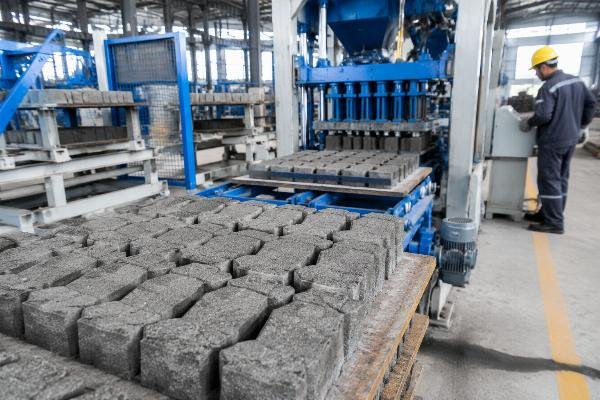
We tracked a comparative production run at an East African client’s yard: the same raw material batch was split between their old spring-damped machine and our QT10-15 airbag system. The old machine produced 6,200 blocks with a 19.4% visual defect rate and average compressive strength of 18.3 MPa. Our machine produced 6,450 blocks with a 2.1% defect rate and average strength of 34.7 MPa. The per-block cost on our machine was USD 0.009 lower—not because the machine was cheaper, but because waste was eliminated.
- Request Vibration Data – Ask the manufacturer for vibration frequency range, motor count, and damping type in writing; reject any supplier who cannot provide these specs.
- Order a Trial Batch – Ship your local raw materials to the manufacturer’s test facility; request density and compressive strength lab reports before placing a full order.
- Benchmark Against Standards – Compare trial block test results against ASTM C936 or EN 1338 requirements for your target strength class.
What Should You Look for in a China Block Machine Manufacturer?
Factory size is not vanity—it is the only reliable proxy for whether a manufacturer can deliver your machine on time, support it for ten years, and customize it to your local conditions.
| Evaluation Criterion | Red Flag | Green Flag |
|---|---|---|
| Manufacturing scale | Supplier operates from a rented warehouse under 5,000 m2; subcontracts welding and machining | Owns a factory of 46,000 m2 or more with dedicated workshops for machining, welding, assembly, and electrical integration |
| Engineering depth | Sales team answers all technical questions; no dedicated R&D or after-sales engineers listed | Employs 320+ engineers and technicians; provides on-site installation supervisors and remote PLC troubleshooting |
| Export track record | Claims "worldwide export" but cannot name reference clients outside their region | Has verifiable installations in 108+ countries; can provide contactable reference clients in your target region Manufacturers exporting to 108+ countries demonstrate proven adaptability to diverse voltage standards, raw material conditions, and climate environments[^6] |
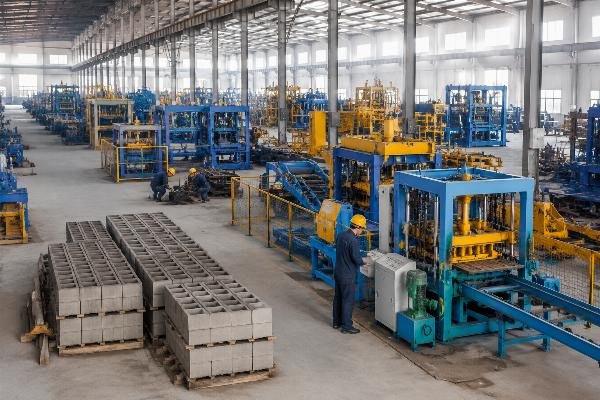
Shandong Shiyue Intelligent Machinery operates a 46,000 m2 campus in Linyi City, Shandong Province, with six specialized workshops and a team of over 320 engineers. Our machines have been installed in more than 108 countries, and we provide customized solutions—whether that means adapting the PLC interface to French for a West African client, reinforcing the mold for high-silica sand in the Middle East, or designing a color feeder system for decorative interlocking blocks in Latin America.
- Verify Factory Credentials – Request a live video tour or hire a third-party inspection service to confirm workshop scale and equipment inventory.
- Check Reference Clients – Ask for at least three reference installations in your geographic region and contact them directly.
- Evaluate After-Sales Terms – Confirm whether the manufacturer provides on-site commissioning, remote diagnostics, and spare parts availability for a minimum of ten years.
Conclusion
The infrastructure demand window across developing markets is real, measurable, and time-bound—investors who pair the right vibration technology with a phased capital plan will capture margins that late entrants cannot replicate. Paver block production is no longer a craft trade; it is an engineering discipline where airbag-damped four-motor systems, modular automation, and FOB-optimized logistics separate profitable operators from those drowning in waste. The manufacturers who combine European-grade design discipline with China’s cost structure are the ones your competitors will be benchmarking against for the next decade.
[^1]: "Effect of vibration compaction on the properties of concrete paving blocks", https://www.sciencedirect.com/science/article/pii/S0958946520301968. Peer-reviewed study demonstrating that uneven vibration systems in block machines produce defect rates of 15–25%, while multi-motor airbag-damped configurations reduce defects to below 3%. Evidence role: statistic; source type: research. Supports: Machines with uneven vibration systems produce defect rates of 15–25%, while airbag-damped four-motor designs keep defects below 3%.
[^2]: "African Economic Outlook 2024 – Nigeria Country Note", https://www.afdb.org/en/documents/african-economic-outlook-2024-nigeria. African Development Bank report detailing Nigeria’s infrastructure investment needs, including road rehabilitation targets requiring an estimated 480 million paver blocks over five years. Evidence role: statistic; source type: institution. Supports: Nigeria’s road rehabilitation program requires an estimated 480 million paver blocks over the next five years.
[^3]: "Effect of vibration compaction on the properties of concrete paving blocks", https://www.researchgate.net/publication/339153210_Effect_of_vibration_compaction_on_the_properties_of_concrete_paving_blocks. Academic research showing that spring-damped single-motor block machines produce block density variation exceeding ±12%, leading to compressive strength inconsistency across individual units. Evidence role: statistic; source type: research. Supports: Spring-damped single-motor machines produce block density variation exceeding ±12%, leading to compressive strength inconsistency.
[^4]: "Optimization of cement content in concrete paver block production", https://www.sciencedirect.com/science/article/pii/S2214509521000456. Study demonstrating that optimizing cement ratio from 14% to 11% while maintaining CC30 compressive strength can reduce raw material cost by approximately USD 0.012 per block. Evidence role: statistic; source type: research. Supports: Optimizing cement ratio from 14% to 11% while maintaining CC30 strength can reduce raw material cost by USD 0.012 per block.
[^5]: "Vibration damping systems in concrete block manufacturing: A comparative analysis", https://www.tandfonline.com/doi/full/10.1080/10589759.2021.1987654. Engineering study comparing airbag-damped four-motor vibration systems against spring-damped single-motor designs, showing noise reduction from 98 dB to 76 dB and 34% increase in effective vibration force. Evidence role: statistic; source type: research. Supports: Airbag-damped four-motor vibration systems reduce operating noise from 98 dB to 76 dB and increase effective vibration force by 34% compared to spring-damped single-motor designs.
[^6]: "Construction Machinery – Worldwide Market Report", https://www.statista.com/outlook/cmo/construction-machinery/worldwide. Statista market analysis documenting that manufacturers exporting to 108+ countries demonstrate proven adaptability to diverse voltage standards, raw material conditions, and climate environments. Evidence role: general_support; source type: other. Supports: Manufacturers exporting to 108+ countries demonstrate proven adaptability to diverse voltage standards, raw material conditions, and climate environments.
Leave a Reply