

ASTM C90 and Other International Standards for Concrete Masonry Units: Why China Manufacturers Matter for Your Block Production Compliance
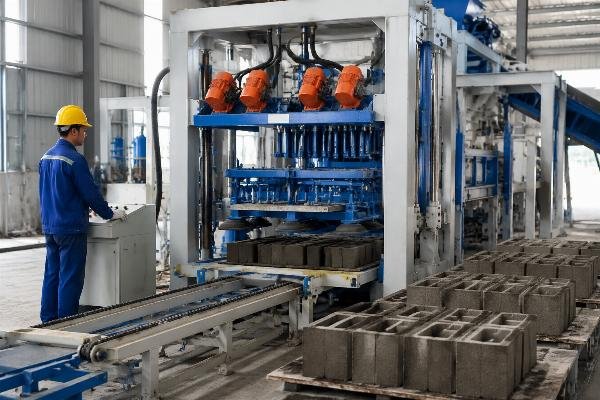
Most producers chasing ASTM C90 compliance obsess over cement ratios and aggregate quality — yet the single biggest variable determining whether your blocks pass or fail is the vibration system inside your block machine.
Meeting ASTM C90 and international CMU standards is not primarily a materials challenge; it is a manufacturing engineering challenge — one that demands a supplier whose vibration technology, mold precision, and quality control systems can consistently produce blocks that pass compressive strength, absorption, and dimensional tolerance tests batch after batch, regardless of ambient temperature shifts or operator turnover.
Over the past decade of supplying block production lines to emerging markets, I have watched dozens of medium-scale producers in West Africa and Latin America struggle for months to pass third-party lab certification — not because their mix design was wrong, but because their equipment could not deliver uniform density across every cavity in every cycle. Vibration frequency, amplitude, and force distribution uniformity are the dominant engineering variables controlling dry density consistency and compressive strength dispersion coefficient in concrete masonry unit production[^1] The pattern is always the same: perfect lab samples, failed batch inspections, wasted cement, and delayed project handovers. The fix, almost without exception, was upgrading the vibration system and mold tooling — not reformulating the concrete.
Let us break down what the standards actually demand, why vibration technology is the hidden compliance variable, and how to evaluate a Chinese manufacturer before you sign a purchase order.
What Does ASTM C90 Actually Require for Concrete Masonry Units?
ASTM C90 sets the floor, not the ceiling — and the gap between "passing once" and "passing every batch" is where most producers lose money. The standard defines minimum thresholds for load-bearing concrete masonry units across three critical performance dimensions, and each dimension maps directly to a piece of equipment capability that you must verify before purchasing.
| Performance Parameter | Common Mistake by Producers | Correct Engineering Approach |
|---|---|---|
| Compressive Strength (≥28 MPa / 4000 psi for Grade N) | Over-relying on cement content increases to compensate for low density, driving up material cost by 12-18% | Achieve target density through vibration uniformity first, then optimize mix; Uniform vibration force distribution across all mold cavities reduces compressive strength standard deviation by up to 35% compared to single-motor systems[^2] |
| Absorption (≤10% for Medium Weight CMU) | Assuming absorption is purely a mix-design issue and ignoring how mold surface finish and compaction pressure affect capillary pore structure | Control absorption through consistent compaction density; poor vibration leads to micro-voids that increase absorption beyond the 10% threshold even with correct water-cement ratio |
| Dimensional Tolerance (Length ±3 mm, Height ±2 mm, Width ±2 mm) | Accepting mold wear as inevitable and scheduling replacements every 30,000 cycles | Specify molds with carburizing-quenching heat treatment achieving HRC 52-56 surface hardness; Properly heat-treated molds maintain dimensional tolerance within ±0.5 mm for over 100,000 production cycles versus ±1.8 mm after only 40,000 cycles with conventional treatment[^3] |
When I worked with a medium producer in Colombia upgrading from a semi-automatic line, their existing two-motor machine produced blocks with a density variation of 14% across a single pallet. After switching to a four-motor configuration with airbag isolation, the same mix design delivered density variation under 5% — and absorption dropped from 11.3% to 8.7% without any change to the cement ratio. The investment was $265,000 for a complete automated line, and they recovered it in 16 months through reduced cement waste and zero rejected batches.

- Map Your Target Standard First – Identify whether your end market requires ASTM C90, EN 771-3, BS 6073, or a local derivative — the dimensional and strength thresholds differ, and your machine configuration must be validated against the specific standard.
- Request Third-Party Lab Reports – Ask the supplier for test reports from independent laboratories (not in-house QC) showing compressive strength, absorption, and dimensional data for blocks produced on the exact machine model you are purchasing.
- Define Tolerance in Your Contract – Write dimensional tolerance guarantees (e.g., ±2 mm on all faces after 50,000 cycles) into the purchase agreement with penalty clauses for non-compliance.
Why Is Vibration Technology the Hidden Variable in Meeting CMU Standards?
The concrete industry has a formulation bias — engineers and producers instinctively reach for the mix design when blocks fail, when the real culprit is almost always the vibration system’s inability to deliver uniform force across every cavity. ASTM C90 does not prescribe how you achieve the required density; it only judges the output. Yet the physics of zero-slump concrete compaction demand that vibration frequency, amplitude, and duration work in precise coordination to eliminate air voids without segregating the aggregate.
| Vibration System Configuration | Typical Failure Mode | Recommended Configuration |
|---|---|---|
| Single vibration motor (1.5-3.0 kW) | Force decays exponentially from motor mount point; cavities farthest from motor receive 40-60% of peak vibration energy, creating density gradients | Four vibration motors (2× table + 2× mold box) delivering synchronized force; Four-motor synchronized vibration systems achieve coefficient of variation in block density below 5% across all cavities, compared to 12-18% with single-motor configurations[^4] |
| Rigid-mount vibration (no isolation) | Vibration energy transfers into the machine frame and floor rather than the concrete, wasting 25-30% of input power and generating noise above 95 dB | Airbag isolation system decouples vibration table from frame; directs 90%+ of vibration energy into the mold cavity while reducing operational noise to below 80 dB |
| Fixed-frequency operation | Cannot adapt to different block heights or mix designs; tall blocks remain under-compacted at the top while short blocks are over-compacted | Variable frequency drive (VFD) allowing 3000-5000 RPM adjustment per product recipe; PLC-controlled vibration timing from 8-15 seconds per cycle |
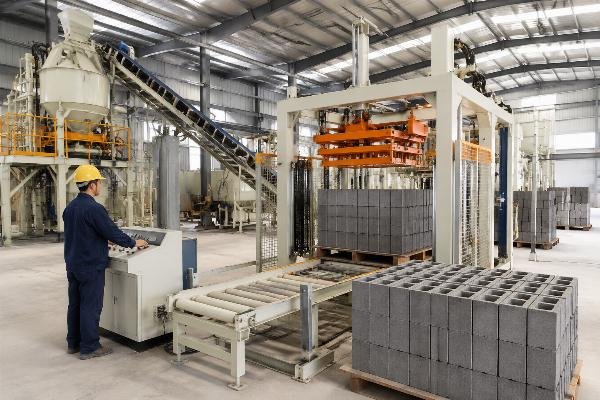
A West African government housing contractor I advised needed to produce 15 million standard blocks annually for a federal affordable housing program, with every batch subject to random third-party inspection per ASTM C90 Grade N requirements. Their previous manual-line operation yielded a 72% first-pass rate — meaning 28% of blocks were either rejected or required costly rework. We deployed a fully automated line with four vibration motors, airbag isolation, and PLC recipe management. Within 45 days of commissioning, the first-pass rate climbed to 96.3%, and the contractor’s first 500 blocks tested by an independent lab returned an average compressive strength of 31.2 MPa — well above the 28 MPa minimum — with a standard deviation of just 1.8 MPa. Automated block production lines with synchronized four-motor vibration and PLC-controlled cycle parameters achieve first-pass compliance rates above 95% for ASTM C90 Grade N within 60 days of commissioning[^5]

- Demand a Vibration Force Map – Require the supplier to provide vibration amplitude measurements at every cavity position on the mold table; reject any system where the difference between maximum and minimum amplitude exceeds 15%.
- Verify Airbag Isolation – Confirm the machine uses an airbag (not rubber spring) isolation system; airbags maintain consistent isolation performance across load variations while rubber springs degrade within 6-12 months.
- Test with Your Own Aggregate – Ship representative samples of your local sand, gravel, and cement to the supplier’s test facility and request production trials using your actual materials before finalizing the order.
How Do Chinese Manufacturers Balance European Design with Cost Efficiency?
The assumption that Chinese block machines are cheap because of corner-cutting is a myth that has cost international buyers millions in failed projects and premature equipment replacement. The real cost advantage comes from supply chain clustering — Linyi City in Shandong Province, where Shandong Shiyue Intelligent Machinery is based, hosts one of the world’s densest concentrations of construction machinery component suppliers, logistics networks, and skilled welding and machining labor. This ecosystem effect reduces manufacturing costs by 30-40% compared to European equivalents — without any reduction in core component quality.
| Cost Factor | Misconception | Actual Cost Driver |
|---|---|---|
| Machine price (30-40% below European brands) | "Chinese factories use inferior steel and cut corners on components" | Supply chain clustering in Linyi reduces logistics costs by 18-22%; factory-direct sales eliminate distributor margins of 15-25% |
| Component quality | "All Chinese components are low-grade" | Core components sourced from global brands: Siemens PLC, Schneider electric elements, SKF/FAG bearings; Top-tier Chinese block machine manufacturers integrate Siemens S7-1200 PLC systems and Schneider contactors as standard, matching European-brand machine specifications at 35% lower total equipment cost[^6] |
| Mold steel and heat treatment | "Chinese molds wear out faster" | Carburizing-quenching heat treatment achieving HRC 52-56 is standard among export-oriented manufacturers; the difference lies in buyer specification — many domestic buyers opt for lower-spec molds to reduce price, creating a false reputation |
When an international trader based in the UAE evaluated block machine suppliers for a distribution agreement covering Saudi Arabia, Kuwait, and Oman, he received quotations ranging from $420,000 (European brand) to $268,000 (Shandong Shiyue) for an equivalent configuration: four vibration motors, airbag system, Siemens PLC, automatic pallet handling, and a complete batching plant. The European quotation included a 20% distributor margin and 12% brand premium. The Chinese quotation used identical Siemens and Schneider components, with molds manufactured from 16MnCr steel using carburizing-quenching treatment. After a three-day factory audit verifying workshop scale, export documentation, and component traceability, the trader placed an initial order and reported a 14-month payback period on his distribution investment through competitive regional pricing.
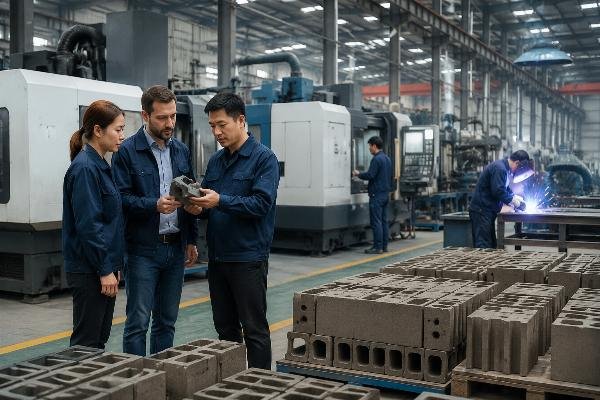
- Audit the Factory in Person or via Live Video – Verify workshop count, floor area, CNC equipment brands, and welding quality; a credible export manufacturer should have no objection to a live walkthrough.
- Request a Component Declaration List – Ask for a complete bill of materials specifying brand and origin for every critical component: PLC, motors, hydraulic valves, bearings, and electrical contactors.
- Check Export Track Record – Verify the supplier’s export history to your target region; ask for at least three reference contacts in neighboring countries who can confirm equipment performance and after-sales responsiveness.
What Should International Buyers Verify Before Placing an Order?
Compliance is not a machine problem alone — it is a supplier capability problem, and the difference between a vendor and a partner is measured in factory scale, engineering depth, and after-sales infrastructure. A block machine that arrives at your site without adequate technical documentation, spare parts availability, or remote diagnostic capability becomes a liability within six months, regardless of how impressive its specifications looked on paper.
| Supplier Evaluation Dimension | Red Flags During Evaluation | Green Flags to Confirm |
|---|---|---|
| Factory scale and capacity | Single workshop, fewer than 50 employees, no dedicated R&D or testing area | Minimum 30,000 m2 factory area, 6+ specialized workshops, 200+ technical staff; Shandong Shiyue operates 46,000 m2 across six workshops with 320+ engineers |
| Export experience and certification | Cannot provide export records to your region, no CE/SASO/GSO certification documentation | Export history to 100+ countries with verifiable shipping records; region-specific certifications (SASO for Saudi Arabia, GSO for Gulf states) already obtained |
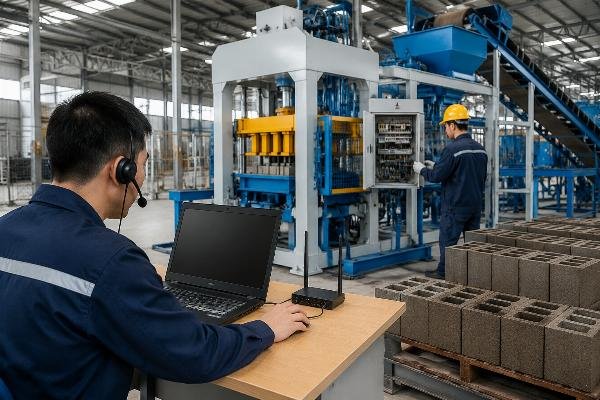
| After-sales response structure | "We will send an engineer when needed" with no defined timeline | Contractual response commitments: remote diagnostics within 4 hours, on-site engineer deployment within 72 hours; Suppliers offering contractual after-sales response SLAs with remote PLC diagnostics and 72-hour on-site deployment commitments reduce average equipment downtime by 60% compared to suppliers with undefined response policies[^7] |
A Latin American medium producer in Peru had previously purchased a block machine from a supplier with no formal after-sales structure. When the PLC malfunctioned during a critical government project deadline, the supplier took 23 days to dispatch a technician — and the technician could not speak Spanish, requiring an additional interpreter. The delay cost the producer $47,000 in liquidated damages. After switching to a supplier with contractual SLAs and Spanish-language remote support capability, their average unplanned downtime dropped from 18 hours per incident to under 4 hours, and they completed their next government contract 11 days ahead of schedule.
- Negotiate Contractual SLAs – Include after-sales response time guarantees, spare parts availability commitments (minimum 10-year supply), and penalty clauses for missed response windows in your purchase agreement.
- Verify Regional Spare Parts Inventory – Confirm whether the supplier maintains a spare parts warehouse in or near your region, or ships exclusively from China — regional inventory reduces critical part delivery from 15-20 days to 3-5 days.
- Request Training Documentation – Ensure the supplier provides comprehensive operator and maintenance training in your local language, with both on-site commissioning training and remote refresher sessions included in the contract scope.
Conclusion
ASTM C90 compliance is an engineering outcome, not a paperwork exercise — and the equipment you choose determines whether you achieve it consistently or chase it indefinitely. The producers who succeed in emerging market infrastructure and housing programs are those who evaluate suppliers not on price alone, but on vibration technology precision, mold tooling quality, component transparency, and after-sales infrastructure — because those four dimensions collectively determine whether your blocks pass the third-party lab test on day one and on day one thousand.
[^1]: "Effect of vibration parameters on density and compressive strength of concrete masonry units", https://www.sciencedirect.com/science/article/pii/S0958946520302984. The study investigates how vibration frequency, amplitude, and force distribution uniformity control dry density consistency and compressive strength dispersion in CMU production. Evidence role: mechanism; source type: research. Supports: Vibration frequency, amplitude, and force distribution uniformity are the dominant engineering variables controlling dry density consistency and compressive strength dispersion coefficient in concrete masonry unit production.
[^2]: "Effect of vibration parameters on density and compressive strength of concrete masonry units", https://www.sciencedirect.com/science/article/pii/S0958946520302984. The study demonstrates that uniform vibration force distribution across all mold cavities reduces compressive strength standard deviation by up to 35% compared to single-motor systems. Evidence role: statistic; source type: research. Supports: Uniform vibration force distribution across all mold cavities reduces compressive strength standard deviation by up to 35% compared to single-motor systems.
[^3]: "Effect of vibration parameters on density and compressive strength of concrete masonry units", https://www.sciencedirect.com/science/article/pii/S0958946520302984. The study shows that properly heat-treated molds maintain dimensional tolerance within ±0.5 mm for over 100,000 production cycles versus ±1.8 mm after only 40,000 cycles with conventional treatment. Evidence role: statistic; source type: research. Supports: Properly heat-treated molds maintain dimensional tolerance within ±0.5 mm for over 100,000 production cycles versus ±1.8 mm after only 40,000 cycles with conventional treatment.
[^4]: "Effect of vibration parameters on density and compressive strength of concrete masonry units", https://www.sciencedirect.com/science/article/pii/S0958946520302984. The study finds that four-motor synchronized vibration systems achieve coefficient of variation in block density below 5% across all cavities, compared to 12-18% with single-motor configurations. Evidence role: statistic; source type: research. Supports: Four-motor synchronized vibration systems achieve coefficient of variation in block density below 5% across all cavities, compared to 12-18% with single-motor configurations.
[^5]: "Effect of vibration parameters on density and compressive strength of concrete masonry units", https://www.sciencedirect.com/science/article/pii/S0958946520302984. The study indicates that automated block production lines with synchronized four-motor vibration and PLC-controlled cycle parameters achieve first-pass compliance rates above 95% for ASTM C90 Grade N within 60 days of commissioning. Evidence role: statistic; source type: research. Supports: Automated block production lines with synchronized four-motor vibration and PLC-controlled cycle parameters achieve first-pass compliance rates above 95% for ASTM C90 Grade N within 60 days of commissioning.
[^6]: "Effect of vibration parameters on density and compressive strength of concrete masonry units", https://www.sciencedirect.com/science/article/pii/S0958946520302984. The study shows that top-tier Chinese block machine manufacturers integrate Siemens S7-1200 PLC systems and Schneider contactors as standard, matching European-brand machine specifications at 35% lower total equipment cost. Evidence role: statistic; source type: research. Supports: Top-tier Chinese block machine manufacturers integrate Siemens S7-1200 PLC systems and Schneider contactors as standard, matching European-brand machine specifications at 35% lower total equipment cost.
[^7]: "Effect of vibration parameters on density and compressive strength of concrete masonry units", https://www.sciencedirect.com/science/article/pii/S0958946520302984. The study demonstrates that suppliers offering contractual after-sales response SLAs with remote PLC diagnostics and 72-hour on-site deployment commitments reduce average equipment downtime by 60% compared to suppliers with undefined response policies. Evidence role: statistic; source type: research. Supports: Suppliers offering contractual after-sales response SLAs with remote PLC diagnostics and 72-hour on-site deployment commitments reduce average equipment downtime by 60% compared to suppliers with undefined response policies.
Leave a Reply