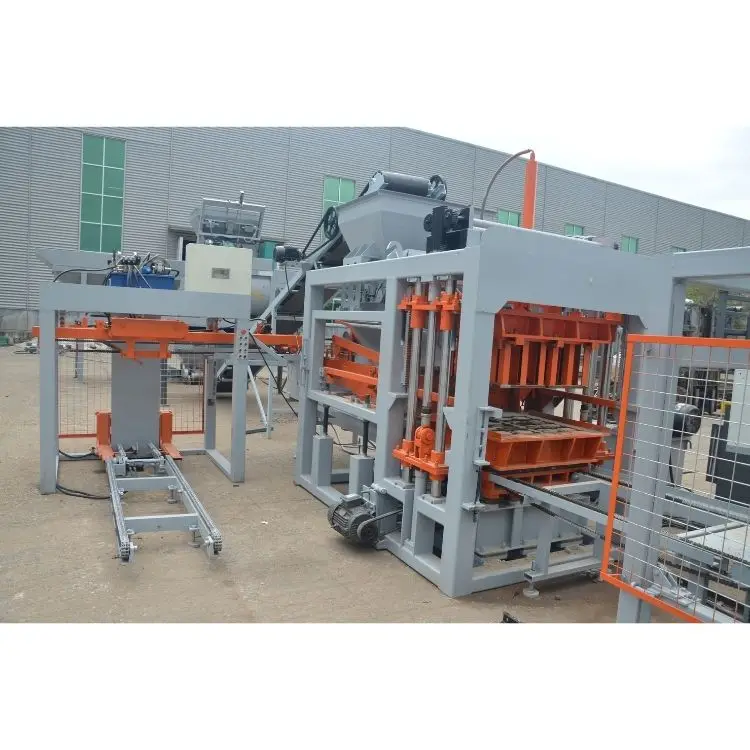
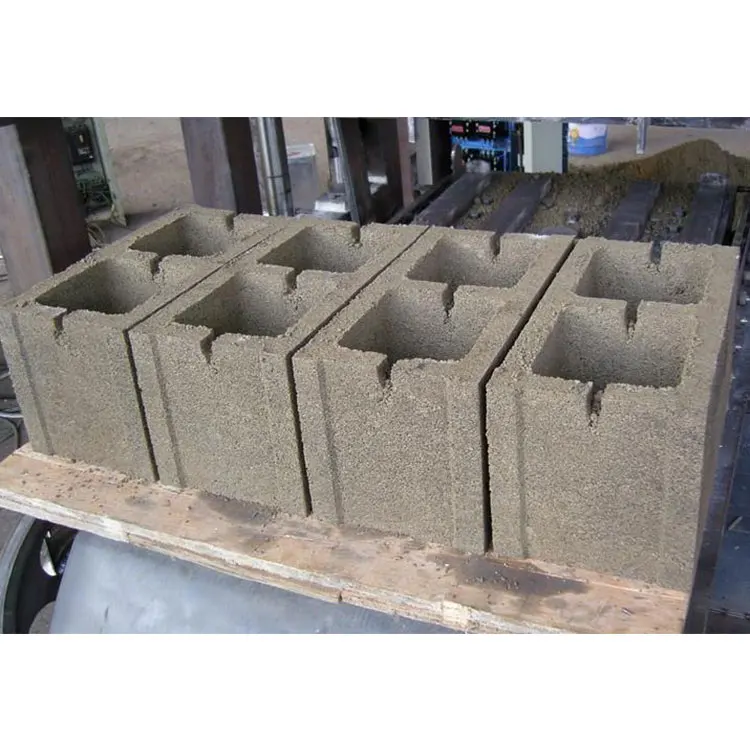
Description
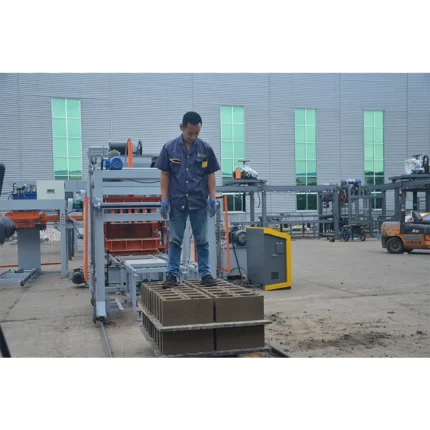
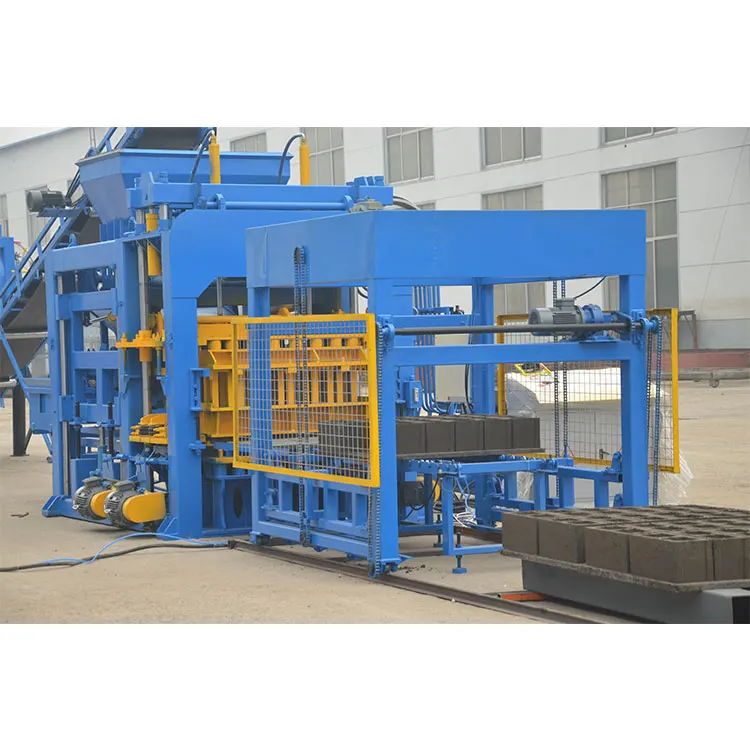
Full-Line Automation Governance — every station from batching to stacking is governed by a single PLC logic loop rather than isolated relays, ensuring pallet timing and press cycles stay locked together.
Technical Specifications
| Parameter | Value |
|---|---|
| Model | QT4-15A |
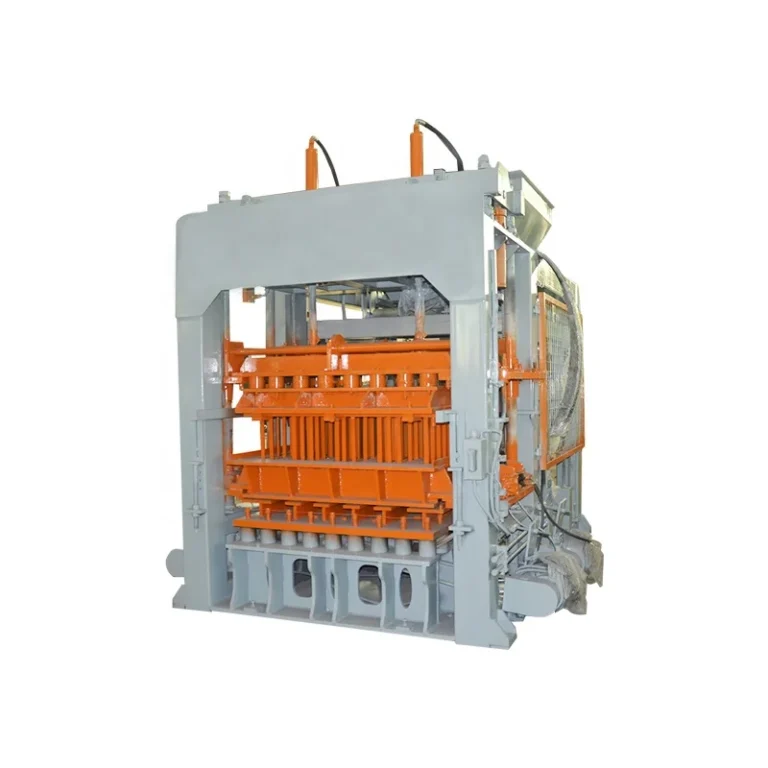
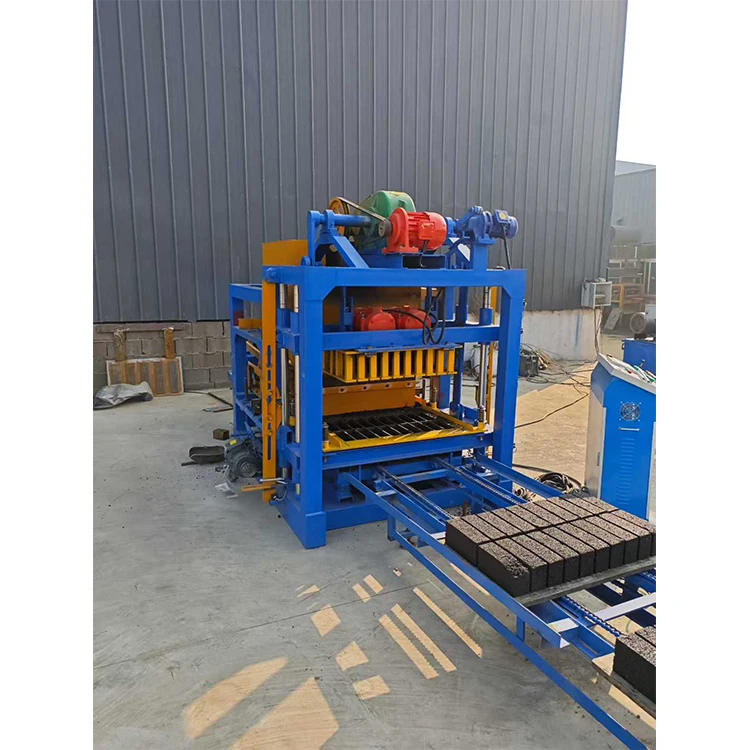
| Product Type | Fully Automatic Hydraulic Block Making Machine |
| Overall Dimensions (L×W×H) | 7100×1700×2610 mm |
| Main Vibration Form | Platform vibration |
| Vibration Frequency | 4600 r/min |
| Pallet Size | 900×500×25 mm |
| Molding Cycle | 15-20 s (basis not stated in source — confirm block format / material / thickness) |
| Total Power | 25.7 kW |
| Exciting Force | 35.5 kN |
| Rated Hydraulic Pressure | 16 MPa |
| Voltage & Frequency | 380V / 3-phase / 50Hz (customizable to local voltage per source) |
| Control System | PLC |
| Automation Level | Fully automatic (main block machine + mixer + belt conveyor + automatic stacker + automatic pallet feeder + batching plant + cement silo) |
| Assembly State | Whole line can be loaded in one 20 ft container |
| Mould Format | Exchangeable moulds |
| Warranty | 1 year (except wearing parts) |
Application Suitability
| Application | Material or Output |
|---|---|
| Hollow Block Production | Crushed stone, sand, cement, and fly ash blends |
| Solid Block Manufacturing | Dense aggregate mixes for load-bearing walls |
| Paving Block Formation | Fine aggregate and pigment layers for interlocking pavers |
| On-Site Construction Supply | Local quarry dust and river sand for contractor yards |
What "15 Seconds Per Cycle" Actually Means for Your PLC
A molding cycle quoted without a block format assumption is a guess, not an engineering specification.
When buyers evaluate an automatic QT4-15A block machine PLC controlled system, they often see a 15-20 second cycle time and calculate their daily output based on the shortest number. The reality is that a 15-second cycle might apply to a thin paving block with a specific vibration profile, while a 200mm hollow block requires longer hydraulic pressure dwell and vibration time to achieve structural density. The PLC allows you to save different recipes for different block formats, adjusting the feeder travel, vibration duration, and hydraulic press time independently [NEED_CITE: concrete block molding cycle variables by format]. Without confirming the exact block geometry and local aggregate mix, the cycle time remains a placeholder waiting to be validated on the factory floor.
Logic Integration Across the Feeder and Stacker
The central advantage of a unified control architecture is that the automatic pallet feeder does not operate on a blind timer. The PLC monitors the press position and only triggers the next pallet when the mould has fully lifted and the stacker has cleared the transfer zone. This prevents the mechanical jams that occur when peripheral equipment is run on separate relay logic boards. An automatic QT4-15A block machine PLC controlled setup coordinates the batching plant, belt conveyor, and stacker as a single continuous sequence.
Recipe Management for Consistent Block Density
Operators use the touch screen to store specific pressure and vibration profiles for different products. When switching from a lightweight hollow block to a dense kerbstone, the system recalls the exact hydraulic dwell time and vibration frequency required. This removes the variability that happens when workers manually adjust valves and timers between shifts, ensuring batch-to-batch consistency [NEED_CITE: PLC recipe management in masonry production]. The automatic QT4-15A block machine PLC controlled interface allows you to lock these parameters behind an operator password, preventing unauthorized changes that could compromise block strength.
Reading the Pressure and Vibration Data
The 16 MPa rated hydraulic pressure and 35.5 kN exciting force are the mechanical baseline, but the PLC is what applies them correctly. For a 900×500 mm pallet, the platform vibration at 4600 r/min must be sustained just long enough to consolidate the mix without causing segregation of the aggregate. The hydraulic system provides the static clamping force while the vibration fluidizes the concrete. The PLC balances these two forces based on the recipe, ensuring the final block meets the required compressive strength for local building codes. If the voltage fluctuates, the control system can compensate or trigger an alarm before the hydraulic pump cavitates.
The Hidden Cost of Unconfigured Control Languages
A frequent failure point during commissioning occurs when the PLC touch screen arrives with default factory language settings that the local maintenance team cannot read. When an alarm triggers on the automatic pallet feeder, an operator who cannot decipher the error code may attempt to manually override the safety interlocks, leading to damaged sensors or jammed mechanisms. Configuring the PLC display language and voltage parameters before the machine leaves the factory eliminates days of lost production waiting for a translator or a remote support call.
Why Sourcing Automation Support Matters
- Single-Source Logic: The machine, mould, and handling equipment are specified as one system, preventing communication faults between mismatched PLC brands.
- Recipe Calibration: Configuration is set against the buyer’s actual mix design and local aggregate, not a generic factory default.
- Automation Scaling: The control architecture allows a buyer to start with semi-automatic pallet handling and add stacking logic later without replacing the main cabinet.
- Format Flexibility: Mould design and supply are integrated, with the PLC cycle times pre-mapped for the specific block formats the buyer’s market demands.
Documentation & Verification
- Line layout showing PLC I/O mapping for all stations
- Machine specification sheet detailing hydraulic and vibration ratings
- Electrical schematic for local maintenance team review
- Factory test record running your specific block format
- Operation and maintenance manual in your chosen language
- Voltage and control language confirmation sheet
Installation, Commissioning & Support
- Site preparation for 25.7 kW total power and dedicated breaker sizing
- Hydraulic oil filling and 16 MPa pressure verification on arrival
- PLC touch screen language verification and operator permission setup
- Vibration frequency tuning at 4600 r/min for your specific aggregate
- Training on storing and recalling molding cycle recipes
- Wear parts list for hydraulic valves and proximity sensors
Defining the Automation Boundary
To properly configure the control system, we need to know the exact level of automation you require for the curing area. Please specify your local voltage and frequency, the target PLC display language, and whether you need the stacker to interface with an existing curing rack system. We also need your primary block format and local raw material profile to pre-load the initial molding recipes.
Frequently Asked Questions
Q: Can the PLC display language be set to my local language before shipment?
A: Yes, the control system allows for multi-language configuration. We confirm the exact language required for the touch screen interface and alarm codes during the pre-production engineering phase to ensure your operators and maintenance team can read all diagnostics immediately upon startup.
Q: How does the automation level affect my labour requirements?
A: The fully automatic configuration integrates the pallet feeder and stacker, which significantly reduces manual handling. The PLC governs the material flow from the batching plant to the stacking station, meaning operators primarily monitor the system and manage forklift logistics rather than moving wet blocks by hand.
Q: What happens if I want to upgrade from semi-automatic to full stacking later?
A: The control cabinet is designed with expansion capacity. If you initially run with manual pallet handling, the PLC architecture allows us to activate the automatic stacker and feeder logic later by adding the necessary sensors and I/O modules without replacing the main processor.
Q: How is the 15-20 second cycle time validated for my specific block?
A: The cycle time depends on the block height, cavity design, and concrete mix. We perform a factory test using your target block format and aggregate profile to determine the exact vibration and hydraulic dwell time required, then save this as the baseline recipe in the PLC.
Q: Can the system handle voltage fluctuations common in my region?
A: The electrical system is configurable to your local voltage and frequency. We can integrate stabilizers or specific protection relays into the PLC logic to monitor incoming power and safely pause the hydraulic pump if voltage drops below the threshold required for consistent block density.